For Homeowners
Battery backup, with or without solar
Storage on its own is a complete project. The decision that drives the whole design is which circuits stay live when the grid is down — and for how long.
Licensed contractor
One company accountable for the job
Free home assessment
No obligation, and a technician rather than a commissioned salesperson
Permits & inspections handled
Pulled under our licence, not left for you to chase
Coverage confirmed for your address
Service areas: Arizona and Massachusetts
You do not need solar to install a battery
A home battery does not require PV solar. It charges from the grid when power is available and carries the circuits you chose when it is not. If the problem you are solving is an outage rather than an electricity bill, storage on its own is often the more direct answer.
What decides the design is not the battery. It is which circuits you want live, and for how long — because runtime is what you are backing up multiplied by the time you want it, and a refrigerator behaves nothing like an air conditioner. Any answer offered in hours before that question is asked is not an answer.
Seamless Home is a licensed contractor: the permit and, where required, the utility application are ours, and the crew is a vetted local installing partner engaged as our subcontractor. Coverage is confirmed per service area rather than promised as blanket availability, and who you are actually contracting with is set out in full rather than left to the fine print.
Services offered
What a home battery job with us covers
Installation of storage and the backup circuits behind it, with the siting and utility paperwork handled.
Battery installation
Wall or floor-mounted storage installed to the listing and to the residential code sections that govern where it may go.
Backup and critical load panel
Deciding and wiring which circuits stay live, and which must never be on backup — the choice that defines what an outage feels like.
Integration with existing PV solar
Connecting storage to an array that is already on the roof, including whether the existing inverter supports it.
Transfer switch and disconnection
The equipment that separates the house from the grid during an outage, which is what makes backup legal as well as possible.
Siting to code
Location, clearances, separation and impact protection assessed against the adopted code before anything is mounted.
Permit, inspection and utility approval
The electrical permit, the inspection, and the utility's own approval step where storage touches the service.
This is installation work. No runtime, capacity or incentive figure is quoted before your loads and your utility are confirmed. Coverage is confirmed per service area rather than promised as blanket availability.
Benefits
Why homeowners choose Seamless Home for battery backup
Designed around what you need running
The design starts from which circuits stay live in an outage and for how long, not from a product tier.
With or without solar
Storage on its own is a complete project. It charges from the grid when power is available and carries your chosen circuits when it is not.
Permit and utility paperwork handled
The permit and, where required, the utility application are ours, including the transfer equipment the inspection checks.
Honest about payback
Where your rate structure makes backup insurance rather than an investment, we say so rather than quote a payback figure we cannot stand behind.
How it works
From outage worry to a working backup system
The circuit list comes first. The equipment follows from it.
- 1
Request a free assessment
Tell us what you need and where the property is. We confirm whether we cover your address for this trade before anything else happens.
- 2
Assessment and written quote
A technician looks at your panel, the loads you want backed up and where the equipment can legally go. The circuit list, runtime expectations and price come in writing.
- 3
Permit and installation
The permit is pulled under our licence and the utility notified or applied to. On-site work is typically one to two days, most of it where a subpanel is added.
- 4
Inspection, handover and support
The inspection verifies the transfer equipment and the clearances, the system is commissioned, and the workmanship obligation stays with us.
Six decisions that make up the design
The first two set the cost. The last two are what an inspector will check.
Which circuits stay live
The central decision, and the one that drives cost. Backing up a chosen set of essential circuits is a different project from backing up the whole house, and the difference is usually a subpanel plus the labour to move circuits into it.
For how long
Runtime is what you are backing up multiplied by how long you want it, and it is arithmetic rather than a product tier. A refrigerator, some lights and a router is a modest load. Add central air conditioning or electric heat and the same battery lasts hours instead of days.
What must never be on it
Large resistive and motor loads are what empty a battery fastest — electric water heating, an electric range, a dryer, a car charger, central air. Deciding these are excluded is part of the design, not a limitation discovered during the first outage.
What must be on it
The reverse case, and it is specific to your property. A well pump where there is no other water source. A sump pump where flooding is a real risk. Medical equipment. These change the sizing rather than the wiring.
Where the equipment goes
Batteries have listing and clearance requirements, and location is constrained by them rather than by preference — garage, exterior wall or utility space, with the working clearance the code and the listing require kept clear afterwards.
How it disconnects from the grid
A system that can energise your circuits during an outage must be incapable of energising the utility's lines. That is a code and equipment-listing requirement, it is what the inspection checks, and it is why a battery is never simply wired in alongside the panel.
Essential circuits, whole home, or managed loads
Essential circuits. A subpanel holds the loads you nominated, and the rest of the house goes dark during an outage. This is the smallest and cheapest version, and most of the labour is moving the chosen circuits into the new panel rather than mounting the battery. It also forces a useful conversation, because you have to decide what actually matters. The critical load panel is the piece of equipment behind this option, and the critical load panel planner tests a proposed circuit list against the inverter and battery ratings in the proposal before you sign it.
Whole home. The entire service is carried during an outage. This needs enough capacity and equipment to handle the largest load that might start while you are on battery — which is usually an air conditioner or a well pump, and starting current is higher than running current. More capable, more expensive, and the runtime is only as long as your habits allow.
Whole home with managed loads. The middle path. The house is backed up, but nominated heavy circuits are automatically shed when you are running on battery, so a dryer or a car charger cannot quietly empty it. This is often the best value of the three and is the one least likely to be offered unprompted.
Worth knowing: the choice is not permanent in principle, but changing it later is electrical work with a permit rather than a setting. It is cheaper to decide correctly once.
The approvals, and why the utility cares about a battery
A battery is permitted electrical work, so there is a building permit and an inspection. The part that surprises people is the utility.
A system capable of energising your circuits during an outage must be structurally incapable of energising the utility's lines at the same time, because a line worker may be on them. That is what the transfer equipment exists to guarantee, it is what the inspection verifies, and it is why a battery is never simply wired in beside the panel. It is also why adding storage to an existing PV solar system is generally a new interconnection application rather than an amendment — the system can now do something it previously could not.
If you already have a standby generator, this is exactly where the complication lives: the generator's transfer switch already owns the single point where your house changes sources. Adding solar and battery to a home with a standby generator sets out the three arrangements in common use and what each costs in scope.
What an inspector looks at is a shorter list than most homeowners expect — who inspects a battery and what they check covers it, including the clearances that have to stay clear after everyone leaves.
Where the unit ends up is not a matter of taste, and the room you have in mind may not be available. Where a home battery can and cannot be installed explains the four locations the code permits, why a bedroom is never one of them, and how the room you choose limits how much battery the house can hold.
Walk a specific proposal through the home battery siting checker before treating any room as available — prohibited locations first, then energy limits.
On payback, plainly
Whether storage reduces a bill depends on your utility's rate structure, and for a large number of homeowners it does not meaningfully. Where rates differ materially by time of day, shifting consumption has a real value. Where they do not, a battery bought for outage protection is closer to insurance than to an investment.
We would rather say that than build a savings case on assumptions about future rates. If backup is what you want, price it as backup — the question then becomes what it is worth to you to keep specific things running, which is a question you can actually answer.
If you have a leased or third-party-owned PV solar system already, there is a prior question about whether you are permitted to modify it at all: adding a battery to a leased solar system.
Local battery backup pages
Massachusetts metros, each with a different outage and panel story: Worcester (inland nor'easters and well pumps), Boston (harbour storms and urban panels), Springfield (Pioneer Valley ice and oil-boiler controls), Cambridge (dense lots where IRC R328 siting is the binding constraint), Somerville (Eversource delivery under three Somerville CCE prices fixed to January 2028, and ConnectedSolutions' $275/kW), Framingham (Eversource under Framingham Community Electricity prices that end in March 2027, plus ConnectedSolutions' $275/kW), Waltham (Eversource under Waltham Community Electricity prices fixed to December 2029, and winter heat-pump load), Lowell (National Grid's summer ConnectedSolutions season against winter outages, and SMART 3.0's dropped storage adder) and Newton (Eversource delivery under the Newton Power Choice supply price, and ConnectedSolutions' per-kW rate), Quincy (two delivery utilities, National Grid and Eversource, under Quincy Community Electricity), Brockton (National Grid Basic Service while the City's aggregation plan is before the DPU) and Fall River (National Grid delivery under a community supply price fixed to November 2028) and Lynn (National Grid ConnectedSolutions+ $5,000 install incentive on eligible circuits) and Malden (ConnectedSolutions+ Malden $5,000 + ~$1,300/yr + Malden Community Electricity rates through Dec 2027) and Medford (ConnectedSolutions+ Medford $7,500 if interconnection starts by Dec 31, 2026, plus Medford CEA rates) and New Bedford (Eversource delivery under MassCEA supply rates through November 2028), and Taunton (Taunton Municipal Lighting Plant's $300 battery rebate; excess solar credited below full retail). Arizona monsoon metros: Phoenix, Mesa, Chandler (SRP E-27 summer peak 2–8 p.m.), Gilbert (SRP Battery Partner, measured above the battery's own baseline), Tempe (SRP's Conserve 6–9 p.m. solar plan and its low export rate), Peoria (APS 4–7 p.m. weekday peak), Glendale (APS RCP solar export rate and its ten-year lock), Scottsdale (APS Storage Rewards conservation season), Surprise (APS's pending 2026 rate case, about +$20/mo at 1,000 kWh if approved as filed), Goodyear (APS Storage Rewards published $110/kW capacity payment), Avondale (APS R-TOU-E filed cents: 34.396¢ summer on-peak), Maricopa (Electrical District No. 3, not APS or SRP — storage counts as DG and applications are capped at 30 a month), Lake Havasu City (UNS Electric's R-Tech pilot: demand billed on the highest on-peak hour, and a battery that qualifies only alongside solar or other tech), Sierra Vista (SSVEC, a member-owned co-op: $30 base charge since January 2026, opt-in 1–7 p.m. peak, no battery program), Yuma (APS's grid-scale batteries, and what they can't do when a house's own line is down), Flagstaff (APS's planned wildfire shutoffs — the June 2026 PSPS — and charging a battery ahead of one) and Tucson (heat and monsoon outages; foothills wells on the Tucson outskirts). Virginia, on Dominion: Norfolk (coastal flooding, where siting elevation is the binding constraint), Virginia Beach (multi-day outages, where recharge is the design question), Chesapeake (inland Southside; Dominion VPP pilot aimed at 2027), Newport News (Dominion's Off-Peak Plan windows and its demand-response exclusion), Suffolk (the approved 2026 base and fuel increases on a Dominion bill), Charlottesville (Dominion's NEM 2.0 from May 1, 2027, which also covers battery additions to existing solar), Hampton (the October 2026 salt-activation outages), Arlington (Northern Virginia townhouse siting), Fredericksburg (Dominion inside the city line, Rappahannock Electric Cooperative around it, with 3.0% residential net-metering capacity left in Oct 2026), Alexandria (the City-promoted 2026 solar group buys with optional storage) and Richmond (ice and wind through a mature canopy, plus Dominion's consumption-based sizing rule); and on Appalachian Power, Roanoke (Hurricane Helene's week-long restoration and APCo's annual-netting, prior-year sizing rule) and Lynchburg (APCo's 2026 base rate case, driven mainly by storm recovery and tree trimming); and on the city-owned Harrisonburg Electric Commission, Harrisonburg (HEC's own net metering rule — Dominion's doesn't apply — and very short outages), Danville (Danville Utilities' own 10.5 MW / 11 MW peak-shaving batteries vs a home battery in a local outage) and Manassas (City of Manassas net metering pays no compensation for excess generation). Coverage is confirmed per service area.
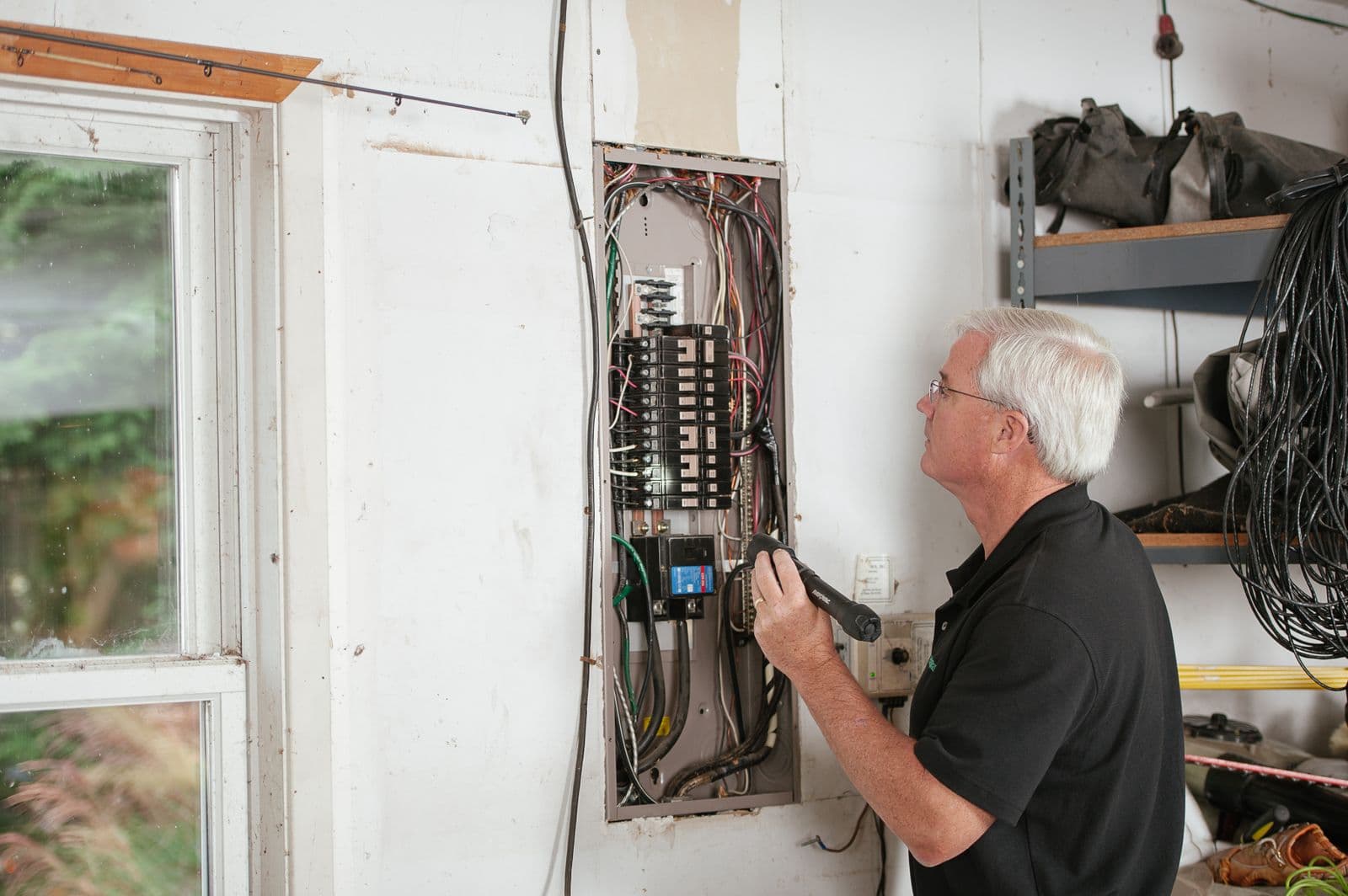
What the work actually looks like
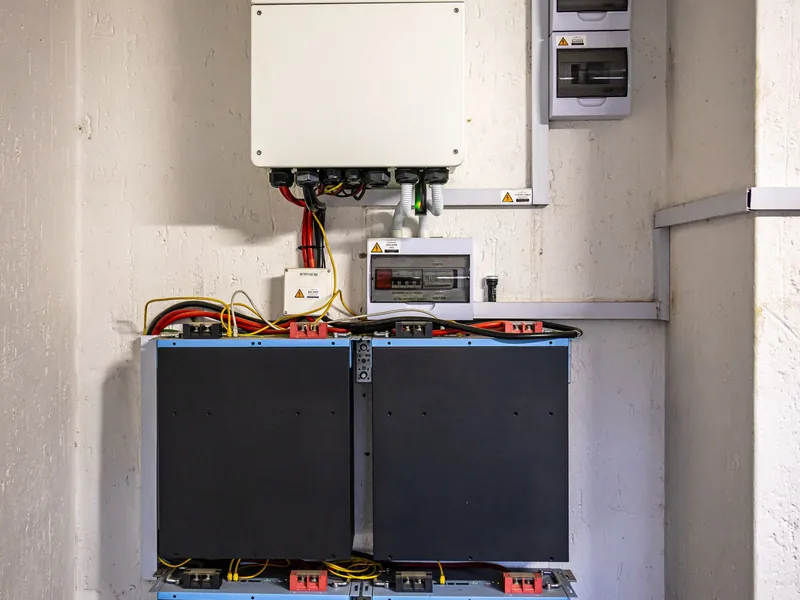
A battery job is an electrical job. The panel, the circuits and the disconnection are most of it.

Frequently Asked Questions
Can I install a home battery without solar panels?+
Yes. Storage without generation is a complete project and a common one, because the problem being solved is usually an outage rather than an electricity bill. The battery charges from the grid when power is available and carries your chosen circuits when it is not. It still needs an electrical design, a building permit and, in most areas, a utility notification or interconnection application — because the equipment is capable of energising circuits and the utility and the jurisdiction both care about that regardless of whether anything is generating. What changes without PV solar is that nothing recharges the battery during a long outage, which makes the runtime question sharper rather than less important.
What will a home battery actually run, and for how long?+
That is set by the loads you put on it, not by the battery alone, and it is the calculation worth doing before you choose equipment. A modest essential set — a refrigerator, lighting, internet, phone charging, a furnace fan — is a small continuous draw and can last a long time. Central air conditioning, electric resistance heat, an electric water heater, a range, a dryer or a vehicle charger are in a different class entirely and can turn days of runtime into hours. This is why any answer that comes as a number of hours without first asking what you want backed up is not an answer.
Should I back up the whole house or just essential circuits?+
Both are legitimate and they are different projects. Essential-circuit backup means a subpanel that holds the loads you chose, with the labour to move those circuits into it — smaller, cheaper, and it forces the useful conversation about what actually matters. Whole-home backup means the entire service is carried, which needs enough capacity and equipment to handle the largest load that might start up, and usually more of both. A middle path exists too: whole-home backup with managed loads, where certain heavy circuits are automatically shed during an outage. Which is right depends on what you are protecting and what you are willing to spend, and it should be settled before equipment is quoted.
Does a battery need a permit and a utility application?+
In almost all cases, yes to the permit and usually yes to some form of utility notification. The permit is because this is electrical work and, depending on the equipment and location, sometimes structural work as well. The utility involvement is because a system capable of energising circuits has to be incapable of backfeeding their lines while a crew may be working on them — which is a safety matter, not a formality. Adding storage to an existing PV solar system generally requires a new application rather than an amendment, because it changes what the system can do. Requirements vary by jurisdiction and by utility, so it is established for your address rather than assumed.
I already have a standby generator. Can I add a battery?+
Usually, but it is a design question rather than a straightforward addition. A standby generator already owns the single transfer point where your house switches between sources, and two sources must never be able to energise the same circuits simultaneously unless the equipment is specifically listed for it. So the design has to state which source keeps the transfer point and what the other one does during an outage. There are several arrangements in common use and they differ in cost and complexity. This is worth resolving on paper before either piece of equipment is ordered.
How long does a battery installation take?+
The on-site work is typically one to two days, and where a subpanel is being added and circuits moved into it, that is most of the labour. As with any permitted electrical work, the schedule is set by the approvals rather than the installation: a permit has to be issued, the utility notification or application processed, and an inspection passed. Where storage is being added to an existing PV solar system, the utility review is often the longest single item.
Will a battery save me money?+
That depends entirely on your utility's rate structure, and for many homeowners the honest answer is that backup is the benefit and any bill reduction is secondary. Where a utility charges materially different rates at different times of day, storage can shift consumption and that has a value. Where it does not, a battery installed for outage protection is insurance rather than an investment, and it is more useful to price it that way than to build a savings case that depends on assumptions about future rates. We would rather set the expectation correctly than quote a payback figure we cannot stand behind.
Related resources
Home battery backup in Worcester, MA
The local page: winter storm backup in central Massachusetts, and why grid-tied solar goes dark in an outage.
Learn more →Home battery backup in Boston, MA
Coastal nor'easters and urban panels — the well-pump surge is rarely the Boston problem.
Learn more →Home battery backup in Phoenix, AZ
Monsoon and heat-driven outages — cooling controls and networking on a critical-load panel.
Learn more →Home battery backup in Tucson, AZ
Monsoon outages; foothills well pumps change inverter selection on the outskirts.
Learn more →Home battery backup in Cambridge, MA
Dense lots and historic housing, where a legal wall under IRC R328 is the first question.
Learn more →Solar panel installation for homeowners
What a PV solar project involves, and why permission to operate is the finish line.
Learn more →What is a critical load panel
The subpanel behind essential-circuit backup, and how circuits get chosen for it.
Learn more →Adding solar and battery with a standby generator
Why two sources cannot share one transfer point, and the three arrangements that work.
Learn more →All home services
PV solar, battery backup and water treatment under one accountable contractor.
Learn more →Start with what you want to keep running
Tell us which circuits matter and where you are. We will confirm coverage for your area, then design to that list rather than to a product tier.
Get a Free Estimate