Newport News, Virginia
Home Battery Backup in Newport News
Dominion territory on the Peninsula. Dominion's Off-Peak Plan prices a few weekday hours far above the rest — one window in summer, two in winter — and it cannot be combined with a demand-response program.
Schedule 1G summer generation charge: 15.3972¢ per kWh on-peak, 0.0112¢ super off-peak.
The short answer
Newport News is served by Dominion Energy Virginia. A grid-tied array produces nothing in an outage; a battery with a transfer switch keeps selected circuits up through the hurricanes, surge and winter storms the City plans for.
On Dominion's Off-Peak Plan (Schedule 1G), on-peak is 3–6 p.m. weekdays in summer and 6–9 a.m. plus 5–8 p.m. in winter, and the plan is not available alongside demand response. We size to a critical load panel, set the outage reserve against the peak schedule deliberately, and confirm the current rate in writing for your account.
Find out what a battery would run in your house
Tell us your Newport News address, your Dominion rate plan and whether you already have solar. We confirm coverage first, then size to a critical load panel — and handle the interconnection paperwork rather than leaving it with you.
Three things that are specific to here
The City's hazard list and the way Dominion's time-of-use plan is written.
A storm list that runs all year
The City of Newport News lists its primary natural hazards as hurricanes and tropical storms, storm surge, flooding and flash floods, severe thunderstorms, tornadoes and microbursts, winter storms and extreme heat. Outage backup on the Peninsula is not a one-season question.
Three hours in summer, six in winter
Under Dominion's Schedule 1G, on-peak is 3–6 p.m. on weekdays from May through September. From October through April there are two on-peak windows each weekday: 6–9 a.m. and 5–8 p.m. A battery schedule that works in July does not cover a January morning.
The time-of-use plan excludes demand response
Schedule 1G is not available to a customer participating in a PJM or Dominion-sponsored demand response or peak-shaving program. A battery owner has to choose which way to earn from it — the rate plan or an event program — rather than stacking both.
What a Newport News battery actually does
A storm produces the critical-load list. The rate schedule decides what the battery does on ordinary weekdays.
Shifting the peak, not just surviving the storm
On the supply portion of the bill, Schedule 1G's summer on-peak generation charge is 15.3972¢ per kWh against 0.9307¢ off-peak and 0.0112¢ super off-peak (before distribution, transmission and riders). A battery that carries the house through 3–6 p.m. is working in that gap.
Winter mornings need stored energy
The 6–9 a.m. winter peak comes before solar produces much. Covering it means energy stored the day before, which changes how much capacity is held back for outage reserve — a trade-off we set deliberately at commissioning.
Heat pump: in or out
If the house heats and cools with a heat pump, whether it is on the backed-up panel decides the size of everything else. And a reserve kept for a hurricane week is energy not used to shave a peak.
Refrigeration, sump pumps, medical equipment
Small continuous draws with high consequences. Sump pumps in a flood-prone lot, oxygen concentrators and CPAP machines belong in the first conversation, because they turn a battery from a convenience into a dependency.
The rate plan is part of the design, not the brochure
A battery that will run on Dominion's grid is an interconnection like solar. What permission to operate actually checks applies to storage too, and adding a battery to an existing array is its own application.
Siting is answerable before anyone visits. The home battery siting checker walks the locations the residential code permits for stationary storage, and where a home battery can and cannot be installed explains the reasoning. The state licenses Seamless Home works under are listed on the licenses page.
Across the water, Norfolk covers Dominion's storage-and-transfer-switch rule, Virginia Beach covers multi-day outage duration, and Chesapeake covers Dominion's virtual power plant filing. Any program of that kind raises the same question here, because Schedule 1G as written excludes Company-sponsored demand response and peak-shaving programs. If the house also needs water treatment, the Newport News water quality page covers Newport News Waterworks' report.
Where these facts come from
- Dominion Energy Virginia — Schedule 1G Residential Service (filed June 16, 2026; effective for usage on and after July 1, 2026) — availability conditions, on-peak / off-peak / super off-peak hours, holidays, generation and distribution kWh charges.
- Dominion Energy Virginia — Net Metering — energy storage and a transfer switch needed to power a home from distributed generation in an outage.
- Virginia SCC — Electric Service Territories map (2020) — Newport News in Dominion Energy Virginia territory (approximation).
- City of Newport News — Newport News' Hazards — the City's primary natural hazards.
What a home battery job with us covers
Installation of storage and the backup circuits behind it, with the siting and utility paperwork handled.
Battery installation
Wall or floor-mounted storage installed to the listing and to the residential code sections that govern where it may go.
Backup and critical load panel
Deciding and wiring which circuits stay live, and which must never be on backup — the choice that defines what an outage feels like.
Integration with existing PV solar
Connecting storage to an array that is already on the roof, including whether the existing inverter supports it.
Transfer switch and disconnection
The equipment that separates the house from the grid during an outage, which is what makes backup legal as well as possible.
Siting to code
Location, clearances, separation and impact protection assessed against the adopted code before anything is mounted.
Permit, inspection and utility approval
The electrical permit, the inspection, and the utility's own approval step where storage touches the service.
This is installation work. No runtime, capacity or incentive figure is quoted before your loads and your utility are confirmed. Coverage is confirmed per service area rather than promised as blanket availability.
What the work actually looks like
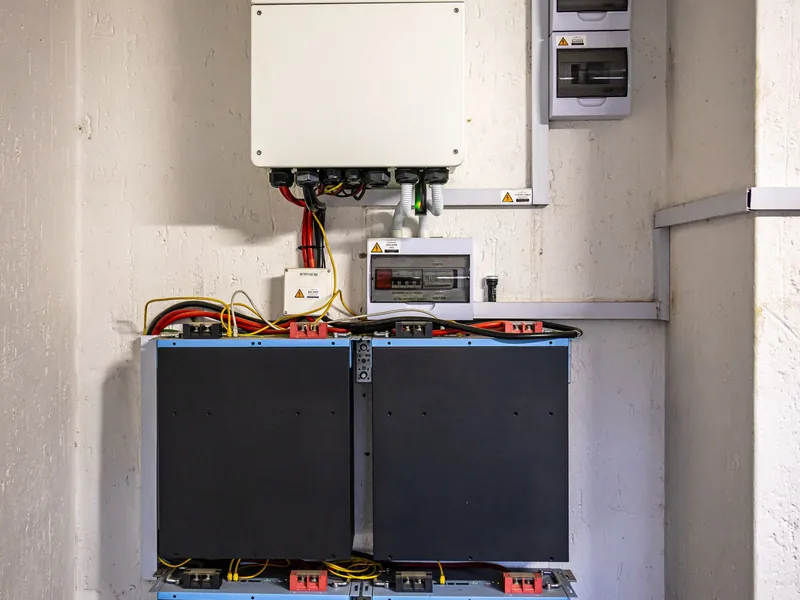
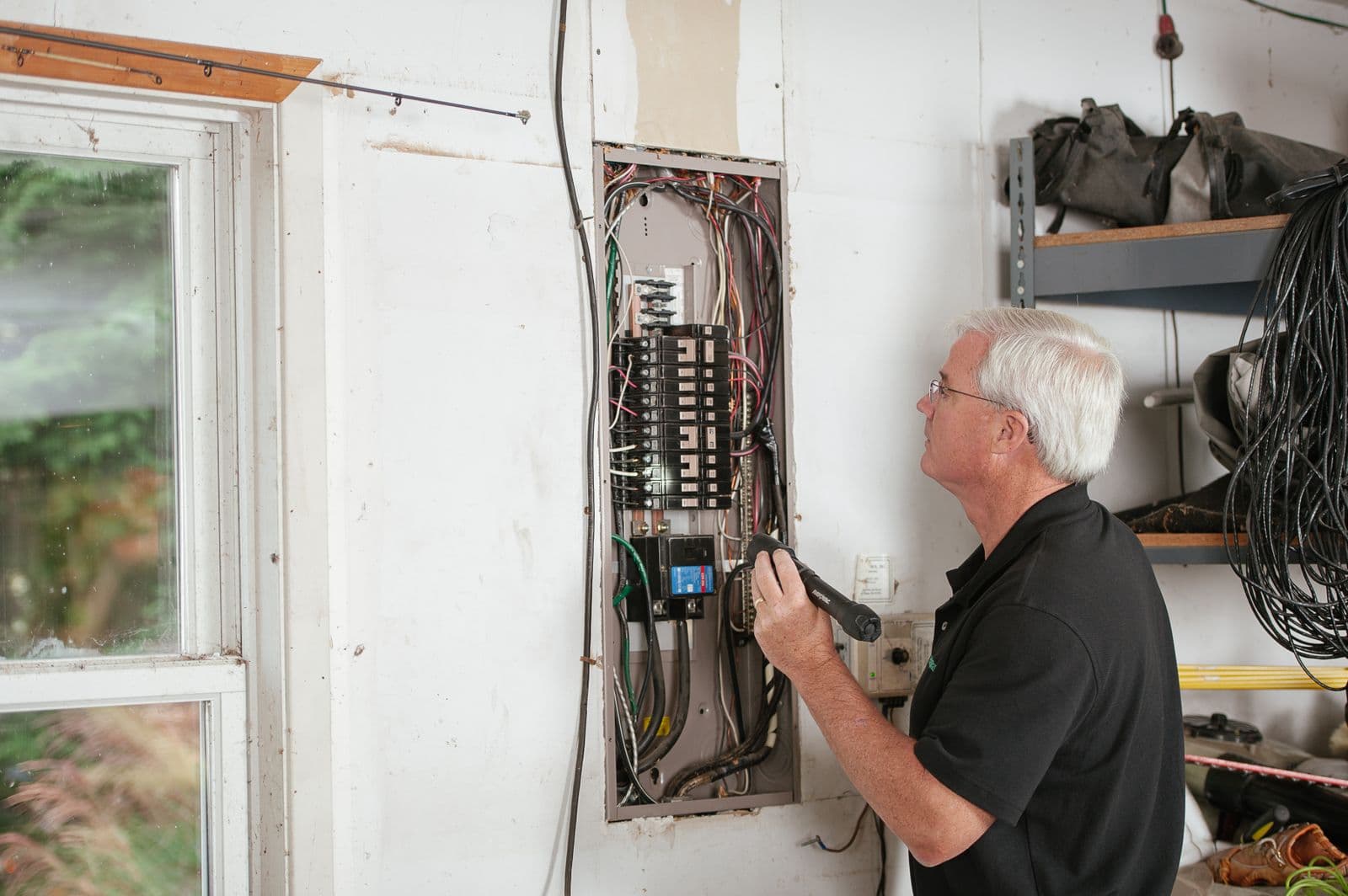
A battery job is an electrical job. The panel, the circuits and the disconnection are most of it.

Battery backup in Newport News, answered plainly
Who is the electric utility in Newport News?+
Dominion Energy Virginia. The State Corporation Commission's Electric Service Territories map shows Newport News inside Dominion's territory; the SCC notes the map is an approximation, so your bill is the final word.
What is Dominion's Off-Peak Plan?+
Residential Schedule 1G, a time-of-use rate. Weekday on-peak hours are 3–6 p.m. from May 1 through September 30, and 6–9 a.m. plus 5–8 p.m. from October 1 through April 30. Super off-peak is midnight to 5 a.m. every day, and six listed holidays are treated as off-peak. It requires an advanced (AMI) meter.
How big is the price difference between peak and off-peak?+
On the generation (Electricity Supply) charge in the schedule effective for usage from July 1, 2026, summer on-peak is 15.3972¢ per kWh, off-peak 0.9307¢ and super off-peak 0.0112¢; in winter, on-peak is 11.9944¢, off-peak 1.7867¢ and super off-peak 1.5514¢. Distribution, transmission and riders are added on top, and the rates change by filing, so we confirm the current schedule in writing for your account.
Can I use the Off-Peak Plan and a battery demand-response program together?+
Not under the schedule as written. Schedule 1G is available only where the customer does not participate in a PJM or Company-sponsored demand response or peak-shaving program. The schedule also says a customer who leaves it within a year cannot return to a residential time-of-use schedule at that premise for a year.
Why does my Newport News solar shut off during an outage?+
A grid-tied inverter is required to disconnect when it loses the utility, so it is not energising lines crews believe are dead. That is anti-islanding, a safety requirement. Dominion's own net metering page notes that powering a home from distributed generation during an outage takes energy storage and a transfer switch.
Who installs it, and who is responsible afterwards?+
Seamless Home is the licensed contractor of record on the work it runs. Installation is performed by vetted installing partners engaged as our subcontractors, so the permit, the inspection and any correction notice carry one name. Coverage is confirmed per service area rather than promised as blanket availability.
Related resources
Home battery backup installation
The national service page: essential-circuit, whole-home and managed-load backup compared.
Learn more →Home battery backup in Norfolk, VA
Dominion's storage-and-transfer-switch rule, across the harbor.
Learn more →Home battery backup in Chesapeake, VA
Dominion's virtual power plant pilot filing.
Learn more →Home battery backup in Virginia Beach, VA
Outage duration and recharge on the coast.
Learn more →Newport News water quality
Newport News Waterworks' 2025 report — the other local page.
Learn more →All home services
Battery backup, water treatment, HVAC and solar under one licensed contractor of record.
Learn more →Find out what a battery would actually run in your house
A panel-level look at your service, your existing solar, your Dominion rate plan and the circuits you want kept up through a Peninsula storm — at no cost, and with no savings, runtime or incentive figure promised before anyone has seen the house.
Get a Free Estimate