Newport News, Virginia
Newport News Water Quality
The Peninsula drinks from Diascund Creek and the Chickahominy, not Lake Gaston. Its 2025 report is low on hardness and byproducts — and puts PFOS right at the federal limit.
2025 treated-water PFOS: 3.7 to 4.9 ppt. The federal limit, with compliance from 2029, is 4.0.
The short answer
Newport News Waterworks serves five Peninsula jurisdictions from Diascund Creek Reservoir and the Chickahominy River, treated with ozone and carried with a chloramine residual. Hardness is low — about four grains — and byproducts sit at roughly a quarter of their limits.
The number that matters is PFOS at 3.7 to 4.9 ppt in treated water, against a 4.0 ppt federal limit that is adopted, with compliance required from 2029. So the household question is PFAS-certified carbon or RO at the drinking tap, rated for chloramine — not a softener.
Get a free test
Tell us your Newport News, Hampton or York County address. We confirm coverage first, then schedule a licensed technician to test at your tap — no charge, no obligation.
What filtration does — and does not
Sediment, carbon, softening and reverse osmosis each address a different problem. On the Peninsula the highlighted finding is PFAS in a chloraminated supply, which makes the certification claim — not the stage name — the thing to check.
Where Newport News water comes from
A reservoir-and-river supply north of the James, one regional utility for five jurisdictions, and a treatment train that ends in chloramine.
Diascund Creek Reservoir, then the Chickahominy
The 2025 report names Diascund Creek Reservoir as the primary source, supplemented by the Chickahominy River above Walkers Dam as weather dictates. Water is pumped to Waterworks' own reservoirs — it owns and operates five — which feed two treatment plants.
Five jurisdictions, one report
Newport News Waterworks is a department of the City and a regional provider for Newport News, Hampton, Poquoson, York County and part of James City County. A Hampton or Poquoson address drinks the same water and reads the same report as a Newport News one.
Susceptibility rated relatively high
The Virginia Department of Health updated its source water assessment in 2020 and rates Waterworks' surface sources as relatively high in susceptibility to contamination. The report adds that the reservoir watersheds contain no industrial PFAS manufacturers but do contain airports and military facilities.
Ozone, then chloramine
Alum and polymer coagulation, ozone disinfection and filtration, then lime for pH, fluoride, zinc orthophosphate for corrosion control, and chloramines as the secondary disinfectant through the pipes. Chloramine is the residual a kitchen filter has to deal with here, not free chlorine.
What the 2025 report actually says
Limits are fixed. The results next to them are from the Newport News Waterworks 2025 report for the Lower Peninsula System and its expanded tables — system-level figures, not a reading at your tap. A later report supersedes them.
PFOS — at the federal limit
The expanded 2025 tables list PFOS in finished water at a maximum of 4.9 ppt, range 3.7–4.9, with a reporting limit of 2.0. The federal MCL adopted in 2024 is 4.0 ppt, assessed as a running annual average with compliance from April 2029. Every listed result sits within about one part per trillion of that limit.
PFOA and four other PFAS
PFOA maximum 3.3 ppt (2.1–3.3), under its 4.0 limit. The same table lists PFHxS to 3.7, PFBA to 3.8, PFHxA to 3.5 and PFPeA to 3.6 ppt. The report states the water meets all current federal and state standards, which is accurate: the PFAS limits are adopted, with compliance not required until 2029.
Chloramine residual
Highest compliance average 3.3 ppm against a maximum residual disinfectant level of 4.0, with individual 2025 samples ranging from under 0.02 to 5.4 ppm. The MRDL is applied to the system-wide running average, so a single high sample is not a violation — but it is noticeable at the tap.
Disinfection byproducts — low
Total trihalomethanes at a highest locational running average of 21 ppb (samples 6–32) against 80, and haloacetic acids at 21 ppb (5–32) against 60. Both sit at roughly a quarter to a third of their limits.
Hardness, sodium, dissolved solids — low
Hardness averaged 69 mg/L (63–75), about four grains per gallon, which Waterworks describes as moderately hard. Sodium 12.6 mg/L, total dissolved solids 120 mg/L, manganese averaging 14 ppb against a 50 ppb aesthetic guideline. None of these argues for a softener.
Lead and copper
In the 2025 sampling round, all 50 Lower Peninsula samples were non-detect for lead (under 1.0 ppb) and no copper sample exceeded the action level. The report says private service lines at properties built before 1988 carry greater risk of lead materials, and Waterworks publishes a service line inventory map.
Why this is a different Virginia page
South of the James, Norfolk and Virginia Beach share the Moores Bridges plant and a Lake Gaston story, and Chesapeake runs four finished waters under two system IDs. None of those is the Peninsula's water. Newport News Waterworks has its own reservoirs, its own plants and its own report, and the figure it puts in front of a homeowner is PFOS rather than hardness or byproducts.
Up the river, Richmond draws the James directly and its page is about reliability after a plant power loss. Same state, different water, different reason to treat.
Where these figures come from
Everything on this page traces to primary sources. Independent compilations of water quality data exist and are not used here.
- Newport News Waterworks — Water Quality Report — 2025 report for the Lower Peninsula System, expanded tables, and the Lightfoot System report.
- EPA — PFAS National Primary Drinking Water Regulation — 4.0 ppt MCLs for PFOA and PFOS.
- EPA — proposed PFOA and PFOS compliance extension (May 2026) — 2029 compliance date, optional request to 2031.
- EPA — identifying drinking water filters certified to reduce PFAS — NSF/ANSI 53 and 58 PFAS reduction claims.
Matching treatment to the finding
In a low-hardness, chloraminated supply whose highlighted number is PFOS, the useful household purchase is narrow.
PFAS-certified carbon or RO at the kitchen tap
If the goal is a lower PFOS number in the water someone drinks, the relevant products are point-of-use carbon or reverse osmosis units certified for PFOA and PFOS reduction — look for NSF/ANSI 53 or 58 on the certification listing. That targets the finding this report actually highlights.
Carbon sized for chloramine
Chloramine is more stable than free chlorine and needs more carbon contact time to reduce. A filter sold for chlorine taste may do little for chloramine; check that the certification claim names chloramine specifically.
Not a softener
At about four grains of hardness and 12.6 mg/L sodium, the report gives no reason for a salt-based softener on the Lower Peninsula system. Anyone quoting one should be able to show a hardness reading from your tap that disagrees with the utility.
Lightfoot is a different water
Customers on the Lightfoot well system in York County get groundwater with free chlorine and their own report, which lists sodium averaging 54 mg/L. If your bill says Lightfoot, the figures on this page are not yours.
How the free test works
A licensed technician tests at your kitchen tap, walks the plumbing, and tells you which of the findings above applies to your house and which does not. There is no charge and no obligation.
Seamless Home is the licensed contractor of record on the work that follows. Installation is performed by vetted installing partners engaged as our subcontractors, and the workmanship obligation stays with us. Coverage is confirmed per service area rather than promised as blanket availability.
Drain connections for under-sink RO still have to meet the indirect-waste rule — where a water softener is allowed to discharge sets out the plumbing logic even when the equipment is RO rather than a softener.
What a water treatment job with us covers
Installation and replacement of whole-home and point-of-use treatment, specified against what your water actually contains.
Sediment filtration
Installation of the first stage that protects everything downstream of it, sized to the service line and the household draw.
Softening
Installation of ion-exchange softening where hardness is the problem, including the drain connection the plumbing code treats as indirect waste.
Carbon filtration
Installation of carbon stages for taste, odour and disinfection by-products, specified from your utility's own water quality report.
Reverse osmosis
Point-of-use installation at the kitchen sink where the target is dissolved solids rather than whole-home flow.
Disinfection
Installation of UV or equivalent treatment where the supply is a private well or is otherwise not continuously disinfected.
System replacement
Replacing equipment that has reached the end of its service life, including the discharge and air gap details an inspector looks at.
This is installation and replacement work, specified from a published water quality report or a test of your supply — not from a sales chart. Coverage is confirmed per service area rather than promised as blanket availability.
What the work actually looks like
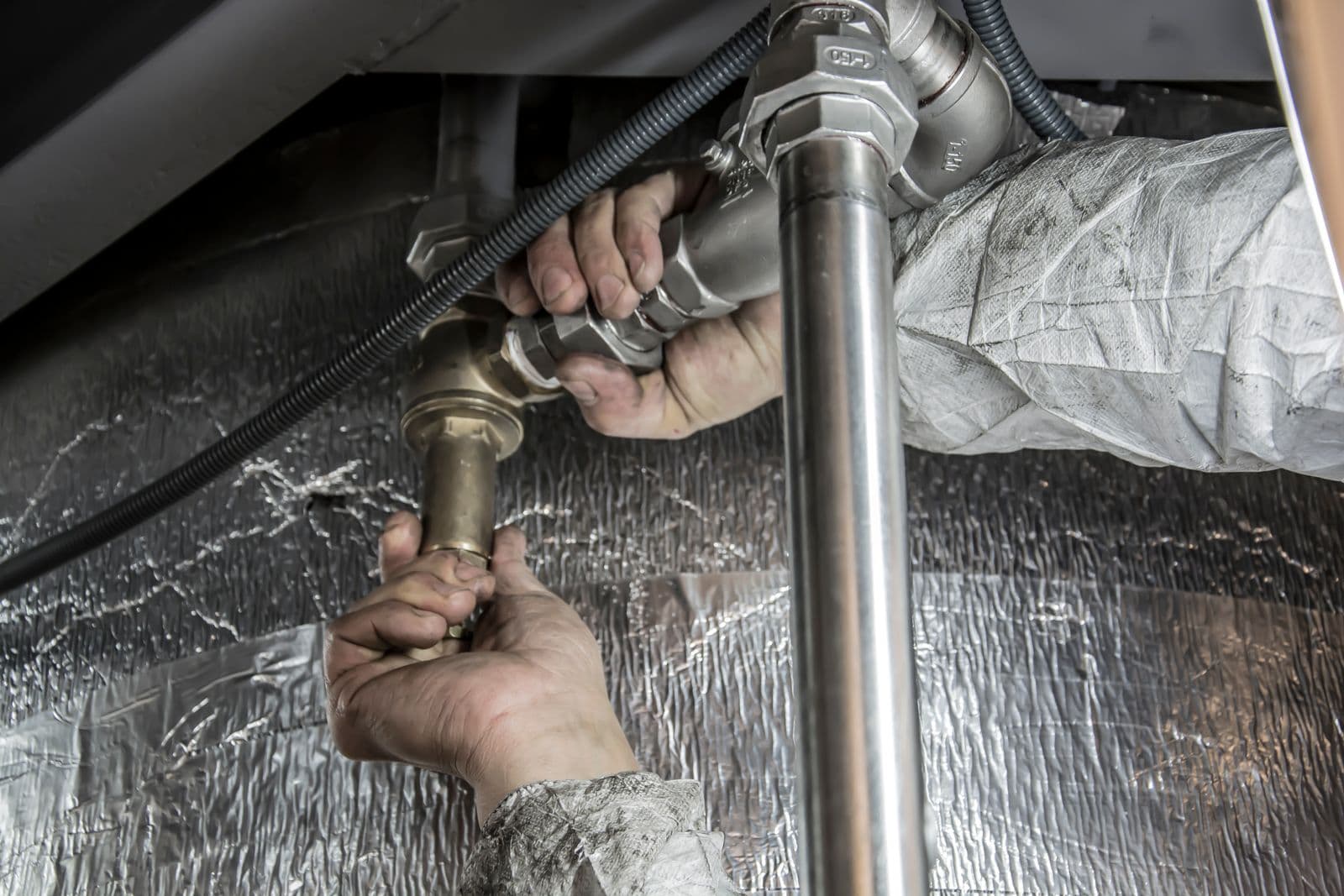
Treatment equipment is plumbing. Most of the job is the connection, the drain and the code detail behind it.


Newport News water, answered plainly
Where does Newport News get its water?+
From Diascund Creek Reservoir, supplemented by the Chickahominy River above Walkers Dam as weather dictates, stored in five Waterworks reservoirs and treated at two plants. Newport News Waterworks serves Newport News, Hampton, Poquoson, York County and part of James City County. Customers on the Lightfoot well system in York County are on separate groundwater with a separate report.
Is there PFAS in Newport News water?+
Yes, at low parts-per-trillion levels in treated water. The 2025 expanded tables list PFOS at 3.7 to 4.9 ppt and PFOA at 2.1 to 3.3 ppt, plus four other PFAS compounds between roughly 2 and 3.8 ppt. The report states the water meets all current federal and state standards, which it does, because compliance with the federal PFAS limits is not required until 2029.
Is that over the federal PFAS limit?+
The federal limit for PFOS is 4.0 ppt, adopted by EPA in April 2024 and assessed as a running annual average, with compliance required from April 2029. In May 2026 EPA proposed letting systems request two more years, to 2031, while keeping the 4.0 ppt limit. The highest 2025 PFOS result, 4.9 ppt, is above 4.0; the low end, 3.7, is below it. The report does not publish an annual average, so this page does not state whether the average is above or below the limit.
Does Newport News use chloramine?+
Yes. The report says chloramines are added as the secondary disinfectant to maintain disinfection through the pipes. The highest compliance average was 3.3 ppm against a maximum of 4.0. Chloramine matters for aquarium owners, for some dialysis equipment, and for choosing a carbon filter, which has to be rated for chloramine rather than chlorine.
Do I need a water softener in Newport News?+
Not on the strength of the report. Hardness averaged 69 mg/L — about four grains per gallon — with sodium at 12.6 mg/L. A softener addresses hardness, and hardness is not what this report highlights.
Is Newport News water the same as Norfolk's?+
No. Norfolk, Virginia Beach and Chesapeake are south of the James on different reservoirs and plants with their own reports. Newport News Waterworks serves the Peninsula from Diascund Creek and the Chickahominy. Neighbouring cities, different water, different governing numbers.
Where do these figures come from?+
The Newport News Waterworks Annual Drinking Water Quality Report 2025 for the Lower Peninsula System and its expanded data tables, reviewed by the Virginia Department of Health, and EPA's published status of the PFOA and PFOS rule. Independent water-quality aggregators are not the source used on this page. A later report supersedes these figures.
Related resources
Home water purification and treatment
The national service page behind this one.
Learn more →Norfolk water quality
South of the James — Moores Bridges plant, its own report.
Learn more →Chesapeake water quality
Four finished waters under two system IDs.
Learn more →Virginia Beach water quality
Lake Gaston water treated at Norfolk's plant.
Learn more →Where a water softener can discharge
Indirect-waste rules for treatment drain lines.
Learn more →All home services
Water, battery, HVAC and solar under one licensed contractor of record.
Learn more →Get a free test at your tap
A licensed technician tests at your kitchen tap and tells you which of the findings above applies to your house — and which does not. No charge, no obligation, and coverage confirmed at your address first.
Get a free test