Chesapeake, Virginia
Chesapeake Water Quality
Chesapeake is four waters, not one. Two City plants, plus water bought from Norfolk and from Portsmouth — and the report that describes them shows hardness and sodium changing by more than double depending on which reaches your address.
The 2025 report lists hardness at 32 ppm for the City's own plants, 74 ppm for Norfolk-supplied water and 36 ppm for Portsmouth water — the same city, three different answers.
The short answer
Chesapeake water comes from four places: the City's Northwest River plant (river water and brackish wells, with reverse osmosis), its Lake Gaston plant (ultrafiltration of raw water bought from Norfolk), and treated water bought from Norfolk and Portsmouth. Two public water systems: PWSID 3550051 and 3550050.
Everything in the 2025 report meets EPA standards. What changes is which water reaches your address: hardness is 32, 74 or 36 ppm and sodium 53, 34 or 73 ppm depending on the supply. None of it is hard water, so a softener is rarely the answer — the first step is finding out which supply you are on.
Get a free test
Tell us your Chesapeake address. We confirm coverage first, then schedule a licensed technician to test at your tap — no charge, no obligation.
What filtration does — and does not
Sediment, carbon, softening and reverse osmosis each address a different problem. In Chesapeake the useful first question is not which stage to buy but which of four supplies you are drinking.
Where Chesapeake water comes from
Two City plants with different treatment trains, and two neighbouring cities' treated water bought under contract — the reason one Chesapeake report carries separate columns for each.
Northwest River Water Treatment Plant — river water and brackish wells
Treats up to 10 million gallons a day from the Northwest River and also treats brackish groundwater from four wells along South Battlefield Boulevard. The 2025 report lists coagulation, sedimentation, filtration, reverse osmosis membrane treatment and ultraviolet disinfection. The City says this supply generally serves customers south of Military Highway, subject to periodic adjustment with demand.
Lake Gaston Water Treatment Plant — ultrafiltration
Provides up to 8 million gallons a day using low-pressure ultrafiltration. It currently treats raw water purchased from Norfolk. Groundwater from Western Branch Wells 1 and 3 supplements it, and because fluoride occurs naturally in that groundwater, the wells provide natural fluoridation to this plant's output.
Norfolk water — Indian River and South Norfolk
Customers in the Indian River and South Norfolk areas, generally north of Providence Road, receive treated water purchased under contract from the City of Norfolk. The report lists it in its own column, marked N, and it is not the same water as either Chesapeake plant produces.
Portsmouth water — Western Branch and Deep Creek
Customers in Western Branch and Deep Creek, generally north of Military Highway, receive treated water purchased under contract from the City of Portsmouth. That area is a separate public water system — PWSID 3550050 — from the Northwest River system, PWSID 3550051, which includes the Lake Gaston plant.
What the 2025 report says, supply by supply
Federal limits are fixed. The results next to them are from the City of Chesapeake 2025 Water Quality Report — system-level figures, not a reading at your tap. A later report supersedes them.
Hardness — 32, 74 or 36 ppm depending on the supply
The 2025 report gives total hardness at a highest level of 32 ppm (range ND–32) for the two Chesapeake plants, 74 ppm (32–74) for the Norfolk-supplied water and 36 ppm (18–36) for the Portsmouth-supplied water. Divided by 17.1, that is about 1.9, 4.3 and 2.1 grains per gallon. None of it is hard water, but the Norfolk-supplied figure is more than twice the Chesapeake-plant figure.
Sodium — 53, 34 or 73 ppm
Highest levels of 53 ppm (51–53) for the Chesapeake plants, 34 ppm (16–34) for Norfolk water and 73 ppm (24–73) for Portsmouth water. The report lists sodium among non-regulated parameters. If someone in the house is on a sodium-restricted diet, which water reaches the tap matters — and a softener would add sodium, not remove it.
Disinfection byproducts — compliant on both systems
For the Northwest River system, TTHM highest locational running annual average 30 ppb (range 8–39) against an MCL of 80, and HAA5 21 ppb (ND–27) against 60. For the Portsmouth-supplied water, TTHM 48 ppb (26–53) and HAA5 33 ppb (4–43). Both inside the limits; the Portsmouth figures are the higher pair.
Disinfectant residual
Total chlorine is reported as a running annual average of 3.36 ppm (range 0.07–4.40) for the Chesapeake plants, 3.20 ppm for Norfolk water and 2.62 ppm for Portsmouth water, against a maximum residual disinfectant level of 4. A chlorine taste at the tap is a residual, not a contaminant, and it is the thing household carbon removes most readily.
Lead and copper — at the house tap
For the Northwest River system in 2025, lead at the 90th percentile was 0.84 ppb (range ND–14.7) against an action level of 15, with 0 of 57 samples above it; copper 0.168 ppm against 1.3. For Portsmouth water (2024 sampling), lead 0.81 ppb with 0 of 30 above. Both systems are on reduced monitoring. The City's service-line inventory is published at CityOfChesapeake.net/LCR.
PFAS — not detected in either system's UCMR 5 sampling
The report lists every compound in EPA's fifth Unregulated Contaminant Monitoring Rule as not detected at the Northwest River system entry point (sampled June 2023 to March 2024) and the Western Branch system entry point (April 2023 to January 2024), including PFOA and PFOS.
Why the neighbouring pages do not describe Chesapeake
Norfolk is one plant and one report: Moores Bridges, with hardness of 32 to 74 ppm. Virginia Beach is Lake Gaston water treated at that same plant. Chesapeake receives some of that Norfolk water too — the 74 ppm in its report is the Norfolk column — but most of the city is on water its own plants make, with a different treatment train and roughly half the hardness.
So a Chesapeake homeowner reading the Norfolk page, or a national average, may be reading about somebody else's water. The report that separates the four supplies is Chesapeake's own, and the neighbourhood decides which column applies.
Where these figures come from
Everything on this page traces to primary sources. Independent compilations of water quality data exist and are not used here.
- City of Chesapeake 2025 Water Quality Report — calendar-year 2025 data, PWSID 3550051 and 3550050.
- City of Chesapeake — Plants & Sources — plant descriptions and the general service areas.
- EPA National Primary Drinking Water Regulations — TTHM MCL 80 ppb, HAA5 MCL 60 ppb, chlorine MRDL 4 ppm.
Matching treatment to the finding
In a city with four supplies and no exceedance, the right household stage depends on the address and on what someone in the house wants lower — not on a brochure.
First: find out which water you have
In most cities a treatment conversation starts from one report. In Chesapeake it starts from the address, because the same report describes four waters. The City's Water Quality Laboratory (757-382-3550) can tell you which supply serves you; a tap test tells you what is actually arriving.
Activated carbon — for taste and byproducts
Carbon addresses chlorine taste and odour and reduces trihalomethanes and haloacetic acids. With byproducts compliant on both systems, it is a taste-and-preference purchase rather than a response to an exceedance — which is a different argument from a city whose own notices report one.
Reverse osmosis — know what the plant already does
Under-sink RO reduces dissolved solids including sodium, which is its real use here for a sodium-restricted household. Part of the Northwest River plant's treatment already includes RO membranes, so the case for it depends on which supply serves you and what the tap test shows, not on the word itself.
A softener — rarely the right first purchase
At 1.9 to 4.3 grains per gallon, none of the four supplies is hard water. A softener also exchanges hardness for sodium, which is the wrong direction in a city where one supply already reports up to 73 ppm. If someone is quoting one, ask what hardness was measured at your tap.
How the free test works
A licensed technician tests at your kitchen tap, walks the plumbing, and tells you which of the findings above applies to your house and which does not. There is no charge and no obligation.
Seamless Home is the licensed contractor of record on the work that follows. Installation is performed by vetted installing partners engaged as our subcontractors, and the workmanship obligation stays with us. Coverage is confirmed per service area rather than promised as blanket availability.
Drain connections for under-sink RO still have to meet the indirect-waste rule — where a water softener is allowed to discharge sets out the plumbing logic even when the equipment is RO rather than a softener.
What a water treatment job with us covers
Installation and replacement of whole-home and point-of-use treatment, specified against what your water actually contains.
Sediment filtration
Installation of the first stage that protects everything downstream of it, sized to the service line and the household draw.
Softening
Installation of ion-exchange softening where hardness is the problem, including the drain connection the plumbing code treats as indirect waste.
Carbon filtration
Installation of carbon stages for taste, odour and disinfection by-products, specified from your utility's own water quality report.
Reverse osmosis
Point-of-use installation at the kitchen sink where the target is dissolved solids rather than whole-home flow.
Disinfection
Installation of UV or equivalent treatment where the supply is a private well or is otherwise not continuously disinfected.
System replacement
Replacing equipment that has reached the end of its service life, including the discharge and air gap details an inspector looks at.
This is installation and replacement work, specified from a published water quality report or a test of your supply — not from a sales chart. Coverage is confirmed per service area rather than promised as blanket availability.
What the work actually looks like
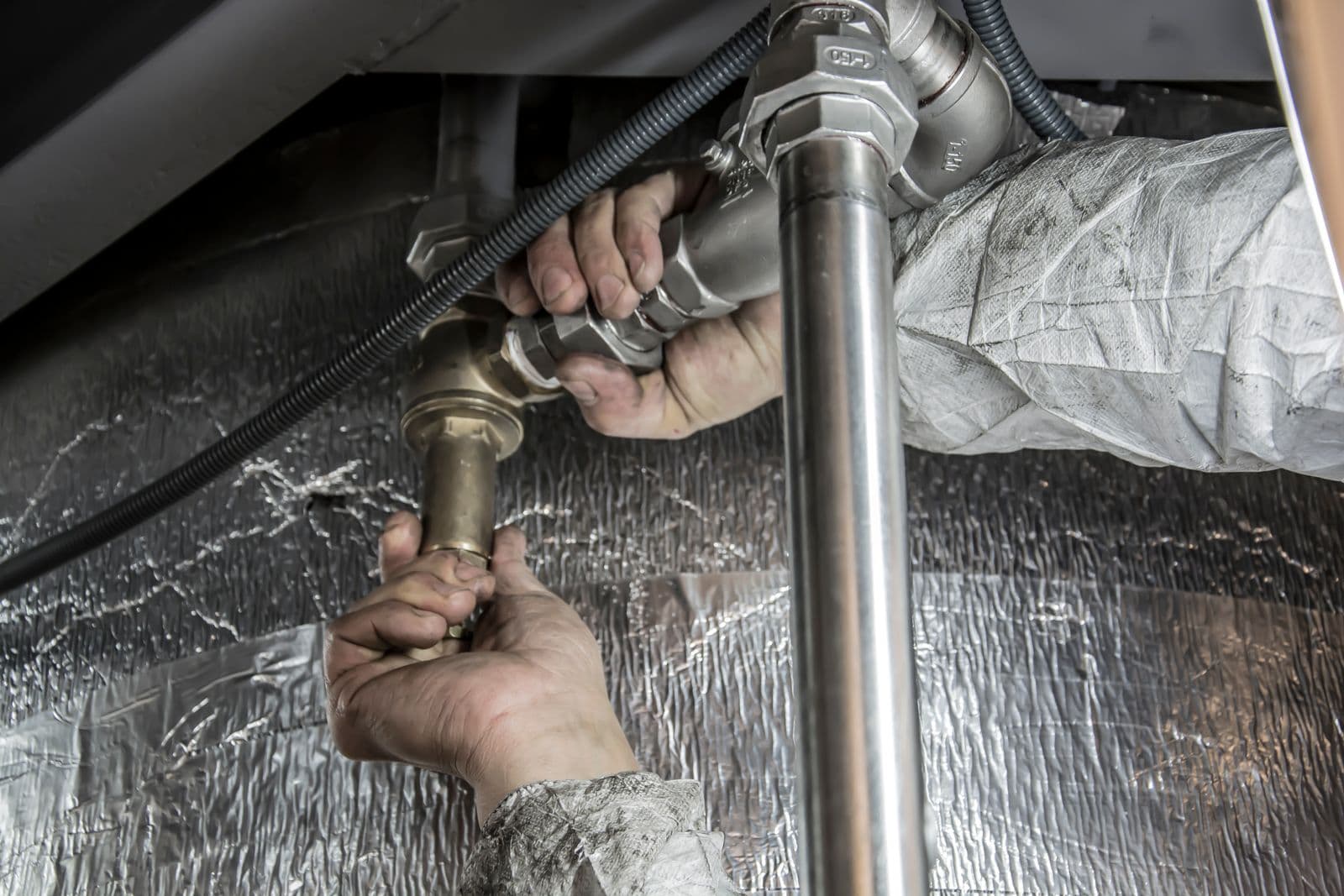
Treatment equipment is plumbing. Most of the job is the connection, the drain and the code detail behind it.


Chesapeake water, answered plainly
Where does Chesapeake get its water?+
From four places. The City's Northwest River plant treats Northwest River water and brackish groundwater; its Lake Gaston plant treats raw water bought from Norfolk, supplemented by Western Branch wells; and the City buys treated water from Norfolk for the Indian River and South Norfolk areas and from Portsmouth for Western Branch and Deep Creek. The 2025 Water Quality Report lists results for each.
Is Chesapeake water the same as Norfolk water?+
Partly, depending on the address. Customers generally north of Providence Road in Indian River and South Norfolk receive treated Norfolk water. Elsewhere the water comes from Chesapeake's own plants or from Portsmouth. Norfolk's own report describes Norfolk's system; Chesapeake's report is the one that separates the four supplies its customers receive.
Is Chesapeake water hard?+
No. The 2025 report's highest hardness is 32 ppm for the Chesapeake plants, 74 ppm for Norfolk-supplied water and 36 ppm for Portsmouth-supplied water — about 1.9, 4.3 and 2.1 grains per gallon. None of the four supplies is hard water — the Norfolk-supplied figure is the highest, which Norfolk itself describes as between soft and slightly hard — and a softener is rarely the first purchase.
Does Chesapeake use reverse osmosis?+
The Northwest River plant does. The City's report lists coagulation, sedimentation, filtration, reverse osmosis membrane treatment and ultraviolet disinfection there, and the plant also treats brackish groundwater from four wells. The Lake Gaston plant uses low-pressure ultrafiltration instead. Neither statement describes the Norfolk or Portsmouth water some neighbourhoods receive.
Did Chesapeake's water have any violations in 2025?+
The 2025 report marks every regulated substance in its tables as meeting EPA standards, including disinfection byproducts, lead and copper, nitrate, radionuclides and turbidity. PFAS compounds were not detected in the UCMR 5 sampling it reports. A compliant system-level result is still not a reading at your kitchen tap.
How do I find out which water serves my house?+
The City describes the service areas in general terms — Northwest River generally south of Military Highway, Norfolk water generally north of Providence Road in Indian River and South Norfolk, Portsmouth water generally north of Military Highway in Western Branch and Deep Creek — and notes the boundaries shift with demand. For your address, ask the Water Quality Laboratory at 757-382-3550.
Where do these figures come from?+
The City of Chesapeake 2025 Water Quality Report (calendar-year 2025 data) for PWSID 3550051 and PWSID 3550050, and the City's Plants & Sources page for the service-area descriptions. Independent water-quality aggregators are not the source used on this page.
Related resources
Home water purification and treatment
The national service page behind this one.
Learn more →Norfolk water quality
Moores Bridges — the source of the Norfolk-supplied column in Chesapeake's report.
Learn more →Virginia Beach water quality
Lake Gaston water treated at Norfolk's plant, under its own report.
Learn more →Arlington water quality
Northern Virginia, Potomac supply — about 8 grains per gallon.
Learn more →Battery backup in Norfolk, VA
Outage cover in the same Hampton Roads flood-and-storm context.
Learn more →Where a water softener can discharge
Indirect-waste rules for treatment drain lines.
Learn more →All home services
Water, battery, HVAC and solar under one licensed contractor of record.
Learn more →Get a free test at your tap
A licensed technician tests at your kitchen tap and tells you which of Chesapeake's supplies — and which of the findings above — applies to your house. No charge, no obligation, and coverage confirmed at your address first.
Get a free test