Alexandria, Virginia
Alexandria Water Quality
Virginia American Water delivers what Fairfax Water treats at Corbalis and Griffith. The 2025 report's everyday number is hardness up to 191 ppm — with regulated PFAS not detected and a chloramine residual in the pipes.
Hardness to ~11 grains. Chloramine in the distribution system. Regulated PFAS listed as not detected — Hazard Index 0.0.
The short answer
Alexandria drinking water is treated by Fairfax Water (Corbalis on the Potomac, Griffith on the Occoquan) and distributed by Virginia American Water as a consecutive system (PWS VA6510010). The residual in the pipes is chloramine, not free chlorine alone.
The 2025 report's everyday figure is hardness up to 191 ppm (~11.2 grains). Regulated PFAS are listed as not detected with a Hazard Index of 0.0. TTHMs and HAAs sit well under their MCLs. Test the tap before buying a stage aimed at a different Northern Virginia CCR.
Get a free test
Tell us your Alexandria address. We confirm coverage first, then schedule a licensed technician to test at your tap — no charge, no obligation.
What filtration does — and does not
Softening, chloramine-rated carbon and RO solve different problems. Alexandria's report is mostly hardness and disinfectant choice — not a PFAS purchase order.
Where Alexandria water comes from
A consecutive system has two names on the path. Fairfax treats; Virginia American delivers and reports.
Consecutive system — Fairfax Water treats, Virginia American delivers
The report classifies Alexandria as a consecutive water system. Drinking water comes from two Fairfax Water plants: J.J. Corbalis on the Potomac River and Griffith at the Occoquan Reservoir. Virginia American Water distributes and reports; it is not a city-owned treatment plant.
Chloramine in the distribution system
Fairfax Water uses chloramines as the distribution disinfectant. The 2025 table lists a chloramine running annual average of 3.1 ppm (range 0.8–3.7) against an MRDL of 4.0. Carbon filters must be rated for chloramine if taste is the complaint — free-chlorine media is the wrong stage.
Fluoride added by Fairfax Water
The report states Fairfax Water adds fluoride to the Alexandria supply toward the U.S. Public Health Service recommendation of 0.7 mg/L. That is a treatment choice upstream of Virginia American's distribution, not a contaminant finding.
Lead at the tap — ND at the 90th percentile
In 2025, fifty customer-tap samples showed a lead 90th percentile of not-detected, range ND to 2 ppb, with zero homes above the 15 ppb action level. Orthophosphate is listed as a corrosion-control additive (highest 1.44 ppm).
What the 2025 report actually says
Limits are fixed. The results next to them are from Virginia American Water's 2025 Alexandria Water Quality Report — system-level figures, not a reading at your tap. A later report supersedes them.
Hardness — up to 191 ppm (~11 grains)
Total hardness is listed with a highest result of 191 ppm and a range of 78–191 ppm for 2025 — roughly 4.6 to 11.2 grains per gallon. That is an aesthetic and scale measure, not a health MCL, and it is the everyday reason Alexandria households notice their water.
Regulated PFAS — not detected; Hazard Index 0.0
Virginia American's 2024 PFAS table for Alexandria lists PFOA, PFOS, PFHxS, HFPO-DA (GenX), PFNA and PFBS as not detected, with a Hazard Index of 0.0 against EPA's mixture rule. That is a different Northern Virginia story from systems still reporting detections above 4 ppt.
Disinfection byproducts
Total trihalomethanes show a highest locational running annual average of 25.3 ppb (range 7.2–43.6) against 80. Haloacetic acids show 17.3 ppb (4.2–29.5) against 60. Both are well under the MCLs.
Nitrate
1.5 ppm average with a range of 1.09–1.5 against an MCL of 10. Compliant, and far from the infant-health threshold that drives other pages.
Sodium and alkalinity
Sodium's highest result is 34.9 ppm (13.0–34.9). Total alkalinity's highest is 120 ppm (41–120). The report notes sodium in water matters mainly for people on sodium-restricted diets.
Why Alexandria is not Arlington with a different ZIP
Arlington publishes a county utility CCR. Downstate, Richmond, Norfolk and Chesapeake each have their own source and disinfectant stories. Alexandria's differentiator is the Fairfax consecutive path, chloramine in distribution, hardness into the low teens of grains, and a regulated-PFAS table that reads not detected.
Where these figures come from
- Virginia American Water — 2025 Alexandria Water Quality Report — PWS ID VA6510010; hardness, chloramine, PFAS, TTHM/HAA, lead and copper.
- Fairfax Water — Corbalis and Griffith plants that treat the water Alexandria receives.
- EPA — PFAS National Primary Drinking Water Regulation — 4.0 ppt MCLs and Hazard Index framework.
Matching treatment to the finding
Alexandria's report supports a softener conversation and chloramine-aware carbon — not a PFAS panic buy.
Hardness: softener if scale is the complaint
At the high end of the 2025 range (~11 grains), scale on fixtures and heaters is the usual household complaint. A softener addresses hardness and nothing else on this page; it adds sodium and needs a legal drain.
Chloramine taste: catalytic carbon, not a pitcher made for free chlorine
Chloramine needs media rated for chloramine reduction. A carbon block sold only for free chlorine can leave the taste and the residual in place.
PFAS: no purchase forced by ND results
Not-detected regulated PFAS with a Hazard Index of 0.0 is not a reason to buy a PFAS filter on speculation. If a household still wants a margin, NSF/ANSI 53 or 58 listings that name PFOA and PFOS reduction are the check.
Test first — consecutive systems still vary by neighborhood plumbing
Fairfax's two plants and Virginia American's distribution mean the CCR is system-level. A free test at your kitchen tap measures hardness, chloramine residual and dissolved solids where you live.
How the free test works
A licensed technician tests at your kitchen tap, walks the plumbing, and tells you which of the findings above applies to your house and which does not. There is no charge and no obligation.
Seamless Home is the licensed contractor of record on the work that follows. Installation is performed by vetted installing partners engaged as our subcontractors, and the workmanship obligation stays with us. Coverage is confirmed per service area rather than promised as blanket availability.
A softener still needs a legal drain — where a water softener is allowed to discharge.
What a water treatment job with us covers
Installation and replacement of whole-home and point-of-use treatment, specified against what your water actually contains.
Sediment filtration
Installation of the first stage that protects everything downstream of it, sized to the service line and the household draw.
Softening
Installation of ion-exchange softening where hardness is the problem, including the drain connection the plumbing code treats as indirect waste.
Carbon filtration
Installation of carbon stages for taste, odour and disinfection by-products, specified from your utility's own water quality report.
Reverse osmosis
Point-of-use installation at the kitchen sink where the target is dissolved solids rather than whole-home flow.
Disinfection
Installation of UV or equivalent treatment where the supply is a private well or is otherwise not continuously disinfected.
System replacement
Replacing equipment that has reached the end of its service life, including the discharge and air gap details an inspector looks at.
This is installation and replacement work, specified from a published water quality report or a test of your supply — not from a sales chart. Coverage is confirmed per service area rather than promised as blanket availability.
What the work actually looks like
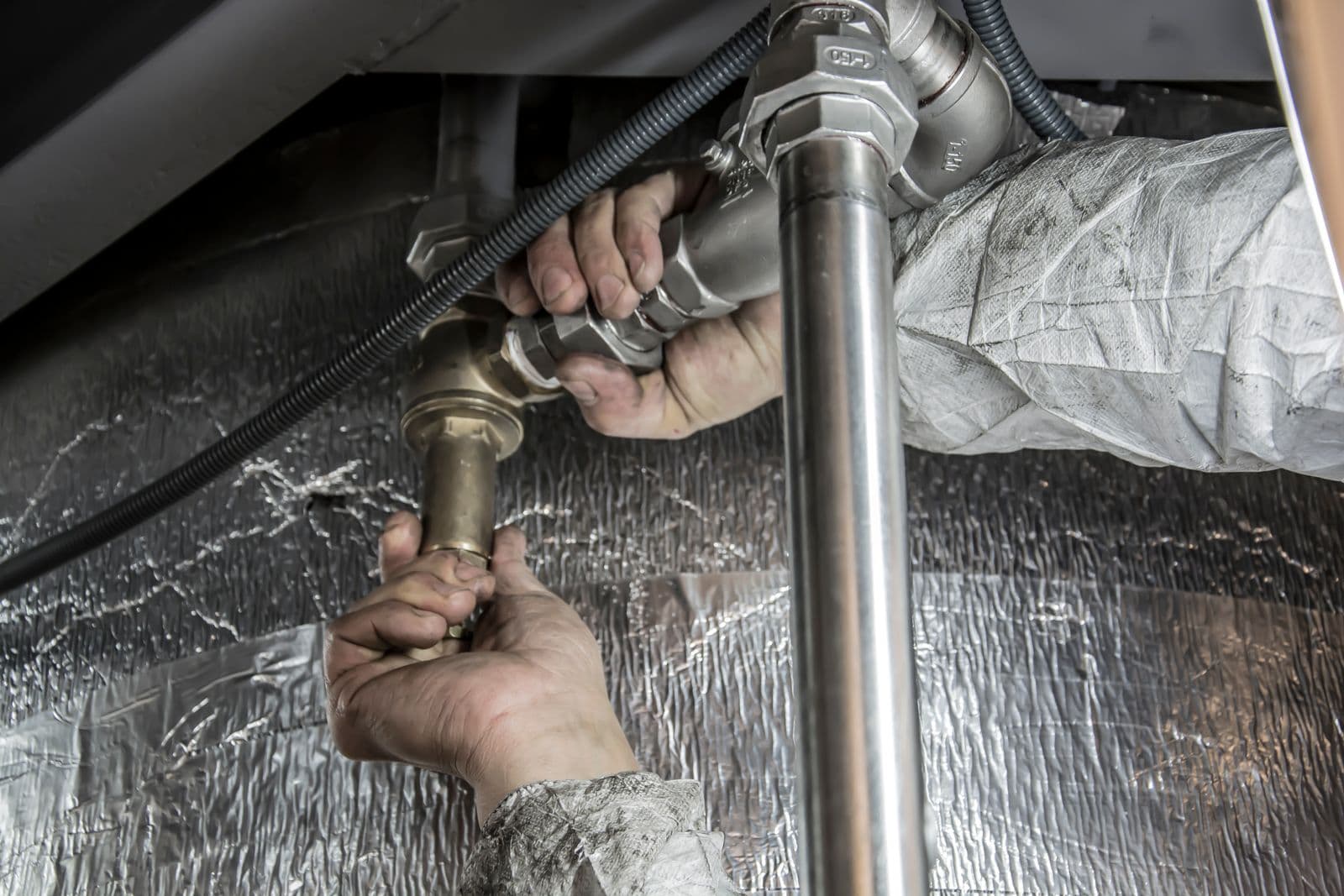
Treatment equipment is plumbing. Most of the job is the connection, the drain and the code detail behind it.


Alexandria water, answered plainly
Who provides Alexandria drinking water?+
Virginia American Water operates the Alexandria distribution system (PWS ID VA6510010) as a consecutive system of Fairfax Water. Fairfax treats Potomac River water at Corbalis and Occoquan Reservoir water at Griffith; Virginia American delivers and publishes the CCR.
Is Alexandria water the same as Arlington's?+
No. Arlington County publishes its own water quality report for its own system. Alexandria's governing document is Virginia American Water's Alexandria CCR. Neighbouring cities are not interchangeable water reports.
Is there PFAS in Alexandria water?+
The 2025 CCR's PFAS table (2024 sampling) lists the EPA-regulated PFAS set as not detected, with a Hazard Index of 0.0. That is the utility's published result for this system, not a prediction for every future sample.
How hard is Alexandria water?+
The 2025 report lists total hardness with a highest result of 191 ppm and a range of 78–191 ppm — about 4.6 to 11.2 grains per gallon. There is no federal health MCL for hardness; scale and spotting are the usual effects at the high end.
Does Alexandria use chloramine?+
Yes. The report describes chloramines as the distribution disinfectant and lists a 2025 running annual average of 3.1 ppm (0.8–3.7) against an MRDL of 4.0. The report also notes chloramine must be removed for kidney dialysis and aquariums.
Where do these figures come from?+
Virginia American Water's 2025 Annual Water Quality Report for Alexandria (PWS VA6510010), including Fairfax Water plant data where the CCR cites it, and EPA's PFAS rule status. Independent aggregators are not used here. A later report supersedes these figures.
Related resources
Home water purification and treatment
The national service page behind this one.
Learn more →Arlington water quality
Neighbouring county utility — different CCR from Virginia American.
Learn more →Richmond water quality
Central Virginia municipal contrast.
Learn more →Chesapeake water quality
Southside Virginia contrast on a different utility.
Learn more →Where a water softener can discharge
Indirect-waste rules for treatment drain lines.
Learn more →All home services
Water, battery, HVAC and solar under one licensed contractor of record.
Learn more →Get a free test at your tap
A licensed technician tests at your kitchen tap and tells you which of the findings above applies to your house — hardness, chloramine taste or none of them. No charge, no obligation, and coverage confirmed at your address first.
Get a free test