Fredericksburg, Virginia
Fredericksburg Water Quality
Rappahannock River water, treated mostly at Spotsylvania County's Motts Run plant and delivered through City pipes. The 2025 report lists two short-chain PFAS at the entry point, sodium above the low-sodium guideline and a TTHM high of 87 ppb.
~95% Motts Run · PFHxA 3.1 ppt + PFPeA 6.4 ppt · sodium 22.8 ppm · TTHM high 87 ppb.
The short answer
Fredericksburg doesn't treat its own water. About 95% comes from Spotsylvania County's Motts Run plant, drawing on the Rappahannock River and Motts Run Reservoir, and the City delivers it. The 2025 report (covering 2024) lists no violations for regulated contaminants.
It does list two unregulated short-chain PFAS at the entry point — PFHxA 3.1 ppt and PFPeA 6.4 ppt — sodium up to 22.8 ppm (above the 20 ppm low-sodium guideline), trihalomethanes averaging 47 ppb with a high of 87, and a July 2024 Level 1 coliform assessment. Reverse osmosis at the kitchen tap matches the PFAS and sodium findings; a tap test comes first.
Get a free test
Tell us your Fredericksburg address. We confirm coverage first, then schedule a licensed technician to test at your tap — no charge, no obligation.
What filtration does — and does not
Softening, carbon and reverse osmosis solve different problems. Fredericksburg's report points at carbon and RO, not a softener.
Where Fredericksburg water comes from
River and reservoir water treated by the county next door, delivered by the City.
Rappahannock River + Motts Run Reservoir
Both feed the Motts Run Water Treatment Plant, operated by Spotsylvania County Utilities in a contractual partnership with the City. The report says about 95% of Fredericksburg's water comes from Motts Run.
Ni Reservoir
The remainder is treated at Spotsylvania County's Ni River Water Treatment Plant.
Then the City's own pipes
The distribution system is owned and operated by the City of Fredericksburg Public Works Department, which also handles lead testing requests and the service-line inventory.
What the 2025 Fredericksburg report actually says
Limits are fixed. Results are from the City of Fredericksburg 2025 Water Quality Report (calendar year 2024) — system-level figures, not a reading at your tap. A later report supersedes them.
Two short-chain PFAS at the entry point
UCMR 5 monitoring by Spotsylvania County Utilities in 2024 detected PFHxA at up to 0.0031 ppb (3.1 ppt) and PFPeA at up to 0.0064 ppb (6.4 ppt). These are unregulated; the City's own CY2025 PFAS results were pending for the next report.
Sodium — 22.8 ppm
Range 16.8–22.8 ppm. There is no MCL for sodium, but the report itself notes a 20 ppm recommended limit for people on low-sodium diets.
TTHMs — 47 ppb, with an 87 ppb high
Total trihalomethanes, a disinfection byproduct, averaged 47 ppb against an 80 ppb MCL (no violation); individual results ranged from 16 to 87 ppb. Haloacetic acids: 37 ppb (1.2–54) against 60.
Level 1 coliform assessment, July 2024
Coliforms found in 2024 triggered one Level 1 assessment, completed in July 2024. No system defects or contamination sources were identified and no corrective action was required.
Lead — not detected (2022 round)
Lead was not detected at the 90th percentile in the most recent round, sampled in 2022, with 0 of 30 sites over the 15 ppb action level. Copper was 0.13 ppm at the 90th percentile, 0 of 30 over.
Source rated highly susceptible
The Virginia Department of Health's source water assessment rated the river and reservoirs highly susceptible to contamination — normal for surface water, and the reason treatment and monitoring matter.
Fredericksburg next to Richmond, Alexandria and Charlottesville
Down I-95, Richmond treats James River water itself and reported non-detect for every UCMR 5 compound, PFAS included. Up the corridor, Alexandria buys Fairfax Water and reported regulated PFAS as non-detect, and Charlottesville gets soft RWSA water with free chlorine. Fredericksburg's report is the one in this group with short-chain PFAS listed at the entry point. For the electric side of the same city, see Fredericksburg battery backup.
Where these figures come from
Everything on this page traces to the City of Fredericksburg.
- City of Fredericksburg — 2025 Water Quality Report (Consumer Confidence Report, CY 2024) — sources and the Spotsylvania County partnership, regulated and unregulated results, UCMR 5 PFAS, lead and copper, and the July 2024 Level 1 assessment.
- City of Fredericksburg — Annual Water Report page — where the City posts each year's report.
Matching treatment to the finding
Fredericksburg's report supports reverse osmosis at the tap and carbon for byproducts — not a default equipment sale.
Reverse osmosis for PFAS and sodium
Under-sink reverse osmosis reduces sodium and a broad range of PFAS, including short-chain compounds that carbon alone handles less consistently. It is the tool that matches both of Fredericksburg's unregulated findings.
Carbon for byproducts and taste
Activated carbon reduces trihalomethanes, haloacetic acids and disinfectant taste. A whole-house carbon filter covers showers as well as the kitchen tap.
Check your service line first
The City publishes a service-line inventory viewer. If your line shows lead or unknown, call Public Works at (540) 372-1023, which also takes lead-testing requests.
Test before buying anything
Fredericksburg's figures are system-level. A tap test tells you which of the findings above show up in your house — and which don't.
How the free test works
A licensed technician tests at your kitchen tap, walks the plumbing, and tells you which of the findings above applies to your house and which does not. There is no charge and no obligation.
Seamless Home is the licensed contractor of record on the work that follows. Installation is performed by vetted installing partners engaged as our subcontractors, and the workmanship obligation stays with us. Coverage is confirmed per service area rather than promised as blanket availability.
What a water treatment job with us covers
Installation and replacement of whole-home and point-of-use treatment, specified against what your water actually contains.
Sediment filtration
Installation of the first stage that protects everything downstream of it, sized to the service line and the household draw.
Softening
Installation of ion-exchange softening where hardness is the problem, including the drain connection the plumbing code treats as indirect waste.
Carbon filtration
Installation of carbon stages for taste, odour and disinfection by-products, specified from your utility's own water quality report.
Reverse osmosis
Point-of-use installation at the kitchen sink where the target is dissolved solids rather than whole-home flow.
Disinfection
Installation of UV or equivalent treatment where the supply is a private well or is otherwise not continuously disinfected.
System replacement
Replacing equipment that has reached the end of its service life, including the discharge and air gap details an inspector looks at.
This is installation and replacement work, specified from a published water quality report or a test of your supply — not from a sales chart. Coverage is confirmed per service area rather than promised as blanket availability.
What the work actually looks like
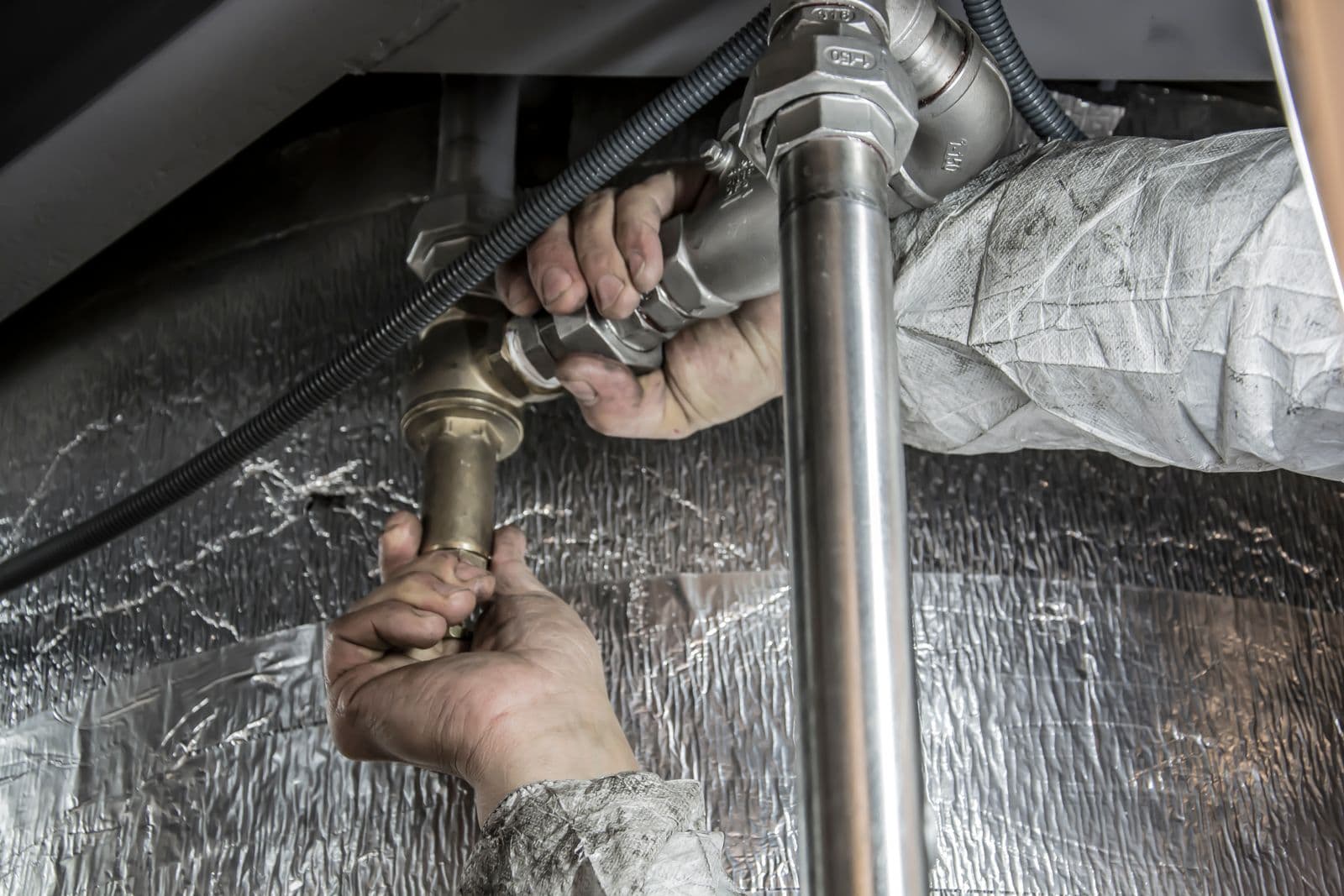
Treatment equipment is plumbing. Most of the job is the connection, the drain and the code detail behind it.


Fredericksburg water, answered plainly
Where does Fredericksburg's water come from?+
Mostly from the Rappahannock River and Motts Run Reservoir, treated at Spotsylvania County's Motts Run Water Treatment Plant under a contractual partnership with the City. The report puts that at about 95%; the rest comes from Ni Reservoir via the Ni River plant.
Is there PFAS in Fredericksburg's water?+
The 2025 report lists two unregulated short-chain PFAS detected at the entry point in 2024 by Spotsylvania County Utilities: PFHxA up to 3.1 ppt and PFPeA up to 6.4 ppt. The City's own CY2025 PFAS results were pending for the next report.
Is Fredericksburg water high in sodium?+
Sodium measured 16.8–22.8 ppm in 2024. There's no federal limit, but the report notes a 20 ppm recommended limit for low-sodium diets, and the high end is above that.
Did Fredericksburg have a water quality violation?+
No violations are listed for regulated contaminants. The report does disclose one Level 1 coliform assessment, completed in July 2024, which found no system defects and required no corrective action.
Why is this the 2025 report and not 2026?+
As of October 20, 2026, the 2025 Water Quality Report (covering calendar year 2024) is the newest posted on the City's Annual Water Report page. When a newer report appears, it supersedes these figures.
Where do these figures come from?+
The City of Fredericksburg 2025 Water Quality Report (Consumer Confidence Report, CY 2024). Third-party aggregators are not used.
Related resources
Home water purification and treatment
The national service page behind this one.
Learn more →Richmond water quality
James River water with UCMR 5 non-detect, PFAS included.
Learn more →Alexandria water quality
Fairfax Water supply with regulated PFAS non-detect.
Learn more →Charlottesville water quality
Soft RWSA water with free chlorine.
Learn more →Fredericksburg battery backup
Dominion inside the city line; REC around it.
Learn more →All home services
Water, battery, HVAC and solar under one licensed contractor of record.
Learn more →Get a free test at your tap
A licensed technician tests at your kitchen tap and tells you which findings apply to your house — PFAS, sodium, disinfection byproducts or none of them. No charge, no obligation, and coverage confirmed at your address first.
Get a free test