Charlottesville, Virginia
Charlottesville Water Quality
Rivanna Water & Sewer Authority surface water through the City's pipes. The 2025 data table shows soft water at 27–40 ppm hardness, free chlorine, lead under 2 ppb — and a February monitoring notice for one missed coliform sample.
Hardness 27–40 ppm · free chlorine · lead under 2 ppb at the 90th percentile.
The short answer
Charlottesville drinks RWSA surface water finished with free chlorine. The 2025 City data table lists hardness at 27–40 ppm (soft to slightly hard) and lead below 2.00 ppb at the 90th percentile.
A February 2025 Notice of Violation covered a monitoring shortfall — 49 of 50 required coliform samples — not a finding that bacteria exceeded the standard. Soft water and free chlorine shape filter choice differently than a hard, chloramine system.
Get a free test
Tell us your Charlottesville address. We confirm coverage first, then schedule a licensed technician to test at your tap — no charge, no obligation.
What filtration does — and does not
Softening, carbon and reverse osmosis solve different problems. Soft City water rarely needs a softener; taste and plumbing metals are the more common questions.
Where Charlottesville water comes from
RWSA treats it. The City delivers it.
Rivanna reservoirs and rivers
The Rivanna Water & Sewer Authority treats surface water from the South Rivanna Reservoir, Ragged Mountain and Sugar Hollow Reservoirs, and the North Fork Rivanna River for the City and the urban ring.
Three RWSA treatment plants
South Rivanna, Observatory and North Rivanna plants use physical and chemical treatment, add fluoride for dental health, and disinfect with sodium hypochlorite (free chlorine — not chloramine).
Then the City's distribution
The City of Charlottesville buys treated water from RWSA and delivers it through its own distribution system to City customers.
What the 2025 Charlottesville report actually says
Limits are fixed. Results are from the City's 2025 Annual Water Quality Report Data Table — system-level figures, not a reading at your tap. A later report supersedes them.
Hardness — 27 to 40 ppm
The 2025 data table lists hardness at 27–40 ppm. That is soft to slightly hard water — far below the ranges printed for many Virginia and Arizona cities on this site.
Lead — below 2.00 ppb
Lead at the 90th percentile was reported below 2.00 ppb against a 15 ppb action level, with zero samples exceeding the action level. Copper was 0.074 ppm with zero exceedances.
Free residual chlorine — 1.3 ppm average
Free residual chlorine averaged 1.3 ppm (range 0.43–2.02 ppm) against a 4 ppm MRDL. This is free chlorine, not chloramine — which changes carbon-filter choice.
Fluoride — 0.80 ppm
Fluoride averaged 0.80 ppm (range about 0.54–0.82 ppm) against a 4 ppm MCL. RWSA adds fluoride at each plant.
February 2025 monitoring notice
VDH issued a Notice of Violation because only 49 of the required 50 coliform samples were analyzed in February 2025. That is a monitoring shortfall, not a finding that coliform was present above the standard.
Disinfection byproducts under the MCL
Total trihalomethanes and haloacetic acids were reported under their respective MCLs (80 ppb and 60 ppb) in the 2025 data table.
Charlottesville next to Harrisonburg and Lynchburg
Up the valley, Harrisonburg reports hardness from 12 to 153 mg/L (average 67) on city-owned HPU supply. Lynchburg sits on a different western Virginia system. Charlottesville's differentiator is soft RWSA water plus free chlorine — and a monitoring notice that is easy to misread as a contamination event.
Where these figures come from
Everything on this page traces to the City of Charlottesville and RWSA's published 2025 data.
- City of Charlottesville — 2025 Annual Water Quality Report Data Table (PDF) — hardness, lead, copper, free chlorine, fluoride and the February 2025 monitoring notice.
- City of Charlottesville — Annual Water Quality Reports — the landing page that links the current and archived reports.
Matching treatment to the finding
Charlottesville's report supports skipping an unnecessary softener and matching carbon to free chlorine — not a default equipment sale.
Soft water rarely needs a softener
At 27–40 ppm hardness, scale from calcium and magnesium is usually not the complaint. Buying a softener for Charlottesville City water without a hardness test is solving the wrong problem.
Free chlorine: standard carbon works
Unlike MWRA and many chloramine systems, Charlottesville finishes with free chlorine. Ordinary catalytic or granulated carbon handles taste and odour without needing chloramine-specific media.
Lead stopgap still belongs at the tap
Even with a sub-2 ppb system 90th percentile, older in-house solder and brass can contribute lead. A certified lead-reducing filter at the kitchen tap is the practical check while you test.
RO for a broader cut
Reverse osmosis at the kitchen tap reduces a wider set of dissolved contaminants when a homeowner wants more than taste control — sized after a tap test, not from the City average alone.
How the free test works
A licensed technician tests at your kitchen tap, walks the plumbing, and tells you which of the findings above applies to your house and which does not. There is no charge and no obligation.
Seamless Home is the licensed contractor of record on the work that follows. Installation is performed by vetted installing partners engaged as our subcontractors, and the workmanship obligation stays with us. Coverage is confirmed per service area rather than promised as blanket availability.
What a water treatment job with us covers
Installation and replacement of whole-home and point-of-use treatment, specified against what your water actually contains.
Sediment filtration
Installation of the first stage that protects everything downstream of it, sized to the service line and the household draw.
Softening
Installation of ion-exchange softening where hardness is the problem, including the drain connection the plumbing code treats as indirect waste.
Carbon filtration
Installation of carbon stages for taste, odour and disinfection by-products, specified from your utility's own water quality report.
Reverse osmosis
Point-of-use installation at the kitchen sink where the target is dissolved solids rather than whole-home flow.
Disinfection
Installation of UV or equivalent treatment where the supply is a private well or is otherwise not continuously disinfected.
System replacement
Replacing equipment that has reached the end of its service life, including the discharge and air gap details an inspector looks at.
This is installation and replacement work, specified from a published water quality report or a test of your supply — not from a sales chart. Coverage is confirmed per service area rather than promised as blanket availability.
What the work actually looks like
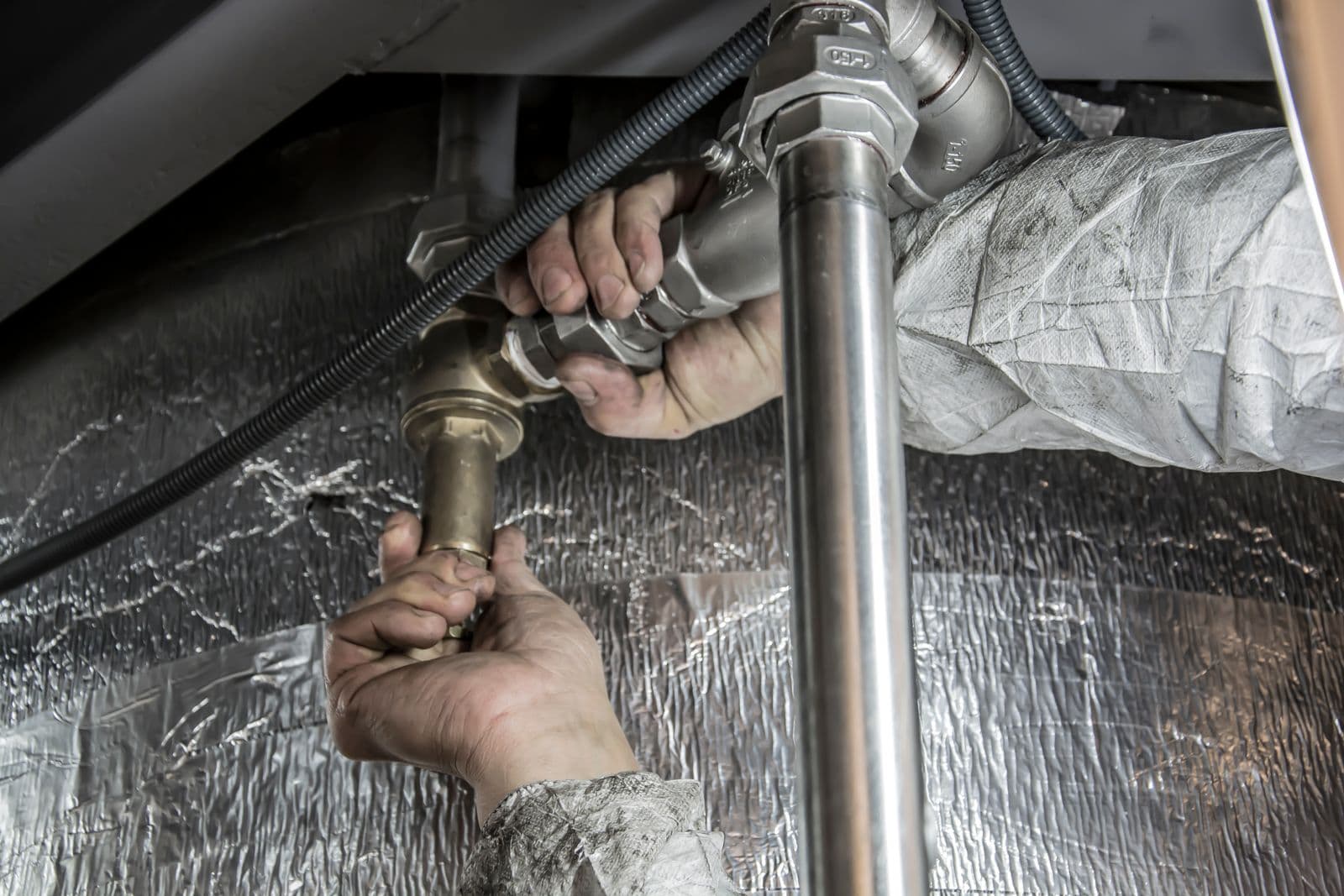
Treatment equipment is plumbing. Most of the job is the connection, the drain and the code detail behind it.


Charlottesville water, answered plainly
Where does Charlottesville's water come from?+
From the Rivanna Water & Sewer Authority. RWSA treats surface water at three plants and sells finished water to the City, which distributes it to customers.
Is Charlottesville water hard or soft?+
Soft to slightly hard. The 2025 City data table lists hardness at 27–40 ppm.
Does Charlottesville use chlorine or chloramine?+
Free chlorine (sodium hypochlorite at the RWSA plants). The 2025 table reports free residual chlorine, not monochloramine.
What was the 2025 Notice of Violation about?+
A monitoring shortfall: fifty coliform samples a month are required, and only forty-nine were analyzed in February 2025. VDH issued a Notice of Violation for that miss. It is not the same as a coliform MCL exceedance.
Was lead above the action level?+
No. Lead was reported below 2.00 ppb at the 90th percentile with zero samples over the 15 ppb action level. Copper also had zero action-level exceedances.
Where do these figures come from?+
The City of Charlottesville 2025 Annual Water Quality Report Data Table published on charlottesville.gov. Third-party aggregators are not used. A later report supersedes these figures.
Related resources
Home water purification and treatment
The national service page behind this one.
Learn more →Harrisonburg water quality
City-owned HPU supply with a wider hardness range.
Learn more →Lynchburg water quality
Another western Virginia city page on this site.
Learn more →Richmond water quality
Dominion-region capital city water page.
Learn more →All home services
Water, battery, HVAC and solar under one licensed contractor of record.
Learn more →Get a free test at your tap
A licensed technician tests at your kitchen tap and tells you which findings apply to your house — soft-water scale myths, chlorine taste or plumbing metals. No charge, no obligation, and coverage confirmed at your address first.
Get a free test