Harrisonburg, Virginia
Harrisonburg Water Quality
Two Shenandoah Valley rivers, treated by Harrisonburg Public Utilities. The 2025 report's most useful number for a homeowner is a range: hardness from 12 to 153 mg/L.
Hardness 12–153 mg/L in 2025, average 67 — soft to hard on the report's own scale.
The short answer
Harrisonburg drinks river water — about half from the Dry River at Rawley Springs and half from the North River at Bridgewater — disinfected with free chlorine. The 2025 report found PFAS below detection, lead under 2.0 ppb, and no known lead service lines.
The number that matters for equipment is hardness: 12 to 153 mg/L, average 67. That spans soft to hard, so a softener is a decision for a tap test, not a city-wide assumption. For taste, plain carbon handles free chlorine well.
Get a free test
Tell us your Harrisonburg address. We confirm coverage first, then schedule a licensed technician to test at your tap — no charge, no obligation.
What filtration does — and does not
Softening, carbon and reverse osmosis solve different problems. Harrisonburg's report points to hardness as the one worth measuring at your own tap.
Where Harrisonburg water comes from
Two rivers today, a third on the way.
Dry River, Rawley Springs
A surface source whose watershed includes the Switzer Reservoir impoundment. Harrisonburg Public Utilities calls it the highest-quality, most cost-effective water it has. About half the city's supply.
North River, Bridgewater
The second surface source, supplying roughly the other half. Both are treated by Harrisonburg Public Utilities before entering 299 miles of city main.
Next: the South Fork Shenandoah
HPU is developing a supply line from the South Fork Shenandoah River. Once complete, it expects a reliable supply of over 15 million gallons a day.
What the 2025 Harrisonburg report actually says
Limits are fixed. Results are from Harrisonburg Public Utilities' 2025 Water Quality Report — system-level figures, not a reading at your tap. A later report supersedes them.
Hardness — 12 to 153 mg/L
The 2025 range runs from soft to hard on the U.S. Geological Survey scale the report prints, with an average of 67 mg/L — moderately hard, about 3.9 grains per gallon.
Free chlorine — 0.87 ppm
Harrisonburg disinfects with chlorine, not chloramine (range 0.10–1.55 ppm, maximum residual 4). Ordinary carbon handles free chlorine well.
TTHM 46 ppb · HAA5 34 ppb
Disinfection byproducts, ranges 7–55 and 10–42, against MCLs of 80 and 60. Within limits, and higher than the MWRA cities on this site report.
PFAS — below detection
HPU took part in EPA's UCMR 5 sampling. All contaminants, including every PFAS measured, were below detectable limits.
Lead — under 2.0 ppb, 0 of 30 sites
90th percentile below 2.0 ppb (range ND–4.82) across 30 sites. HPU is not aware of any lead service lines in the city.
Nitrate 1.39 ppm · sodium 6.06 ppm
Nitrate + nitrite against an MCL of 10; sodium has no MCL. Average pH was 8.1.
Harrisonburg next to Lynchburg and Roanoke
Lynchburg also uses free chlorine, but its water runs by gravity from a single mountain reservoir. Roanoke draws on several sources under one authority, with a GenX story at one of them. Harrisonburg's PFAS result was below detection, and its homeowner question is hardness. If you're here for backup power too, see battery backup in Harrisonburg.
Where these figures come from
Everything on this page traces to Harrisonburg Public Utilities.
- Harrisonburg Public Utilities — 2025 Water Quality Report (PDF) — sources, system facts, detected contaminants, lead and copper, UCMR 5, hardness and pH.
- City of Harrisonburg — Lead Service Line information — service line status lookup and self-identification survey.
Matching treatment to the finding
Harrisonburg's report supports measuring hardness at your tap and a simple carbon filter for taste — not a default equipment sale.
Hardness: test before sizing a softener
With a reported range of 12 to 153 mg/L, the system average says little about your tap on a given day. A test — ideally more than one — is the honest basis for deciding whether a softener earns its keep.
Taste: ordinary carbon works
Because Harrisonburg uses free chlorine, a standard activated-carbon filter addresses chlorine taste and odour. Catalytic carbon is not required here.
Byproducts: carbon or RO at the sink
TTHM and HAA5 are within limits. If you want them lower at the kitchen tap, a certified carbon block or reverse osmosis unit is the targeted tool.
Lead: check your service line
HPU knows of no lead lines but asks residents to confirm theirs. Its lead service line page has a self-identification survey; older in-house plumbing is a separate question a tap test answers.
How the free test works
A licensed technician tests at your kitchen tap, walks the plumbing, and tells you which of the findings above applies to your house and which does not. There is no charge and no obligation.
Seamless Home is the licensed contractor of record on the work that follows. Installation is performed by vetted installing partners engaged as our subcontractors, and the workmanship obligation stays with us. Coverage is confirmed per service area rather than promised as blanket availability.
What a water treatment job with us covers
Installation and replacement of whole-home and point-of-use treatment, specified against what your water actually contains.
Sediment filtration
Installation of the first stage that protects everything downstream of it, sized to the service line and the household draw.
Softening
Installation of ion-exchange softening where hardness is the problem, including the drain connection the plumbing code treats as indirect waste.
Carbon filtration
Installation of carbon stages for taste, odour and disinfection by-products, specified from your utility's own water quality report.
Reverse osmosis
Point-of-use installation at the kitchen sink where the target is dissolved solids rather than whole-home flow.
Disinfection
Installation of UV or equivalent treatment where the supply is a private well or is otherwise not continuously disinfected.
System replacement
Replacing equipment that has reached the end of its service life, including the discharge and air gap details an inspector looks at.
This is installation and replacement work, specified from a published water quality report or a test of your supply — not from a sales chart. Coverage is confirmed per service area rather than promised as blanket availability.
What the work actually looks like
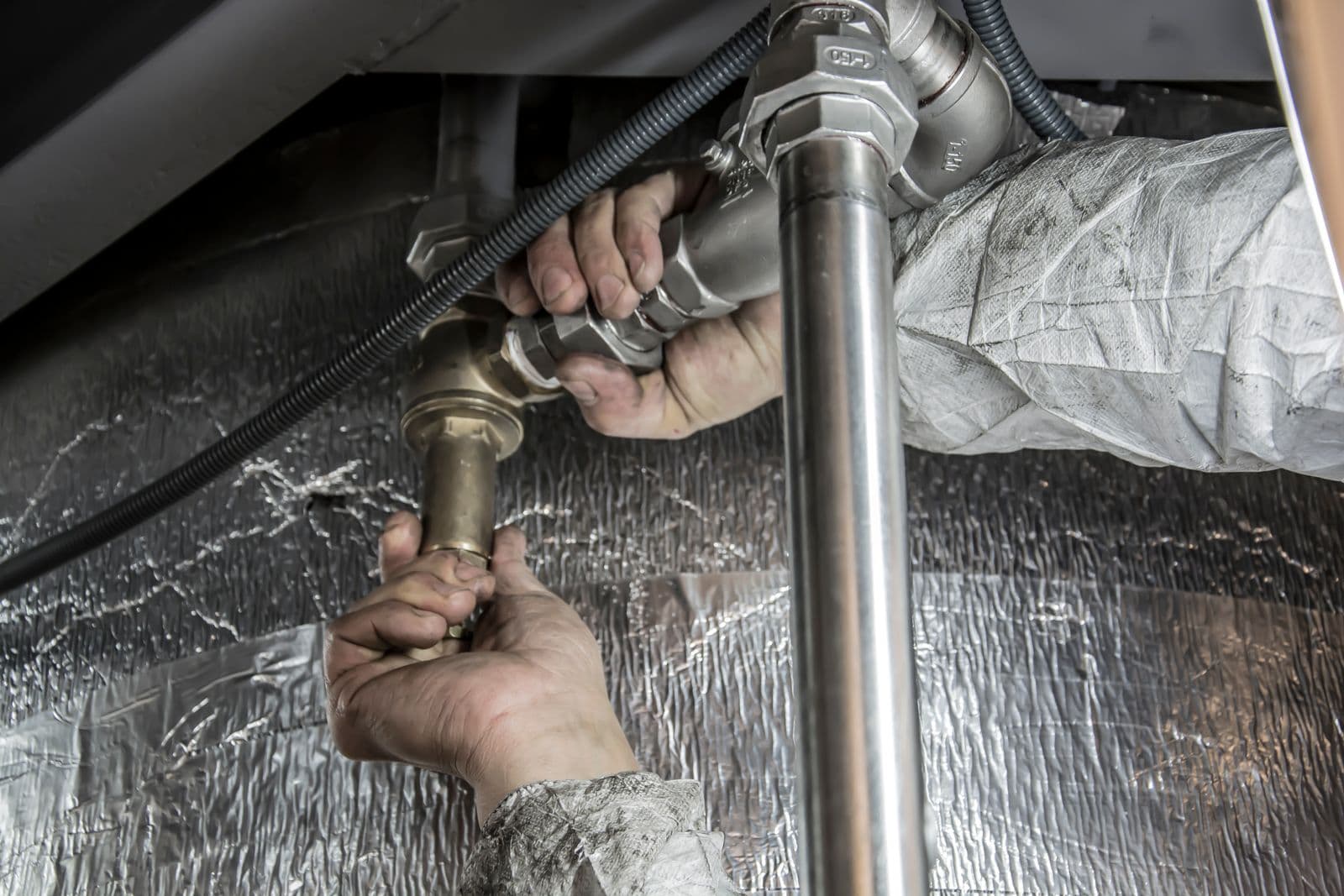
Treatment equipment is plumbing. Most of the job is the connection, the drain and the code detail behind it.


Harrisonburg water, answered plainly
Where does Harrisonburg's water come from?+
Two rivers, roughly half each: the Dry River at Rawley Springs, whose watershed includes the Switzer Reservoir, and the North River at Bridgewater. Harrisonburg Public Utilities is also developing a supply line from the South Fork Shenandoah River.
Is Harrisonburg water hard?+
It varies. The 2025 report gives a range of 12 to 153 mg/L with an average of 67 mg/L. On the USGS scale printed in the report, 0–60 is soft, 61–120 moderately hard and 121–180 hard, so the average is moderately hard (about 3.9 grains per gallon) and the range spans soft to hard. The report does not explain the variation.
Do I need a water softener in Harrisonburg?+
Not by default. At the 67 mg/L average, many households won't. Because the reported range is wide, we test at your tap before recommending one, and size it to what we measure.
Does Harrisonburg use chlorine or chloramine?+
Free chlorine. The 2025 average residual was 0.87 ppm (range 0.10–1.55).
Is there PFAS in Harrisonburg water?+
Harrisonburg Public Utilities took part in EPA's fifth Unregulated Contaminant Monitoring Rule (UCMR 5). Per the 2025 report, all contaminants, including all measured PFAS, were below detectable limits.
Where do these figures come from?+
Harrisonburg Public Utilities' 2025 Water Quality Report (Consumer Confidence Report, calendar-year 2025 data). Third-party aggregators are not used. A later report supersedes these figures.
Related resources
Home water purification and treatment
The national service page behind this one.
Learn more →Lynchburg water quality
A gravity-fed mountain reservoir, also on free chlorine.
Learn more →Roanoke water quality
Several sources under one authority, and GenX at one of them.
Learn more →Home battery backup in Harrisonburg, VA
HEC, the city's own electric utility, and its net metering rules.
Learn more →All home services
Water, battery, HVAC and solar under one licensed contractor of record.
Learn more →Get a free test at your tap
A licensed technician tests at your kitchen tap and tells you which findings apply to your house — hardness, chlorine taste, older plumbing or none of them. No charge, no obligation, and coverage confirmed at your address first.
Get a free test