Roanoke, Virginia
Roanoke Water Quality
One water authority, several sources, and your address decides which one you drink. Spring Hollow is where GenX was found and where carbon now holds it well under the federal limit.
Spring Hollow treated water, GenX: 1.36 ppt average in 2025 against a federal limit of 10.
The short answer
The Western Virginia Water Authority serves Roanoke from Carvins Cove, Spring Hollow (filled from the Roanoke River) and Crystal Spring, plus smaller reservoirs and wells. Which one reaches your tap depends on your address.
GenX was found at Spring Hollow and traced to upstream industrial wastewater. With carbon changed every three months, treated water averaged 1.36 ppt in 2025 against a federal limit of 10. Hardness varies by source, so the useful first step is finding yours, then testing at the tap.
Get a free test
Tell us your Roanoke address. We confirm coverage first, then schedule a licensed technician to test at your tap — no charge, no obligation.
What filtration does — and does not
Softening, carbon and reverse osmosis solve different problems. In Roanoke the source behind your address decides which of them is relevant.
Where Roanoke water comes from
A reservoir in a natural reserve, a reservoir filled from the river, and a city spring — treated three different ways.
Carvins Cove Reservoir
A 630-acre reservoir in an 11,200-acre natural reserve in Botetourt County, also fed by two tunnels carrying overflow from Tinker and Catawba Creeks. Its plant can treat 28 million gallons a day, filtering through gravel, sand and carbon before chlorine disinfection, fluoride and orthophosphate for corrosion control.
Spring Hollow Reservoir
A 3.2-billion-gallon side-stream reservoir filled by pumping from the Roanoke River. Its plant has 18 million gallons a day of capacity and is the one with granular activated carbon treatment for GenX.
Crystal Spring
The Authority's oldest source, a spring at the base of Mill Mountain in the south of the city, averaging about 4.25 million gallons a day. It is treated by ultrafiltration that removes particles larger than 0.01 micron, then chlorine and fluoride.
Smaller reservoirs and 72+ wells
Beaverdam Creek and Falling Creek reservoirs east of Vinton, a share of the Smith Mountain Lake plant, and more than 72 wells — some inactive, some serving outlying communities. Your primary source is listed on the Authority's public GIS map.
What the Water Authority's own data says
From the Western Virginia Water Authority's PFAS and source pages, with treated-water results posted through July 8, 2026 — system-level figures, not a reading at your tap.
GenX was found at Spring Hollow
HFPO-DA, known as GenX, was detected in Spring Hollow water in 2020 at 62 ppt. The Authority's page says a sample of ProChem, Inc.'s industrial wastewater, collected by Virginia DEQ in October 2022, measured 1,310,000 ppt; that business was discharging to the Elliston wastewater plant upstream of the intake.
Treated water: 1.36 ppt average in 2025
With granular activated carbon at Spring Hollow, weekly tests of treated water averaged 1.36 ppt for 2025, with no result above 5.9 ppt. The EPA set 10 ppt as the federal limit for HFPO-DA in April 2024.
The carbon is changed every three months
The Authority receives, tests and puts new carbon into service about every three months, and says settlements with Chemours and others fund the media exchanges rather than ratepayers.
2026 so far: non-detect to 2.4 ppt
Treated-water results posted for 2026 through July 8 range from non-detect to 2.4 ppt. Untreated reservoir water ran 3.9 to 8.6 ppt across 2025 and has been under 5 ppt in 2026.
Hardness depends on the source
The Authority states that hardness varies by source because it comes from the rock and soil the water passes through. A reservoir and a spring need not match, so your address decides the figure.
What this page does not quote
The 2026 Water Quality Report (2025 data) carries the byproduct, lead and source-by-source tables. We could not retrieve its tables for this page, so none of those figures appear here rather than borrowing them from a third party.
Why Roanoke is not Lynchburg over the ridge
Lynchburg drinks mainly from one gravity-fed mountain reservoir, so one report describes nearly every tap. Roanoke's authority blends several sources, and one of them carries a GenX history the others do not. Richmond treats the James River every day. A quote built on another city's report — or on the wrong Roanoke source — is a quote for the wrong house.
If the house also needs backup power, the Roanoke battery backup page covers Appalachian Power's rules and the Hurricane Helene restoration record.
Where these figures come from
Everything on this page traces to the Western Virginia Water Authority. Independent compilations of water quality data exist and are not used here.
- Western Virginia Water Authority — Learn About PFAS — GenX history, source investigation, carbon treatment and weekly treated and untreated results through July 8, 2026.
- Western Virginia Water Authority — Water Sources and Treatment — Carvins Cove, Spring Hollow, Crystal Spring, smaller reservoirs and wells, and how each is treated.
- Western Virginia Water Authority — Water Hardness — hardness by source and the GIS lookup.
- Western Virginia Water Authority — Water Quality Reports — the 2026 Water Quality Report (2025 data), with the full regulated-substance tables.
Matching treatment to the finding
In Roanoke the source decides the conversation — find it, test it, then choose equipment.
Spring Hollow households: the plant already uses carbon
Treated water is well under the federal GenX limit. A household that wants an extra margin adds a kitchen-tap reverse osmosis or carbon system certified for PFAS reduction, and confirms it with a lab test.
Hardness: find your source first
Check the Authority's GIS map for your primary source, then test at the tap. A softener sized for a spring-fed address is not the right unit for a reservoir-fed one.
Taste: ordinary carbon handles chlorine
The Authority describes chlorine disinfection at its plants. Standard activated carbon reduces chlorine taste and odour.
Older homes: check the service line
A house with an older or unknown service line is answered by the service line inventory every water system had to prepare by October 2024 and a tap test, not by a system-wide figure.
How the free test works
A licensed technician tests at your kitchen tap, walks the plumbing, and tells you which of the findings above applies to your house and which does not. There is no charge and no obligation.
Seamless Home is the licensed contractor of record on the work that follows. Installation is performed by vetted installing partners engaged as our subcontractors, and the workmanship obligation stays with us. Coverage is confirmed per service area rather than promised as blanket availability.
An RO unit needs a legal drain connection — where a water softener is allowed to discharge sets out the indirect-waste rule that applies to treatment drain lines.
What a water treatment job with us covers
Installation and replacement of whole-home and point-of-use treatment, specified against what your water actually contains.
Sediment filtration
Installation of the first stage that protects everything downstream of it, sized to the service line and the household draw.
Softening
Installation of ion-exchange softening where hardness is the problem, including the drain connection the plumbing code treats as indirect waste.
Carbon filtration
Installation of carbon stages for taste, odour and disinfection by-products, specified from your utility's own water quality report.
Reverse osmosis
Point-of-use installation at the kitchen sink where the target is dissolved solids rather than whole-home flow.
Disinfection
Installation of UV or equivalent treatment where the supply is a private well or is otherwise not continuously disinfected.
System replacement
Replacing equipment that has reached the end of its service life, including the discharge and air gap details an inspector looks at.
This is installation and replacement work, specified from a published water quality report or a test of your supply — not from a sales chart. Coverage is confirmed per service area rather than promised as blanket availability.
What the work actually looks like
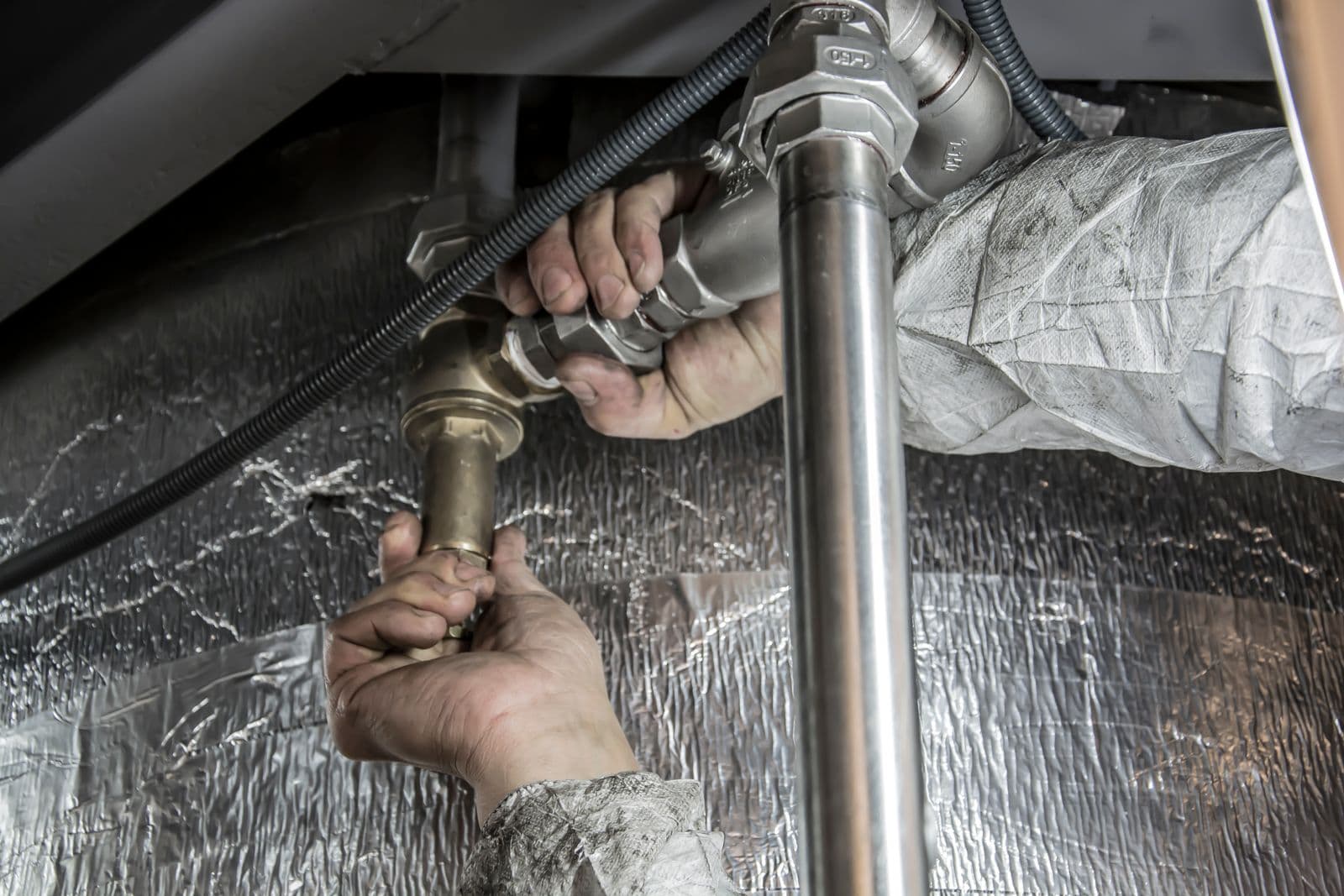
Treatment equipment is plumbing. Most of the job is the connection, the drain and the code detail behind it.


Roanoke water, answered plainly
Where does Roanoke's water come from?+
The Western Virginia Water Authority uses five surface water sources plus springs and wells. The main ones for the Roanoke area are Carvins Cove Reservoir, Spring Hollow Reservoir (filled from the Roanoke River) and Crystal Spring at the base of Mill Mountain. Your address's primary source appears on the Authority's public GIS map.
Is there GenX or PFAS in Roanoke water?+
GenX (HFPO-DA) has been found in Spring Hollow Reservoir water, traced by the Authority to industrial wastewater from ProChem, Inc. discharged upstream. Spring Hollow uses granular activated carbon, and weekly treated-water tests averaged 1.36 ppt in 2025 against the federal limit of 10 ppt. The Authority reported Carvins Cove results below detection in the 2021 state study.
Is Roanoke water hard?+
It depends on your source. The Authority says hardness varies by source and points customers to its GIS map to find their primary source. We do not quote a single Roanoke figure because there is not one; a tap test gives the reading a softener decision needs.
Why does my water taste different sometimes?+
The source mix can change. When GenX was first found, the Authority said it was maximising water from the Carvins Cove system and reducing Spring Hollow's share, and noted customers might notice a difference as the mix changed. Its hardness page also says your source may vary with distribution and plant production.
Who installs treatment, and who is responsible afterwards?+
Seamless Home is the licensed contractor of record on the work it runs. Installation is performed by vetted installing partners engaged as our subcontractors, and the workmanship obligation stays with us. Coverage is confirmed per service area rather than promised as blanket availability.
Where do these figures come from?+
The Western Virginia Water Authority's Water Sources and Treatment, Learn About PFAS (data posted through July 8, 2026) and Water Hardness pages. Third-party water-quality aggregators are not the source used here. Newer Authority data supersedes these figures.
Related resources
Home water purification and treatment
The national service page behind this one.
Learn more →Lynchburg water quality
A single gravity-fed mountain reservoir — the contrast.
Learn more →Richmond water quality
The James River as an everyday source.
Learn more →Home battery backup in Roanoke, VA
Appalachian Power rules and the Helene restoration record.
Learn more →Where a water softener can discharge
Indirect-waste rules for treatment drain lines.
Learn more →All home services
Water, battery, HVAC and solar under one licensed contractor of record.
Learn more →Get a free test at your tap
A licensed technician tests at your kitchen tap and tells you which of the findings above applies to your house — PFAS margin, hardness, chlorine taste or none of them. No charge, no obligation, and coverage confirmed at your address first.
Get a free test