Blacksburg, Virginia
Blacksburg Water Quality
New River water, treated at a regional plant renovated from 2020 to 2024 and disinfected with chloramines. The 2025 report lists no contaminant-level violations, one monitoring slip, and PFAS below the reporting level.
Chloramine 2.86 ppm · TTHM 25 ppb · HAA5 23 ppb · sodium 12 ppm · lead not detected.
The short answer
Blacksburg drinks the New River, treated by the New River Valley Regional Water Authority and disinfected with chloramines. The 2025 report lists trihalomethanes at 25 ppb and haloacetic acids at 23 ppb, both under their limits, with lead not detected and sodium at 12 ppm.
The practical issue is chloramine taste and odor, which standard carbon handles poorly. The report also notes a January 2026 monitoring violation for byproduct sampling, which state officials said needs no action. Catalytic carbon is the usual fix, after a test.
Get a free test
Tell us your Blacksburg address. We confirm coverage first, then schedule a licensed technician to test at your tap — no charge, no obligation.
What filtration does — and does not
Carbon, catalytic carbon and reverse osmosis solve different problems. Blacksburg's report points at chloramine first.
Where Blacksburg water comes from
River water, treated regionally, delivered by the Town.
The New River
Blacksburg's water is taken from the New River and pumped to the New River Valley Regional Water Authority plant on Route 114 (Peppers Ferry Road).
One regional plant, renovated 2020–2024
The 12.4 million-gallon-a-day plant also serves Christiansburg, Virginia Tech and Montgomery County, about 102,000 people. Its pumping and treatment facilities were renovated from 2020 to 2024.
Town pipes after that
The Town of Blacksburg (PWS 1121052) buys the finished water. Blacksburg used an average of 2.76 million gallons a day in 2025, and Virginia Tech 1.15.
What the 2025 Blacksburg report actually says
Limits are fixed. Results are from the Town of Blacksburg's Water Quality Report for reporting year 2025. They are system-level figures, not a reading at your tap.
Chloramines, not free chlorine
After chlorination, the plant adds a small amount of ammonia to form chloramines, which last longer in pipes. The reported disinfectant level was 2.86 ppm (0.4–3.9) against a 4 ppm limit.
Trihalomethanes — 25 ppb
TTHMs were 25 ppb (19–32) against an 80 ppb limit, and haloacetic acids 23 ppb (3.9–26) against 60. No violation for the levels themselves.
A January 2026 monitoring violation
Samples for TTHMs and HAAs were collected in February instead of during the January 2026 monitoring period. State officials said there is little need for concern, and the follow-up results were satisfactory.
Lead not detected
2023 tap samples put lead at not detected at the 90th percentile, with 0 of 15 sites over the action level. Copper was 0.0382 ppm.
Sodium — 12 ppm
Sodium was 12.0 ppm in January 2025. EPA recommends no more than 20 ppm in drinking water for people on a very low sodium diet.
PFAS below reporting level
The Town's 2024 sampling under EPA's fifth Unregulated Contaminant Monitoring Rule came back below the minimum reporting level.
Blacksburg next to Roanoke, Lynchburg and Charlottesville
Over the mountain, Roanoke draws from several sources depending on the address. Lynchburg gravity-feeds water from a mountain reservoir and disinfects with free chlorine, as does Charlottesville. Blacksburg's chloramine sets it apart from Lynchburg and Charlottesville, and it changes which filter actually works.
Where these figures come from
Everything on this page traces to the Town of Blacksburg.
- Town of Blacksburg — Water Quality Report, Reporting Year 2025 (PDF) — source, treatment process, regulated results, UCMR5, sodium and the monitoring violation.
- Town of Blacksburg — Drinking Water — daily testing at the regional authority and the Town's distribution testing.
Matching treatment to the finding
Blacksburg's report supports chloramine-rated carbon. It does not support a default equipment sale.
Catalytic carbon for chloramine
Chloramine is the taste and odor most Blacksburg homes notice. Catalytic carbon, sized for chloramine, removes it better than standard carbon.
Carbon also reduces byproducts
The same carbon stage lowers trihalomethanes and haloacetic acids, which are well under their limits but present.
Aquariums and dialysis need more
The report says chloramines must be removed from water used in kidney dialysis machines, aquariums and ponds. That needs a dedicated treatment step.
Test before buying anything
These are system-level results. A test at your tap shows what reaches your house and whether your plumbing adds anything.
How the free test works
A licensed technician tests at your kitchen tap, walks the plumbing, and tells you which of the findings above applies to your house and which does not. There is no charge and no obligation.
Seamless Home is the licensed contractor of record on the work that follows. Installation is performed by vetted installing partners engaged as our subcontractors, and the workmanship obligation stays with us. Coverage is confirmed per service area rather than promised as blanket availability.
What a water treatment job with us covers
Installation and replacement of whole-home and point-of-use treatment, specified against what your water actually contains.
Sediment filtration
Installation of the first stage that protects everything downstream of it, sized to the service line and the household draw.
Softening
Installation of ion-exchange softening where hardness is the problem, including the drain connection the plumbing code treats as indirect waste.
Carbon filtration
Installation of carbon stages for taste, odour and disinfection by-products, specified from your utility's own water quality report.
Reverse osmosis
Point-of-use installation at the kitchen sink where the target is dissolved solids rather than whole-home flow.
Disinfection
Installation of UV or equivalent treatment where the supply is a private well or is otherwise not continuously disinfected.
System replacement
Replacing equipment that has reached the end of its service life, including the discharge and air gap details an inspector looks at.
This is installation and replacement work, specified from a published water quality report or a test of your supply — not from a sales chart. Coverage is confirmed per service area rather than promised as blanket availability.
What the work actually looks like
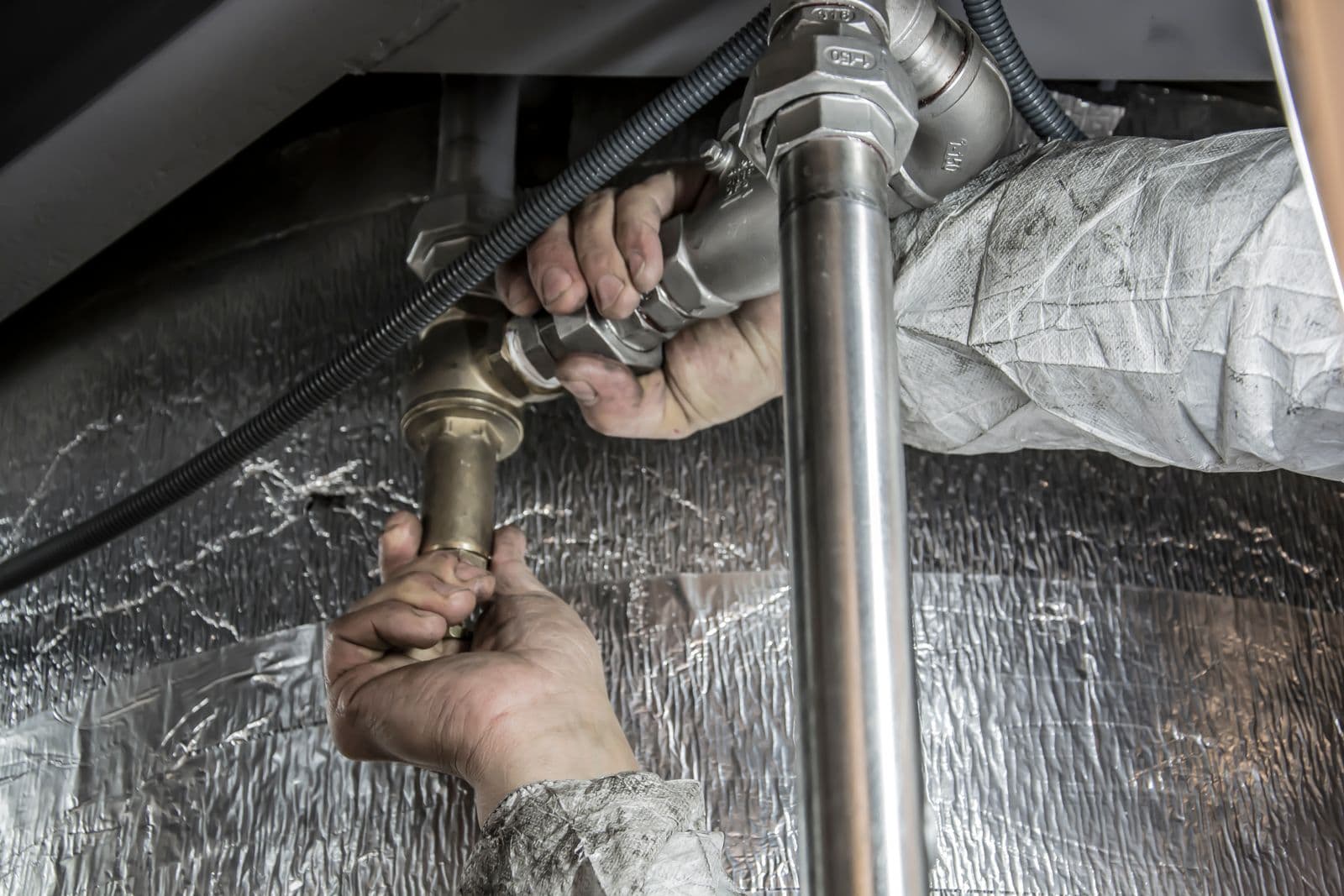
Treatment equipment is plumbing. Most of the job is the connection, the drain and the code detail behind it.

Blacksburg water, answered plainly
Where does Blacksburg's water come from?+
From the New River. The New River Valley Regional Water Authority treats it at its plant on Route 114 (Peppers Ferry Road) and supplies Blacksburg, Christiansburg, Virginia Tech and Montgomery County.
Does Blacksburg use chlorine or chloramine?+
Chloramine. The plant chlorinates, then adds a small amount of ammonia so the chlorine forms chloramines, a longer-lasting disinfectant for the far ends of the regional system.
Is Blacksburg water safe to drink?+
The 2025 report lists no contaminant-level violations. It does list a monitoring violation: TTHM and HAA samples for January 2026 were collected in February. State officials said there is little need for concern.
Is there PFAS in Blacksburg water?+
The Town's 2024 sampling under EPA's fifth Unregulated Contaminant Monitoring Rule, which covers PFAS, came back below the minimum reporting level.
Is Blacksburg water hard?+
The 2025 report doesn't list a hardness figure. A tap test measures it directly.
Where do these figures come from?+
The Town of Blacksburg's Water Quality Report for reporting year 2025 (PWS 1121052). Third-party aggregators are not used.
Related resources
Home water purification and treatment
The national service page behind this one.
Learn more →Roanoke water quality
Several sources, depending on your address.
Learn more →Lynchburg water quality
A gravity-fed mountain reservoir and free chlorine.
Learn more →Charlottesville water quality
Soft Rivanna surface water with free chlorine.
Learn more →All home services
Water, battery, HVAC and solar under one licensed contractor of record.
Learn more →Get a free test at your tap
A licensed technician tests at your kitchen tap and tells you which findings apply to your house — chloramine, byproducts or your own plumbing. No charge, no obligation, and coverage confirmed at your address first.
Get a free test