Charleston, West Virginia
Charleston Water Quality
Charleston drinks treated Elk River water. The 2025 Kanawha Valley report shows lead not detected at the 90th percentile and disinfection byproducts that vary from one sampling site to the next.
Elk River · lead 90th ND (0 of 50 over AL) · TTHM LRAA up to 58.0 ppb · hardness 1–5 gpg.
The short answer
Charleston's tap water comes from West Virginia American Water's Kanawha Valley District (PWS ID WV3302016), which treats the Elk River.
The 2025 report says the system met state and federal requirements. Lead was not detected at the 90th percentile across 50 homes. The number to watch is trihalomethanes: the highest running average was 58.0 ppb against an 80 ppb limit, with some single samples above 100 ppb.
Get a free test
Tell us your Charleston address. We confirm coverage first, then schedule a licensed technician to test at your tap — no charge, no obligation.
What the 2025 Kanawha Valley report shows
Figures below are results from West Virginia American Water's 2025 Annual Water Quality Report for the Kanawha Valley District. A later report supersedes them.
Source water rated highly susceptible
The West Virginia Bureau for Public Health's 2002 source water assessment ranked the Elk River supply's susceptibility as high, because it is surface water exposed to agricultural and urban activity. The utility reviews its Source Water Protection Plan every three years under state law.
Trihalomethanes up to 58.0 ppb
The highest locational running annual average for total trihalomethanes was 58.0 ppb at the Sissonville site, against an 80 ppb MCL. Individual samples ranged as high as 101.2 ppb there and 100.5 ppb at Pocatalico River Road. Haloacetic acids peaked at a 32.4 ppb average (limit 60).
Lead not detected at the 90th percentile
2025 tap sampling at 50 homes found a lead 90th percentile of not detected, with a range of ND to 1.0 ppb and 0 sites over the 15 ppb action level. Copper's 90th percentile was 0.148 ppm, also with 0 sites over.
Moderately hard at most
Hardness leaving the plant ranged from 19 to 79 mg/L as calcium carbonate — about 1 to 5 grains per gallon. Sodium was 10.6 ppm and chloride 13.1 ppm.
No PFOA or PFOS detected
Testing in 2023 found PFOA, PFOS, GenX and PFHxS not detected at the treatment plant. The report notes EPA's national PFAS limits apply from April 2029.
Turbidity met the standard
The highest turbidity reading was 0.73 NTU in February 2025, and the lowest monthly share of samples at or under 0.3 NTU was 97%, above the 95% treatment-technique requirement.
How the water is produced
One river, one large treatment plant, eight counties of pipe.
Elk River — a surface water source
West Virginia American Water's Kanawha Valley system draws from the Elk River. The treatment plant supplied roughly 9 billion gallons in 2025 to customers in Kanawha, Putnam, Cabell, Lincoln, Boone, Logan, Fayette and Clay counties.
Conventional treatment
The report lists coagulation, flocculation and sedimentation, followed by filtration and chlorine disinfection. A corrosion inhibitor and fluoride are added (fluoride 0.63 ppm in 2025).
Kanawha Valley District — PWS ID WV3302016
Former Armstrong PSD and Montgomery Heights customers joined the Kanawha Valley District after September 4, 2025; their earlier results are in separate reports.
Charleston next to other river cities
Louisville and Pittsburgh treat and chlorinate river water too, so their reports track the same disinfection byproducts. To the southeast, Roanoke blends several sources under one authority. Each has its own report and its own numbers.
Where these figures come from
Everything on this page traces to West Virginia American Water's 2025 Annual Water Quality Report (Consumer Confidence Report) for the Kanawha Valley District, PWS ID WV3302016.
Matching treatment to the finding
Disinfection byproducts and chlorine taste drive most Charleston decisions; hardness and lead lines are secondary.
Disinfection byproducts
If a test at your tap shows elevated trihalomethanes, carbon filtration certified for trihalomethane reduction at the kitchen tap is the usual answer to the byproduct readings.
Taste and odor from chlorine
Chlorine residual averaged 2.2 ppm across the system. A whole-house carbon filter removes chlorine taste and smell at every tap.
Softening is optional
At 1–5 grains per gallon, most homes do not need a softener. Test first; spend on byproduct reduction if that is what your tap shows.
Older plumbing
System lead results were low, but homes built before 1930 are more likely to have lead plumbing. West Virginia American Water publishes a service-line inventory map.
How the free test works
A licensed technician tests at your kitchen tap, walks the plumbing, and tells you which of the findings above applies to your house and which does not. There is no charge and no obligation.
Seamless Home is the licensed contractor of record on the work that follows. Installation is performed by vetted installing partners engaged as our subcontractors, and the workmanship obligation stays with us. Coverage is confirmed per service area rather than promised as blanket availability.
What a water treatment job with us covers
Installation and replacement of whole-home and point-of-use treatment, specified against what your water actually contains.
Sediment filtration
Installation of the first stage that protects everything downstream of it, sized to the service line and the household draw.
Softening
Installation of ion-exchange softening where hardness is the problem, including the drain connection the plumbing code treats as indirect waste.
Carbon filtration
Installation of carbon stages for taste, odour and disinfection by-products, specified from your utility's own water quality report.
Reverse osmosis
Point-of-use installation at the kitchen sink where the target is dissolved solids rather than whole-home flow.
Disinfection
Installation of UV or equivalent treatment where the supply is a private well or is otherwise not continuously disinfected.
System replacement
Replacing equipment that has reached the end of its service life, including the discharge and air gap details an inspector looks at.
This is installation and replacement work, specified from a published water quality report or a test of your supply — not from a sales chart. Coverage is confirmed per service area rather than promised as blanket availability.
What the work actually looks like
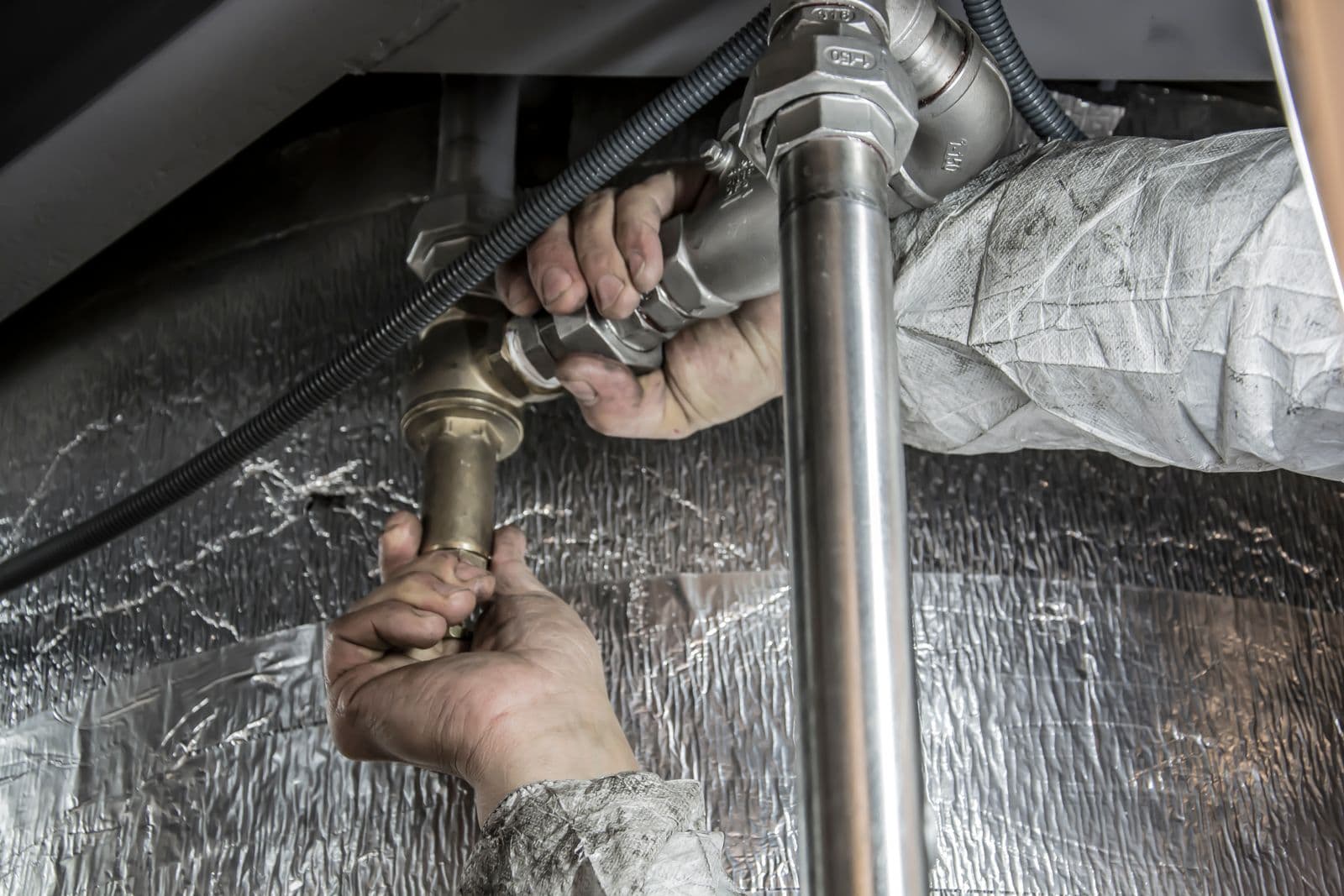
Treatment equipment is plumbing. Most of the job is the connection, the drain and the code detail behind it.

Charleston water, answered plainly
Where does Charleston, WV get its water?+
From the Elk River, treated by West Virginia American Water's Kanawha Valley plant. The plant supplied roughly 9 billion gallons in 2025 across eight counties.
Is Charleston water safe to drink?+
West Virginia American Water reports that in 2025 the Kanawha Valley District met state and federal drinking water requirements. The figures on this page show what was detected and how it compares with each limit.
Is there lead in Charleston water?+
The 2025 lead 90th percentile was not detected, with results from ND to 1.0 ppb at 50 homes and no site over the action level. Lead comes from service lines and household plumbing, so a home test is the only way to know about one tap.
What are trihalomethanes and why are they in my water?+
Trihalomethanes form when chlorine reacts with natural organic matter in river water. The highest running annual average in 2025 was 58.0 ppb, under the 80 ppb limit, though some individual samples were higher.
Is Charleston water hard?+
Not very. The report lists hardness of 19 to 79 mg/L, or about 1 to 5 grains per gallon.
Where do these figures come from?+
From West Virginia American Water's 2025 Annual Water Quality Report for the Kanawha Valley District (PWS ID WV3302016). Third-party aggregators are not used.
Related resources
Home water purification and treatment
The national service page behind this one.
Learn more →Louisville water quality
Ohio River water and its own byproduct readings.
Learn more →Pittsburgh water quality
Another river city's latest report.
Learn more →Roanoke water quality
Blended sources in southwest Virginia.
Learn more →All home services
Water, battery, HVAC and solar under one licensed contractor of record.
Learn more →Get a free test at your tap
A licensed technician tests at your kitchen tap and tells you which Kanawha Valley findings apply to your house — disinfection byproducts, chlorine taste or older plumbing. No charge, no obligation, and coverage confirmed at your address first.
Get a free test