Pittsburgh, Pennsylvania
Pittsburgh, PA Water Quality
One river, free chlorine, and a lead program years in the making. Here is what Pittsburgh Water's 2025 report shows.
Allegheny River only · lead 90th pct 2.0 ppb · TTHM 51 ppb (up to 112) · no PFAS detected.
The short answer
Pittsburgh Water draws only from the Allegheny River and disinfects with free chlorine, not chloramine. Treated water is low in nitrate and fluoride, and no PFAS were detected in its testing.
The story here is lead. Orthophosphate and thousands of line replacements brought the 2025 90th-percentile result down to 2.0 ppb, a 20-year low. Trihalomethanes are the other number to watch: 51 ppb reported, with single samples up to 112 ppb.
Get a free test
Tell us your Pittsburgh address. We confirm coverage first, then schedule a licensed technician to test at your tap — no charge, no obligation.
What filtration does — and does not
Carbon, lead-certified filters and reverse osmosis solve different problems. In Pittsburgh, your service line matters most.
Where Pittsburgh water comes from
One river, a four-stage treatment process, and a corrosion-control additive.
The Allegheny River
Pittsburgh Water draws all of its water from the Allegheny River. The 2025 report says it uses no ground or well water.
65 to 75 million gallons a day
That is the average amount treated each day, according to the report, through clarification, filtration and disinfection.
Orthophosphate since 2019
Since April 2019 the utility has added orthophosphate, which forms a protective layer inside pipes to reduce lead release.
What the 2025 Pittsburgh report actually says
Limits are fixed. Results are system figures from Pittsburgh Water's 2025 report, not a reading at your tap.
Lead 2.0 ppb at the 90th percentile
2025 sampling ranged from 0 to 6.4 ppb, with no site over the 15 ppb action level. The report calls it the lowest lead level in 20 years.
Trihalomethanes up to 112 ppb
Total trihalomethanes were reported at 51 ppb against an 80 ppb limit, with a range of 12 to 112 ppb across samples. Haloacetic acids were 15 ppb (limit 60).
Free chlorine, not chloramine
Pittsburgh disinfects with chlorine. The distribution result was 1.03 ppm (range 0.50–1.03), under the 4 ppm maximum residual level.
No PFAS detected
Monitored since 2018. The 2025 report says there were no detections of PFAS or synthetic organic compounds.
Fluoride under Pennsylvania's lower limit
Fluoride was 0.78 ppm. Pennsylvania's limit is 2 ppm, half of EPA's 4 ppm. Nitrate was 0.62 ppm (limit 10).
One reporting violation
In December 2025 a lab uploaded byproduct results after the state deadline. The report says the samples were taken on time and were under the limit.
Pittsburgh next to Philadelphia
Philadelphia draws from the Delaware and Schuylkill rivers, uses chloramine, and reported PFOA and PFOS between Pennsylvania's limits and EPA's. Pittsburgh uses one river and free chlorine, and reported no PFAS detections.
Both utilities report lead at 2.0 ppb at the 90th percentile. Pittsburgh's report credits the orthophosphate it has added since April 2019, and after nine consecutive compliant rounds it now only has to run official lead testing every three years.
Where these figures come from
Everything on this page traces to Pittsburgh Water.
- Pittsburgh Water — 2025 Annual Drinking Water Quality Report (PDF) — source water, the 2025 tables, lead and copper, PFAS and the violation notice.
- Pittsburgh Water — Water quality and treatment — treatment steps and orthophosphate.
Matching treatment to the finding
Pittsburgh's report points at lead from service lines and plumbing, and at chlorine taste. Softening depends on a tap test.
Carbon for chlorine taste
Free chlorine is the easiest disinfectant for carbon to remove. A whole-house carbon filter handles taste and smell at every tap.
Find out what your service line is made of
Thousands of lead lines have been replaced, but some remain. Knowing your line material comes before choosing a lead filter.
Lead-certified filter at the sink
Where a lead line or old plumbing is still in place, a point-of-use filter certified for lead reduction covers drinking and cooking water.
Test hardness at your tap
The report lists calcium (18–38 ppm) but no hardness figure, so a tap test decides whether a softener makes sense.
How the free test works
A licensed technician tests at your kitchen tap, walks the plumbing, and tells you which of the findings above applies to your house and which does not. There is no charge and no obligation.
Seamless Home is the licensed contractor of record on the work that follows. Installation is performed by vetted installing partners engaged as our subcontractors, and the workmanship obligation stays with us. Coverage is confirmed per service area rather than promised as blanket availability.
What a water treatment job with us covers
Installation and replacement of whole-home and point-of-use treatment, specified against what your water actually contains.
Sediment filtration
Installation of the first stage that protects everything downstream of it, sized to the service line and the household draw.
Softening
Installation of ion-exchange softening where hardness is the problem, including the drain connection the plumbing code treats as indirect waste.
Carbon filtration
Installation of carbon stages for taste, odour and disinfection by-products, specified from your utility's own water quality report.
Reverse osmosis
Point-of-use installation at the kitchen sink where the target is dissolved solids rather than whole-home flow.
Disinfection
Installation of UV or equivalent treatment where the supply is a private well or is otherwise not continuously disinfected.
System replacement
Replacing equipment that has reached the end of its service life, including the discharge and air gap details an inspector looks at.
This is installation and replacement work, specified from a published water quality report or a test of your supply — not from a sales chart. Coverage is confirmed per service area rather than promised as blanket availability.
What the work actually looks like
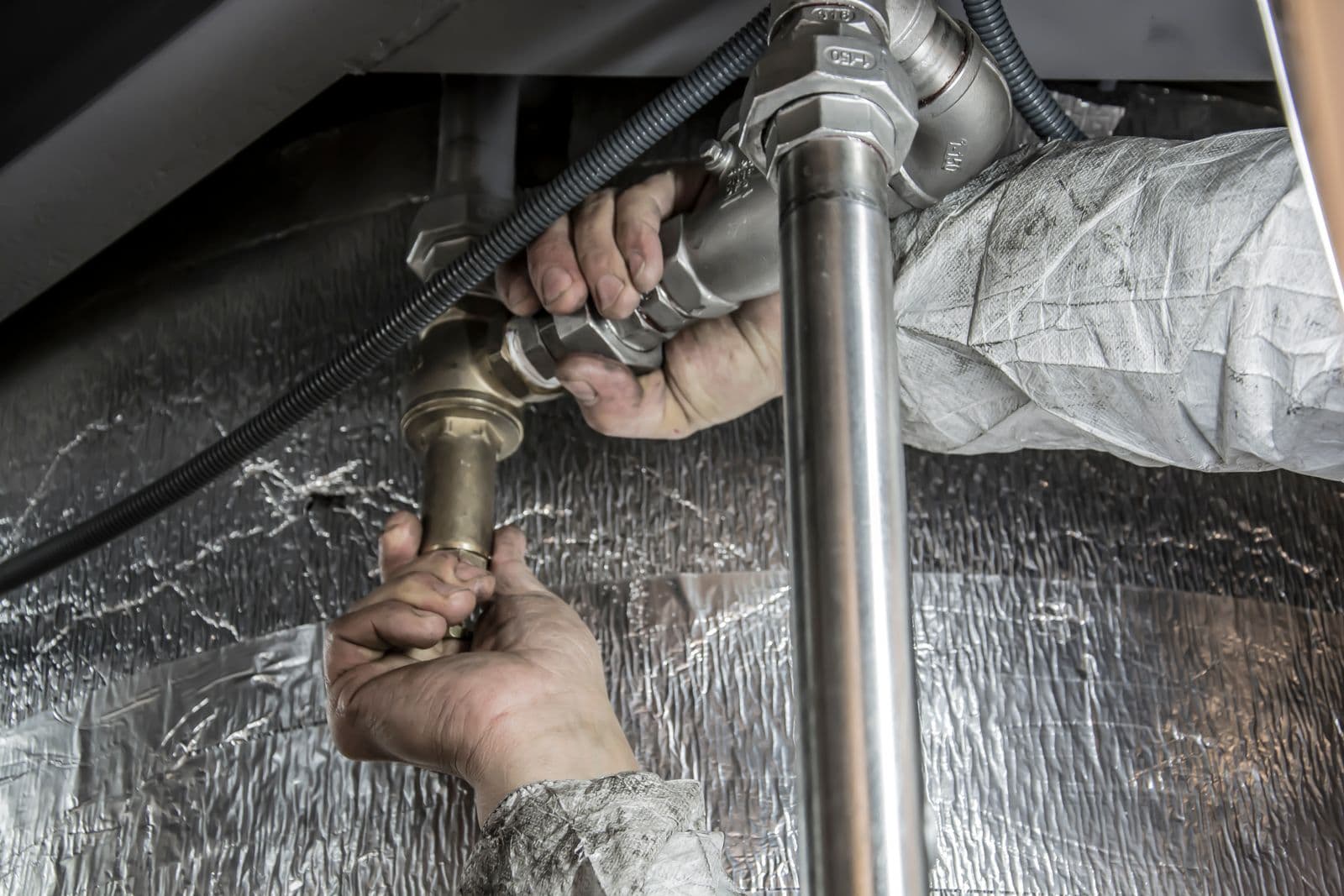
Treatment equipment is plumbing. Most of the job is the connection, the drain and the code detail behind it.


Pittsburgh water, answered plainly
Where does Pittsburgh get its water?+
From the Allegheny River only. Pittsburgh Water says it does not use ground or well water and treats 65 to 75 million gallons a day on average.
Is there lead in Pittsburgh water?+
The report says lead in drinking water comes mainly from service lines and home plumbing. In 2025, the 90th-percentile result was 2.0 ppb with no home over the 15 ppb action level. The utility credits orthophosphate, added since April 2019.
Is Pittsburgh still replacing lead service lines?+
Yes. In 2025 crews replaced over 1,800 public and close to 1,800 private lead service lines, and the utility's goal is to remove lead service lines from its system by 2027.
Does Pittsburgh water have PFAS?+
Pittsburgh Water has monitored PFAS since 2018. Its 2025 report says levels have never exceeded Pennsylvania's limits of 14 ppt for PFOA and 18 ppt for PFOS, and that there were no detections of PFAS in its testing.
Did Pittsburgh Water have a violation in 2025?+
One for late reporting. Byproduct results were uploaded to PADEP after the December 10, 2025 deadline. The samples were collected on time and did not exceed the limit.
How do I get my water tested for lead?+
Pittsburgh Water's report lists (412) 255-2423 for lead testing. Our free in-home test is separate and also covers chlorine, hardness and your plumbing.
Where do these figures come from?+
From Pittsburgh Water's 2025 Annual Drinking Water Quality Report and its water quality and treatment page. Third-party aggregators are not used.
Related resources
Home water purification and treatment
The national service page behind this one.
Learn more →Philadelphia water quality
Delaware and Schuylkill water, and PFAS between two standards.
Learn more →Detroit water quality
Great Lakes water and a large lead line replacement program.
Learn more →All home services
Water, battery, HVAC and solar under one licensed contractor of record.
Learn more →Get a free test at your tap
A licensed technician tests at your kitchen tap and tells you which findings apply to your house — lead, chlorine, hardness or your own plumbing. No charge, no obligation, and coverage confirmed at your address first.
Get a free test