Philadelphia, Pennsylvania
Philadelphia, PA Water Quality
Delaware and Schuylkill river water from three plants. The 2025 report meets Pennsylvania's PFAS limits but sits above EPA's 4 ppt limits due in 2029.
PFOA up to 6.1 ppt and PFOS up to 4.6 ppt (EPA 4 ppt from 2029) · hardness 6–10 gpg by plant · lead 2.0 ppb at the 90th percentile.
The short answer
Philadelphia's water comes from the Delaware and Schuylkill rivers, treated at three plants. Which plant serves your street sets your hardness: about 6 grains per gallon from Baxter, 9 to 10 from Belmont and Queen Lane.
The number to know is PFAS. In 2025, PFOA reached 6.1 ppt and PFOS 4.6 ppt. That met Pennsylvania's limits, but EPA's limits are 4 ppt, and PWD says they apply from 2029. PWD is adding powdered activated carbon at its plants. At home, reverse osmosis at the kitchen tap is the standard way to take PFAS lower now.
Get a free test
Tell us your Philadelphia address. We confirm coverage first, then schedule a licensed technician to test at your tap — no charge, no obligation.
What filtration does — and does not
Carbon, catalytic carbon and reverse osmosis solve different problems. Philadelphia's report points at PFAS and chloramine.
Where Philadelphia water comes from
Two rivers, three plants, one watershed.
Delaware River: Baxter
The Baxter plant in Northeast Philadelphia draws from the Delaware River. Its water is the softest of the three, averaging 101 ppm (6 grains per gallon).
Schuylkill: Queen Lane and Belmont
Queen Lane and Belmont draw from the Schuylkill. Their water averaged 169 ppm (10 gpg) and 151 ppm (9 gpg). Some neighborhoods receive a mix from more than one plant.
Chloramine and zinc orthophosphate
PWD disinfects with chloramine and has added zinc orthophosphate for over 30 years to coat pipe interiors and reduce lead dissolving from plumbing. Water travels through about 3,100 miles of mains.
What the 2025 Philadelphia report actually says
Limits are fixed. Results are from PWD's 2025 Drinking Water Quality Report. They are system-level figures, not a reading at your tap.
PFOA up to 6.1 ppt
2025 results ranged from 2.6 to 6.1 ppt. That meets Pennsylvania's 14 ppt limit, which governed 2025 compliance, but is above EPA's 4 ppt limit, which PWD says must be met beginning in 2029.
PFOS up to 4.6 ppt
Results ranged from 1.6 to 4.6 ppt against Pennsylvania's 18 ppt limit and EPA's 4 ppt limit. PFNA peaked at 2.6 ppt and PFHxS at 1.7; GenX was not found.
Lead: 1 of 106 homes
90% of sampled homes were at or below 2.0 ppb lead, and 1 of 106 had an elevated result. Results ranged from 0 to 21 ppb. Copper was 0.210 ppm at the 90th percentile.
Byproducts: highest average 51 ppb
The highest locational running annual average for total trihalomethanes was 51 ppb (limit 80), with single results from 18 to 90 ppb. Haloacetic acids peaked at an average of 41 ppb (limit 60).
Nitrate up to 5.3 ppm
Nitrate ranged from 0.509 to 5.3 ppm against a 10 ppm limit, with no violation.
Sodium varies by plant
Average sodium was 28 ppm at Baxter, 55 at Belmont and 49 at Queen Lane, where it reached 188 ppm. PWD publishes these figures for information; there is no sodium limit.
Philadelphia next to Woburn and Houston
Woburn, Massachusetts, is another system where PFAS is the headline. In Philadelphia the gap is between two standards: 2025 results met Pennsylvania's limits but are above EPA's. Compliance is measured on running annual averages at each plant, not on the single highest result.
Houston is the other large chloraminated river system on this site. Its 2025 report does not list PFAS for the Main System, and its hardness comes from a blend of rivers and deep wells rather than from which plant serves you.
PWD also reported that, on March 7, 2026, Filter #10 at Queen Lane was found running without turbidity monitoring for 50.3 hours because of a sensor error. PWD says no water quality emergency occurred and the notice is for information only.
Where these figures come from
Everything on this page traces to the Philadelphia Water Department.
- Philadelphia Water Department — 2025 Drinking Water Quality Report — sources and plants, PFAS results and limits, lead and copper, byproducts, hardness and sodium by plant, HELP loans and the Queen Lane monitoring notice.
Matching treatment to the finding
Philadelphia's report supports PFAS reduction at the tap and chloramine reduction. Softening depends on your plant.
Reverse osmosis for PFAS
An under-sink RO system certified for PFOA and PFOS reduction is the direct answer to results above EPA's future 4 ppt limit, while PWD adds powdered activated carbon capacity at its plants.
Catalytic carbon for chloramine
PWD says 1 in 5 taste-and-odor calls last year were about chlorine. Catalytic carbon handles chloramine taste and smell better than standard carbon.
Softening depends on your plant
A Baxter home at about 6 grains per gallon may not need a softener. A Queen Lane home averaging 10 gpg, and reaching 16, usually sees more scale.
Check your service line
PWD offers free lead tests and zero-interest HELP loans to replace lead or galvanized service lines over five years. Fix the line before buying a lead filter.
How the free test works
A licensed technician tests at your kitchen tap, walks the plumbing, and tells you which of the findings above applies to your house and which does not. There is no charge and no obligation.
Seamless Home is the licensed contractor of record on the work that follows. Installation is performed by vetted installing partners engaged as our subcontractors, and the workmanship obligation stays with us. Coverage is confirmed per service area rather than promised as blanket availability.
What a water treatment job with us covers
Installation and replacement of whole-home and point-of-use treatment, specified against what your water actually contains.
Sediment filtration
Installation of the first stage that protects everything downstream of it, sized to the service line and the household draw.
Softening
Installation of ion-exchange softening where hardness is the problem, including the drain connection the plumbing code treats as indirect waste.
Carbon filtration
Installation of carbon stages for taste, odour and disinfection by-products, specified from your utility's own water quality report.
Reverse osmosis
Point-of-use installation at the kitchen sink where the target is dissolved solids rather than whole-home flow.
Disinfection
Installation of UV or equivalent treatment where the supply is a private well or is otherwise not continuously disinfected.
System replacement
Replacing equipment that has reached the end of its service life, including the discharge and air gap details an inspector looks at.
This is installation and replacement work, specified from a published water quality report or a test of your supply — not from a sales chart. Coverage is confirmed per service area rather than promised as blanket availability.
What the work actually looks like
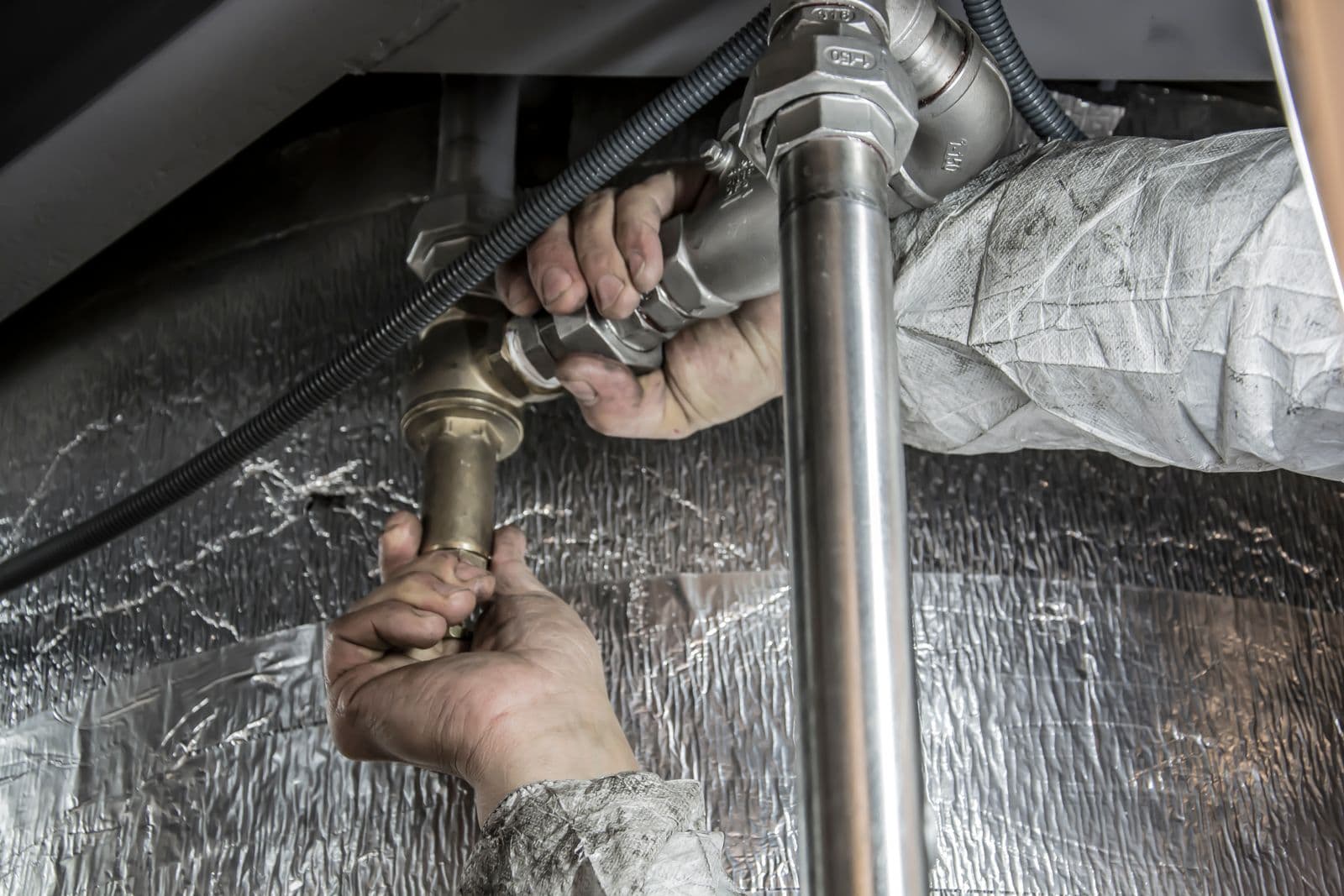
Treatment equipment is plumbing. Most of the job is the connection, the drain and the code detail behind it.


Philadelphia water, answered plainly
Where does Philadelphia's water come from?+
From the Delaware River Watershed. The Baxter plant draws from the Delaware River, and the Queen Lane and Belmont plants draw from the Schuylkill. Some areas receive a mix from more than one plant.
Is there PFAS in Philadelphia's water?+
Yes, at low levels. In 2025 PFOA ranged from 2.6 to 6.1 ppt and PFOS from 1.6 to 4.6 ppt, with no violation under Pennsylvania's limits of 14 and 18 ppt. EPA's limits are 4 ppt, and PWD says they must be met beginning in 2029. PWD is adding powdered activated carbon capacity to remove PFAS.
Is Philadelphia's water hard?+
PWD describes it as moderately hard or hard, depending on your service area. Baxter averaged 101 ppm (6 gpg), Belmont 151 ppm (9 gpg) and Queen Lane 169 ppm (10 gpg), with Queen Lane reaching 270 ppm (16 gpg).
Why does my Philadelphia tap water smell like chlorine?+
PWD disinfects with chloramine, and it says 1 in 5 taste-and-odor calls last year were about chlorine. Warm summer water can lower chloramine levels, and cold weather can make the smell more noticeable.
How does PWD handle lead?+
It adds zinc orthophosphate, which coats pipes, and has done so for over 30 years. In 2025 sampling, 90% of homes were at or below 2.0 ppb and 1 of 106 had an elevated result. PWD offers free lead tests and HELP zero-interest loans for lead or galvanized service line replacement.
Where do these figures come from?+
From the Philadelphia Water Department's 2025 Drinking Water Quality Report. Third-party aggregators are not used.
Related resources
Home water purification and treatment
The national service page behind this one.
Learn more →Woburn water quality
Another system where PFAS leads the report.
Learn more →Houston water quality
Another large chloraminated river system.
Learn more →All home services
Water, battery, HVAC and solar under one licensed contractor of record.
Learn more →Get a free test at your tap
A licensed technician tests at your kitchen tap and tells you which findings apply to your house — PFAS, chloramine, hardness or your own plumbing. No charge, no obligation, and coverage confirmed at your address first.
Get a free test