Houston, Texas
Houston, TX Water Quality
Two rivers and 104 deep wells feed Houston's Main System. The 2025 report shows chloramine disinfection, hard water and two violations.
90.3% surface water · chloramine avg 2.8 ppm · hardness avg 135.5 ppm · lead 90% below 5.1 ppb.
The short answer
Houston's Main System is 90.3% river water from the San Jacinto and Trinity rivers, topped up by 104 deep wells. It serves 2.97 million customers, and TCEQ rates it a Superior Water Supply System.
The things you notice at the tap are chloramine, averaging 2.8 ppm, and hardness, averaging 135.5 ppm. The 2025 report also lists two violations, one for turbidity in May and one for missed chlorite monitoring in September. Catalytic carbon and a softener are the usual home answers.
Get a free test
Tell us your Houston address. We confirm coverage first, then schedule a licensed technician to test at your tap — no charge, no obligation.
What filtration does — and does not
Carbon, catalytic carbon and reverse osmosis solve different problems. Houston's report points at chloramine and hardness first.
Where Houston water comes from
Two river basins, one aquifer system, one very large set of mains.
San Jacinto River
Lake Conroe and Lake Houston hold San Jacinto River water for the Main System. Surface water made up 90.3% of the supply in 2025.
Trinity River
Lake Livingston, on the Trinity River, is the second surface source. Both rivers are treated at City plants before entering the mains.
104 deep wells
The rest comes from 104 wells in the Evangeline and Chicot aquifers, drilled deeper than 750 feet. The Main System produced 500 million gallons a day for 2.97 million customers.
What the 2025 Houston report actually says
Limits are fixed. Results are Main System figures from the Houston Water Quality Report 2025, not a reading at your tap.
Chloramine 0.04–4.8 ppm
Houston disinfects with chloramines. Distribution readings averaged 2.8 ppm. The 4.0 ppm limit is a maximum residual disinfectant level, and the highest single reading was 4.8 ppm.
Hardness averaging 135.5 ppm
The Main System ranged from 43.5 to 229 ppm as calcium carbonate. How hard your tap runs depends on the blend of river and well water reaching your street.
Byproducts under the limits
The highest running annual average for total trihalomethanes was 43.6 ppb (limit 80) and for haloacetic acids 40.8 ppb (limit 60). Single samples reached 47.7 and 55.9 ppb.
Arsenic up to 6.7 ppb
Plant results ranged from not detected to 6.7 ppb, averaging 1.7, against a 10 ppb limit. The report says Houston's water meets the arsenic standard but contains low levels.
Lead and copper at the tap
90% of tap samples were below 5.1 ppb lead, with none over the 15 ppb action level. Copper was below 0.22 ppm at the 90th percentile.
Iron and dissolved solids
Iron reached 1.02 ppm against a 0.3 ppm aesthetic guideline, and total dissolved solids averaged 260 ppm (range 146–331). These are secondary, taste-and-staining standards.
Houston next to Austin
Austin draws from a single river system, the Lower Colorado through Lake Travis and Lake Austin, and its 2025 hardness averaged 93 ppm. Houston blends two rivers with deep groundwater, and its Main System averaged 135.5 ppm. Both cities disinfect with chloramines.
The two 2025 violations in Houston's report are a single-sample turbidity exceedance at a combined filter in May, and a major monitoring and reporting violation for chlorite in September. Both are listed in the Main System table.
Houston homeowners also weigh hurricane and storm outages. See home battery backup in Houston.
Where these figures come from
Everything on this page traces to Houston Public Works.
- Houston Public Works — Houston Water Quality Report 2025 (PDF) — sources, Main System results, secondary standards, lithium monitoring, violations, and the service line inventory.
- Houston Public Works — Drinking Water Quality Report page — current and past reports for each Houston Water system.
Matching treatment to the finding
Houston's report supports chloramine reduction and softening. It does not call for a whole-house system aimed at any single health contaminant.
Catalytic carbon for chloramine
Standard carbon handles chlorine well but chloramine slowly. A whole-house catalytic carbon system is the usual answer to chloramine taste and smell.
Softening for scale
At an average of 135.5 ppm, scale on fixtures and water heaters is common. A softener addresses hardness; carbon does not.
Reverse osmosis at the sink
An under-sink RO system certified for the contaminants you care about, such as arsenic or lead, adds a drinking-water stage after the whole-house equipment.
Check your service line
Houston publishes a service line inventory map and offers free lead and copper testing for qualified homes. Check both before buying lead-specific equipment.
How the free test works
A licensed technician tests at your kitchen tap, walks the plumbing, and tells you which of the findings above applies to your house and which does not. There is no charge and no obligation.
Seamless Home is the licensed contractor of record on the work that follows. Installation is performed by vetted installing partners engaged as our subcontractors, and the workmanship obligation stays with us. Coverage is confirmed per service area rather than promised as blanket availability.
What a water treatment job with us covers
Installation and replacement of whole-home and point-of-use treatment, specified against what your water actually contains.
Sediment filtration
Installation of the first stage that protects everything downstream of it, sized to the service line and the household draw.
Softening
Installation of ion-exchange softening where hardness is the problem, including the drain connection the plumbing code treats as indirect waste.
Carbon filtration
Installation of carbon stages for taste, odour and disinfection by-products, specified from your utility's own water quality report.
Reverse osmosis
Point-of-use installation at the kitchen sink where the target is dissolved solids rather than whole-home flow.
Disinfection
Installation of UV or equivalent treatment where the supply is a private well or is otherwise not continuously disinfected.
System replacement
Replacing equipment that has reached the end of its service life, including the discharge and air gap details an inspector looks at.
This is installation and replacement work, specified from a published water quality report or a test of your supply — not from a sales chart. Coverage is confirmed per service area rather than promised as blanket availability.
What the work actually looks like
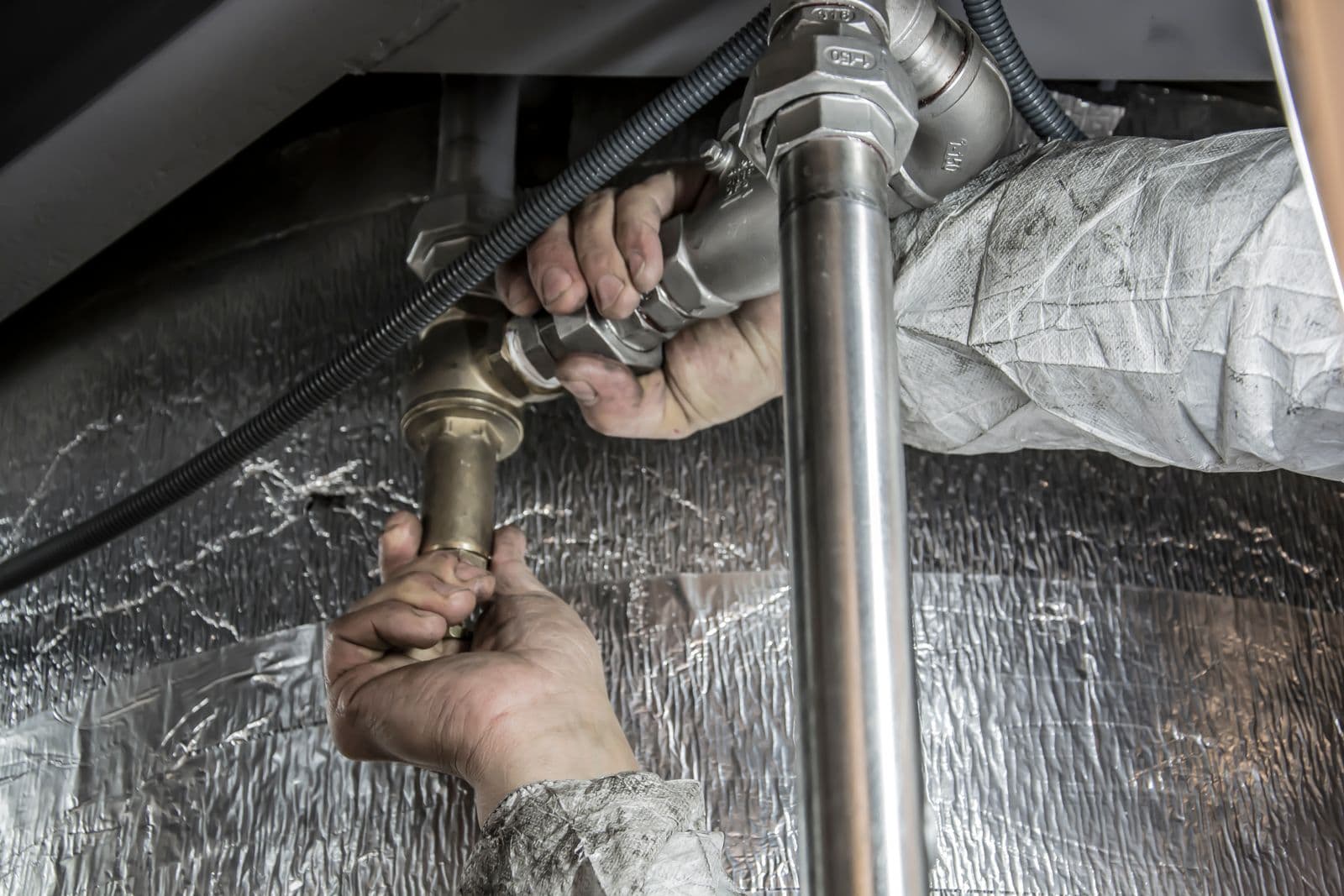
Treatment equipment is plumbing. Most of the job is the connection, the drain and the code detail behind it.


Houston water, answered plainly
Where does Houston's water come from?+
Mostly from two rivers. In 2025, 90.3% of the Main System's water was surface water from the San Jacinto River (Lake Conroe and Lake Houston) and the Trinity River (Lake Livingston). The rest came from 104 wells in the Evangeline and Chicot aquifers.
Does Houston use chlorine or chloramine?+
Chloramines. The 2025 report shows distribution readings from 0.04 to 4.8 ppm, averaging 2.8 ppm, against a 4.0 ppm maximum residual disinfectant level.
Is Houston's water hard?+
It varies with the blend reaching your street. Main System hardness ranged from 43.5 to 229 ppm as calcium carbonate and averaged 135.5 ppm in 2025.
Did Houston have any water violations in 2025?+
The Main System lists two: a single-sample turbidity exceedance at a combined filter in May 2025, and a major monitoring and reporting violation for chlorite in September 2025.
Is there lead in Houston's water?+
In 2025 tap sampling, 90% of samples were below 5.1 ppb and none were over the 15 ppb action level. Houston publishes a service line inventory map at bit.ly/HouLCRRMap and offers free lead and copper testing for qualified homes.
My house is in Kingwood. Do these figures apply?+
Not exactly. Houston Water runs six community systems, and Kingwood, Willow Chase, District 73, District 82 and Belleau Woods have their own tables in the same report. The figures on this page are for the Main System.
Where do these figures come from?+
From Houston Public Works' Houston Water Quality Report 2025, covering January to December 2025. Third-party aggregators are not used.
Related resources
Home water purification and treatment
The national service page behind this one.
Learn more →Austin water quality
Lower Colorado River water through Lake Travis and Lake Austin.
Learn more →Home battery backup in Houston, TX
CenterPoint delivery and Hurricane Beryl's 11-day restoration.
Learn more →Philadelphia water quality
Another large chloraminated river system.
Learn more →All home services
Water, battery, HVAC and solar under one licensed contractor of record.
Learn more →Get a free test at your tap
A licensed technician tests at your kitchen tap and tells you which findings apply to your house — chloramine, hardness or your own plumbing. No charge, no obligation, and coverage confirmed at your address first.
Get a free test