Louisville, Kentucky
Louisville Water Quality
Louisville drinks Ohio River water treated at Crescent Hill and B.E. Payne. The 2025 report shows moderately hard water at 7.5 grains per gallon, lead at 1.1 ppb (90th percentile) and chloramine disinfection.
Ohio River · hardness 128 ppm (7.5 gpg) · lead 90th 1.1 ppb · chloramine RAA 2.69 ppm · PFOA 1.9 ppt.
The short answer
Louisville's tap water comes from Louisville Water Company (PWSID KY0560258), which draws from the Ohio River at Crescent Hill and from riverbank-filtered groundwater at B.E. Payne.
The 2025 report lists hardness of 128 ppm (7.5 grains per gallon), a lead 90th percentile of 1.1 ppb with none of 50 sites over the action level, and chloramine as the disinfectant. PFOA was 1.9 ppt at Crescent Hill; PFOS was 0 at both plants.
Get a free test
Tell us your Louisville address. We confirm coverage first, then schedule a licensed technician to test at your tap — no charge, no obligation.
What the 2025 Louisville report shows
Figures below are system-level results from Louisville Water Company's 2025 Water Quality Report. A later report supersedes them.
Moderately hard: 128 ppm (7.5 grains per gallon)
The report's additional water quality data lists hardness of 128 ppm as CaCO₃ — 7.5 grains per gallon — averaged across Crescent Hill and B.E. Payne finished water. Calcium is 31 ppm and magnesium 13 ppm. That is enough to leave scale on fixtures and in water heaters.
Lead 90th percentile at 1.1 ppb
Lead and copper results in the 2025 report are from 2023 testing at 50 customer taps. The lead 90th percentile was 1.1 ppb against a 15 ppb action level, with a highest single result of 4.2 ppb. Zero of the 50 samples exceeded the action level for lead or copper.
Chloramine, not free chlorine
The disinfectant residual is chloramines, with a running annual average of 2.69 ppm (range 1.97–3.46) against a 4 ppm limit. Chloramine lasts longer in pipes than chlorine and takes catalytic carbon, not ordinary carbon, to remove well.
Disinfection byproducts under the limits
Haloacetic acids had a maximum locational running annual average of 22.4 ppb against a 60 ppb MCL. Total trihalomethanes had a maximum LRAA of 30.3 ppb against 80. No violation for either.
PFAS: PFOA 1.9 ppt at Crescent Hill
The report's PFAS table shows PFOS at 0 ppt at both plants and PFOA at 1.9 ppt at Crescent Hill (0 at B.E. Payne), against EPA's 4.0 ppt maximum for each. PFHxS, PFNA and GenX were 0 at both plants.
Nitrate low; sodium 26 ppm
Nitrate averaged 0.84 ppm at Crescent Hill and 0.16 ppm at B.E. Payne, against a 10 ppm MCL. Sodium in the additional data table is 26 ppm and total dissolved solids 225 ppm.
How the water is produced
One river, two very different intakes.
Crescent Hill: Ohio River surface water
Most of Louisville's drinking water comes from the Crescent Hill Water Treatment Plant, which treats water pumped directly from the Ohio River.
B.E. Payne: riverbank-filtered groundwater
The B.E. Payne Water Treatment Plant in eastern Jefferson County treats groundwater collected from the aquifer next to the Ohio River, so the river water is filtered through the riverbank before treatment.
Louisville Water Company — PWSID KY0560258
The report says Louisville Water pumps an average of 138 million gallons a day to nearly one million people in Louisville Metro and parts of Bullitt, Hardin, Nelson, Oldham, Shelby and Spencer counties.
If you are also planning for outages
Louisville homeowners who rely on a well pump, sump pump or medical equipment often ask about power as well as water. Our Louisville battery backup page covers LG&E rates and outage history. For another river city on the same pattern, see Omaha water quality.
Where these figures come from
Everything on this page traces to Louisville Water Company's 2025 Water Quality Report (PWSID KY0560258), covering January 1 to December 31, 2025. Lead and copper results in that report are from 2023, the most recent required round.
Matching treatment to the finding
Hardness and chloramine drive most Louisville decisions; lead is a question about your own pipes.
Softening is a real conversation here
At about 7.5 grains per gallon, a softener or scale-control system is a reasonable discussion for homes fighting spotting, scale on fixtures or water-heater buildup.
Catalytic carbon for chloramine taste
If the complaint is taste or odor, chloramine is the usual suspect. Catalytic carbon filters are designed for it; standard carbon pitchers are not.
Lead is a plumbing question, not a plant question
The report states the water does not contain lead when it leaves the plants. Risk comes from service lines and home plumbing. Louisville Water offers a lead test kit, and it has replaced more than 1,100 private service lines since 2020 under its Find and Fix program.
Test before you buy
The report is system-wide. A kitchen-tap test tells you which of these findings actually shows up at your address.
How the free test works
A licensed technician tests at your kitchen tap, walks the plumbing, and tells you which of the findings above applies to your house and which does not. There is no charge and no obligation.
Seamless Home is the licensed contractor of record on the work that follows. Installation is performed by vetted installing partners engaged as our subcontractors, and the workmanship obligation stays with us. Coverage is confirmed per service area rather than promised as blanket availability.
What a water treatment job with us covers
Installation and replacement of whole-home and point-of-use treatment, specified against what your water actually contains.
Sediment filtration
Installation of the first stage that protects everything downstream of it, sized to the service line and the household draw.
Softening
Installation of ion-exchange softening where hardness is the problem, including the drain connection the plumbing code treats as indirect waste.
Carbon filtration
Installation of carbon stages for taste, odour and disinfection by-products, specified from your utility's own water quality report.
Reverse osmosis
Point-of-use installation at the kitchen sink where the target is dissolved solids rather than whole-home flow.
Disinfection
Installation of UV or equivalent treatment where the supply is a private well or is otherwise not continuously disinfected.
System replacement
Replacing equipment that has reached the end of its service life, including the discharge and air gap details an inspector looks at.
This is installation and replacement work, specified from a published water quality report or a test of your supply — not from a sales chart. Coverage is confirmed per service area rather than promised as blanket availability.
What the work actually looks like
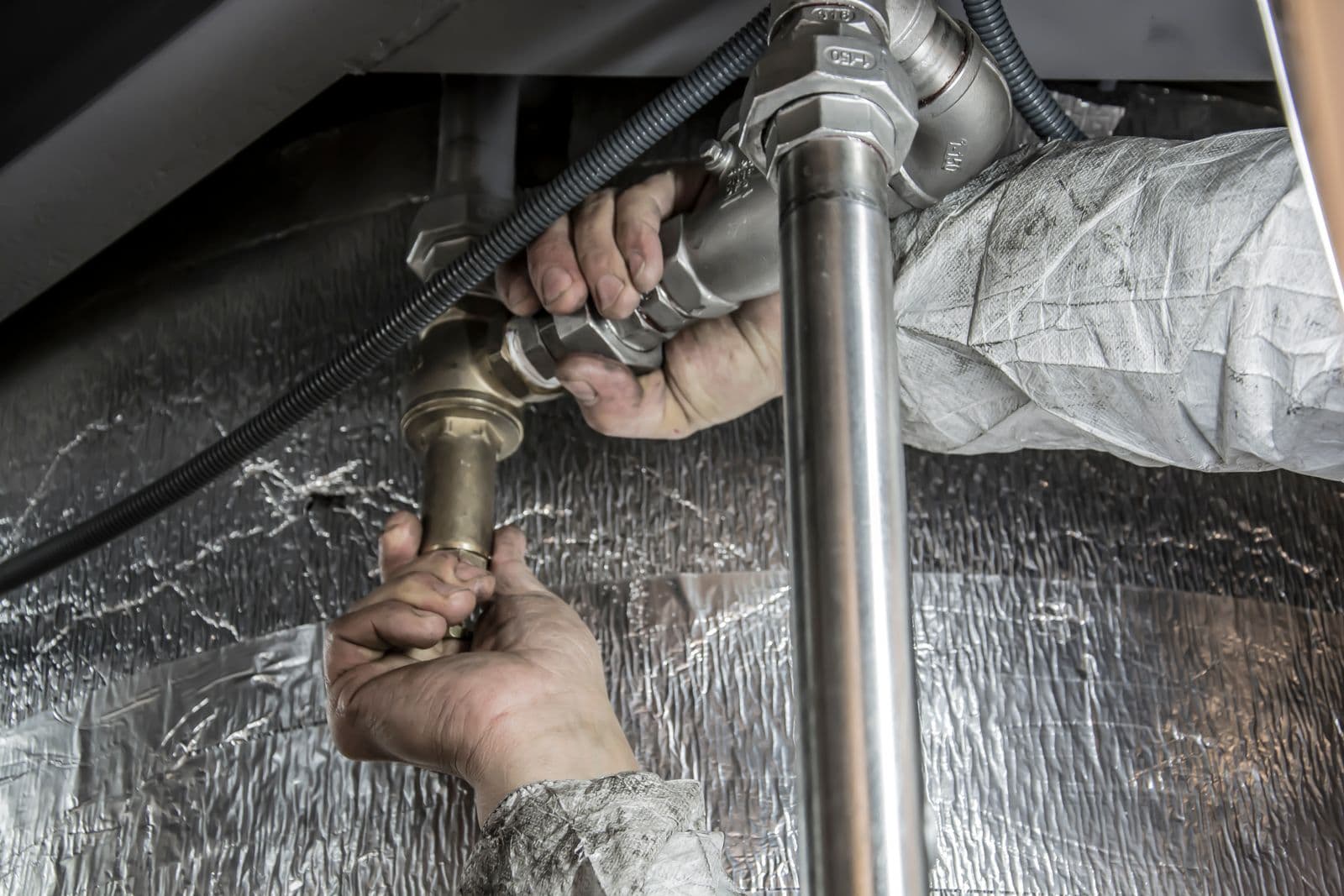
Treatment equipment is plumbing. Most of the job is the connection, the drain and the code detail behind it.


Louisville water, answered plainly
Where does Louisville get its water?+
From the Ohio River. Crescent Hill treats water pumped directly from the river; B.E. Payne treats groundwater drawn from the aquifer beside the river, which is filtered through the riverbank first.
Is Louisville tap water hard?+
Moderately. The 2025 report lists hardness of 128 ppm as CaCO₃, or 7.5 grains per gallon, averaged across both plants' finished water.
Is there lead in Louisville water?+
The 2023 lead testing reported in the 2025 report found a 90th percentile of 1.1 ppb at 50 customer taps, with none over the 15 ppb action level. The water leaves the plants without lead; any lead comes from service lines and plumbing in the home.
Does Louisville water have PFAS?+
The report lists PFOA at 1.9 ppt at Crescent Hill and 0 at B.E. Payne, and PFOS at 0 at both plants. EPA's maximum for each is 4.0 ppt.
Why does my water taste different from other cities?+
Louisville disinfects with chloramines (running annual average 2.69 ppm). Many cities use free chlorine. Chloramine has a different taste and needs a catalytic carbon filter to remove effectively.
Where do these figures come from?+
From Louisville Water Company's 2025 Water Quality Report (PWSID KY0560258), covering January 1 to December 31, 2025. Third-party aggregators are not used.
Related resources
Home water purification and treatment
The national service page behind this one.
Learn more →Louisville battery backup
LG&E rates and outage context.
Learn more →Omaha water quality
Missouri and Platte River water in another river city.
Learn more →Des Moines water quality
Raccoon and Des Moines River water, with nitrate in focus.
Learn more →All home services
Water, battery, HVAC and solar under one licensed contractor of record.
Learn more →Get a free test at your tap
A licensed technician tests at your kitchen tap and tells you which Louisville Water findings apply to your house — hardness, chloramine taste or lead from plumbing. No charge, no obligation, and coverage confirmed at your address first.
Get a free test