Louisville, Kentucky
Home Battery Backup in Louisville
LG&E pays 7.09¢ for exported solar while charging 11.36¢ for power you buy, and its time-of-day rate has two winter peaks. A battery covers both, and keeps chosen circuits on in an outage.

Standard 11.36¢/kWh · time-of-day 19.17¢ on-peak / 9.18¢ off-peak · exports credited at 7.09¢ · 300,000+ out in 2008.
The short answer
Louisville is mostly served by LG&E. Its standard rate is 11.362¢ per kWh; the optional time-of-day rate bills 19.172¢ on-peak and 9.177¢ off-peak, with a 1–5 p.m. summer peak and morning and evening winter peaks.
Solar installed since September 2021 earns a 7.089¢ credit per exported kWh, so storing it for your own use is usually worth more. And a battery keeps chosen circuits on when storms hit, as in 2008, when the remnants of Hurricane Ike left more than 300,000 LG&E customers in the dark.
Get a Free Estimate
Tell us your Louisville address, whether you have solar and what must stay on in an outage. We confirm coverage before anyone sizes a battery.
LG&E rates and outages in Louisville
From LG&E's electric tariff and the Kentucky Public Service Commission.
11.36¢ standard, 19.17¢ on-peak
LG&E's standard residential rate charges 11.362¢ per kWh plus a $0.47 daily basic charge. The optional time-of-day energy rate bills 19.172¢ on-peak and 9.177¢ off-peak, with the same daily charge.
One summer peak, two winter peaks
On the time-of-day rate, on-peak is 1–5 p.m. on weekdays from April through October, and 6–10 a.m. plus 6–10 p.m. on weekdays from November through March. Weekends are off-peak.
The 2008 windstorm
On September 14, 2008, the remnants of Hurricane Ike left more than 300,000 LG&E customers — about three-quarters of its customer base — without power, according to the Kentucky PSC.
Where a battery fits in Louisville
Export credits, the winter peaks, rate limits and backup circuits.
Exports earn less than you pay
Under LG&E's current net metering rider, NMS-2, each kWh you export earns a 7.089¢ bill credit, against 11.362¢ for each kWh you buy on the standard rate. Using stored solar yourself is usually worth more.
Cover both winter peaks
Winter on the time-of-day rate has a morning and an evening peak. A battery charged off-peak can carry the house through both, instead of buying at 19.17¢.
Time-of-day spots are limited
LG&E caps its residential time-of-day rates at 500 customers in total, first come, first served, and requires an advanced meter. Most homes stay on the standard rate, where backup is the main reason for a battery.
Choose the circuits that matter
Refrigeration, sump pump, furnace or heat pump controls, internet, lights and medical devices. A critical load panel decides what the battery carries in an outage.
Louisville next to Grand Rapids and Omaha
Grand Rapids' Consumers Energy puts its summer peak at 2–7 p.m. at 24.5¢ per kWh. LG&E's summer peak is shorter, 1–5 p.m., but its time-of-day rate is capped at 500 customers.
In Omaha, public power district OPPD credits exports at only 4¢ per kWh and is just starting a time-of-use pilot.
Where these figures come from
Rates trace to LG&E's electric tariff; the 2008 outage to a Kentucky PSC order.
- LG&E — Electric Rates (tariff issued March 6, 2026) — RS, RTOD-Energy and net metering riders NMS-1 and NMS-2.
- Kentucky PSC — Order in Case 2008-00456 — the September 14, 2008 windstorm.
What a home battery job with us covers
Installation of storage and the backup circuits behind it, with the siting and utility paperwork handled.
Battery installation
Wall or floor-mounted storage installed to the listing and to the residential code sections that govern where it may go.
Backup and critical load panel
Deciding and wiring which circuits stay live, and which must never be on backup — the choice that defines what an outage feels like.
Integration with existing PV solar
Connecting storage to an array that is already on the roof, including whether the existing inverter supports it.
Transfer switch and disconnection
The equipment that separates the house from the grid during an outage, which is what makes backup legal as well as possible.
Siting to code
Location, clearances, separation and impact protection assessed against the adopted code before anything is mounted.
Permit, inspection and utility approval
The electrical permit, the inspection, and the utility's own approval step where storage touches the service.
This is installation work. No runtime, capacity or incentive figure is quoted before your loads and your utility are confirmed. Coverage is confirmed per service area rather than promised as blanket availability.
What the work actually looks like
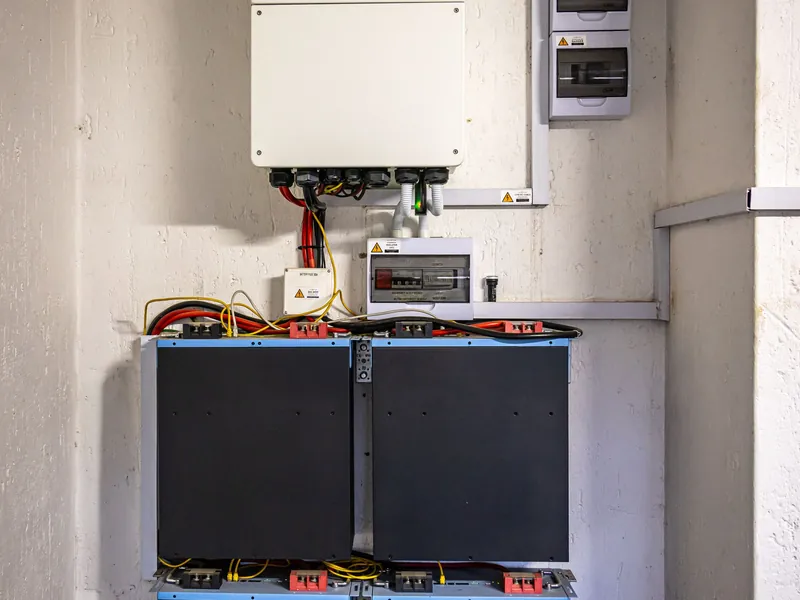
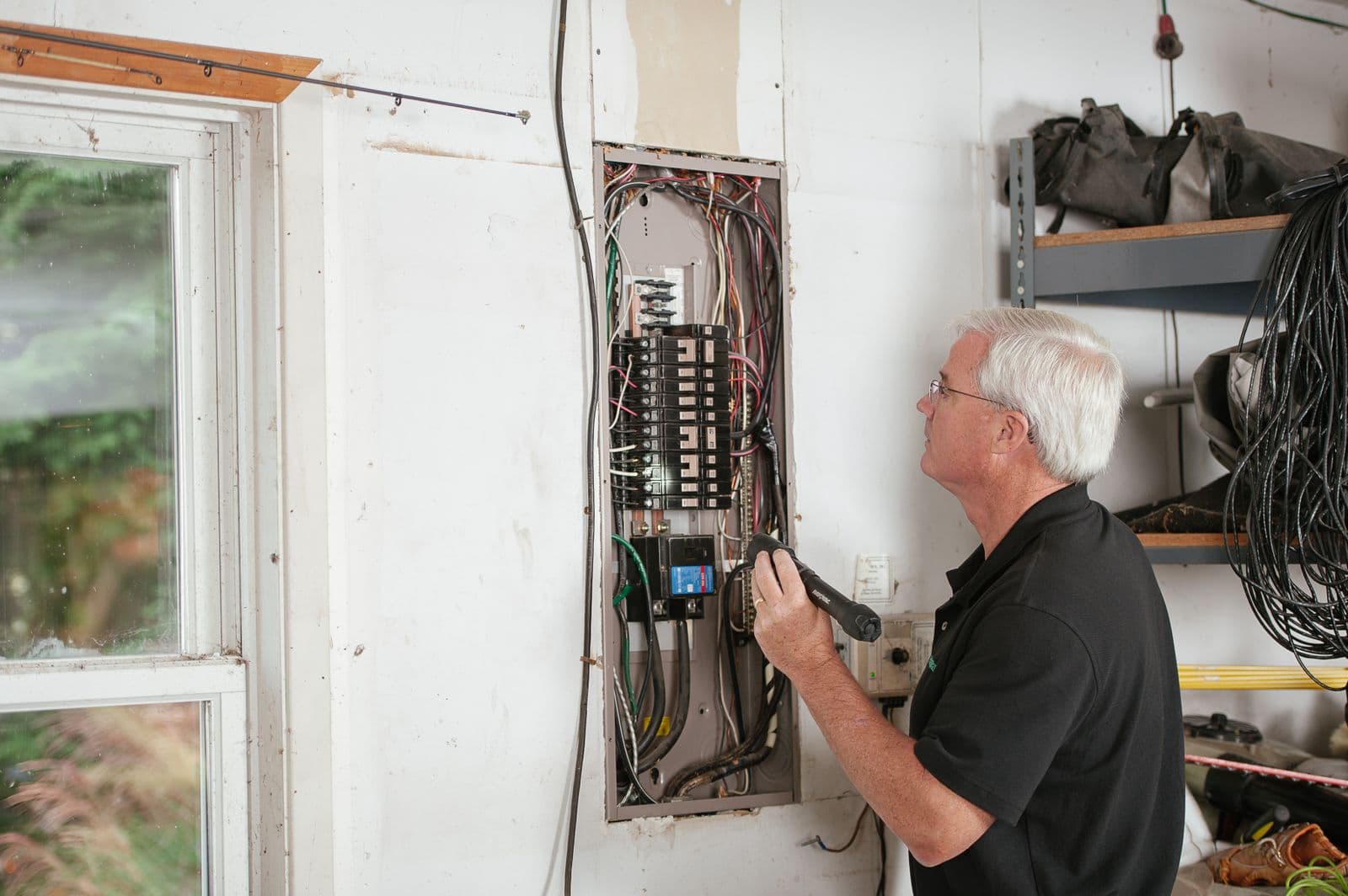
A battery job is an electrical job. The panel, the circuits and the disconnection are most of it.

Battery backup in Louisville, answered plainly
Who is the electric utility in Louisville?+
Most of Louisville is served by Louisville Gas and Electric (LG&E). Check your bill; some areas around the metro are served by other utilities or cooperatives.
What does LG&E charge for electricity?+
On the standard residential rate (RS), a basic service charge of $0.47 per day plus 11.362¢ per kWh, before riders and adjustments, for service on and after February 16, 2026.
What are LG&E's on-peak hours?+
On the optional time-of-day energy rate (RTOD-Energy), on-peak is 1–5 p.m. on weekdays from April through October, and 6–10 a.m. and 6–10 p.m. on weekdays from November through March. Weekends are off-peak, and hours are in Eastern Standard Time year-round.
Can anyone switch to the time-of-day rate?+
It requires an advanced (AMI) meter and is limited to 500 customers across LG&E's two residential time-of-day rates, on a first-come, first-served basis.
How does LG&E net metering work now?+
Systems in service on or after September 24, 2021 take Rider NMS-2: each exported kWh earns a $0.07089 bill credit applied to energy charges, and unused credit carries forward. Systems up to 45 kW qualify. Older systems on NMS-1 keep kWh-for-kWh netting.
How long will a battery run my house?+
It depends on capacity and which circuits you put on it, so we don't quote a runtime before seeing the panel.
Who installs it, and who is responsible afterwards?+
Seamless Home is the licensed contractor of record on the work it runs. Installation is performed by vetted installing partners engaged as our subcontractors, so the permit, the inspection and any correction notice carry one name. Coverage is confirmed per service area rather than promised as blanket availability.
Related resources
Home battery backup
The national service page behind this one.
Learn more →Home battery backup in Grand Rapids, MI
Consumers Energy's 2–7 p.m. summer peak and outage credits.
Learn more →Home battery backup in Omaha, NE
OPPD's July 2024 storm and its new TOU pilot.
Learn more →Critical load panel planner
Pick the circuits a battery should carry.
Learn more →What is a critical load panel?
How backup circuits are chosen.
Learn more →All home services
Water, battery, HVAC and solar under one licensed contractor of record.
Learn more →Get a free battery estimate
We confirm your Louisville address is in coverage, check your panel and solar setup, and size backup circuits before anyone promises bill savings. No obligation.
Get a Free Estimate