Omaha, Nebraska
Omaha Water Quality
Omaha drinks Missouri and Platte River water from M.U.D. The 2025 report shows hard water near 9 grains per gallon and a fall 2025 lead 90th percentile of 12.3 ppb.

Missouri + Platte · hardness ~9 gpg · lead 90th 12.3 ppb (2 sites over AL) · TTHM RAA 44.4 ppb · PFAS below reporting limits.
The short answer
Omaha's tap water comes from the Metropolitan Utilities District (M.U.D.), which treats Missouri River water at Florence and Platte River wellfield water at Platte West and Platte South.
The 2025 report lists hardness averaging 9 grains per gallon and a fall 2025 lead 90th percentile of 12.3 ppb — under the 15 ppb action level, with 2 sites above it. Every PFAS compound tested was below the reporting limit.
Get a free test
Tell us your Omaha address. We confirm coverage first, then schedule a licensed technician to test at your tap — no charge, no obligation.
What the 2025 Omaha report shows
Figures below are system-level results from M.U.D.'s 2025 Water Quality Report. A later report supersedes them.
Hard water: about 9 grains per gallon
The report lists total hardness averaging 9 grains per gallon as CaCO₃, with a range of 8–13. That is hard water by any common scale, and it is the most frequent reason Omaha homeowners look at treatment.
Lead 90th percentile at 12.3 ppb
The most recent lead and copper round, sampled August 7 to September 29, 2025, produced a lead 90th percentile of 12.3 ppb against a 15 ppb action level, with a range of <0.5 to 33.5 ppb and 2 sites over the action level. Copper's 90th percentile was 0.0231 ppm, with 0 sites over.
Trihalomethanes highest RAA 44.4 ppb
Total trihalomethanes had a highest running annual average of 44.4 ppb against an 80 ppb MCL (individual results 26.5–74.1, monitoring period April 2024 to March 2025). Haloacetic acids had a highest RAA of 20.2 ppb against 60. No violations.
Nitrate and atrazine from farm country
Nitrate-nitrite peaked at 3.19 ppm (range 0.532–3.19) against a 10 ppm MCL in 2025. Atrazine peaked at 0.326 ppb against a 3 ppb MCL in 2024 sampling. Both are typical of river supplies draining agricultural land.
Arsenic present at low levels
Arsenic reached 4.77 ppb (range 0–4.77) against a 10 ppb MCL in 2023–2025 monitoring. The report includes EPA's standard note that the water meets the standard but contains low levels of arsenic.
PFAS below reporting limits
Every PFAS compound in the report's table — including PFOA, PFOS, PFHxS, PFNA and GenX — is shown as below the laboratory reporting limit.
How the water is produced
Two rivers, three plants.
Missouri River — Florence plant
M.U.D. classifies the Missouri River as surface water. It is treated at the Florence plant, one of three treatment plants the District calls its "triangle of reliability."
Platte River wellfields — Platte West and Platte South
The Platte supply is groundwater under the direct influence of surface water, plus groundwater, pumped from District wellfields. M.U.D. keeps wellhead protection plans for both Platte wellfields.
Metropolitan Utilities District
The report says M.U.D. serves nearly 600,000 people through more than 3,100 miles of mains, delivering an average of 90 million gallons a day. It replaced 15.5 miles of high-risk mains in 2025.
Omaha next to Des Moines and Louisville
Des Moines is the closest comparison: another Midwest river supply where nitrate from farmland is part of the report. Louisville also draws from a major river and riverbank wells, but its water is softer at about 7.5 grains per gallon.
If storms and outages are on your list too, our Omaha battery backup page covers OPPD rates and outage history.
Where these figures come from
Everything on this page traces to the Metropolitan Utilities District's 2025 Water Quality Report (Consumer Confidence Report for January 1 to December 31, 2025). Some contaminants are monitored on multi-year schedules; the monitoring period is noted where it is not 2025.
Matching treatment to the finding
Hardness drives most Omaha decisions; lead is a question about your own service line and plumbing.
A softener is worth pricing
At roughly 9 grains per gallon, scale on fixtures, glassware and water heaters is common. A softener or scale-control system is the usual first conversation.
Lead reduction if your house is older
M.U.D. says lead is not detected in source water, finished water or the mains; it comes from service lines and home plumbing. Its 10-year, $160 million Lead Service Line Replacement program targets all known lead and galvanized lines. A certified lead-reduction filter covers the gap.
RO for nitrate, arsenic or sodium
Point-of-use reverse osmosis reduces nitrate, arsenic and sodium (which reached 75 ppm) at the kitchen tap. It is optional given the results, not required.
Test before you buy
The report is system-wide. A kitchen-tap test tells you which of these findings actually shows up at your address.
How the free test works
A licensed technician tests at your kitchen tap, walks the plumbing, and tells you which of the findings above applies to your house and which does not. There is no charge and no obligation.
Seamless Home is the licensed contractor of record on the work that follows. Installation is performed by vetted installing partners engaged as our subcontractors, and the workmanship obligation stays with us. Coverage is confirmed per service area rather than promised as blanket availability.
What a water treatment job with us covers
Installation and replacement of whole-home and point-of-use treatment, specified against what your water actually contains.
Sediment filtration
Installation of the first stage that protects everything downstream of it, sized to the service line and the household draw.
Softening
Installation of ion-exchange softening where hardness is the problem, including the drain connection the plumbing code treats as indirect waste.
Carbon filtration
Installation of carbon stages for taste, odour and disinfection by-products, specified from your utility's own water quality report.
Reverse osmosis
Point-of-use installation at the kitchen sink where the target is dissolved solids rather than whole-home flow.
Disinfection
Installation of UV or equivalent treatment where the supply is a private well or is otherwise not continuously disinfected.
System replacement
Replacing equipment that has reached the end of its service life, including the discharge and air gap details an inspector looks at.
This is installation and replacement work, specified from a published water quality report or a test of your supply — not from a sales chart. Coverage is confirmed per service area rather than promised as blanket availability.
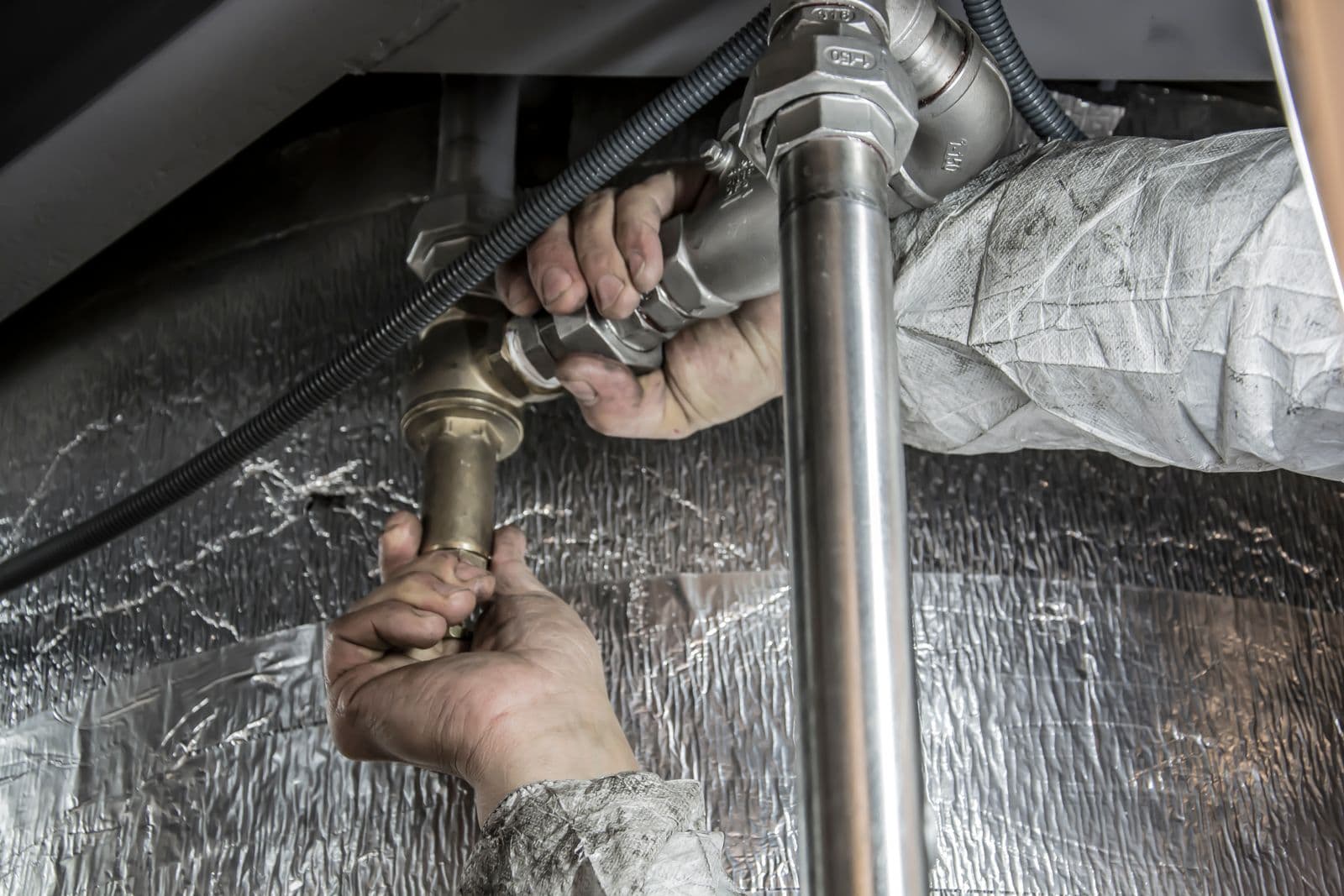
What the work actually looks like
Treatment equipment is plumbing. Most of the job is the connection, the drain and the code detail behind it.


Omaha water, answered plainly
Where does Omaha get its water?+
From the Missouri River and the Platte River. M.U.D. treats Missouri River water at the Florence plant and Platte River wellfield water at Platte West and Platte South.
Is Omaha tap water hard?+
Yes. The 2025 report lists total hardness averaging 9 grains per gallon, with a range of 8–13.
Is there lead in Omaha water?+
The fall 2025 lead round found a 90th percentile of 12.3 ppb, below the 15 ppb action level, with 2 sites above it. M.U.D. says lead comes from service lines and home plumbing, not from the source or the mains, and is replacing known lead and galvanized service lines over 10 years.
Does Omaha water have PFAS?+
The 2025 report lists every PFAS compound it tested — PFOA, PFOS and others — as below the laboratory reporting limit.
Is nitrate a concern in Omaha?+
Nitrate-nitrite peaked at 3.19 ppm in 2025, under the 10 ppm MCL. Households with infants or specific medical advice sometimes choose reverse osmosis anyway.
Where do these figures come from?+
From the Metropolitan Utilities District's 2025 Water Quality Report, the Consumer Confidence Report for January 1 to December 31, 2025. Third-party aggregators are not used.
Related resources
Home water purification and treatment
The national service page behind this one.
Learn more →Omaha battery backup
OPPD rates and storm outage history.
Learn more →Des Moines water quality
Another Midwest river supply.
Learn more →Louisville water quality
Ohio River and riverbank-filtered groundwater.
Learn more →All home services
Water, battery, HVAC and solar under one licensed contractor of record.
Learn more →Get a free test at your tap
A licensed technician tests at your kitchen tap and tells you which M.U.D. findings apply to your house — hardness, nitrate or lead from plumbing. No charge, no obligation, and coverage confirmed at your address first.
Get a free test