Arlington, Virginia
Arlington Water Quality
Arlington does not drink Lake Gaston water. It drinks Potomac River water treated at Dalecarlia by the Washington Aqueduct — and the figure a treatment decision turns on here is hardness at about 8 grains per gallon.
The 2025 CCR lists total hardness at 142 mg/L — about 8 grains per gallon — with a chloramine residual. That is the first Virginia city page on this site where a softener is a real question.
The short answer
Arlington's drinking water is Potomac River water treated at the Dalecarlia Treatment Plant by the Washington Aqueduct (U.S. Army Corps of Engineers), then distributed by Arlington County. It is not Lake Gaston water and it is not James River water.
The governing household number on the 2025 CCR is hardness at 142 mg/L — about 8 grains per gallon — with a chloramine residual. Disinfection byproducts sit inside their MCLs (TTHM 55 / 80, HAA5 36.5 / 60). A softener is a real question here; it is usually the wrong question on this site's Massachusetts pages.
Get a free test
Tell us your Arlington-area address. We confirm coverage first, then schedule a licensed technician to test at your tap — no charge, no obligation.
What filtration does — and does not
Sediment, carbon, softening and reverse osmosis each address a different problem. In Arlington the County's own hardness figure puts softening on the table — alongside carbon for chloramine taste — in a way Tidewater pages on this site do not.
Which water system serves you?
Enter a ZIP code. We will name the utility that supplies it and its public water system identifier, so you can look up that system's own annual report. No contact details needed for this part.
Phoenix-metro ZIP codes are covered here. Five digits will do it.
A licensed technician tests at your own tap and tells you which findings actually apply to your house — including when the answer is none of them. Coverage is confirmed per service area rather than promised as blanket availability.
Where Arlington water comes from
A federal aqueduct on the Potomac, a County distribution system, and a hardness figure that Tidewater Virginia does not share.
Potomac River via the Washington Aqueduct
Arlington County purchases water from the Washington Aqueduct, a division of the U.S. Army Corps of Engineers. The Aqueduct treats Potomac River water at plants in the District of Columbia; Arlington's water is treated at the Dalecarlia Treatment Plant on MacArthur Boulevard in Northwest Washington. That is a federal treatment train, not a Tidewater reservoir transfer.
Not Lake Gaston, not the James
Norfolk and Virginia Beach arguments on this site turn on Lake Gaston water and the Moores Bridges plant. Richmond turns on the James River. Arlington shares a state with those cities and almost none of their source chemistry. Quoting a Tidewater CCR at an Arlington address describes somebody else's tap.
County distribution after Dalecarlia
Treated water is pumped from Dalecarlia into Arlington County's distribution and storage system — on the order of 550 miles of pipeline in county materials, with the County responsible for distribution-side monitoring. The 2025 CCR notes 7.7 billion gallons delivered from Dalecarlia in FY25 County water use figures.
Willston pressure zone is a consecutive system
A portion of the County (Willston) is served as a consecutive system with its own sampling and its own CCR. If your address is in that zone, read the Willston report rather than assuming the countywide table describes your pressure zone. The County publishes both.
What the 2025 report actually says
Federal MCLs and Action Levels are fixed. The results next to them are from the Arlington County 2025 Annual Water Quality Report — system-level and sampling-round figures, not a reading at your tap. A later report supersedes them.
Hardness — the number that governs here
Arlington County's 2025 CCR lists total hardness among finished-water characteristics from distribution monitoring at 142 mg/L, or about 8 grains per gallon. That is moderately hard water — scale on fixtures, shorter soap life, and a softener that actually has something to remove. It is also the opposite of the Massachusetts soft-water pages on this site, where 1–2 grains is typical and a softener is usually the wrong purchase.
Chloramine residual
The disinfectant residual in the distribution system is chloramine, listed at 2.1 mg/L among finished-water characteristics, with monitoring results ranging from non-detect to 3.96 ppm against an MRDL of 4. Chloramine is a different residual from the free chlorine used on many Virginia Beach / Norfolk narratives and on Springfield and Worcester in Massachusetts. Carbon still works; it needs adequate contact time.
Disinfection byproducts — compliant
Total trihalomethanes: highest running annual compliance average 55.0 ppb against an MCL of 80, range 19.0 to 95.0. Haloacetic acids (HAA5): 36.5 ppb against 60, range 5.0 to 61.0. Both marked against the federal limits without an MCL violation in the 2025 table. Individual samples can still run high; the compliance figure is the running annual average.
Sodium
Listed at 34 ppm among finished-water characteristics. Sodium is not regulated by an MCL; the CCR footnotes the EPA's Fall 2009 Drinking Water Advisory value of 20 mg/L for a person on a 500 mg/day restricted sodium diet. A softener that trades hardness for sodium raises this number — relevant for anyone whose physician has them on that restriction.
Lead and copper — plumbing, not the Potomac
2025 sampling: copper 90th percentile 0.0496 ppm against an Action Level of 1.3 (0 of 52 samples over). Lead 90th percentile 0.595 ppb against 15, with one of 52 samples over the Action Level (range non-detect to 15.912). Lead in drinking water here is framed as corrosion of household plumbing — not as something the Potomac arrives with.
Fluoride and nitrate
Fluoride detected at 0.7 ppm against an MCL of 4 (range 0.7–0.7 at entry-point monitoring). Nitrate (as nitrogen) 1.0 ppm against 10 (range 0.7–1.0). Both well inside their limits; listed because they are among the regulated results residents ask about.
Why hardness is the argument — and Tidewater is not
Norfolk and Virginia Beach describe a Lake Gaston supply. Richmond describes the James. Arlington describes the Potomac via Dalecarlia. Copying any of those pages and swapping the city name would be false on the source, the plant and the hardness story.
Eight grains per gallon is also why this page disagrees with the Massachusetts water cluster: Boston, Worcester, Cambridge and Springfield are soft-water arguments where a softener is usually wrong. Arlington is the VA page where scale is a legitimate complaint — and where the sodium footnote has to sit next to any softener quote.
Arlington already has an HVAC page; this page is the water half of the same address, not a rewrite of that one.
Where these figures come from
Everything on this page traces to primary sources. Independent compilations of water quality data exist and are not used here.
- Arlington County 2025 Annual Water Quality Report
- Arlington Water Quality Reports — including the Willston consecutive-system CCR.
- Washington Aqueduct (USACE) — the federal treatment provider.
- EPA National Primary Drinking Water Regulations
Matching treatment to the finding
In a moderately hard chloraminated supply whose DBP averages are inside their limits, the honest equipment conversation starts with hardness — and only then with carbon or RO.
A softener — actually on the table here
At about 8 grains per gallon, hardness is high enough that scale and soap performance are real complaints, and a softener has something to remove. That is the opposite finding from Boston, Worcester, Cambridge and Springfield. Pair it with the sodium footnote: softening adds sodium, and the CCR already lists 34 ppm against a 20 mg/L advisory for sodium-restricted diets.
Activated carbon — for chloramine taste and DBPs
Carbon addresses chloramine taste/odor and reduces trihalomethanes and haloacetic acids. Chloramine needs a larger bed or longer contact time than free chlorine. Useful where taste is the complaint or where someone wants DBP reduction at the tap even though the compliance averages are inside their limits.
Reverse osmosis — drinking water, not whole-house hardness
Under-sink RO reduces hardness, sodium, and a long list of dissolved contaminants at one tap. It is a drinking-water answer, not a whole-house scale answer — the water heater and fixtures still see hard water unless a softener or other POE stage is installed upstream.
A lead-reduction filter — only if your plumbing says so
The 2025 90th-percentile lead result is low, with one sample over the Action Level. Lead here is a household-plumbing question. A certified lead-reduction filter answers a finding at your tap, not a citywide 90th percentile.
How the free test works
A licensed technician tests at your kitchen tap, walks the plumbing, and tells you which of the findings above applies to your house and which does not. There is no charge and no obligation.
Seamless Home is the licensed contractor of record on the work that follows. Installation is performed by vetted installing partners engaged as our subcontractors, and the workmanship obligation stays with us. Coverage is confirmed per service area rather than promised as blanket availability.
Softener and RO drain lines still have to meet the indirect-waste rule — where a water softener is allowed to discharge.
What a water treatment job with us covers
Installation and replacement of whole-home and point-of-use treatment, specified against what your water actually contains.
Sediment filtration
Installation of the first stage that protects everything downstream of it, sized to the service line and the household draw.
Softening
Installation of ion-exchange softening where hardness is the problem, including the drain connection the plumbing code treats as indirect waste.
Carbon filtration
Installation of carbon stages for taste, odour and disinfection by-products, specified from your utility's own water quality report.
Reverse osmosis
Point-of-use installation at the kitchen sink where the target is dissolved solids rather than whole-home flow.
Disinfection
Installation of UV or equivalent treatment where the supply is a private well or is otherwise not continuously disinfected.
System replacement
Replacing equipment that has reached the end of its service life, including the discharge and air gap details an inspector looks at.
This is installation and replacement work, specified from a published water quality report or a test of your supply — not from a sales chart. Coverage is confirmed per service area rather than promised as blanket availability.
What the work actually looks like
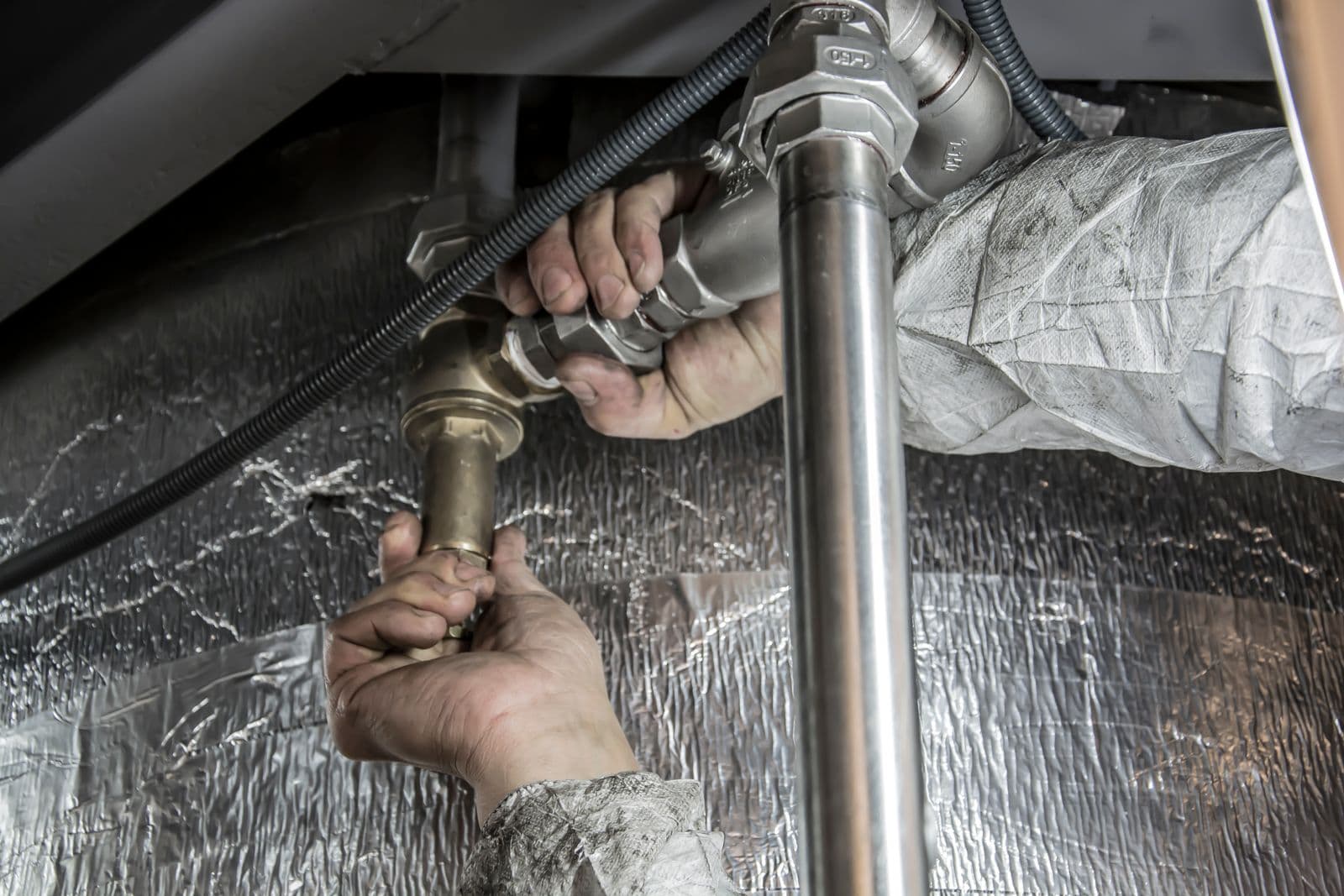
Treatment equipment is plumbing. Most of the job is the connection, the drain and the code detail behind it.


Arlington water, answered plainly
Where does Arlington drinking water come from?+
The Potomac River, treated by the Washington Aqueduct (U.S. Army Corps of Engineers) at the Dalecarlia Treatment Plant in Northwest Washington, D.C., then distributed by Arlington County. It is not Lake Gaston water and it is not James River water.
What does the 2025 water quality report say?+
That finished water met the regulated MCLs in the summary table for the contaminants listed, including TTHM at a highest running annual average of 55 ppb against 80 and HAA5 at 36.5 against 60. Distribution monitoring lists hardness at 142 mg/L (about 8 grains per gallon), chloramine residual at 2.1 mg/L, fluoride at 0.7 ppm and sodium at 34 ppm. Lead 90th percentile was 0.595 ppb against an Action Level of 15, with one of 52 samples over.
Is Arlington water hard?+
Moderately hard, by the County's own 2025 figure: 142 mg/L total hardness, stated as 8 grains per gallon. That is the governing household number on this page — scale, soap, and whether a softener is justified — and it is why this page is not a Tidewater clone.
How is this different from Norfolk or Virginia Beach?+
Those pages describe Lake Gaston water treated in South Hampton Roads. Arlington describes Potomac River water treated at Dalecarlia by a federal aqueduct. Different source, different plant, different hardness story, chloramine residual in the distribution characteristics. Sharing a state abbreviation does not make the CCRs interchangeable.
Do I need a water softener in Arlington?+
Possibly — unlike in soft-water New England cities on this site. At about 8 grains per gallon, hardness is in the range where scale and soap performance are common complaints. Measure at your tap before buying, and if anyone in the house is on a physician-directed sodium-restricted diet, read the CCR's sodium footnote before trading hardness for sodium.
What about the Willston pressure zone?+
Willston is a consecutive system that purchases through Fairfax Water / Washington Aqueduct arrangements and publishes its own CCR. If you live in that zone, use the Willston report for compliance tables rather than assuming the countywide Arlington CCR is yours.
Where do these figures come from?+
The Arlington County 2025 Annual Water Quality Report (Consumer Confidence Report), including its finished-water characteristics table and regulated-contaminant summary, plus the federal MCLs and Action Levels those tables compare against. Aggregator sites are not the source used here.
Related resources
Home water purification and treatment
The national service page behind this one.
Learn more →Norfolk water quality
Lake Gaston / Moores Bridges — a different Virginia supply.
Learn more →Richmond water quality
James River chemistry, not the Potomac.
Learn more →Virginia Beach water quality
Tidewater supply — not Dalecarlia.
Learn more →HVAC in Arlington, VA
The heating and cooling side of the same address.
Learn more →Where a water softener can discharge
Indirect-waste rules for treatment drain lines.
Learn more →All home services
Water, battery, HVAC and solar under one licensed contractor of record.
Learn more →Get a free test at your tap
A licensed technician tests at your kitchen tap and tells you which of the findings above applies to your house — and which does not. No charge, no obligation, and coverage confirmed at your address first.
Get a free test