Portsmouth, Virginia
Portsmouth Water Quality
Lake water from Suffolk, treated at the Lake Kilby plant for Portsmouth, part of Chesapeake and part of Suffolk. The 2024 report's everyday facts: a strong chloramine residual, soft water and PFAS below reporting limits.
Chloramine averaged 3.72 ppm in 2024 against a limit of 4 — above the Chesapeake-plant and Suffolk averages next door.
The short answer
Portsmouth drinks lake water from Suffolk — Lake Meade, influenced by Lake Cohoon, Speight's Run and Lake Kilby — plus five deep wells, treated at the Lake Kilby plant for over 150,000 customers in three cities.
The Reporting Year 2024 report lists chloramine averaging 3.72 ppm (limit 4), hardness of 24 ppm (soft), sodium at 60 ppm, a negative corrosion index and UCMR5 PFAS results below reporting limits. The likely complaint is disinfectant taste, not scale.
Get a free test
Tell us your Portsmouth address. We confirm coverage first, then schedule a licensed technician to test at your tap — no charge, no obligation.
What filtration does — and does not
Softening, carbon and reverse osmosis solve different problems. Portsmouth's report is a chloramine-and-byproducts story on soft water, not a hardness purchase order.
Where Portsmouth water comes from
A city whose reservoirs sit in the next city over — and whose plant serves its neighbours too.
Lake Meade, with influence from three more lakes
The report says Portsmouth's tap water comes from Lake Meade, with influence from Lake Cohoon, Speight's Run and Lake Kilby. Those lakes sit in neighbouring Suffolk, not inside Portsmouth's city limits — which is why the source protection story is about someone else's watershed.
Five deep wells
Alongside the lakes, the report lists five deep wells as part of the supply. The finished-water table is a system-level picture of the blend, not a reading for any one source.
One plant, three cities
The Lake Kilby Water Treatment Plant has the capacity to treat 32 million gallons a day and, per the report, serves over 150,000 customers in Portsmouth, Chesapeake and Suffolk. Western Branch and Deep Creek in Chesapeake, and part of Suffolk, drink water made here.
Source water rated medium susceptibility
The state Source Water Assessment rated the system's susceptibility as medium, most exposed to agriculture, urban and forestry runoff. The report adds that no contaminants from those sources were detected in the drinking water.
What the Reporting Year 2024 report actually says
Limits are fixed. The results next to them are from the City of Portsmouth Water Quality Report, Reporting Year 2024 — system-level figures, not a reading at your tap. A later report supersedes them.
Chloramines — average 3.72 ppm, range 1.40–4.20
Portsmouth disinfects with chloramine. The 2024 table lists an amount detected of 3.72 ppm against a maximum residual disinfectant level of 4, with individual readings from 1.40 to 4.20. That is above the averages printed for the Chesapeake plants (3.36) and Suffolk (3.05), and the main reason Portsmouth water can taste of disinfectant.
Disinfection byproducts — TTHM 42 ppb, HAA 40 ppb
Total trihalomethanes 42 ppb (range 19–61) against an MCL of 80; haloacetic acids 40 ppb (range 5–58) against 60. Both within limits. Surface lakes carry organic matter — total organic carbon is listed at 2.10 ppm — and byproducts are what forms when disinfectant meets it.
Hardness — 24 ppm (18–34)
Listed among unregulated substances: hardness 24 ppm, calcium hardness 20 ppm. Divided by 17.1, about 1.4 grains per gallon. Soft water — a softener is not the default purchase here.
Corrosion index — Langelier −1.14
The report prints a Langelier index of −1.14 (range −1.75 to −0.51). A negative index describes water that tends not to deposit calcium carbonate scale. It also lists orthophosphate at 0.31 ppm (0.23–1.50, as PO4). For an older house, the plumbing material matters more here than scale.
Sodium — 60 ppm (50–78)
Sodium is listed at 60 ppm with a range of 50 to 78. Relevant for anyone on a sodium-restricted diet — and a reason a salt-based softener, which adds sodium, makes little sense on water this soft.
PFAS — below reporting limits in UCMR5 (2023)
Four UCMR5 sampling rounds in 2023 are shown for PFOA, PFOS, HFPO-DA, PFHxS, PFNA and PFBS, every result printed as less-than the reporting level (for example PFOA <4.0, <3.8, <4.0 and <3.9 ng/L). Nothing in that table forces a PFAS purchase.
Lead and copper — 2021 sampling, 0 of 52 above
Tap samples collected in 2021: copper 0.125 ppm at the 90th percentile and lead reported below detection, with 0 of 52 sites above either action level. The city's service-line inventory, due October 16, 2024, is published under Lead-Free Portsmouth.
Why Portsmouth is not Suffolk or Chesapeake with a different ZIP
Portsmouth water shows up on two other pages on this site as a purchased supply. Suffolk buys 2.54 million gallons a day of it to supplement its own lakes and wells, and Chesapeake serves Western Branch and Deep Creek with it as a separate system. This page is the producing plant's own report. Across the river, Norfolk runs a different utility with different lakes.
Where these figures come from
Everything on this page traces to primary sources. Independent compilations of water quality data exist and are not used here.
- City of Portsmouth — Water Quality Report, Reporting Year 2024 (PDF) — PWS ID 3740600; sources, SWAP rating, regulated, secondary and unregulated tables, UCMR5, lead and copper.
- City of Portsmouth — Lead-Free Portsmouth — service-line inventory referenced in the report.
- EPA — PFAS National Primary Drinking Water Regulation — 4.0 ppt MCLs for PFOA and PFOS.
Matching treatment to the finding
Portsmouth's report supports a chloramine-aware carbon conversation and a plumbing check — not a softener default.
Chloramine-rated carbon for taste
A residual averaging 3.72 ppm is noticeable. Standard "chlorine" pitcher filters often underperform on chloramine; catalytic carbon with a certification naming chloramine reduction is the check.
Skip the softener pitch
At 24 ppm hardness, softening solves a problem Portsmouth water mostly does not have — and adds sodium to water already listed at 60 ppm.
Byproducts: carbon, sized to flow
TTHM and HAA are within limits. Households that want them lower at the tap usually start with point-of-use carbon or reverse osmosis at the kitchen sink rather than whole-house equipment.
Older plumbing: test, then decide
With a negative corrosion index on the report, a tap test in a pre-1986 house tells you more than any system average. Lead-reduction certification (NSF/ANSI 53 or 58) is the filter check if a result says it is needed.
How the free test works
A licensed technician tests at your kitchen tap, walks the plumbing, and tells you which of the findings above applies to your house and which does not. There is no charge and no obligation.
Seamless Home is the licensed contractor of record on the work that follows. Installation is performed by vetted installing partners engaged as our subcontractors, and the workmanship obligation stays with us. Coverage is confirmed per service area rather than promised as blanket availability.
A softener or RO unit needs a legal drain connection — where a water softener is allowed to discharge sets out the indirect-waste rule that decides where it goes.
What a water treatment job with us covers
Installation and replacement of whole-home and point-of-use treatment, specified against what your water actually contains.
Sediment filtration
Installation of the first stage that protects everything downstream of it, sized to the service line and the household draw.
Softening
Installation of ion-exchange softening where hardness is the problem, including the drain connection the plumbing code treats as indirect waste.
Carbon filtration
Installation of carbon stages for taste, odour and disinfection by-products, specified from your utility's own water quality report.
Reverse osmosis
Point-of-use installation at the kitchen sink where the target is dissolved solids rather than whole-home flow.
Disinfection
Installation of UV or equivalent treatment where the supply is a private well or is otherwise not continuously disinfected.
System replacement
Replacing equipment that has reached the end of its service life, including the discharge and air gap details an inspector looks at.
This is installation and replacement work, specified from a published water quality report or a test of your supply — not from a sales chart. Coverage is confirmed per service area rather than promised as blanket availability.
What the work actually looks like
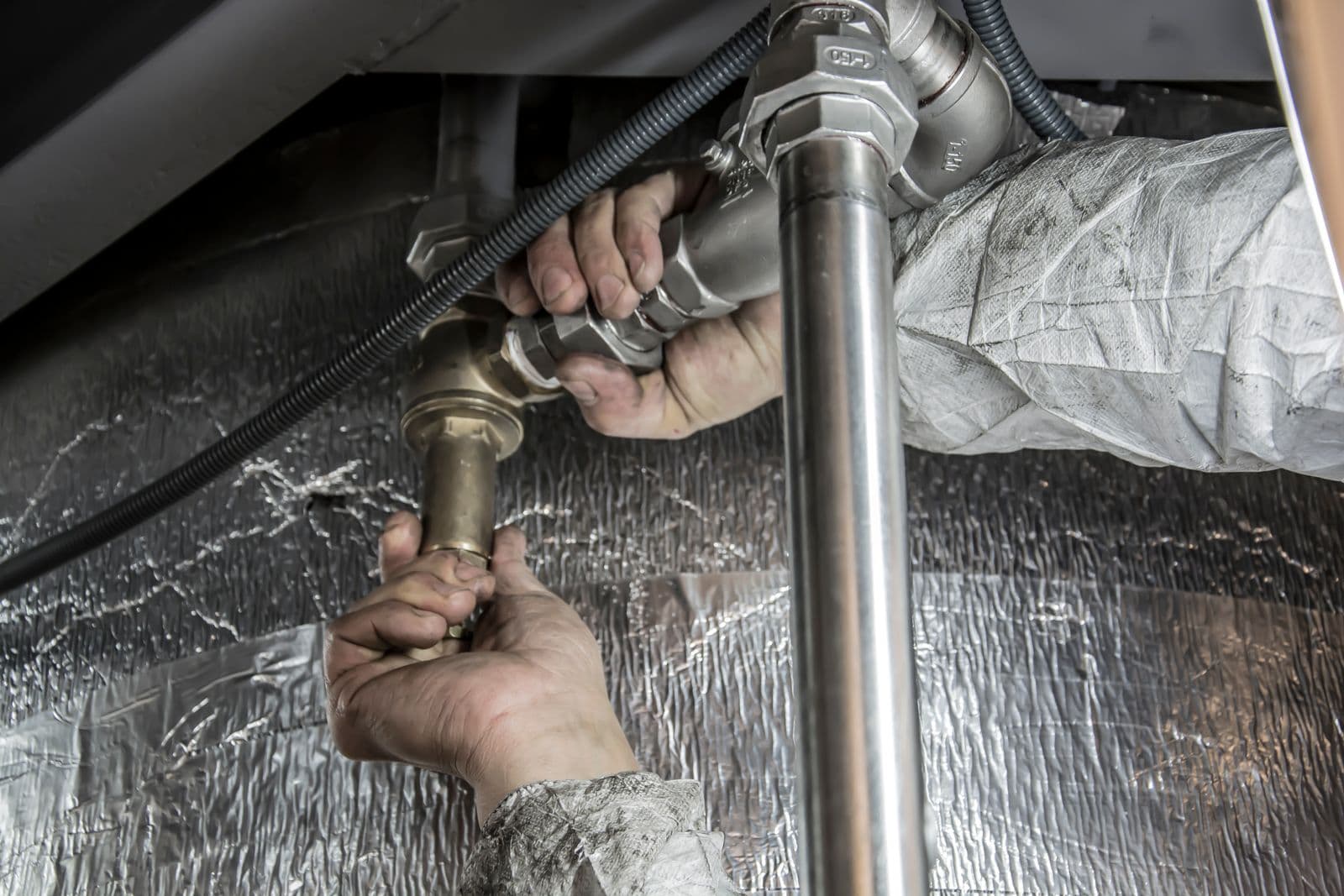
Treatment equipment is plumbing. Most of the job is the connection, the drain and the code detail behind it.


Portsmouth water, answered plainly
Where does Portsmouth get its water?+
From Lake Meade, with influence from Lake Cohoon, Speight's Run and Lake Kilby, plus five deep wells, treated at the Lake Kilby Water Treatment Plant. The lakes are in Suffolk. The plant can treat 32 million gallons a day and serves over 150,000 customers in Portsmouth, Chesapeake and Suffolk, according to the city's Reporting Year 2024 water quality report.
Does Portsmouth use chloramine?+
Yes. The report lists chloramines at an average of 3.72 ppm, range 1.40 to 4.20, against a maximum residual disinfectant level of 4. Dialysis patients and aquarium owners need to remove chloramine specifically; ordinary dechlorinators and basic carbon may not.
Is Portsmouth water hard?+
No. Hardness is listed at 24 ppm (18–34), roughly 1.4 grains per gallon — soft water. The report also prints a negative Langelier corrosion index (−1.14), which describes water that tends not to deposit scale.
Is there PFAS in Portsmouth water?+
In the UCMR5 results printed in the report — four rounds in 2023 — PFOA, PFOS, HFPO-DA, PFHxS, PFNA and PFBS were all below the reporting levels. A later sampling round or report can change that picture.
I live in Western Branch or Deep Creek. Is this my water?+
Likely, but confirm it. Chesapeake's own report says Western Branch and Deep Creek, generally north of Military Highway, receive water purchased from Portsmouth as a separate system. Suffolk also buys water from Portsmouth. Your bill names your utility; the Chesapeake and Suffolk pages cover those reports.
Where do these figures come from?+
The City of Portsmouth Water Quality Report, Reporting Year 2024 (PWS ID 3740600), covering testing from January 1 to December 31, 2024. Third-party water-quality aggregators are not the source used here. A later report supersedes these figures.
Related resources
Home water purification and treatment
The national service page behind this one.
Learn more →Suffolk water quality
Buys 2.54 MGD from Portsmouth on top of its own sources.
Learn more →Chesapeake water quality
Western Branch and Deep Creek receive Portsmouth water.
Learn more →Norfolk water quality
Across the Elizabeth River — a different utility.
Learn more →Where a water softener can discharge
Indirect-waste rules for treatment drain lines.
Learn more →All home services
Water, battery, HVAC and solar under one licensed contractor of record.
Learn more →Get a free test at your tap
A licensed technician tests at your kitchen tap and tells you which of the findings above applies to your house — chloramine taste, disinfection byproducts, plumbing materials or none of them. No charge, no obligation, and coverage confirmed at your address first.
Get a free test