Lowell, Massachusetts
Lowell Water Quality
Lowell drinks a river. One Merrimack intake, a watershed that starts in New Hampshire, a state susceptibility ranking of High — and a 2025 report whose most important number is PFAS, not disinfection byproducts.
The 2025 report puts PFAS6 at 12.5 ppt against a Massachusetts limit of 20 — compliant, about 63 percent of the limit, and the highest of any Massachusetts city on this site.
The short answer
Lowell is not an MWRA community and not a reservoir system. The Lowell Regional Water Utility draws its only supply from the Merrimack River, which rises in New Hampshire, and MassDEP ranks that source's susceptibility as High — public water system 3160000.
The governing number on the 2025 report is PFAS6 at 12.5 ppt against a Massachusetts MCL of 20: compliant, and the highest of any Massachusetts city on this site. Byproducts are low (TTHM 38, HAA5 14). So the household question is PFAS-certified carbon or RO at the drinking tap — not a softener, and not the byproduct argument that governs Worcester and Springfield.
Get a free test
Tell us your Lowell-area address. We confirm coverage first, then schedule a licensed technician to test at your tap — no charge, no obligation.
What filtration does — and does not
Sediment, carbon, softening and reverse osmosis each address a different problem. In Lowell the report's highlighted finding is PFAS, which makes certification — not the name of the stage — the thing to check.
Where Lowell water comes from
A single river intake, a High susceptibility ranking, and interconnections that run one way — the facts that separate this page from every reservoir-supplied Massachusetts city.
The Merrimack River — the only supply
The 2025 report states that the only water supply for Lowell's treatment plant is surface water from the Merrimack River, which has its source in the White Mountains of New Hampshire. The intake is on the riverbank north of the city and the water is pumped half a mile to the plant. Every other Massachusetts page on this site describes a reservoir supply; this one is a river running through other communities first.
Susceptibility: High
MassDEP's source water assessment assigned the system a susceptibility ranking of High, and the report says plainly that the watershed contains potential sources of contamination. It also notes the utility coordinates emergency planning and source protection with upstream communities in Massachusetts and New Hampshire.
One-way interconnections
The report says Lowell's interconnections with surrounding communities exist to supply them — they cannot supply water to Lowell. In 2025 the utility purified more than 4 billion gallons for about 120,000 residents and businesses in Lowell, Dracut, Tewksbury, Tyngsboro and Chelmsford, under public water system ID 3160000.
Chlorine dioxide in the train
The utility's 2026–2030 capital plan lists a chlorine dioxide system at the treatment plant, and the 2025 report lists chlorite — the byproduct chlorine dioxide leaves — at 0.43 ppm (range 0.14–0.43) against an MCL of 1.0. Disinfectant residual averaged 1.33 ppm (0.55–1.33) against a maximum of 4.
What the 2025 report actually says
Limits are fixed. The results next to them are from the Lowell Regional Water Utility 2025 Annual Water Quality Report for PWS 3160000 — system-level figures, not a reading at your tap. A later report supersedes them.
PFAS6 — the number that governs here
Massachusetts regulates the sum of six PFAS compounds with an MCL of 20 ppt. Lowell's 2025 report gives PFAS6 at 12.5 ppt, with a range of non-detect to 12.5, and marks no violation. That is about 63 percent of the limit — compliant, and the highest PFAS6 of any Massachusetts city page on this site.
Disinfection byproducts — low
Total trihalomethanes at a highest running annual average of 38 ppb (range 16–69) against 80, and haloacetic acids at 14 ppb (1.46–33.2) against 60. Both well inside the limits, and far below the figures that govern Worcester and Springfield.
A monitoring violation, not an exceedance
The report discloses that during November 2025 the utility did not complete all required turbidity monitoring, so it cannot be sure of water quality during that time; a Notice of Non-Compliance was issued on 5/22/2026. It states all other requirements and MCLs were met, and that new plant controllers with data memory and updated procedures are being implemented. Reported turbidity peaked at 0.190 NTU.
Sodium
Reported at 51.1 mg/L, attributed to natural deposits, road salt and treatment chemicals. There is no MCL; MassDEP's guideline for people on sodium-restricted diets is 20 mg/L. Worth knowing for that household — and a reason a softener, which adds sodium, is the wrong direction here.
Lead and copper
The 2025 report prints the 90th-percentile lead result as .0000 with 0 of 50 samples above the 15 ppb action level, and copper at .0168 ppm with 0 of 50 above 1.3. It states the lead and copper action levels have not been exceeded in any compliance round since 2000. Lead at a given tap is still a service-line and plumbing question — the utility's service line inventory is ongoing.
Fluoride and nitrate
Fluoride is added, reported at 0.86 ppm (0.57–0.86) against the state MCL of 2 and the federal MCL of 4. Nitrate 0.430 ppm against 10.
Why a river supply changes the argument
Worcester reports PFAS6 at 3.3 ppt and Cambridge at 6.4 — both reservoir systems. Lowell's 12.5 is roughly two to four times those, and it comes from a river whose watershed, in the report's own words, contains potential sources of contamination. It is still inside the Massachusetts limit.
The byproduct story runs the other way. Springfield is over its haloacetic acids limit at 67 ppb and Worcester's TTHM sits at 63 of 80. Lowell's are 14 and 38. Importing either city's carbon-for-byproducts argument into Lowell — or Boston's MWRA service-line argument — would describe somebody else's water.
Where these figures come from
Everything on this page traces to primary sources. Independent compilations of water quality data exist and are not used here.
- Lowell Regional Water Utility 2025 Annual Water Quality Report — PWS ID 3160000, calendar 2025.
- LRWU 2026–2030 Capital Plan Update — treatment plant systems, including chlorine dioxide.
- MassDEP — PFAS in drinking water — the PFAS6 MCL of 20 ppt.
- EPA — identifying drinking water filters certified to reduce PFAS — NSF/ANSI 53 and 58 PFAS reduction claims.
Matching treatment to the finding
In a city whose highlighted number is PFAS and whose byproducts are low, the useful household purchase is narrow — and the most heavily marketed category in New England is the wrong one.
PFAS-certified carbon or RO at the kitchen tap
If the goal is a lower PFAS number in the water someone drinks, the relevant products are point-of-use carbon or reverse osmosis units certified for PFOA and PFOS reduction — look for NSF/ANSI 53 or 58 on the certification listing, not on the box copy alone. That targets the finding the report actually highlights.
Not a byproduct problem
In Worcester and Springfield the case for carbon is disinfection byproducts. In Lowell they are low — TTHM 38, HAA5 14 — so carbon here is a PFAS-and-taste purchase, and the certification matters more than the stage name.
A softener — the wrong direction
The report publishes no hardness figure, so do not assume one. It does publish sodium at 51.1 mg/L, already above the 20 mg/L guideline for sodium-restricted diets, and a salt-based softener adds sodium. Measure hardness at the tap before anyone quotes one.
Whole-house vs one tap
PFAS matters for water that is swallowed, which is why a single drinking-water tap is the usual scope. Whole-house treatment is a larger system, a larger drain and maintenance question, and a budget decision rather than a chemistry one.
How the free test works
A licensed technician tests at your kitchen tap, walks the plumbing, and tells you which of the findings above applies to your house and which does not. There is no charge and no obligation.
Seamless Home is the licensed contractor of record on the work that follows. Installation is performed by vetted installing partners engaged as our subcontractors, and the workmanship obligation stays with us. Coverage is confirmed per service area rather than promised as blanket availability.
Drain connections for under-sink RO still have to meet the indirect-waste rule — where a water softener is allowed to discharge sets out the plumbing logic even when the equipment is RO rather than a softener.
What a water treatment job with us covers
Installation and replacement of whole-home and point-of-use treatment, specified against what your water actually contains.
Sediment filtration
Installation of the first stage that protects everything downstream of it, sized to the service line and the household draw.
Softening
Installation of ion-exchange softening where hardness is the problem, including the drain connection the plumbing code treats as indirect waste.
Carbon filtration
Installation of carbon stages for taste, odour and disinfection by-products, specified from your utility's own water quality report.
Reverse osmosis
Point-of-use installation at the kitchen sink where the target is dissolved solids rather than whole-home flow.
Disinfection
Installation of UV or equivalent treatment where the supply is a private well or is otherwise not continuously disinfected.
System replacement
Replacing equipment that has reached the end of its service life, including the discharge and air gap details an inspector looks at.
This is installation and replacement work, specified from a published water quality report or a test of your supply — not from a sales chart. Coverage is confirmed per service area rather than promised as blanket availability.
What the work actually looks like
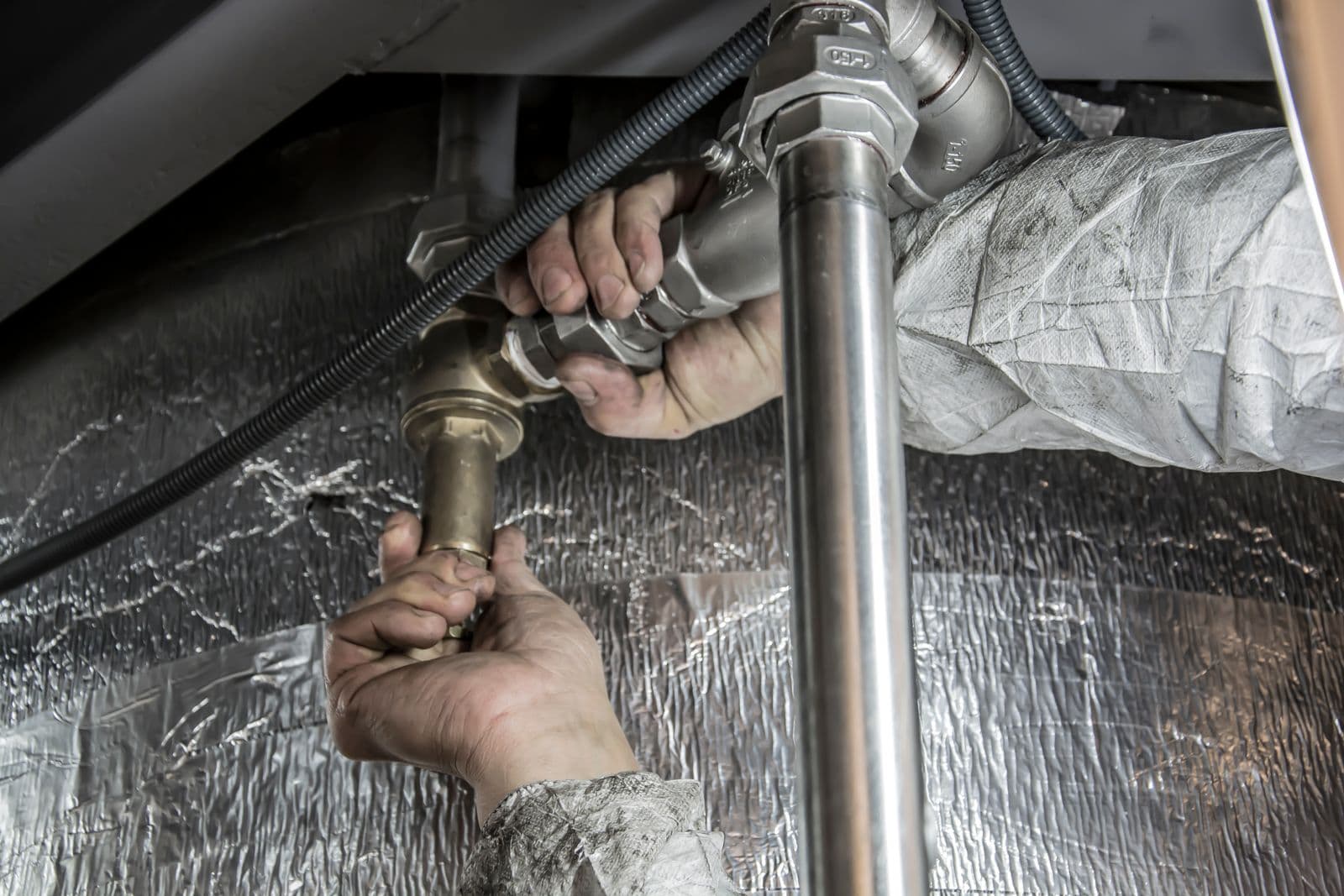
Treatment equipment is plumbing. Most of the job is the connection, the drain and the code detail behind it.


Lowell water, answered plainly
Where does Lowell get its water?+
From the Merrimack River only. The Lowell Regional Water Utility's 2025 report states that the river is the only supply for its treatment plant, that it rises in the White Mountains of New Hampshire, and that the intake sits on the riverbank north of the city. Lowell is not an MWRA community, and its interconnections supply neighbouring towns rather than Lowell.
Is there PFAS in Lowell water?+
Yes, detected and compliant. The 2025 report gives PFAS6 — the sum of six PFAS compounds Massachusetts regulates — at 12.5 ppt, ranging from non-detect to 12.5, against a state MCL of 20 ppt, with no violation. That is the highest PFAS6 of the Massachusetts cities covered on this site, and the finding a Lowell treatment decision is most reasonably built around.
Did Lowell have a water violation in 2025?+
One monitoring violation. The report says that during November 2025 the utility did not complete all required turbidity monitoring, so it cannot be sure of the water's quality during that period, and a Notice of Non-Compliance was issued on 5/22/2026. It states that all other requirements and MCLs were met, and that monitoring resumed with new controller data memory and updated procedures. A missed measurement and an exceeded limit are different findings.
How is Lowell different from Worcester or Springfield?+
Both of those are reservoir supplies where the governing number is a disinfection byproduct — TTHM at 63 ppb in Worcester, HAA5 over its limit at 67 ppb in Springfield. Lowell is a river supply whose byproducts are low (TTHM 38, HAA5 14) and whose highlighted number is PFAS6 at 12.5 ppt. Same state, different water, different reason to treat.
Does a water filter remove PFAS?+
Some do. Point-of-use activated carbon and reverse osmosis units can be certified for PFOA and PFOS reduction under NSF/ANSI 53 or 58; the certification listing states what a specific model was tested to reduce. A filter without that certification may be sold for taste and odour only. Replace cartridges on the stated schedule, because a spent cartridge stops reducing what it was certified for.
Do I need a water softener in Lowell?+
Not on the strength of the report. It publishes no hardness figure, and it does publish sodium at 51.1 mg/L — above the 20 mg/L guideline for sodium-restricted diets. A salt-based softener would add sodium. If hardness matters to you, measure it at your tap first.
Where do these figures come from?+
The Lowell Regional Water Utility 2025 Annual Water Quality Report for PWS ID 3160000, covering calendar 2025, and the utility's 2026–2030 Capital Plan Update for the chlorine dioxide system. The report is published as a scanned PDF; figures here were read from it and checked against the page images. Independent water-quality aggregators are not the source used on this page.
Related resources
Home water purification and treatment
The national service page behind this one.
Learn more →Worcester water quality
Reservoir supply — PFAS6 3.3, governing number TTHM 63 of 80.
Learn more →Cambridge water quality
Reservoirs plus carbon filtration — governing number is sodium.
Learn more →Springfield water quality
Cobble Mountain supply — HAA5 over the MCL, new plant due ~2028.
Learn more →Boston water quality
The MWRA system — unfiltered, chloraminated, different governing number.
Learn more →Where a water softener can discharge
Indirect-waste rules for treatment drain lines.
Learn more →All home services
Water, battery, HVAC and solar under one licensed contractor of record.
Learn more →Get a free test at your tap
A licensed technician tests at your kitchen tap and tells you which of the findings above applies to your house — and which does not. No charge, no obligation, and coverage confirmed at your address first.
Get a free test