Haverhill, Massachusetts
Haverhill Water Quality
On the Merrimack, but not from it: lakes and ponds that end at Kenoza Lake, a sand-then-carbon filter plant and free chlorine. The 2025 report's everyday facts: byproducts within limits but the highest in the valley, sodium twice the state guideline, and low PFAS.
TTHM 58 ppb, up to 65 — under the limit of 80, and the highest Merrimack Valley figure on this site.
The short answer
Haverhill drinks from lakes, ponds and a reservoir — Millvale Reservoir and Crystal Lake pumped into Kenoza Lake, with Round Pond and Winnekenni Basin overflowing into it. It does not use the Merrimack River.
The 2025 report shows TTHM at 58 ppb (up to 65, limit 80), sodium at 41 ppm against a MassDEP guideline of 20, and PFAS6 at 3.09 ppt against a standard of 20. If anything here justifies equipment, it is byproduct margin at the kitchen tap — and sodium is a reason to be careful with a salt-based softener.
Get a free test
Tell us your Haverhill address. We confirm coverage first, then schedule a licensed technician to test at your tap — no charge, no obligation.
What filtration does — and does not
Softening, carbon and reverse osmosis solve different problems. Haverhill's report is a byproduct and sodium story, not a hardness purchase order.
Where Haverhill water comes from
A chain of lakes and ponds ending at Kenoza Lake — a different starting point from the river systems in Lowell and Lawrence.
Millvale Reservoir and Crystal Lake
All of Haverhill's water is surface water, not wells. Water is pumped as needed from Millvale Reservoir and Crystal Lake into Kenoza Lake, where the treatment plant sits.
Round Pond and Winnekenni Basin
Both overflow into Kenoza Lake and are part of the same system. The combined water is pumped from Kenoza Lake into the plant.
Sand, then granular activated carbon
The plant is conventional — coagulation, flocculation, clarification, filtration and disinfection — with a two-stage filter of sand and then granular activated carbon. Water is then fluoridated, disinfected with sodium hypochlorite and dosed with zinc orthophosphate to control lead and copper corrosion.
A hilly system
The plant processed 2.0 billion gallons in 2025 into about 278 miles of main, three storage tanks holding 17 million gallons and 13 pumping stations — which the City attributes to keeping pressure up across Haverhill's hills.
What the 2025 Haverhill report actually says
Limits are fixed. The results next to them are from the Haverhill Water Department's Annual Water Quality Report for Reporting Year 2025 — system-level figures, not a reading at your tap. A later report supersedes them.
TTHM — 58 ppb (15–65)
Total trihalomethanes are reported at 58 ppb with a range of 15 to 65, against an MCL of 80. Compliant, and the highest of the Merrimack Valley reports on this site, which is why byproducts are the first thing to look at here.
HAA5 — 25 ppb (ND–30)
Haloacetic acids at 25 ppb with a range up to 30, against an MCL of 60. Like TTHM, they form when chlorine meets the natural organic matter lake water carries.
Sodium — 41 ppm
Sodium is listed at 41 ppm. That is about twice the 20 ppm guideline MassDEP uses for people on a sodium-restricted diet — not a drinking water limit, but relevant to anyone told to watch sodium, and to anyone weighing a salt-based softener.
PFAS6 — 3.09 ppt (1.89–4.61)
The sum of six PFAS was 3.09 ppt with a range of 1.89 to 4.61, against the Massachusetts standard of 20 ppt. Low — well below the 12.5 ppt Lowell reported from the Merrimack River.
Free chlorine — 0.78 ppm (0.52–1.62)
Disinfection is with sodium hypochlorite, reported as chlorine at 0.78 ppm on average, against a maximum residual level of 4. This is free chlorine, not chloramine.
Lead — ND at the 90th percentile
In the 2023 round, lead at the 90th percentile was not detected and 0 of 30 sites exceeded the 15 ppb action level; copper was 0.018 ppm. The City publishes a service line inventory map.
Why Haverhill is not Lawrence downriver
Lawrence and Lowell both draw from the Merrimack River; Lowell's governing number is PFAS6 at 12.5 ppt, and Lawrence's are sodium and PFAS. Haverhill sits on the same river but drinks from its own lakes: its PFAS6 is a fraction of Lowell's, and its trihalomethane figure is higher than either. On the North Shore, Lynn also uses local ponds, but disinfects with chlorine dioxide and chlorine. Those differences decide whether carbon, reverse osmosis or neither is the answer, so a quote built on another city's report is a quote for the wrong house.
Where these figures come from
Everything on this page traces to the Haverhill Water Department. Independent compilations of water quality data exist and are not used here.
- Haverhill Water Department — Annual Water Quality Report, Reporting Year 2025 (PDF) — sources, treatment process, regulated, secondary and unregulated substances, lead and copper, and the 2025 SOC monitoring violation.
- City of Haverhill — 2025 Water Quality Report Now Available (June 2, 2026) — publication notice and how to request a printed copy.
- City of Haverhill — Water Treatment Plant — earlier reports and the source water assessment.
Matching treatment to the finding
Haverhill's report supports a byproduct-margin conversation at the kitchen tap, with sodium as a reason for care — not a softener default.
Byproducts: point-of-use first
TTHM and HAA5 are within limits. A household that wants them lower starts with a kitchen-tap carbon or reverse osmosis system certified for the reduction it claims.
Sodium: think twice about adding more
At 41 ppm before any treatment, a salt-based softener adds sodium on top. If someone in the house is on a sodium-restricted diet, that belongs in the softener conversation — and reverse osmosis at the kitchen tap reduces sodium.
Hardness: test, do not assume
The 2025 report prints no hardness figure. Alkalinity is listed at 31.9 ppm and pH at 7.6, but neither is hardness. A tap test answers it before anyone sizes a softener.
Taste: ordinary carbon handles free chlorine
A free chlorine residual that can reach about 1.6 ppm is noticeable to some households. Standard activated carbon reduces chlorine taste and odour well.
How the free test works
A licensed technician tests at your kitchen tap, walks the plumbing, and tells you which of the findings above applies to your house and which does not. There is no charge and no obligation.
Seamless Home is the licensed contractor of record on the work that follows. Installation is performed by vetted installing partners engaged as our subcontractors, and the workmanship obligation stays with us. Coverage is confirmed per service area rather than promised as blanket availability.
An RO unit needs a legal drain connection — where a water softener is allowed to discharge sets out the indirect-waste rule that applies to treatment drain lines.
What a water treatment job with us covers
Installation and replacement of whole-home and point-of-use treatment, specified against what your water actually contains.
Sediment filtration
Installation of the first stage that protects everything downstream of it, sized to the service line and the household draw.
Softening
Installation of ion-exchange softening where hardness is the problem, including the drain connection the plumbing code treats as indirect waste.
Carbon filtration
Installation of carbon stages for taste, odour and disinfection by-products, specified from your utility's own water quality report.
Reverse osmosis
Point-of-use installation at the kitchen sink where the target is dissolved solids rather than whole-home flow.
Disinfection
Installation of UV or equivalent treatment where the supply is a private well or is otherwise not continuously disinfected.
System replacement
Replacing equipment that has reached the end of its service life, including the discharge and air gap details an inspector looks at.
This is installation and replacement work, specified from a published water quality report or a test of your supply — not from a sales chart. Coverage is confirmed per service area rather than promised as blanket availability.
What the work actually looks like
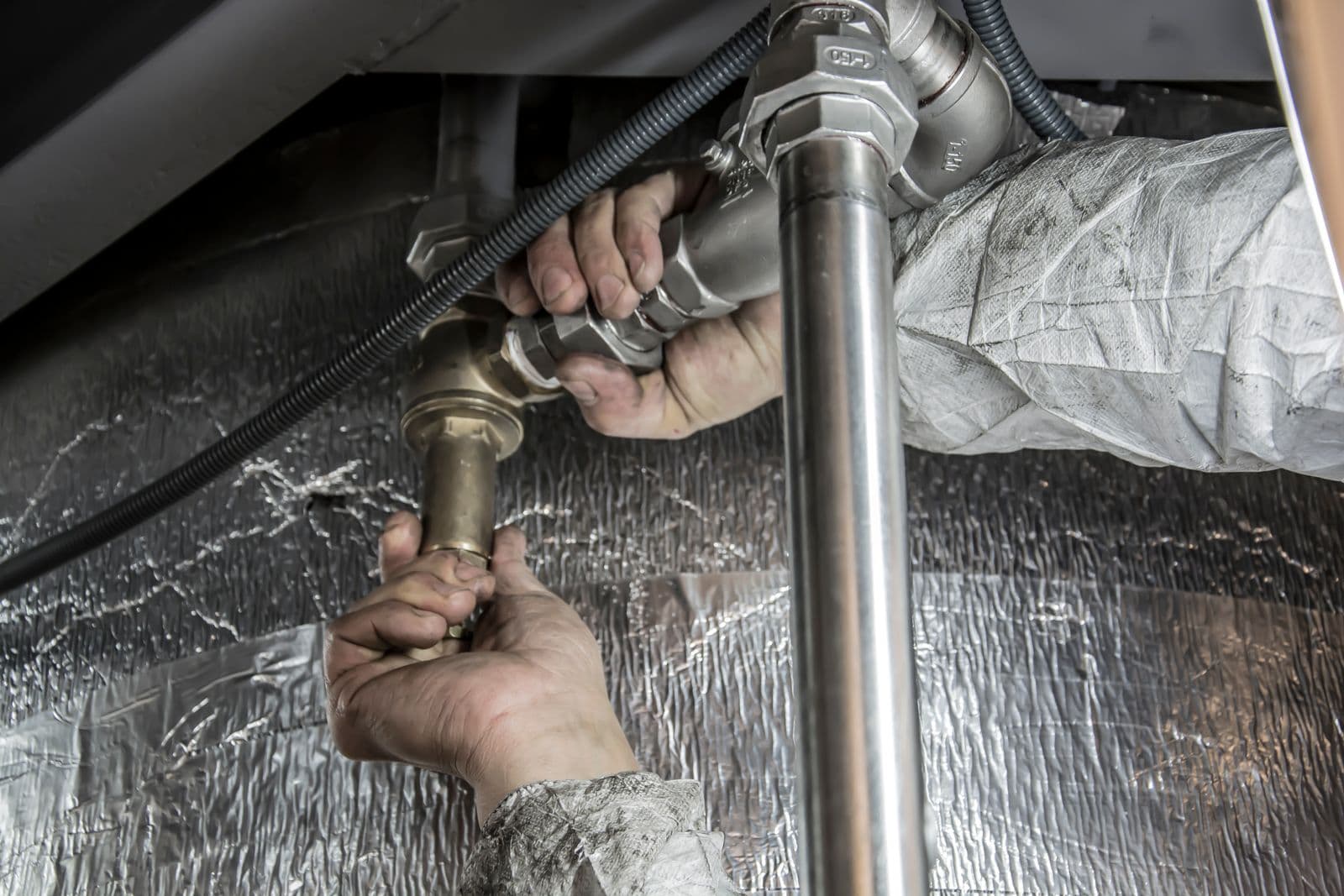
Treatment equipment is plumbing. Most of the job is the connection, the drain and the code detail behind it.


Haverhill water, answered plainly
Where does Haverhill's water come from?+
From lakes, ponds and a reservoir — all surface water, no wells. Water is pumped as needed from Millvale Reservoir and Crystal Lake into Kenoza Lake, and Round Pond and Winnekenni Basin overflow into it. The plant draws from Kenoza Lake. Haverhill does not use the Merrimack River, unlike Lowell and Lawrence.
Is Haverhill water safe to drink?+
Every regulated substance in the Reporting Year 2025 table is marked no violation. The report does record one monitoring violation: a required synthetic organic chemical sample was not collected on time in the first quarter of 2025. The City says follow-up sampling found no detectable SOCs and no action is required by consumers.
Is Haverhill water hard?+
The report does not print a hardness figure, so we do not quote one. It does list sodium at 41 ppm, which matters if you are considering a salt-based softener. A tap test gives the hardness reading a softener decision needs.
Is there PFAS in Haverhill water?+
Yes, at a low level. PFAS6 was 3.09 ppt in 2025, with a range of 1.89 to 4.61 ppt, against the Massachusetts standard of 20 ppt. A certified lab test at your tap is the direct answer for your house.
Does Haverhill use chlorine or chloramine?+
Chlorine. The plant disinfects with sodium hypochlorite, and the report lists the chlorine residual at 0.78 ppm on average, ranging from 0.52 to 1.62. Ordinary activated carbon handles the taste.
Where do these figures come from?+
The Haverhill Water Department's Annual Water Quality Report for Reporting Year 2025 (PWS ID 3128000), announced by the City on June 2, 2026. Third-party water-quality aggregators are not the source used here. A later report supersedes these figures.
Related resources
Home water purification and treatment
The national service page behind this one.
Learn more →Lawrence water quality
The Merrimack River treated downstream — the contrast.
Learn more →Lowell water quality
A single Merrimack River intake and its PFAS figure.
Learn more →Lynn water quality
Another local-pond system, with chlorine dioxide.
Learn more →Where a water softener can discharge
Indirect-waste rules for treatment drain lines.
Learn more →All home services
Water, battery, HVAC and solar under one licensed contractor of record.
Learn more →Get a free test at your tap
A licensed technician tests at your kitchen tap and tells you which of the findings above applies to your house — byproducts, sodium, hardness or none of them. No charge, no obligation, and coverage confirmed at your address first.
Get a free test