Lynn, Massachusetts
Lynn Water Quality
Six local ponds and river intakes, not the MWRA. The 2025 report's everyday facts: chlorine dioxide and chlorine instead of chloramine, PFAS6 at 7.7 ppt, and PFOA and PFOS just under EPA's 4 ppt limits.
PFOS 3.40 ppt and PFOA 3.30 ppt in the 2025 report — under the federal 4.0 ppt limit, but not by much.
The short answer
Lynn is not on MWRA water. The Water and Sewer Commission runs six local surface sources — four ponds and the Ipswich and Saugus River intakes — and disinfects with chlorine dioxide and chlorine, not chloramine.
The 2025 report lists PFAS6 at 7.70 ppt against the state's 20, with PFOA 3.30 and PFOS 3.40 ppt — just under EPA's 4.0 ppt federal limits. Byproducts and lead are within limits. If anything here justifies equipment, it is PFAS margin at the kitchen tap.
Get a free test
Tell us your Lynn address. We confirm coverage first, then schedule a licensed technician to test at your tap — no charge, no obligation.
What filtration does — and does not
Softening, carbon and reverse osmosis solve different problems. Lynn's report is a PFAS-margin and free-chlorine story, not a hardness purchase order.
Where Lynn water comes from
Local ponds and river diversions with their own plant — a different supply and a different disinfectant from the MWRA towns next door.
Six local surface sources
The Lynn Water and Sewer Commission operates six public surface water supply sources in four protection areas: Breeds Pond (entirely in Lynn), Hawkes Pond (Lynnfield and Saugus), Birch Pond (Lynn and Saugus) and Walden Pond (Lynn, Lynnfield and Saugus), plus intakes on the Ipswich River and the Saugus River, both in Lynnfield.
MWRA only for GE and emergencies
The report says Lynn also uses Massachusetts Water Resources Authority water to serve General Electric and as an emergency source for customers. For ordinary households, the Quabbin and Wachusett story told on Boston pages is not the everyday supply.
Direct filtration at the Reardon plant
Water is treated at the Raymond F. Reardon Treatment Plant: alum is added so particles clump, then it passes filters of activated carbon, sand and gravel, backwashed at least daily. Fluoride is added, and zinc orthophosphate and caustic soda are added for corrosion control.
Chlorine dioxide and chlorine — not chloramine
Disinfection uses chlorine dioxide and chlorine at several stages. That is a different chemistry from MWRA's monochloramine, and it changes which filter answers a taste complaint.
What the 2025 Lynn report actually says
Limits are fixed. The results next to them are from the Lynn Water and Sewer Commission Water Quality Report, Reporting Year 2025 — system-level figures, not a reading at your tap. A later report supersedes them.
PFAS6 — 7.70 ppt (range 1.90–7.70)
Against the Massachusetts PFAS6 MCL of 20 ppt, Lynn's 2025 result is 7.70 ppt. That is below the state limit and below the 12.5 ppt printed on our Lowell page — but not zero.
PFOA 3.30 ppt and PFOS 3.40 ppt
The report lists PFOA at 3.30 ppt (2.70–3.30) and PFOS at 3.40 ppt (1.90–3.40), printed against the state standard. EPA's federal rule sets 4.0 ppt for each. Lynn's highest figures sit just under that line — the reason a PFAS-certified filter is a reasonable question here rather than a sales reflex.
Chlorine residual 0.61 ppm; chlorine dioxide 240 ppb peak
Chlorine averaged 0.61 ppm (0.03–1.02) against an MRDL of 4. Chlorine dioxide is listed at 240 ppb (ND–240) against an MRDL of 800, and its byproduct chlorite at 0.18 ppm (0.05–0.18) against an MCL of 1.
Disinfection byproducts — TTHM 48 ppb, HAA5 22 ppb
Total trihalomethanes 48 ppb (27–65) against 80; haloacetic acids 22 ppb (5–30) against 60. Both within limits. Pond water carries organic matter, and byproducts form when disinfectant meets it.
Sodium — 75.2 ppm
Listed among unregulated substances at 75.2 ppm. Worth knowing for a sodium-restricted diet, and a reason not to add a salt-based softener without a hardness reason.
Lead and copper — 2023 sampling, 0 of 30 above
Lead at the 90th percentile was 2.40 ppb (ND–4.20) and copper 0.10 ppm (0.01–0.20), with 0 of 30 sites above either action level. The Commission's lead service line inventory project is published on its website.
Why Lynn is not Boston with a different ZIP
Boston and Cambridge both use monochloramine as the residual — Boston on MWRA water, Cambridge on its own reservoirs. Lynn, north of Boston, drinks from its own ponds with chlorine dioxide and chlorine. The closer comparison is Lowell, another off-MWRA surface supply whose 2025 PFAS6 figure was higher. Borrowing a neighbour's report for a Lynn filter quote is how households buy the wrong stage.
Where these figures come from
Everything on this page traces to primary sources. Independent compilations of water quality data exist and are not used here.
- Lynn Water and Sewer Commission — Water Quality Report, Reporting Year 2025 (PDF) — sources, treatment, regulated and unregulated tables, PFAS6, lead and copper.
- Lynn Water and Sewer Commission — Commission Reports — current and archived annual reports, including the 2024 hardness figure.
- EPA — PFAS National Primary Drinking Water Regulation — 4.0 ppt MCLs for PFOA and PFOS.
Matching treatment to the finding
Lynn's report supports a PFAS-certified point-of-use conversation — not a softener default or chloramine-grade media.
PFAS: certified carbon or RO at the kitchen tap
With PFOA and PFOS just under 4.0 ppt, households who want margin usually start at the drinking-water tap. Check NSF/ANSI 53 or 58 listings that name PFOA and PFOS reduction.
Taste: ordinary carbon works on free chlorine
Unlike chloramine towns, Lynn's residual is free chlorine averaging 0.61 ppm. Standard activated carbon handles chlorine taste well — no catalytic media needed for that complaint.
Byproducts: point-of-use first
TTHM and HAA5 are within limits. If a household wants them lower, kitchen-tap carbon or RO is the proportionate step before whole-house equipment.
Older plumbing: test the house, not the system
System lead results are low. A pre-1986 house or an unknown service line is answered by a tap test and the Commission's inventory, not by the 90th-percentile figure.
How the free test works
A licensed technician tests at your kitchen tap, walks the plumbing, and tells you which of the findings above applies to your house and which does not. There is no charge and no obligation.
Seamless Home is the licensed contractor of record on the work that follows. Installation is performed by vetted installing partners engaged as our subcontractors, and the workmanship obligation stays with us. Coverage is confirmed per service area rather than promised as blanket availability.
An RO unit needs a legal drain connection — where a water softener is allowed to discharge sets out the indirect-waste rule that applies to treatment drain lines.
What a water treatment job with us covers
Installation and replacement of whole-home and point-of-use treatment, specified against what your water actually contains.
Sediment filtration
Installation of the first stage that protects everything downstream of it, sized to the service line and the household draw.
Softening
Installation of ion-exchange softening where hardness is the problem, including the drain connection the plumbing code treats as indirect waste.
Carbon filtration
Installation of carbon stages for taste, odour and disinfection by-products, specified from your utility's own water quality report.
Reverse osmosis
Point-of-use installation at the kitchen sink where the target is dissolved solids rather than whole-home flow.
Disinfection
Installation of UV or equivalent treatment where the supply is a private well or is otherwise not continuously disinfected.
System replacement
Replacing equipment that has reached the end of its service life, including the discharge and air gap details an inspector looks at.
This is installation and replacement work, specified from a published water quality report or a test of your supply — not from a sales chart. Coverage is confirmed per service area rather than promised as blanket availability.
What the work actually looks like
Treatment equipment is plumbing. Most of the job is the connection, the drain and the code detail behind it.
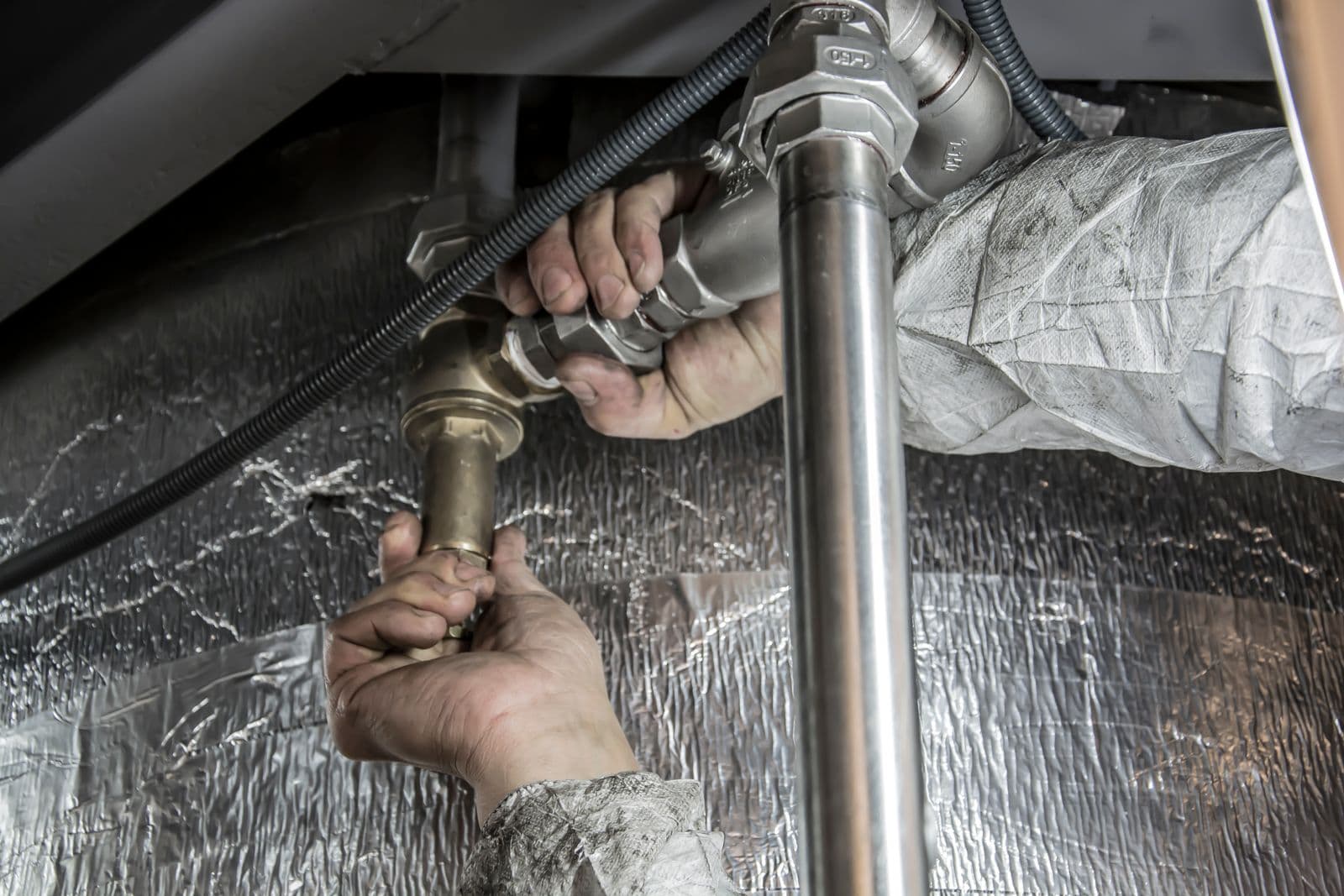


Lynn water, answered plainly
Is Lynn on MWRA water?+
Not for ordinary households. The Lynn Water and Sewer Commission runs six of its own surface sources — Breeds, Birch, Walden and Hawkes ponds plus Ipswich and Saugus River intakes — and treats them at the Reardon plant. Its 2025 report says MWRA water is used to serve General Electric and as an emergency source.
Does Lynn use chloramine?+
No. The report describes disinfection with chlorine dioxide and chlorine, with a chlorine residual averaging 0.61 ppm in 2025. That is different from MWRA communities such as Boston and Cambridge, which use monochloramine.
Is there PFAS in Lynn water?+
Yes, at low levels. The 2025 report lists PFAS6 at 7.70 ppt (1.90–7.70) against the Massachusetts limit of 20 ppt, with PFOA at 3.30 ppt and PFOS at 3.40 ppt. EPA's federal rule sets 4.0 ppt each for PFOA and PFOS. Lynn's figures are under both, but close to the federal line.
Is Lynn water hard?+
The 2025 report's tables do not print a hardness figure. The Commission's 2024 report listed hardness at 55 ppm as CaCO3, which is about 3.2 grains per gallon. A tap test answers it for your house.
Where do these figures come from?+
The Lynn Water and Sewer Commission Water Quality Report, Reporting Year 2025, covering testing during 2025. Third-party water-quality aggregators are not the source used here. A later report supersedes these figures.
Related resources
Home water purification and treatment
The national service page behind this one.
Learn more →Boston water quality
MWRA supply with monochloramine — the contrast.
Learn more →Lowell water quality
Another off-MWRA surface supply — PFAS6 at 12.5 ppt.
Learn more →Cambridge water quality
Its own reservoirs — monochloramine residual, unlike Lynn.
Learn more →Where a water softener can discharge
Indirect-waste rules for treatment drain lines.
Learn more →All home services
Water, battery, HVAC and solar under one licensed contractor of record.
Learn more →Get a free test at your tap
A licensed technician tests at your kitchen tap and tells you which of the findings above applies to your house — PFAS margin, chlorine taste, disinfection byproducts or none of them. No charge, no obligation, and coverage confirmed at your address first.
Get a free test