Manchester, New Hampshire
Manchester Water Quality
Manchester drinks Lake Massabesic and Merrimack River water. The 2025 report shows very soft water, PFOA averaging 5.34 ppt at the Massabesic plant, and a lead 90th percentile of 1.8 ppb.

Lake Massabesic + Merrimack River · PFOA 5.34 ppt (Massabesic avg) · lead 90th 1.8 ppb, 3 of 69 over AL · very soft.
The short answer
Manchester's tap water comes from Manchester Water Works (PWS ID NH1471010), which treats Lake Massabesic and, since August 2023, the Merrimack River.
The 2025 report shows PFOA averaging 5.34 ppt at the Massabesic plant — under the 12 ppt limit listed in the report, above EPA's future 4.0 ppt national limit — and a lead 90th percentile of 1.8 ppb, with 3 of 69 homes over the action level. The water is very soft.
Get a free test
Tell us your Manchester address. We confirm coverage first, then schedule a licensed technician to test at your tap — no charge, no obligation.
What the 2025 Manchester report shows
Figures below are results from Manchester Water Works' Water Quality Report for reporting year 2025. A later report supersedes them.
PFOA averages 5.34 ppt at Lake Massabesic
The regulated table lists PFOA at 5.34 ppt (range 4.72–5.99) at the Lake Massabesic plant and 2.08 ppt at the Merrimack plant, against the 12 ppt limit shown in the report (New Hampshire's state standard). EPA's national PFOA limit of 4.0 ppt is on a later compliance schedule, so Massabesic water sits above that future federal number today.
Other PFAS at low single-digit ppt
PFOS averaged 1.49 ppt at Massabesic and 1.11 ppt at Merrimack (limit shown 15). PFHxS averaged 0.688 and 0.960 ppt (limit shown 18). Unregulated PFBS was 0.948 and 1.450 ppt.
Lead 90th percentile at 1.8 ppb
2025 tap sampling found a lead 90th percentile of 1.8 ppb against a 15 ppb action level, but the range ran from not detected to 34.0 ppb and 3 of 69 sites were over the action level. Copper's 90th percentile was 0.092 ppm with 0 of 69 over.
Very soft water
The report lists calcium at only 4.2 ppm at Massabesic and 6.65 ppm at Merrimack. Manchester Water Works adjusts pH and adds phosphoric acid for corrosion control, which matters more in soft water than in hard.
Sodium 44–55 ppm
Sodium averaged 44.1 ppm at Massabesic and 54.5 ppm at Merrimack. Chloride averaged 41.4 and 74.5 ppm. Neither is a health violation; both are relevant for people on sodium-restricted diets.
Disinfection byproducts low on average
Total trihalomethanes averaged 14.9 ppb (range 0.7–66.0) against an 80 ppb MCL. Haloacetic acids averaged 9.3 ppb (range 1.4–39.0) against 60. The Massabesic plant uses ozone, which cuts color, taste and odor before filtration.
How the water is produced
A lake supply since 1874 and a river plant since 2023.
Lake Massabesic — since 1874
Lake Massabesic has supplied Manchester and parts of six surrounding communities since 1874. It is treated at the plant beside the lake, completed in 1974 and upgraded in 2003–06.
Merrimack River — Hooksett plant since August 2023
The Merrimack River Water Treatment Facility in Hooksett began supplying water in August 2023. The 2025 report lists results for both plants side by side.
Manchester Water Works — PWS ID NH1471010
Treated water is pumped into a roughly 500-mile piping network. Manchester Water Works also serves parts of Salem, Hampstead, Atkinson and Plaistow.
Where these figures come from
Everything on this page traces to Manchester Water Works' Water Quality Report for reporting year 2025 (PWS ID NH1471010), which covers testing from January 1 to December 31, 2025.
Matching treatment to the finding
PFAS and lead plumbing drive most Manchester decisions; hardness does not.
PFAS reduction at the kitchen tap
If you want PFOA below EPA's 4.0 ppt future limit now, point-of-use reverse osmosis or carbon certified for PFOA and PFOS is the usual answer.
Lead reduction in older homes
Three of 69 sampled homes were over the action level. Manchester Water Works publishes a service-line inventory. Flushing after stagnation and a certified lead-reduction filter are the first steps.
Softening is unnecessary
With calcium around 4–7 ppm, scale is not the problem. Spend on PFAS or lead reduction instead of a softener.
Test before you buy
The report is system-wide and covers two plants. A kitchen-tap test tells you which findings show up at your address.
How the free test works
A licensed technician tests at your kitchen tap, walks the plumbing, and tells you which of the findings above applies to your house and which does not. There is no charge and no obligation.
Seamless Home is the licensed contractor of record on the work that follows. Installation is performed by vetted installing partners engaged as our subcontractors, and the workmanship obligation stays with us. Coverage is confirmed per service area rather than promised as blanket availability.
What a water treatment job with us covers
Installation and replacement of whole-home and point-of-use treatment, specified against what your water actually contains.
Sediment filtration
Installation of the first stage that protects everything downstream of it, sized to the service line and the household draw.
Softening
Installation of ion-exchange softening where hardness is the problem, including the drain connection the plumbing code treats as indirect waste.
Carbon filtration
Installation of carbon stages for taste, odour and disinfection by-products, specified from your utility's own water quality report.
Reverse osmosis
Point-of-use installation at the kitchen sink where the target is dissolved solids rather than whole-home flow.
Disinfection
Installation of UV or equivalent treatment where the supply is a private well or is otherwise not continuously disinfected.
System replacement
Replacing equipment that has reached the end of its service life, including the discharge and air gap details an inspector looks at.
This is installation and replacement work, specified from a published water quality report or a test of your supply — not from a sales chart. Coverage is confirmed per service area rather than promised as blanket availability.
What the work actually looks like
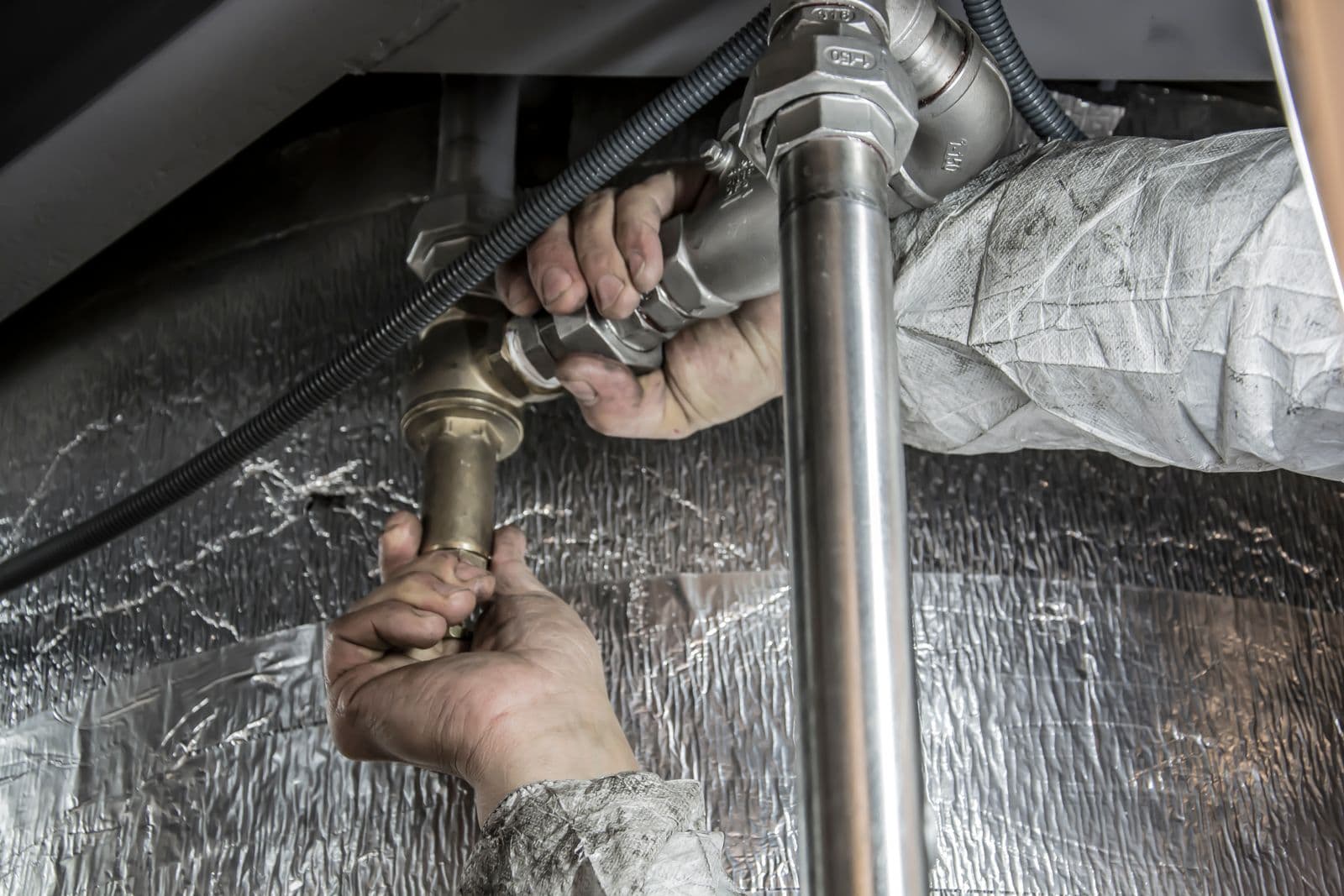
Treatment equipment is plumbing. Most of the job is the connection, the drain and the code detail behind it.


Manchester water, answered plainly
Where does Manchester, NH get its water?+
From Lake Massabesic, treated at the plant beside the lake, and since August 2023 from the Merrimack River, treated at the Hooksett facility.
Does Manchester water have PFAS?+
Yes, at low parts-per-trillion levels. PFOA averaged 5.34 ppt at the Lake Massabesic plant and 2.08 ppt at the Merrimack plant in 2025. That is under the 12 ppt limit listed in the report, but above EPA's 4.0 ppt national limit, which takes effect on a later compliance schedule.
Is there lead in Manchester water?+
The 2025 lead 90th percentile was 1.8 ppb, below the 15 ppb action level, but 3 of 69 sampled sites were above it and the highest result was 34.0 ppb. Lead comes from service lines and home plumbing.
Is Manchester water hard?+
No. Calcium is only about 4–7 ppm across the two plants, which is very soft water.
Why does Manchester water have sodium?+
The report lists sodium averaging 44.1 ppm at Massabesic and 54.5 ppm at Merrimack and calls it naturally occurring. It is relevant if you are on a sodium-restricted diet.
Where do these figures come from?+
From Manchester Water Works' Water Quality Report for reporting year 2025 (PWS ID NH1471010). Third-party aggregators are not used.
Related resources
Home water purification and treatment
The national service page behind this one.
Learn more →Lowell water quality
Merrimack River water downstream.
Learn more →Haverhill water quality
Another Merrimack Valley system.
Learn more →Boston water quality
MWRA water in the nearest major metro.
Learn more →All home services
Water, battery, HVAC and solar under one licensed contractor of record.
Learn more →Get a free test at your tap
A licensed technician tests at your kitchen tap and tells you which Manchester Water Works findings apply to your house — PFAS or lead from plumbing. No charge, no obligation, and coverage confirmed at your address first.
Get a free test