Springfield, Massachusetts
Springfield Water Quality
Springfield is not on the MWRA. It filters Cobble Mountain water at a 1974-era plant and disinfects with chlorine — and the figure a treatment decision turns on here is a haloacetic acids exceedance the utility has been disclosing for years.
The 2025 CCR marks haloacetic acids at a highest running annual average of 67 ppb against a limit of 60 — a violation, with four quarterly public notices that year and a new plant expected online in 2028.
The short answer
Springfield is not an MWRA community. The Springfield Water and Sewer Commission supplies itself from Cobble Mountain and Borden Brook reservoirs, filters at West Parish, and disinfects with free chlorine — public water system 1281000.
The governing number on the 2025 report is haloacetic acids at a highest LRAA of 67 ppb against an MCL of 60, marked as a violation, with quarterly public notices continuing while a new plant is built toward an expected September 2028 completion. Activated carbon is the household stage that targets that finding — not a softener.
Get a free test
Tell us your Springfield-area address. We confirm coverage first, then schedule a licensed technician to test at your tap — no charge, no obligation.
What filtration does — and does not
Sediment, carbon, softening and reverse osmosis each address a different problem. In Springfield the city's own notices point at a disinfection byproduct exceedance, which is a carbon question — not a softener brochure.
Which water system serves you?
Enter a ZIP code. We will name the utility that supplies it and its public water system identifier, so you can look up that system's own annual report. No contact details needed for this part.
Phoenix-metro ZIP codes are covered here. Five digits will do it.
A licensed technician tests at your own tap and tells you which findings actually apply to your house — including when the answer is none of them. Coverage is confirmed per service area rather than promised as blanket availability.
Where Springfield water comes from
A western Massachusetts reservoir pair, a plant last modernized in 1974, and a free-chlorine residual — three facts that separate this page from Boston, Worcester and Cambridge.
Cobble Mountain and Borden Brook — not the Quabbin
Springfield Water and Sewer Commission draws surface water from Cobble Mountain Reservoir (Source ID 1281000-02S) and Borden Brook Reservoir (Source ID 1281000-04S) in Blandford and Granville. That is a western Massachusetts supply, not the MWRA Quabbin/Wachusett system whose figures circulate for the eastern part of the state. Public water system identifier: 1281000. The CCR states the treated water serves more than 250,000 customers in the region.
West Parish Filters — 1974 plant, 2028 replacement
Raw water is coagulated, filtered through rapid sand filters (with some slow sand filters also in use), chlorinated, treated with phosphate for corrosion control and sodium hydroxide for pH, then gravity-fed to the distribution system. Construction of a new West Parish plant began in fall 2024 and is expected to be complete by September 2028; the new train adds dissolved air flotation for organics removal. Progress is published at newwestparish.com.
Free chlorine, phosphate corrosion control
Like Worcester and unlike the MWRA and Cambridge, Springfield holds a free-chlorine residual rather than monochloramine. Phosphate is dosed to protect pipes from leaching lead or copper. Knowing which residual and which corrosion strategy your city uses is part of reading your own report.
An Administrative Consent Order sits behind the notices
On April 22, 2024 the Commission entered into an agreed-upon resolution with MassDEP covering the HAA5 exceedances and the path to the new plant. The CCR points readers to waterandsewer.org for the ACO and each quarterly public notice. The notices are not optional reading here — they are the primary source for the violation itself.
What the 2025 report and notices actually say
Federal MCLs are fixed. The results next to them are from the Springfield Water and Sewer Commission 2025 CCR for PWS 1281000 and the Q4 2025 HAA5 public notice issued January 6, 2026 — system-level figures, not a reading at your tap. A later report supersedes them.
Haloacetic acids (HAA5) — the number that governs here
The federal MCL is 60 ppb, judged as a locational running annual average. Springfield's 2025 CCR reports a highest LRAA of 67 ppb with a range of 46 to 80, and marks a violation. The Q4 2025 public notice (issued January 6, 2026) lists seven monitoring locations above 60 on the LRAA, with site averages from 61 to 67. The Commission first recorded an HAA5 MCL violation in December 2018. This is not Worcester's story of a high-but-compliant TTHM average — it is an exceedance the utility is disclosing every quarter.
Total trihalomethanes (TTHM) — high, still compliant
The MCL is 80 ppb. The 2025 CCR gives a highest LRAA of 70 ppb with a range of 45 to 85, and marks no violation. Same chemistry family as HAA5 — chlorine meeting natural organic matter — and the same treatment answer, but not the result that crossed the line.
Why the byproducts are where they are
DBPs form when chlorine required for disinfection reacts with dissolved natural organic matter that enters Cobble Mountain Reservoir from forest runoff. The CCR states that NOM levels fluctuate with weather and reservoir turnover, and that the existing West Parish Filters plant — last modernized in 1974 — cannot remove current NOM levels to the extent today's DBP rules require. That is the utility's own explanation, not an outside reading of the table.
Chlorine residual
Disinfection is with free chlorine. The CCR reports a running annual average of 0.71 ppm against an MRDL of 4, with a range from non-detect to 2.50 ppm. Free chlorine is the more reactive residual for byproduct formation, and it is also the residual activated carbon removes most readily at the tap.
Sodium — not the Cambridge story
Reported at 13.5 ppm against a MassDEP ORSG of 20 on 10/29/2025 sampling. That is inside the guideline. Cambridge's 93.5 ppm against the same 20 is a different city with a different governing number; do not import it.
Lead — source water vs plumbing
The CCR states Cobble Mountain source water and the treated water supplied to the distribution system contain no detectable lead. Lead exposure, where it exists, is from household plumbing and service materials — the same address-specific question every Massachusetts city page has to separate from the plant.
Why an exceedance is a different argument from a high average
Forty miles of Massachusetts separate Springfield from Worcester, and both cities run off-MWRA free-chlorine surface supplies. Worcester's 2025 headline is TTHM at 63 ppb against 80 — compliant. Springfield's is HAA5 at 67 against 60 — over the limit. Same region, same broad chemistry, different byproduct family crossing the line.
Cambridge is the third off-MWRA comparison: granular activated carbon and chloramine put its TTHM at 8.6 ppb, and its governing number becomes sodium. Importing Cambridge's sodium argument — or Boston's MWRA service-line argument — into Springfield would describe somebody else's water.
The practical read for a homeowner: if you are buying treatment because of the notices, buy the stage that addresses disinfection byproducts. The new plant is the utility's permanent fix on a 2028 horizon; carbon is what a kitchen tap can do in the meantime.
Where these figures come from
Everything on this page traces to primary sources. Independent compilations of water quality data exist and are not used here.
- SWSC 2025 Consumer Confidence Report — PWS 1281000.
- Q4 2025 HAA5 Tier 2 public notice — issued January 6, 2026.
- SWSC Water Quality Report archive and newwestparish.com for plant construction progress.
- EPA National Primary Drinking Water Regulations — HAA5 MCL 60 ppb, TTHM MCL 80 ppb.
Matching treatment to the finding
In a city whose own notices name haloacetic acids above the MCL, the right household stage is narrow — and the most heavily marketed category in New England is usually the wrong one.
Activated carbon — the stage that matches the finding
Carbon addresses haloacetic acids, trihalomethanes and the chlorine taste that comes with a free-chlorine residual. Given that HAA5 is the result over its MCL on Springfield's own notices, it is the stage with the clearest justification. Point-of-use vs point-of-entry is a plumbing and budget question, not a chemistry one.
Reverse osmosis — narrower, still valid for drinking water
Under-sink RO reduces the same byproducts plus dissolved solids. It treats one tap, wastes water to drain, and costs more to run. Reasonable where someone wants the widest reduction at the kitchen sink; expensive as a whole-house answer to a problem carbon already targets.
A softener — not the headline purchase
Springfield's governing finding is a disinfection byproduct exceedance, not hardness. A softener does not remove HAA5 or TTHM. If hardness at your tap is separately high, that is an address measurement — not something to assume from the byproduct table.
Waiting on the new plant is not a home-treatment plan
The Commission expects DBP exceedances to continue until the new West Parish plant is online around September 2028. That is useful context for why the notices keep arriving. It is not a reason to skip a tap test if someone in the house wants the byproduct number lower at the glass they drink from now.
How the free test works
A licensed technician tests at your kitchen tap, walks the plumbing, and tells you which of the findings above applies to your house and which does not. There is no charge and no obligation.
Seamless Home is the licensed contractor of record on the work that follows. Installation is performed by vetted installing partners engaged as our subcontractors, and the workmanship obligation stays with us. Coverage is confirmed per service area rather than promised as blanket availability.
Drain connections for under-sink RO still have to meet the indirect-waste rule — where a water softener is allowed to discharge sets out the plumbing logic even when the equipment is carbon or RO rather than a softener. And Springfield already has a battery backup page for the outage side of the same house.
What a water treatment job with us covers
Installation and replacement of whole-home and point-of-use treatment, specified against what your water actually contains.
Sediment filtration
Installation of the first stage that protects everything downstream of it, sized to the service line and the household draw.
Softening
Installation of ion-exchange softening where hardness is the problem, including the drain connection the plumbing code treats as indirect waste.
Carbon filtration
Installation of carbon stages for taste, odour and disinfection by-products, specified from your utility's own water quality report.
Reverse osmosis
Point-of-use installation at the kitchen sink where the target is dissolved solids rather than whole-home flow.
Disinfection
Installation of UV or equivalent treatment where the supply is a private well or is otherwise not continuously disinfected.
System replacement
Replacing equipment that has reached the end of its service life, including the discharge and air gap details an inspector looks at.
This is installation and replacement work, specified from a published water quality report or a test of your supply — not from a sales chart. Coverage is confirmed per service area rather than promised as blanket availability.
What the work actually looks like
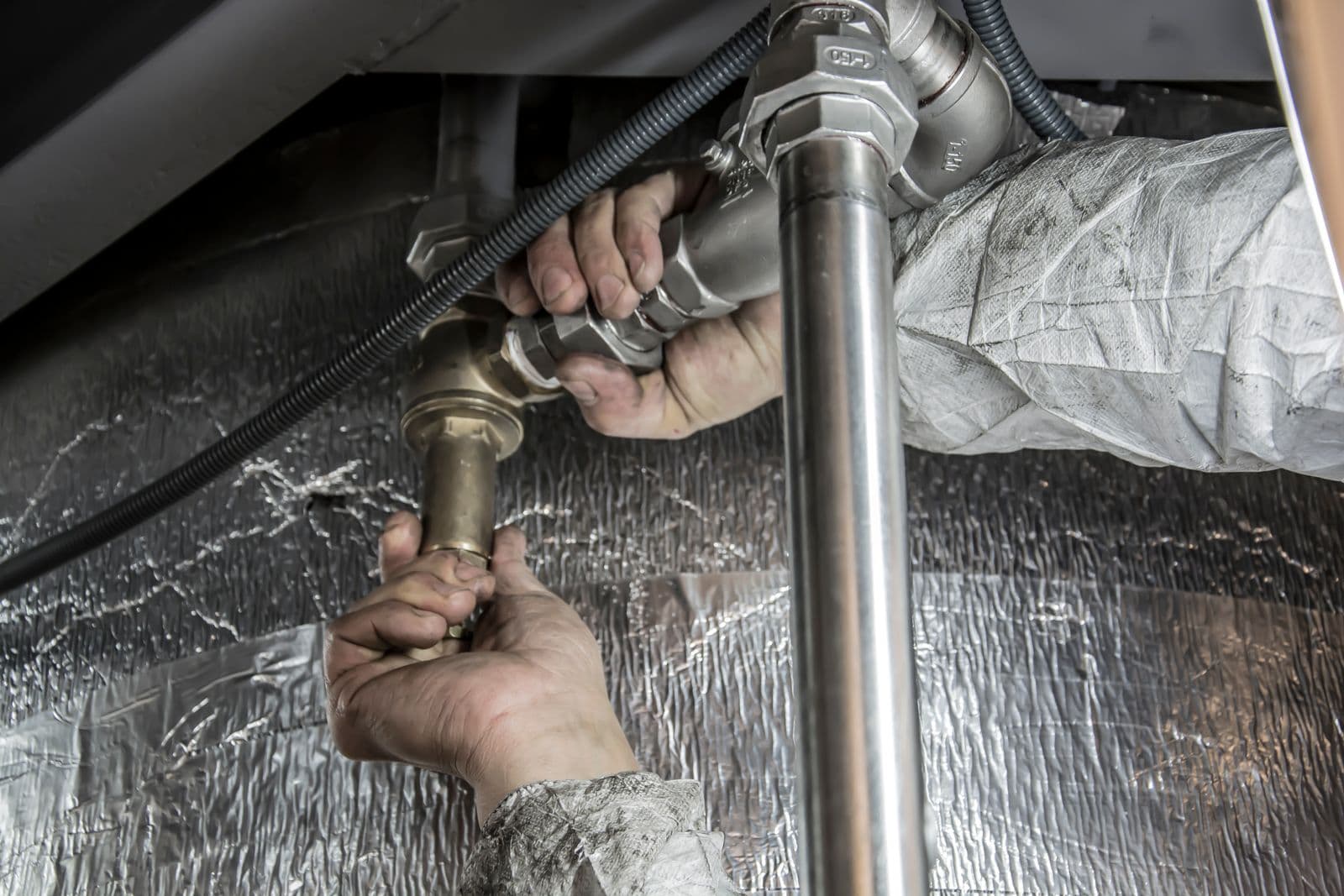
Treatment equipment is plumbing. Most of the job is the connection, the drain and the code detail behind it.


Springfield water, answered plainly
Is Springfield on the MWRA?+
No. The Massachusetts Water Resources Authority supplies Boston and much of eastern Massachusetts from the Quabbin and Wachusett reservoirs. Springfield Water and Sewer Commission runs its own supply from Cobble Mountain and Borden Brook reservoirs, treated at West Parish Filters in Westfield, under public water system identifier 1281000. An MWRA figure quoted at a Springfield address describes somebody else's water.
What does the 2025 water quality report say?+
That the system exceeded the haloacetic acids MCL: highest locational running annual average 67 ppb against a limit of 60, range 46 to 80, marked as a violation, with four quarterly public notices in 2025. Total trihalomethanes were at a highest LRAA of 70 against 80 without a violation. Chlorine averaged 0.71 ppm. Sodium was 13.5 ppm against a state guideline of 20. Source and finished water are described as having no detectable lead; lead risk is framed as household plumbing.
Is the water safe to drink?+
The Commission's public notices state this is not an emergency and that customers can drink and use their water as usual, while also stating that some people who drink water containing HAA5 above the MCL over many years may have an increased risk of cancer, with additional caution for young children and pregnant people. That is the utility's own wording. A compliance exceedance and an emergency are different categories — and neither category is a reading at your kitchen tap.
How is this different from Worcester?+
Worcester's 2025 governing number is total trihalomethanes at 63 ppb against 80 — high and compliant. Springfield's is haloacetic acids at 67 against 60 — over the limit, with ongoing quarterly notices and a plant replacement scheduled through 2028. Both are off-MWRA free-chlorine surface supplies. The byproduct family that crossed the line, and whether it crossed, are not the same.
Will the new plant fix this?+
The Commission says the existing plant cannot remove enough natural organic matter to meet today's DBP rules, and that the new West Parish plant — construction started fall 2024, expected complete September 2028 — adds dissolved air flotation and other upgrades aimed at regulatory compliance. Until it is online, the Commission expects exceedances to continue. Follow newwestparish.com and the quarterly notices for schedule changes.
Do I need a water softener in Springfield?+
Not on the strength of the DBP finding. Softeners do not remove haloacetic acids or trihalomethanes. If someone is quoting a softener, ask what hardness was measured at your tap and what it is being compared against — that is a separate question from the HAA5 notices.
Where do these figures come from?+
The Springfield Water and Sewer Commission 2025 Consumer Confidence Report for PWS 1281000 (published PDF dated 5.4.26 on the Commission site), the Q4 2025 HAA5 Tier 2 public notice issued January 6, 2026, and the federal MCLs those documents compare against. Independent water-quality aggregators are not the source used on this page.
Related resources
Home water purification and treatment
The national service page behind this one.
Learn more →Worcester water quality
Off-MWRA like Springfield — but TTHM-compliant at 63/80, not an HAA5 exceedance.
Learn more →Cambridge water quality
Off-MWRA with carbon filtration — TTHM 8.6, governing number is sodium.
Learn more →Boston water quality
The MWRA system — unfiltered, chloraminated, different governing number.
Learn more →Battery backup in Springfield, MA
Outage cover for the same address.
Learn more →Where a water softener can discharge
Indirect-waste rules for treatment drain lines.
Learn more →All home services
Water, battery, HVAC and solar under one licensed contractor of record.
Learn more →Get a free test at your tap
A licensed technician tests at your kitchen tap and tells you which of the findings above applies to your house — and which does not. No charge, no obligation, and coverage confirmed at your address first.
Get a free test