Worcester, Massachusetts
Worcester Water Quality
Worcester is not on the MWRA. It filters its own water from ten reservoirs and disinfects with chlorine, which means the figure a treatment decision turns on here is not the one that gets quoted for eastern Massachusetts.
Every regulated contaminant in Worcester's 2025 report is inside its limit. The one closest to it is trihalomethanes, at 63 ppb against a ceiling of 80 — with individual samples running to 92.
The short answer
Worcester is not an MWRA community. It supplies itself from ten reservoirs in Leicester, Paxton, Rutland, Holden and Princeton, filters the water at its own plant in Holden, and disinfects with free chlorine — public water system 2348000. The water is soft, about 1.7 grains per gallon, so the softener that gets sold in this market has almost nothing to remove.
Every regulated contaminant in the 2025 report is inside its limit. The one sitting closest to its ceiling is total trihalomethanes at 63 ppb against an MCL of 80, with individual results ranging from 17 to 92. That is a disinfection byproduct, formed after treatment rather than carried in from the reservoir, and activated carbon is the stage that addresses it.
Get a free test
Tell us your Worcester-area address. We confirm coverage first, then schedule a licensed technician to test at your tap — no charge, no obligation.
What filtration does — and does not
Sediment, carbon, softening and reverse osmosis each address a different problem. In Worcester one of those four stages has a clear justification in the city's own numbers and one of them has almost none, which is worth establishing before anybody quotes you.
Which water system serves you?
Enter a ZIP code. We will name the utility that supplies it and its public water system identifier, so you can look up that system's own annual report. No contact details needed for this part.
Phoenix-metro ZIP codes are covered here. Five digits will do it.
A licensed technician tests at your own tap and tells you which findings actually apply to your house — including when the answer is none of them. Coverage is confirmed per service area rather than promised as blanket availability.
Where Worcester water comes from
Ten reservoirs outside the city, one filtration plant in Holden, and a treatment train that differs from eastern Massachusetts at three separate points — the filtration, the disinfectant and the corrosion control.
Ten reservoirs, none of them in Worcester
The supply is ten surface water reservoirs in Leicester, Paxton, Rutland, Holden and Princeton, holding over seven billion gallons between them. The largest named in the report are Quinapoxet in Holden and Princeton at 1,100 million gallons, Kendall at 792.2, Holden Reservoir No. 1 at 729.3 and Holden Reservoir No. 2 at 257.4. Every one of them is outside the city that drinks from them.
A filtration plant in Holden
In 2025 the Worcester Water Filtration Plant treated 8,499,068,723 gallons. This is the fact that separates Worcester from the eastern Massachusetts systems people compare it to: the water is filtered. Ozone is generated on site to disinfect and to break down organic matter, alum and a cationic polymer coagulate the fine particles, and direct filtration through anthracite removes them.
Free chlorine, not chloramine
Disinfection is with chlorine. That is a different residual from the monochloramine used on the MWRA system to the east, and it has two consequences at your tap: chlorine reacts more readily with organic matter to form the byproducts above, and it is easier to strip out with activated carbon. Both of those cut the same way for someone choosing equipment.
Corrosion control by phosphate, not by pH
Lime is added to raise pH — the reported average is 7.44, near neutral — and a blended phosphate corrosion inhibitor is dosed to lay down a protective film inside metal pipe. Orthophosphate averages 0.555 ppm in the distribution system. MWRA's approach to the east is to push pH up to roughly 9 instead. Two legitimate strategies for the same problem, and knowing which one your water uses is part of reading your own report.
What the 2025 report actually says
Federal and state limits are fixed regulatory values. The results next to them are from the City of Worcester Water Quality Report for PWS ID 2348000, which states that it covers calendar year 2025 — system-level and sampling-round figures, not a reading at your tap. The lead and copper figures within it are labelled 2023 and are shown that way. A later report supersedes them.
Total trihalomethanes (TTHM) — the number that governs here
The federal MCL is 80 ppb. Worcester's 2025 report gives a highest running annual average of 63 ppb, with individual results ranging from 17 to 92 ppb. That is compliant — compliance is judged on the running annual average, not on a single sample — and it is also 79 percent of the limit, which is the closest any regulated result on the report comes to its ceiling. If a treatment decision in Worcester turns on one figure, it is this one.
Haloacetic acids (HAA5)
The other regulated family of disinfection byproducts. The MCL is 60 ppb. Worcester reports a highest running annual average of 41 ppb with a range of 16 to 58 ppb. Same origin as TTHM, same treatment answer, and the same pattern of sitting well inside the limit on the average while individual locations run higher.
Total organic carbon — why the byproducts are where they are
Reported as an average of 2.7 ppm with a range of 2.09 to 4.37 ppm. Organic carbon is not itself a health concern at these levels, and it is not regulated here. It matters because it is the raw material: disinfection byproducts form when chlorine reacts with naturally occurring organic matter. A surface supply draped across ten forested reservoirs carries more of it than a deep groundwater source does, which is the whole explanation for the TTHM figure above.
Chlorine residual
Worcester disinfects with free chlorine rather than the monochloramine used east of here, and the report states the water carries about 25 percent of the maximum allowed. The maximum level detected was 1.05 ppm against an MRDL of 4.0 ppm, with a distribution range of 0.1 to 3.7 ppm. Free chlorine is easier to remove at the tap than chloramine, which is one of the few places Worcester's treatment train works in a homeowner's favour.
Lead and copper — and the year on them
The 2025 report carries lead and copper results labelled 2023, because this monitoring runs on a multi-year cycle rather than annually. The 90th-percentile lead result was 2 ppb against an Action Level of 15, across 89 samples with a range of non-detect to 14 ppb, and no exceedance. Copper's 90th percentile was 0.095 ppm against 1.3 ppm, with a range of 0.002 to 1.5 ppm and one sample over the Action Level. Read those as what they are: a 2023 sampling round, not a current reading, and not a reading at your address.
PFAS
Massachusetts regulates a sum of six PFAS compounds with an MCL of 20 ppt. Worcester reports PFAS6 at 3.3 ppt — detected, well inside the limit. A separate unregulated compound, perfluorohexanoic acid, was reported at 4.0 ppt with no standard to compare it against. Detected and compliant is the accurate description; not present would not be.
Sodium, and the guideline it sits under
Reported at 18 ppm against a Massachusetts Office of Research and Standards Guideline of 20 ppm. That is a guideline rather than an enforceable limit, and it exists for people on physician-directed sodium-restricted diets. Chloride at an average of 35.29 ppm tells you where it comes from: road salt, in a city that gets winter. It is worth knowing before anyone proposes a softener, because a softener adds sodium to water that is already carrying some.
Hardness
An average of 29.8 ppm with a range of 21.9 to 55.2 ppm — roughly 1.7 grains per gallon, which is soft. Calcium averages 10.0 ppm. Like Boston, Worcester sits on central Massachusetts granite, and the water arrives with very little to soften. This is the one category where the two cities agree, and in both of them the softener is the wrong purchase.
Why a compliant number can still be the one to act on
Worcester's trihalomethane result is compliant. Compliance for disinfection byproducts is judged on a running annual average at each monitoring location, and the highest of those was 63 ppb against a limit of 80. Nothing about that is a violation and nothing about it requires action.
It is still the most informative figure on the report, for two reasons. It is the closest any regulated result comes to its ceiling — 79 percent of it — and the individual samples behind that average ranged from 17 to 92 ppb. An average inside a limit can be built from results that were not, which is exactly what an average is for and exactly what it hides.
The reason the spread is that wide is geographic. Byproducts keep forming while chlorinated water sits in pipe, so the far end of a distribution system reads higher than the plant. Worcester monitors at eight representative locations, including locations expected to have the highest levels. Where your house sits on that system is not something a citywide figure can tell you.
None of this argues that Worcester water is a problem. It argues that if you are buying treatment here, buy the one that matches the finding — which is carbon — rather than the one with the largest advertising budget, which in soft-water New England is usually a softener.
Where these figures come from
Everything on this page traces to primary sources. Independent compilations of water quality data exist and are not used here.
- City of Worcester Water Quality Report — public water system 2348000. The document states in its own text that it covers calendar year 2025; the lead and copper table within it is labelled 2023.
- Worcester DPW Water and Sewer Operations — the utility itself, including the archive the report is published in.
- EPA National Primary Drinking Water Regulations — federal limits, including TTHM 80 ppb, HAA5 60 ppb, the lead Action Level of 15 ppb and copper 1.3 ppm.
- EPA SDWIS Federal Reports — search public water system identifier MA2348000.
Matching treatment to the finding
Filtration is not one product. In a soft-water city whose governing number is a disinfection byproduct, the right answer is narrow — and the most heavily marketed category is the wrong one.
Activated carbon — the one that matches the finding
Carbon is the treatment that addresses trihalomethanes, haloacetic acids and the chlorine taste that comes with a free-chlorine residual. Given that TTHM is the closest regulated result to its limit on Worcester's report, it is also the stage with the clearest justification here. Whether it belongs at the kitchen tap or at the point of entry is a question about how much water you want treated, not about whether carbon is the right medium.
Reverse osmosis — for a narrower job
An under-sink RO unit will reduce the byproducts too, along with dissolved solids and a long list of things Worcester's report does not flag. It treats a single tap rather than the house, wastes water to drain, and costs more to maintain. It is a reasonable choice for drinking and cooking water where somebody wants the widest reduction at one point of use, and an expensive way to solve a problem carbon already solves.
A softener — almost certainly not
At roughly 1.7 grains per gallon there is nearly nothing for a softener to remove, and it would add sodium to a supply already reporting 18 ppm against a 20 ppm guideline. This is the same wrong purchase that gets sold in Boston, for the same geological reason, and it is worth refusing before anyone measures your basement for a brine tank.
A lead-reduction filter — only if your plumbing says so
Worcester's source water is lead-free and the 2023 sampling round found a 90th percentile of 2 ppb. Lead here, where it exists at all, comes from pre-1986 solder and from service line material at individual addresses — which is exactly what a citywide 90th percentile cannot tell you. A certified lead-reduction filter is the answer to a finding at your tap, not to a number in a report.
How the free test works
A licensed technician tests at your kitchen tap, walks the plumbing, and tells you which of the findings above applies to your house and which does not. There is no charge and no obligation, and nothing has to be decided while someone is standing in your kitchen.
In Worcester the address matters for a specific reason. Disinfection byproducts keep forming as chlorinated water travels the distribution system, so the figure at your tap depends on where you sit on it — and the citywide range of 17 to 92 ppb is the measure of how much that varies. If the honest finding is that your address does not need equipment, that is the finding, and a free test that always ends in a recommendation is not a test.
Seamless Home is the licensed contractor of record on the work that follows. Installation is performed by vetted installing partners engaged as our subcontractors, and the workmanship obligation stays with us. Coverage is confirmed per service area rather than promised as blanket availability.
Two installation details outlive the equipment choice. Any under-sink reverse osmosis unit, and any softener if one were ever justified here, discharges to the drain, and the plumbing code will not let that line connect directly — where a water softener is allowed to discharge sets out the indirect-waste rule. And Worcester's own report names the most common cross connection in a house as the outside tap a hose attaches to, which is the same backflow logic applied to the garden rather than the basement.
What a water treatment job with us covers
Installation and replacement of whole-home and point-of-use treatment, specified against what your water actually contains.
Sediment filtration
Installation of the first stage that protects everything downstream of it, sized to the service line and the household draw.
Softening
Installation of ion-exchange softening where hardness is the problem, including the drain connection the plumbing code treats as indirect waste.
Carbon filtration
Installation of carbon stages for taste, odour and disinfection by-products, specified from your utility's own water quality report.
Reverse osmosis
Point-of-use installation at the kitchen sink where the target is dissolved solids rather than whole-home flow.
Disinfection
Installation of UV or equivalent treatment where the supply is a private well or is otherwise not continuously disinfected.
System replacement
Replacing equipment that has reached the end of its service life, including the discharge and air gap details an inspector looks at.
This is installation and replacement work, specified from a published water quality report or a test of your supply — not from a sales chart. Coverage is confirmed per service area rather than promised as blanket availability.
What the work actually looks like
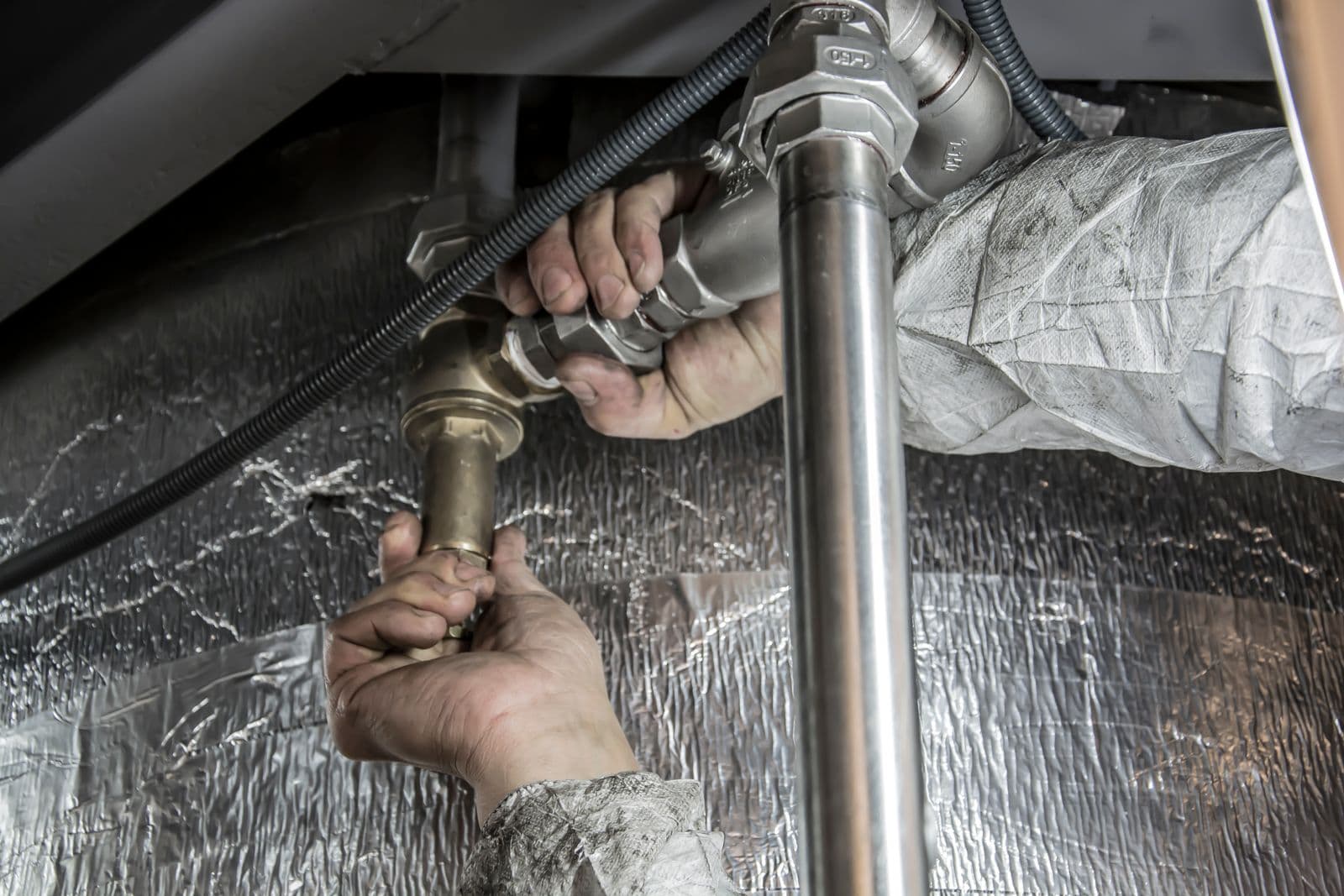
Treatment equipment is plumbing. Most of the job is the connection, the drain and the code detail behind it.


Worcester water, answered plainly
Is Worcester on the MWRA?+
No, and this is the single most useful thing to know before reading anything about Massachusetts water quality. The Massachusetts Water Resources Authority supplies Boston and much of the eastern part of the state from the Quabbin and Wachusett reservoirs, and its figures are the ones that circulate. Worcester runs its own supply: ten reservoirs in Leicester, Paxton, Rutland, Holden and Princeton, its own filtration plant in Holden, and its own public water system identifier, 2348000. The treatment is different, the disinfectant is different, the corrosion control strategy is different and the numbers are different. An MWRA figure quoted at a Worcester address is describing somebody else's water.
What does Worcester's water quality report actually say?+
That every regulated contaminant was inside its limit in calendar year 2025. The result closest to its ceiling is total trihalomethanes, at a highest running annual average of 63 ppb against a federal MCL of 80, with individual results ranging from 17 to 92 ppb. Haloacetic acids came in at 41 ppb against a limit of 60, ranging from 16 to 58. PFAS6 was 3.3 ppt against a Massachusetts limit of 20. No E. coli was found. Radioactive contaminants were tested in 2025 and none was detectable, and no synthetic organic contaminants were detected. Hardness averaged 29.8 ppm, which is soft.
Why is TTHM so much higher in Worcester than in Boston?+
Because of what the water is made of and what it is disinfected with. Disinfection byproducts form when a chlorine-based disinfectant reacts with naturally occurring organic matter, so the amount you get depends on how much organic carbon is in the water and which disinfectant meets it. Worcester's supply is surface water from ten forested reservoirs and reports total organic carbon averaging 2.7 ppm, and it is disinfected with free chlorine. The MWRA system to the east uses monochloramine, which is a less reactive disinfectant for this purpose. Neither city is out of compliance. The difference is chemistry, not diligence, and it is the reason the right filter is not the same in both places.
Is the water safe to drink?+
Every regulated contaminant in the 2025 report is inside its federal or state limit, and the report says so explicitly. What a compliance statement does not do is describe the water at your kitchen tap. Two things sit between the plant and your glass: the distribution system, where disinfection byproducts continue to form as chlorinated water sits in pipe — which is why individual TTHM samples ran to 92 ppb while the compliance average was 63 — and your own plumbing, which is where any lead in Worcester water comes from. Both of those are address-specific and neither appears in a citywide number.
Why are the lead results dated 2023 in a 2025 report?+
Because lead and copper monitoring runs on a multi-year cycle rather than annually. A system that has demonstrated low results is permitted to sample less often, and Worcester's most recent round at the time of the 2025 report was 2023: 89 samples, a 90th-percentile lead result of 2 ppb against a 15 ppb Action Level, a range of non-detect to 14 ppb, and no exceedance. That is a genuinely good result, and it is also two years old and taken at other people's taps. It is worth reading as evidence that the water leaving the plant is not corrosive, rather than as a measurement of your house.
Do I need a water softener in Worcester?+
Almost certainly not. The 2025 report puts hardness at an average of 29.8 ppm — roughly 1.7 grains per gallon — with calcium averaging 10.0 ppm. That is soft water, for the same reason Boston's is soft: central Massachusetts granite gives up very little calcium and magnesium. A softener installed here has close to nothing to remove, and it would add sodium to a supply already reporting 18 ppm against a state guideline of 20. If you are being quoted for a softener in Worcester, the question to ask is what hardness was measured at your tap and what it is being compared against.
What should I actually do about the chlorine taste?+
Activated carbon, and the good news is that Worcester's free chlorine residual is easier to remove than the chloramine used in eastern Massachusetts, which needs a longer contact time and a larger carbon bed. The same carbon that takes out the taste is the stage that addresses the trihalomethanes and haloacetic acids, so one decision answers both. Where it goes — a filter at the kitchen tap or a unit at the point of entry — depends on whether you want treated water for drinking or for the whole house, which is a budget and plumbing question rather than a water quality one.
Where do these figures come from?+
The City of Worcester Water Quality Report for public water system 2348000, which states in its own text that it covers calendar year 2025, plus the federal drinking water standards the report compares against. The lead and copper figures within it are labelled 2023 and are presented that way here. Independent compilations of water quality data exist and are not the source used on this page. Every figure is a system-level or sampling-round result and none of it is a reading at your address — which is exactly why the free test exists.
Related resources
Home water purification and treatment
The national service page behind this one: what each treatment stage removes, and why a test comes first.
Learn more →Boston water quality
The MWRA system 45 miles east — unfiltered, chloraminated, and with a completely different governing number.
Learn more →HVAC in Worcester, MA
The heating side of the same house, and what a Worcester retrofit runs into.
Learn more →Battery backup in Worcester, MA
Storm outages, and what a battery does and does not cover.
Learn more →Where a water softener can discharge
If softening is ever justified, the code decides where the brine line is allowed to go.
Learn more →All home services
Water treatment, battery backup, HVAC and solar under one licensed contractor of record.
Learn more →Get a free test at your tap
A licensed technician tests at your kitchen tap and tells you which of the findings above applies to your house — and which does not. No charge, no obligation, and coverage confirmed at your address first.
Get a free test