Brockton, Massachusetts
Brockton Water Quality
Silver Lake is the year-round supply. Aquaria's Taunton River desalination plant fills summer demand. The Woodland Avenue plant has been offline since 2021 for PFAS6 in Brockton Reservoir — and finished-water PFAS6 in 2024 was 2.2 ppt.
Massachusetts' PFAS6 limit is 20 ppt. Brockton's 2024 finished-water result was 2.2 — and the reservoir plant that failed that test stays offline.
The short answer
Brockton is not on the MWRA. Its primary supply is Silver Lake, with a summer supplement from the Aquaria desalination plant on the Taunton River. The Woodland Avenue plant has been inactive since spring 2021 because of PFAS6 in Brockton Reservoir.
In the distribution system, 2024 finished-water PFAS6 was 2.2 ppt against Massachusetts' 20 ppt MCL. TTHMs averaged 43 ppb and HAAs 21 ppb. Lead's 2023 90th percentile was 4 ppb, with individual taps higher. Test the tap before buying a stage aimed at someone else's CCR.
Get a free test
Tell us your Brockton address. We confirm coverage first, then schedule a licensed technician to test at your tap — no charge, no obligation.
What filtration does — and does not
Carbon, RO and lead-certified filters solve different Brockton findings. A softener is rarely the first answer on this report.
Where Brockton water comes from
A lake, a desalination plant, and a reservoir taken offline. That mix is why Brockton is not a Boston water page with a different city name.
Silver Lake — the primary supply since the early 1900s
Brockton's report identifies Silver Lake (Pembroke, Kingston, Plympton and Halifax) as the primary supply, treated at a 24-million-gallon-per-day Silver Lake Water Treatment Facility. Furnace Pond and Monponsett Pond diversions feed the lake between October and May. This is surface water with free chlorine, not MWRA.
Aquaria desalination — the summer supplement
GS Inima's Aquaria plant in Dighton draws from the Taunton River, desalinates, and connects into Brockton's distribution at a Pearl Street meter vault. The report says it typically supplies one to two million gallons per day in summer when demand is highest. That seasonal path is unique among the Massachusetts pages on this site.
Brockton Reservoir / Woodland Avenue — offline for PFAS6
The Woodland Avenue plant, fed by Brockton Reservoir in Avon / D.W. Field Park, has been inactive since spring 2021 because of PFAS6 in the reservoir. The city mailed residents on March 19, 2021. That offline source is the PFAS story that shaped Brockton's supply mix — it is not the same as the finished-water PFAS6 figure in the distribution system.
Lead service line inventory published
Under the federal lead rule, Brockton published a service-line inventory (the report links a LeadCAST map). The 2023 lead 90th percentile was 4 ppb with a range of not-detected to 80 ppb and 2 of 51 sites above the 15 ppb action level — compliance on the 90th percentile, with individual high taps still possible.
What the 2024 report actually says
Limits are fixed. The results next to them are from the City of Brockton 2024 Consumer Confidence Report — system-level figures, not a reading at your tap. A later report supersedes them.
PFAS6 — finished water at 2.2 ppt; reservoir plant offline
Massachusetts regulates the sum of six PFAS (PFAS6) at 20 ppt. Brockton's 2024 finished-water amount detected was 2.2 ppt. Separately, PFAS6 in Brockton Reservoir is why Woodland Avenue has been offline since 2021. Those are related stories with different numbers — do not conflate reservoir and tap.
Disinfection byproducts
Total trihalomethanes averaged 43 ppb (range 17–68) against an 80 ppb MCL. Haloacetic acids averaged 21 ppb (2.3–29) against 60. Neither is a violation. Free chlorine residual averaged 0.71 ppm (0.48–1.35).
Nitrate
0.18 ppm against an MCL of 10 — well below the infant-health threshold that matters on other Massachusetts reports. Listed for completeness, not as a Brockton purchase driver.
Lead at high individual taps
The 2023 90th percentile was 4 ppb with two of fifty-one sites over the 15 ppb action level and a high end of 80 ppb. System compliance and a problem tap can coexist; flushing, filters certified for lead reduction, and the service-line inventory are the household tools the report points to.
Why the offline plant still matters
Taking Woodland Avenue offline removed a PFAS6 source from the blend. It also left Brockton more dependent on Silver Lake and on Aquaria's summer desalinated water — a design fact for anyone comparing Brockton to Boston, Lowell or Worcester, each of which publishes a different source story and a different governing number.
Finished-water PFAS6 at 2.2 ppt is not an exceedance under Massachusetts' 20 ppt rule. It is still the reason to read the CCR before buying a filter aimed at a different city's problem.
Where these figures come from
- City of Brockton — 2024 Consumer Confidence Report — Silver Lake, Aquaria, Woodland Avenue status, PFAS6, TTHM/HAA5, lead and copper.
- Massachusetts — PFAS in drinking water — state PFAS6 MCL of 20 ppt.
- EPA — PFAS National Primary Drinking Water Regulation — federal PFOA/PFOS context alongside the state sum rule.
Matching treatment to the finding
Brockton's report is a PFAS-context and lead-inventory story more than a softener brochure.
PFAS: certified carbon or RO if you want a margin below 2.2 ppt
Finished-water PFAS6 at 2.2 ppt is far under Massachusetts' 20 ppt MCL. A household that still wants its own margin should buy a point-of-use unit whose NSF/ANSI 53 or 58 listing names PFOA and PFOS reduction — check the listing for the model, not the box.
Lead: the filter that matches the inventory
Where the service line or home plumbing is the risk, a filter certified for lead reduction and the flushing guidance in the CCR matter more than a softener. Softening does not remove lead.
Taste of chlorine: carbon, not a softener
Free chlorine at about 0.7 ppm is a disinfection residual, not hardness. Activated carbon addresses taste and odor; a softener does not.
Test first — summer desal changes the blend
Silver Lake year-round and Aquaria in summer means a Brockton tap is not one fixed water. A free test at the kitchen tap measures what you actually have before anyone sells a stage.
How the free test works
A licensed technician tests at your kitchen tap, walks the plumbing, and tells you which of the findings above applies to your house and which does not. There is no charge and no obligation.
Seamless Home is the licensed contractor of record on the work that follows. Installation is performed by vetted installing partners engaged as our subcontractors, and the workmanship obligation stays with us. Coverage is confirmed per service area rather than promised as blanket availability.
A treatment drain still has to be legal — where a water softener is allowed to discharge explains the indirect-waste rule that decides where it goes.
What a water treatment job with us covers
Installation and replacement of whole-home and point-of-use treatment, specified against what your water actually contains.
Sediment filtration
Installation of the first stage that protects everything downstream of it, sized to the service line and the household draw.
Softening
Installation of ion-exchange softening where hardness is the problem, including the drain connection the plumbing code treats as indirect waste.
Carbon filtration
Installation of carbon stages for taste, odour and disinfection by-products, specified from your utility's own water quality report.
Reverse osmosis
Point-of-use installation at the kitchen sink where the target is dissolved solids rather than whole-home flow.
Disinfection
Installation of UV or equivalent treatment where the supply is a private well or is otherwise not continuously disinfected.
System replacement
Replacing equipment that has reached the end of its service life, including the discharge and air gap details an inspector looks at.
This is installation and replacement work, specified from a published water quality report or a test of your supply — not from a sales chart. Coverage is confirmed per service area rather than promised as blanket availability.
What the work actually looks like
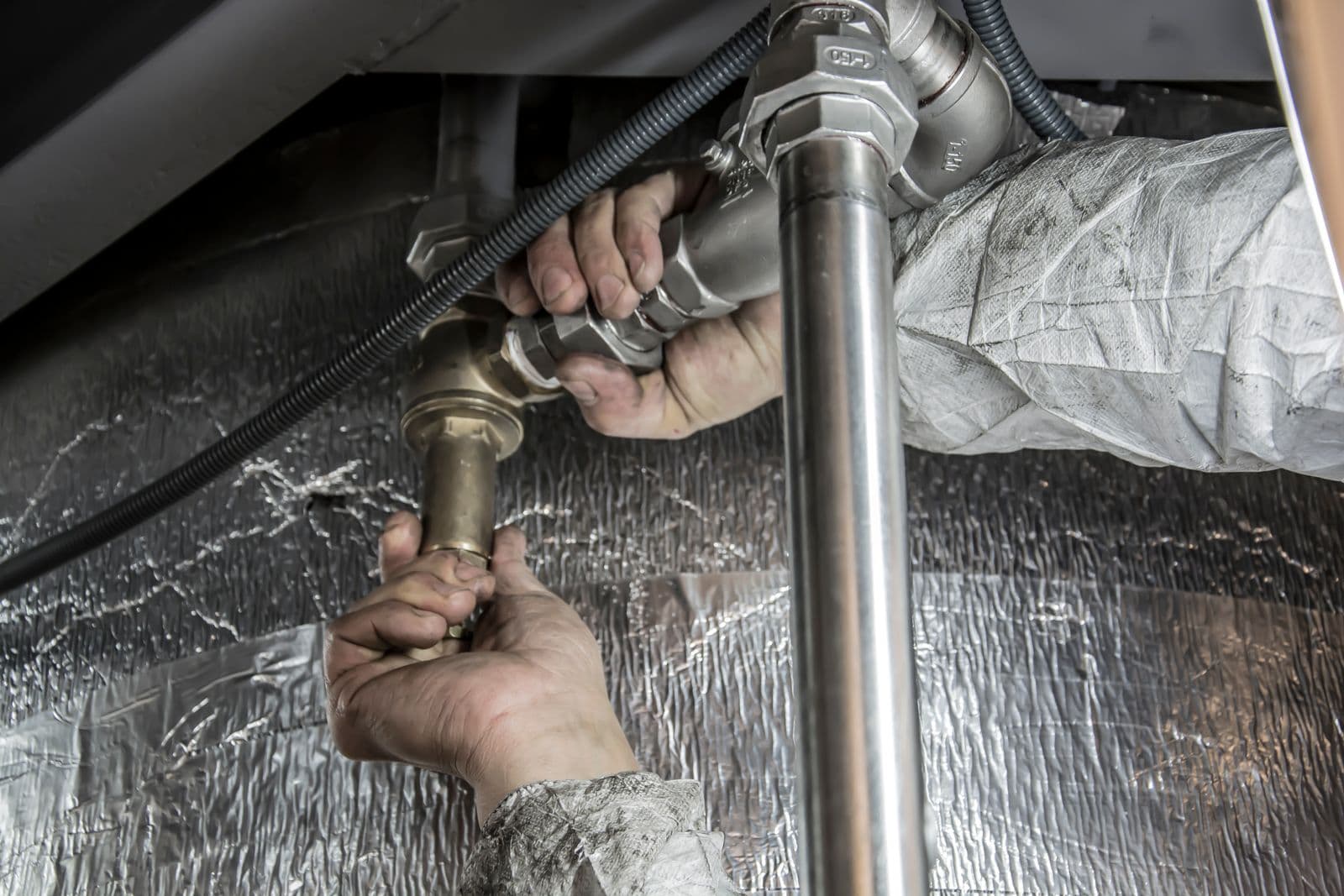
Treatment equipment is plumbing. Most of the job is the connection, the drain and the code detail behind it.


Brockton water, answered plainly
Where does Brockton water come from?+
Primarily Silver Lake, treated at the Silver Lake Water Treatment Facility. In summer the city typically adds one to two million gallons a day from the Aquaria desalination plant on the Taunton River in Dighton. The Brockton Reservoir / Woodland Avenue plant has been offline since spring 2021 because of PFAS6 in that reservoir.
Is there PFAS in Brockton water?+
The 2024 Consumer Confidence Report lists finished-water PFAS6 at 2.2 ppt against Massachusetts' 20 ppt MCL. Separately, PFAS6 in Brockton Reservoir is why the Woodland Avenue plant has been inactive since 2021. The offline reservoir and the current distribution figure are not the same reading.
Does Brockton use the MWRA?+
No. Boston, Cambridge and other MWRA communities are a different system. Brockton's Silver Lake and Aquaria path is its own — which is why this page does not borrow MWRA hardness or PFAS figures.
Is Brockton water hard?+
The 2024 CCR tables emphasize disinfection byproducts, PFAS6, chlorine and lead rather than publishing a grains-per-gallon hardness average in the extractable regulated tables used for this page. Aesthetic hardness is still something a tap test answers directly; do not assume Boston's soft MWRA profile applies here.
Should I worry about lead?+
The 2023 90th-percentile lead result was 4 ppb, under the 15 ppb action level, but two of fifty-one sites exceeded the action level and the range reached 80 ppb. Check the city's lead service line inventory and consider a certified lead-reduction filter if your plumbing is a risk.
Where do these figures come from?+
The City of Brockton 2024 Consumer Confidence Report (reporting year 2024) and Massachusetts' PFAS6 drinking-water standard. Independent aggregators are not the source used here. A later report supersedes these figures.
Related resources
Home water purification and treatment
The national service page behind this one.
Learn more →Boston water quality
MWRA contrast — different source, different governing numbers.
Learn more →Lowell water quality
Merrimack River supply and its PFAS6 figure.
Learn more →Worcester water quality
Central Massachusetts surface-water contrast.
Learn more →Where a water softener can discharge
Indirect-waste rules for treatment drain lines.
Learn more →All home services
Water, battery, HVAC and solar under one licensed contractor of record.
Learn more →Get a free test at your tap
A licensed technician tests at your kitchen tap and tells you which of the findings above applies to your house — PFAS margin, lead, chlorine taste or none of them. No charge, no obligation, and coverage confirmed at your address first.
Get a free test