Quincy, Massachusetts
Quincy Water Quality
MWRA reservoir water, delivered through Quincy's own 238 miles of main. The 2025 report's local facts: lead above the MWRA-wide figure but under the action level, old cast-iron mains, and a late-summer run of coliform positives the City had to assess and flush out.
Lead at the 90th percentile: 8.74 ppb in Quincy vs 5.96 ppb MWRA-wide (action level 15).
The short answer
Quincy drinks MWRA water from the Quabbin and Wachusett Reservoirs, disinfected with chloramine. What sets Quincy apart is what happens after the master meters: an estimated 20% of City mains are unlined cast iron over 85 years old.
In 2025 Quincy's lead result was 8.74 ppb at the 90th percentile (action level 15; MWRA-wide 5.96), and 59 of 1,328 coliform samples tested positive, triggering four Level 2 Assessments before December came back clean. If anything here justifies equipment, it is a certified lead filter at the kitchen tap.
Get a free test
Tell us your Quincy address. We confirm coverage first, then schedule a licensed technician to test at your tap — no charge, no obligation.
What filtration does — and does not
Softening, carbon and reverse osmosis solve different problems. Quincy's report is a lead and distribution-pipe story, not a hardness purchase order.
Where Quincy water comes from
The same reservoirs as Boston — then Quincy's own pipes.
Quabbin and Wachusett Reservoirs
Quincy purchases all its water from the MWRA, delivered through five MWRA master meters. The source is the Quabbin and Wachusett Reservoirs, with the Ware River used when needed.
Treated in Marlborough
MWRA's John J. Carroll Water Treatment Plant disinfects with ozone and UV, adds fluoride, adjusts pH and alkalinity with sodium carbonate and carbon dioxide to reduce lead corrosion, and finishes with monochloramine.
Then Quincy's own system
About 238 miles of City main, from four to twenty inches, with 2,549 hydrants. The DPW estimates twenty percent of those pipes are unlined cast iron more than 85 years old; 6.5 miles of main on 33 roads were replaced in 2025.
What the 2025 Quincy report actually says
Limits are fixed. Results are from MWRA's 2025 Drinking Water Test Results for Quincy, including the City DPW letter — system-level figures, not a reading at your tap. A later report supersedes them.
Lead — 8.74 ppb at the 90th percentile
Quincy's September 2025 round of 20 homes with known lead or lead-lined services: 8.74 ppb at the 90th percentile, range 0.075–11, none over the 15 ppb action level. The MWRA-wide figure for the same season was 5.96 ppb.
Total coliform — 59 of 1,328 positives
In 2025, 59 routine samples tested positive for total coliform: 2 in July, 19 in August, 18 in September, 9 in October and 11 in November. December's 102 samples were all negative.
Four Level 2 Assessments
The August–November positives required four Level 2 Assessments submitted to MassDEP. The City ran low-flow flushing to improve chlorine residuals, improved sampling taps, maintained tanks and added a monitoring program with MWRA.
TTHM — 16.1 ppb (2.8–35.3)
MWRA's 2025 system figure, against an MCL of 80. HAA5 was 15.8 ppb (2.5–23.2) against 60. Low by the standards of the other Massachusetts pages on this site.
Monochloramine — 1.99 ppm (0.02–3.7)
MWRA disinfects with chloramine, not free chlorine, against a maximum residual of 4 ppm. That matters for filter choice: ordinary carbon handles chlorine better than chloramine.
Sodium — highest 35.6 mg/L
MWRA's highest monthly sodium result in 2025, which MWRA notes is 'Very Low Sodium' by the FDA definition. PFAS stayed below the Massachusetts PFAS6 standard of 20 ppt.
Why Quincy is not Boston with a different ZIP
Boston drinks the same MWRA water, and its autumn 2025 lead result at higher-risk taps was 22.5 ppb, over the action level; Quincy's was 8.74. Cambridge, by contrast, is not on the MWRA at all. Quincy gets the same water as Boston at the meter, so the differences are local: its lead figure, its mains and its 2025 coliform response. South of the city, Brockton runs its own sources and treatment. If you are also thinking about outage power, the Quincy battery backup page covers the city's two electric utilities.
Where these figures come from
Everything on this page traces to MWRA and the City of Quincy Department of Public Works. Independent compilations of water quality data exist and are not used here.
- MWRA — 2025 Drinking Water Test Results, with the City of Quincy DPW letter (PDF) — MWRA sources, treatment and detected contaminants; Quincy's distribution system, lead and copper, service lines and total coliform results.
- City of Quincy — Water Service Line Inventory — look up the recorded service line material for an address.
Matching treatment to the finding
Quincy's report supports a lead conversation at the kitchen tap and a chloramine-aware filter choice — not a softener default.
Lead: a certified point-of-use filter
Lead comes from service lines and household plumbing, not the reservoir. A kitchen-tap filter certified to reduce lead is the direct step, alongside checking the City's service line inventory for your address.
Chloramine: catalytic carbon, not ordinary carbon
If taste or odour is the complaint, chloramine needs catalytic carbon or reverse osmosis; a standard carbon filter does less with it than with free chlorine.
Old mains: sediment and discoloration
Unlined cast iron can shed rust after flushing or main work. A whole-house sediment prefilter protects fixtures and appliances; it is not a health treatment.
Hardness: test, do not assume
The report prints no hardness figure, and MWRA water is not usually sold a softener. A tap test answers it before anyone sizes one.
How the free test works
A licensed technician tests at your kitchen tap, walks the plumbing, and tells you which of the findings above applies to your house and which does not. There is no charge and no obligation.
Seamless Home is the licensed contractor of record on the work that follows. Installation is performed by vetted installing partners engaged as our subcontractors, and the workmanship obligation stays with us. Coverage is confirmed per service area rather than promised as blanket availability.
An RO unit needs a legal drain connection — where a water softener is allowed to discharge sets out the indirect-waste rule that applies to treatment drain lines.
What a water treatment job with us covers
Installation and replacement of whole-home and point-of-use treatment, specified against what your water actually contains.
Sediment filtration
Installation of the first stage that protects everything downstream of it, sized to the service line and the household draw.
Softening
Installation of ion-exchange softening where hardness is the problem, including the drain connection the plumbing code treats as indirect waste.
Carbon filtration
Installation of carbon stages for taste, odour and disinfection by-products, specified from your utility's own water quality report.
Reverse osmosis
Point-of-use installation at the kitchen sink where the target is dissolved solids rather than whole-home flow.
Disinfection
Installation of UV or equivalent treatment where the supply is a private well or is otherwise not continuously disinfected.
System replacement
Replacing equipment that has reached the end of its service life, including the discharge and air gap details an inspector looks at.
This is installation and replacement work, specified from a published water quality report or a test of your supply — not from a sales chart. Coverage is confirmed per service area rather than promised as blanket availability.
What the work actually looks like
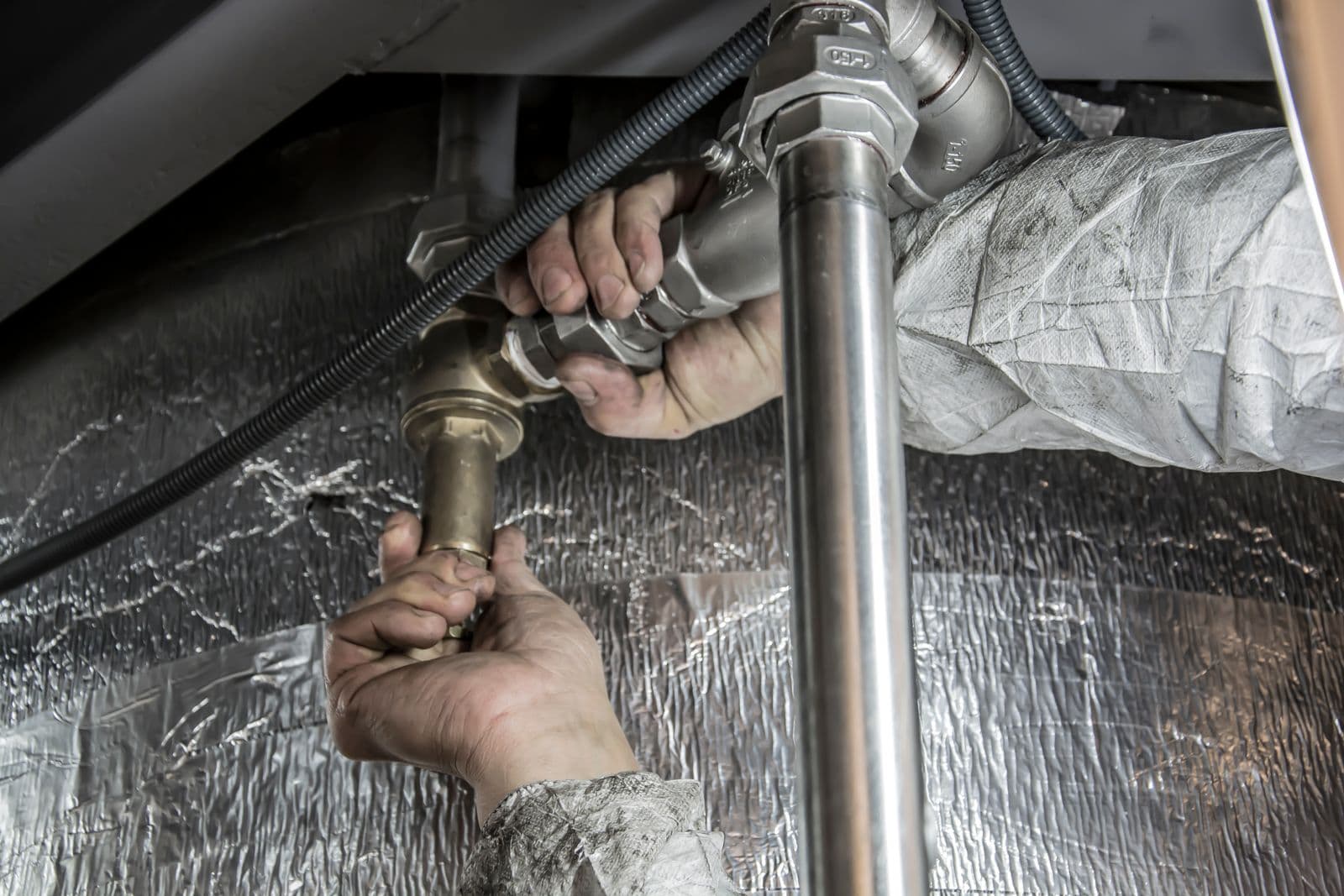
Treatment equipment is plumbing. Most of the job is the connection, the drain and the code detail behind it.


Quincy water, answered plainly
Where does Quincy's water come from?+
From the MWRA. The City of Quincy purchases its water directly from MWRA, delivered through five master meters. MWRA's sources are the Quabbin and Wachusett Reservoirs, treated at the Carroll Water Treatment Plant in Marlborough.
Is there lead in Quincy water?+
The water leaves MWRA lead-free; lead enters from lead service lines and household plumbing. In September 2025, Quincy's 90th percentile among 20 homes with known lead or lead-lined services was 8.74 ppb, below the 15 ppb action level, with no home over it. The City replaced 96 lead services in 2025 and aims to remove the remaining identified lead services by 2034.
What happened with coliform in 2025?+
59 of 1,328 routine samples tested positive for total coliform, concentrated from August to November. That required four Level 2 Assessments with MassDEP. The City responded with low-flow flushing to improve chlorine residuals, sampling-tap improvements, tank maintenance and an added monitoring program with MWRA. December 2025 had no positive samples. Total coliform is an indicator organism; the report does not describe an E. coli finding in Quincy's samples.
Does Quincy use chlorine or chloramine?+
Chloramine. MWRA disinfects with monochloramine, reported at 1.99 ppm on average in 2025. Catalytic carbon or reverse osmosis handles chloramine taste better than standard carbon.
How do I find out if I have a lead service line?+
The City publishes a water service line inventory map, and its DPW can help identify the material. Quincy mailed 748 letters in 2024 and 2025 to properties with suspected lead or incomplete records. A tap test tells you what is actually coming out of the faucet.
Where do these figures come from?+
MWRA's 2025 Drinking Water Test Results for Quincy, which includes the City of Quincy Department of Public Works letter (PWS 3243000). Third-party water-quality aggregators are not the source used here. A later report supersedes these figures.
Related resources
Home water purification and treatment
The national service page behind this one.
Learn more →Boston water quality
The same MWRA water, and Boston's 2025 lead exceedance.
Learn more →Cambridge water quality
Not MWRA: its own Fresh Pond supply, for contrast.
Learn more →Brockton water quality
Silver Lake, desalination and PFAS — not MWRA.
Learn more →Home battery backup in Quincy, MA
Two utilities and the Quincy Community Electricity price.
Learn more →Framingham water quality
MWRA water with no known lead service lines.
Learn more →Waltham water quality
Another MWRA city with a coliform assessment in its 2025 report.
Learn more →All home services
Water, battery, HVAC and solar under one licensed contractor of record.
Learn more →Get a free test at your tap
A licensed technician tests at your kitchen tap and tells you which of the findings above applies to your house — lead, chloramine taste, sediment or none of them. No charge, no obligation, and coverage confirmed at your address first.
Get a free test