Framingham, Massachusetts
Framingham Water Quality
MWRA reservoir water, treated just down the road in Marlborough. Framingham's 2025 report is unusually good news on lead: no known lead service lines, and a 90th-percentile result of 1.6 ppb.
Lead at the 90th percentile: 1.6 ppb in Framingham vs 5.96 ppb MWRA-wide (action level 15).
The short answer
Framingham drinks MWRA water from the Quabbin and Wachusett Reservoirs, disinfected with chloramine. Its 2025 report found no known lead service lines among about 18,000, and a lead result of 1.6 ppb at the 90th percentile (MWRA-wide 5.96).
That leaves a short list: two galvanized lines and 61 of unknown material still to check in 2026, plus whatever plumbing is inside your own house. For most Framingham homes, the practical questions are chloramine taste and older fixtures — and a tap test answers both.
Get a free test
Tell us your Framingham address. We confirm coverage first, then schedule a licensed technician to test at your tap — no charge, no obligation.
What filtration does — and does not
Softening, carbon and reverse osmosis solve different problems. Framingham's report does not make the case for a whole-house system by itself.
Where Framingham water comes from
The same reservoirs as Boston, treated closer to home.
Quabbin and Wachusett Reservoirs
Framingham buys its water from the MWRA. The sources are the Quabbin Reservoir (412 billion gallons of storage) and the Wachusett Reservoir (65 billion), with the Ware River when needed.
Treated next door in Marlborough
MWRA's John J. Carroll Water Treatment Plant disinfects with ozone and UV, adds fluoride, adjusts pH and alkalinity to reduce lead corrosion, and finishes with monochloramine.
Then Framingham's own system
About 18,000 service connections run by the Framingham Water Division, which replaced roughly 3,200 feet of main in 2025 on Second St., Edgell Rd. and Centennial Pl.
What the 2025 Framingham report actually says
Limits are fixed. Results are from MWRA's 2025 Drinking Water Test Results for Framingham, including the City DPW letter — system-level figures, not a reading at your tap. A later report supersedes them.
Lead — 1.6 ppb at the 90th percentile
Framingham's 2025 round of 20 higher-risk homes: 1.6 ppb at the 90th percentile, range 0.253–4.23, none over the 15 ppb action level. The MWRA-wide figure was 5.96 ppb.
No known lead service lines
The 2024 inventory found no known lead services among about 18,000. It flagged 60 galvanized lines requiring replacement and 61 of unknown material.
2 galvanized + 61 unknown left
Records review and inspections eliminated most of the galvanized flags, and five were replaced, leaving two galvanized-requiring-replacement and 61 unknown lines to investigate in 2026.
Copper — 78.7 ppb
90th percentile across the same 20 homes (range 4.16–88.6), against a 1,300 ppb action level.
TTHM 16.1 ppb · HAA5 15.8 ppb
MWRA's 2025 system averages for disinfection byproducts, against MCLs of 80 and 60.
Monochloramine — 1.99 ppm
MWRA disinfects with chloramine (range 0.02–3.7 ppm, maximum residual 4). That shapes filter choice more than any contaminant on this list.
Framingham next to Boston and Quincy
Boston drinks the same MWRA water, and its autumn 2025 lead result at higher-risk taps was over the action level. Quincy came in at 8.74 ppb with old cast-iron mains. Framingham's 1.6 ppb shows how much the local pipes matter when the source water is identical. West of the MWRA system, Worcester runs its own reservoirs and treatment. Closer to Boston, Waltham also reports no lead service lines, and Somerville is down to its last 24 known lead services.
Where these figures come from
Everything on this page traces to MWRA and the Framingham Department of Public Works.
- MWRA — 2025 Drinking Water Test Results, with the Framingham DPW letter (PDF) — MWRA sources, treatment and detected contaminants; Framingham's lead and copper, service line inventory and coliform compliance.
- City of Framingham — Water Service Line / Lead in Drinking Water — the interactive inventory map for checking an address.
Matching treatment to the finding
Framingham's report supports checking your service line and a chloramine-aware filter choice — not a default equipment sale.
Check the inventory before buying anything
With no known lead lines, the first step is the City's interactive service line map. If your address is one of the few galvanized or unknown lines, that is when a certified lead filter makes sense.
Chloramine taste: catalytic carbon or RO
Ordinary carbon handles free chlorine better than chloramine. If taste or odour is the complaint, catalytic carbon or reverse osmosis is the right tool.
Older house plumbing
The report's lead figure is about service lines and sampled homes. Old solder or brass fixtures inside a house are a separate question that a tap test answers.
Hardness: test, do not assume
The report prints no hardness figure, and MWRA water is not usually sold a softener. A tap test settles it before anyone sizes one.
How the free test works
A licensed technician tests at your kitchen tap, walks the plumbing, and tells you which of the findings above applies to your house and which does not. There is no charge and no obligation.
Seamless Home is the licensed contractor of record on the work that follows. Installation is performed by vetted installing partners engaged as our subcontractors, and the workmanship obligation stays with us. Coverage is confirmed per service area rather than promised as blanket availability.
What a water treatment job with us covers
Installation and replacement of whole-home and point-of-use treatment, specified against what your water actually contains.
Sediment filtration
Installation of the first stage that protects everything downstream of it, sized to the service line and the household draw.
Softening
Installation of ion-exchange softening where hardness is the problem, including the drain connection the plumbing code treats as indirect waste.
Carbon filtration
Installation of carbon stages for taste, odour and disinfection by-products, specified from your utility's own water quality report.
Reverse osmosis
Point-of-use installation at the kitchen sink where the target is dissolved solids rather than whole-home flow.
Disinfection
Installation of UV or equivalent treatment where the supply is a private well or is otherwise not continuously disinfected.
System replacement
Replacing equipment that has reached the end of its service life, including the discharge and air gap details an inspector looks at.
This is installation and replacement work, specified from a published water quality report or a test of your supply — not from a sales chart. Coverage is confirmed per service area rather than promised as blanket availability.
What the work actually looks like
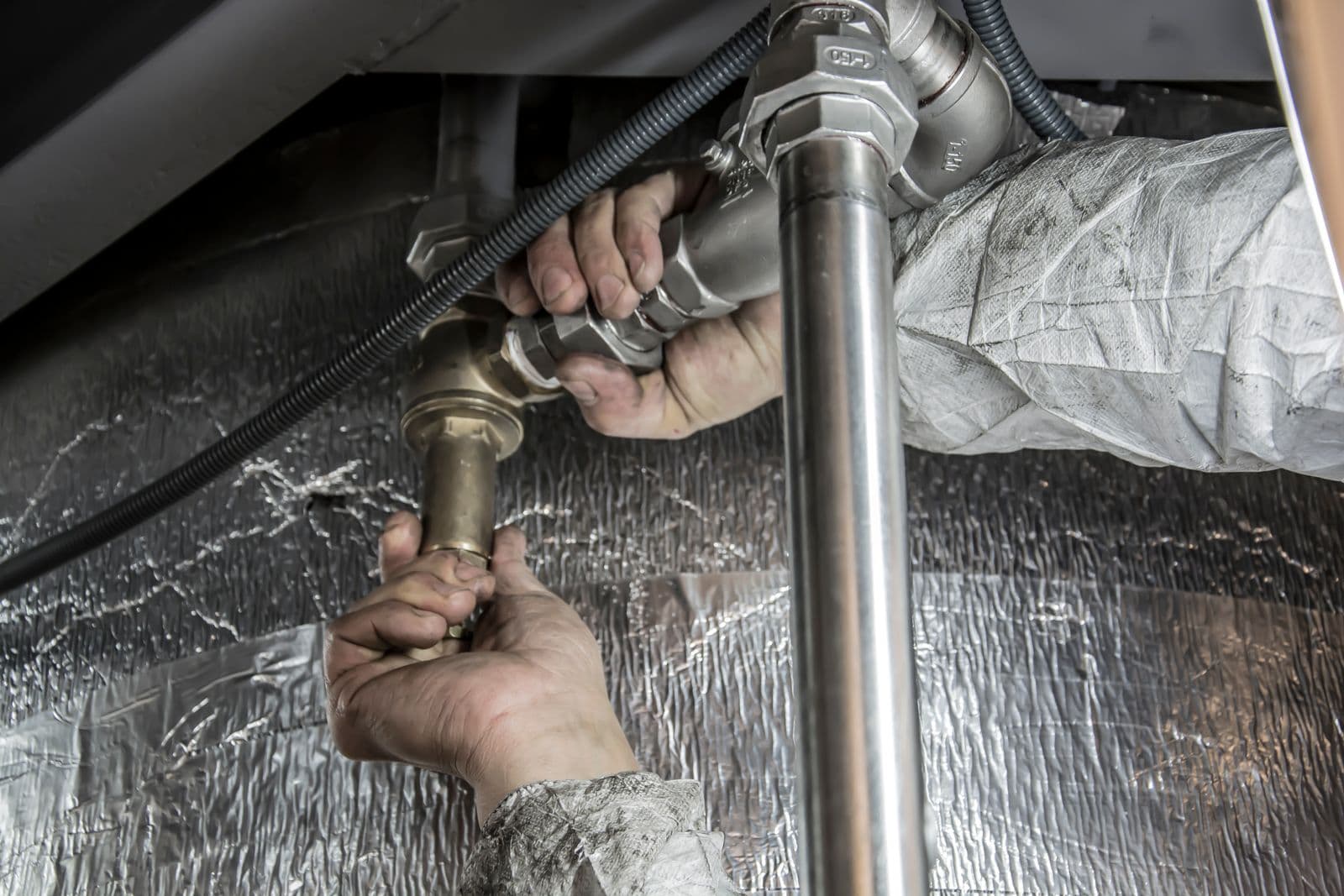
Treatment equipment is plumbing. Most of the job is the connection, the drain and the code detail behind it.


Framingham water, answered plainly
Where does Framingham's water come from?+
From the MWRA. Framingham buys its water from the MWRA's Quabbin and Wachusett Reservoirs, treated at the John J. Carroll Water Treatment Plant in Marlborough and carried east through the MetroWest Water Supply Tunnel.
Does Framingham have lead service lines?+
Per the City's 2025 report letter, there are no known lead services among roughly 18,000. The 2024 inventory identified 60 galvanized lines requiring replacement and 61 of unknown status; by the report, two galvanized and 61 unknown remained to investigate in 2026. The City's interactive service line map shows the recorded material for an address.
Is there lead in Framingham tap water?+
In 2025 the 90th percentile among 20 higher-risk homes was 1.6 ppb, with no sample over the 15 ppb action level. Lead can still come from plumbing inside an individual house, which only a test at your tap shows.
Does Framingham use chlorine or chloramine?+
Chloramine. MWRA disinfects with monochloramine, averaging 1.99 ppm in 2025.
Do I need a water softener in Framingham?+
The report gives no hardness figure, so we don't assume one. We test at the tap before recommending any softener.
Where do these figures come from?+
MWRA's 2025 Drinking Water Test Results for Framingham, which includes the Framingham Department of Public Works letter. Third-party aggregators are not used. A later report supersedes these figures.
Related resources
Home water purification and treatment
The national service page behind this one.
Learn more →Boston water quality
The same MWRA water, and Boston's 2025 lead exceedance.
Learn more →Quincy water quality
MWRA water through old cast-iron mains.
Learn more →Worcester water quality
Its own reservoirs and treatment, not MWRA.
Learn more →Waltham water quality
MWRA water, no lead lines on file, and a November 2025 coliform finding.
Learn more →All home services
Water, battery, HVAC and solar under one licensed contractor of record.
Learn more →Get a free test at your tap
A licensed technician tests at your kitchen tap and tells you which findings apply to your house — chloramine taste, older plumbing or none of them. No charge, no obligation, and coverage confirmed at your address first.
Get a free test