New Bedford, Massachusetts
New Bedford Water Quality
Assawompsett and Quittacas surface water — not MWRA. The city's annual report plus EPA UCMR5 monitoring set the South Coast story, including a published PFBA detection and MassDEP's PFAS6 rule at 20 ppt.
PWS MA4201000 treats South Coast reservoirs. Boston's MWRA numbers do not apply here.
The short answer
New Bedford addresses on the City of New Bedford DPI system (PWS MA4201000) drink treated surface water from the Assawompsett / Quittacas complex — not MWRA water from Greater Boston.
EPA UCMR5 monitoring for this system includes a published PFBA detection at 7 ng/L (one detect in four samples in the 2024 UCMR5 record). Massachusetts still enforces a PFAS6 MCL of 20 ppt. Open the city's latest annual water quality report for the full regulated tables before buying equipment.
Get a free test
Tell us your New Bedford address. We confirm coverage first, then schedule a licensed technician to test at your tap — no charge, no obligation.
What filtration does — and does not
Softening, carbon and reverse osmosis solve different problems. New Bedford's story is surface-water treatment and PFAS monitoring — not a desert hardness slogan.
Where New Bedford water comes from
A South Coast municipal reservoir system — not MWRA and not Brockton's Silver Lake story.
Assawompsett Pond Complex and Quittacas ponds
EPA's SDWIS facility inventory for New Bedford (PWS MA4201000) lists surface sources including Assawompsett Pond, Great Quittacas Pond, Little Quittacas Pond and Long Pond. That is a South Coast reservoir system — not the MWRA tunnels that serve Greater Boston.
Quittacas Water Treatment Plant and High Hill Reservoir
Treatment is listed at the Quittacas Water Treatment Plant and the High Hill Reservoir Treatment Plant. Finished water is a surface-water product with the disinfection-byproduct profile that comes with organic-rich New England reservoirs.
City of New Bedford Department of Public Infrastructure
The city DPI publishes the annual water quality report (Consumer Confidence Report) for PWS ID 4201000 and states that regular monitoring is intended to meet or exceed state and federal requirements. Read the latest PDF on the city's water-quality page before treating any third-party summary as your tap.
Not Boston MWRA water
New Bedford is outside the Massachusetts Water Resources Authority service area that supplies Boston and many inner-core suburbs. Borrowing MWRA hardness or PFAS figures for a New Bedford softener quote is how households buy the wrong stage.
What monitoring and state rules actually say
Figures below cite the city's annual report page, EPA SDWIS, EPA UCMR5 and MassDEP's PFAS6 standard. Open the latest CCR PDF for every regulated row. A later report supersedes older figures.
PFAS — EPA UCMR5 detected PFBA at 7 ng/L
Under EPA's Fifth Unregulated Contaminant Monitoring Rule, New Bedford's public results include a PFBA detection at 7 ng/L (one detect in four samples in the 2024 UCMR5 record commonly cited for this system). PFBA does not have a standalone federal MCL today. MassDEP's enforceable PFAS6 standard of 20 ppt for the sum of six PFAS still governs Massachusetts systems.
MassDEP PFAS6 at 20 ppt — stricter local frame than "no federal MCL yet"
Since 2020 Massachusetts has enforced a Maximum Contaminant Level of 20 parts per trillion for the sum of six PFAS (PFOS, PFOA, PFHxS, PFNA, PFHpA and PFDA). EPA's April 2024 rule separately set 4.0 ppt MCLs for PFOA and PFOS with a later compliance date. City statements that finished water sits below current EPA regulation limits should be read against both rulebooks — and against the latest CCR PDF.
Surface-water disinfection byproducts
Reservoir systems form trihalomethanes and haloacetic acids when organic matter meets disinfectant. Exact LRAA figures belong in the city's latest annual report tables — open that PDF for the compliance numbers rather than a third-party scrape.
Soft surface water — confirm grains at the tap
South Coast surface supplies are typically far softer than desert groundwater. Softener sales pitches copied from Arizona pages do not travel. If scale is still a complaint, test the tap; do not assume a hardness number from another Massachusetts city.
Lead and copper — plumbing, not the reservoir
Lead in drinking water is primarily a home-plumbing and service-line story. Use the city's latest CCR lead/copper table and any published service-line inventory rather than a regional rumor.
Read the city's PDF for the full regulated table
This page names the utility, the source complex, the UCMR5 PFBA result and the MassDEP PFAS6 frame. Contaminant rows that only appear in the annual CCR PDF are cited from that PDF when you open it — we do not invent missing cells.
Why New Bedford is not Brockton or Boston with a different ZIP
Boston sits on MWRA. Brockton is a different municipal system with its own Silver Lake / Aquaria story and PFAS6 finished-water figures. Lowell is Merrimack River territory again. New Bedford's Assawompsett / Quittacas complex is why South Coast filter advice has to start from this CCR, not a metro Boston average.
Where these figures come from
Everything on this page traces to primary sources. Independent compilations of water quality data exist and are not used here.
- City of New Bedford DPI — Water Quality Report — annual CCR PDF downloads for PWS 4201000.
- EPA — Fifth Unregulated Contaminant Monitoring Rule (UCMR5) — PFBA monitoring context; use EPA's UCMR5 data finder for system-level results.
- MassDEP — PFAS in drinking water — PFAS6 MMCL of 20 ppt.
- EPA — PFAS National Primary Drinking Water Regulation — 4.0 ppt MCLs for PFOA and PFOS.
Matching treatment to the finding
New Bedford's monitoring supports a careful PFAS conversation and a tap test — not a copied desert softener quote.
PFAS: certified reduction, not "forever chemical" box art
If a household wants a margin after reading UCMR5 and the city CCR, NSF/ANSI 53 or 58 listings that name PFOA and PFOS reduction are the check. PFBA behaves differently from PFOA/PFOS in some filters — ask which compounds the listing actually covers.
Carbon for taste and DBPs when the CCR shows them
Surface-water DBP complaints are a carbon conversation when the city's tables support it. Match the filter to the residual disinfectant the plant uses.
Skip the desert softener default
New Bedford is not a 15-grain West Valley system. Softener sizing starts from a tap test, not a Phoenix brochure.
Confirm City of New Bedford vs Fairhaven or a consecutive system
EPA's inventory notes New Bedford may also buy water from Fairhaven. Confirm the utility on the bill before treating any South Coast average as your kitchen sink.
How the free test works
A licensed technician tests at your kitchen tap, walks the plumbing, and tells you which of the findings above applies to your house and which does not. There is no charge and no obligation.
Seamless Home is the licensed contractor of record on the work that follows. Installation is performed by vetted installing partners engaged as our subcontractors, and the workmanship obligation stays with us. Coverage is confirmed per service area rather than promised as blanket availability.
A softener or RO unit needs a legal drain connection — where a water softener is allowed to discharge sets out the indirect-waste rule that decides where it goes.
What a water treatment job with us covers
Installation and replacement of whole-home and point-of-use treatment, specified against what your water actually contains.
Sediment filtration
Installation of the first stage that protects everything downstream of it, sized to the service line and the household draw.
Softening
Installation of ion-exchange softening where hardness is the problem, including the drain connection the plumbing code treats as indirect waste.
Carbon filtration
Installation of carbon stages for taste, odour and disinfection by-products, specified from your utility's own water quality report.
Reverse osmosis
Point-of-use installation at the kitchen sink where the target is dissolved solids rather than whole-home flow.
Disinfection
Installation of UV or equivalent treatment where the supply is a private well or is otherwise not continuously disinfected.
System replacement
Replacing equipment that has reached the end of its service life, including the discharge and air gap details an inspector looks at.
This is installation and replacement work, specified from a published water quality report or a test of your supply — not from a sales chart. Coverage is confirmed per service area rather than promised as blanket availability.
What the work actually looks like
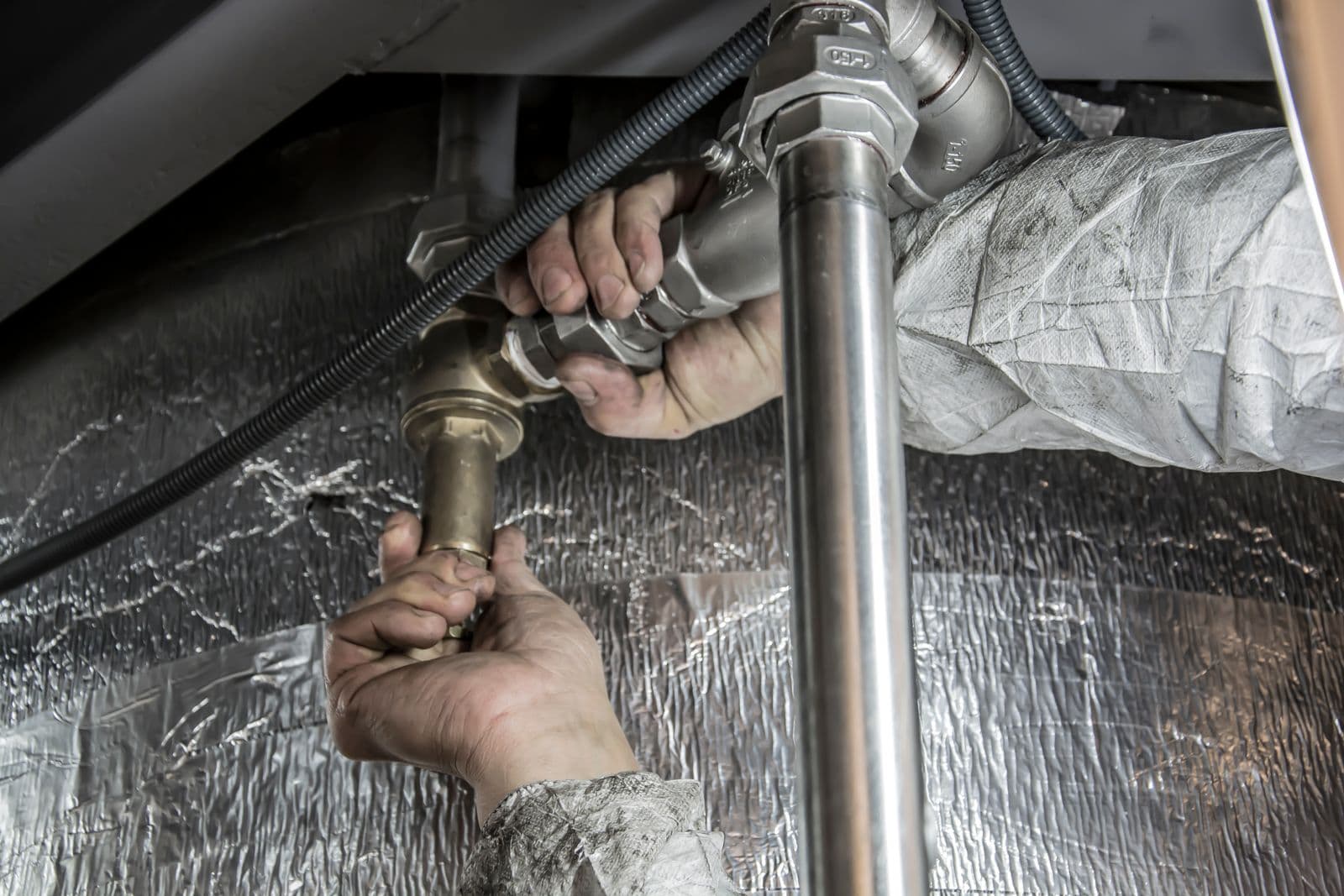
Treatment equipment is plumbing. Most of the job is the connection, the drain and the code detail behind it.


New Bedford water, answered plainly
Who provides New Bedford drinking water?+
The City of New Bedford Department of Public Infrastructure operates PWS ID MA4201000 (also styled 4201000 in city materials). It is a municipal surface-water system based on the Assawompsett / Quittacas complex, not MWRA.
Is New Bedford water the same as Boston's?+
No. Boston and many inner-core communities are on the Massachusetts Water Resources Authority. New Bedford treats water from its own South Coast reservoir system. Different source, different CCR, different treatment.
Is there PFAS in New Bedford water?+
EPA UCMR5 monitoring for this system includes a published PFBA detection at 7 ng/L (one detect in four samples in the 2024 UCMR5 record). MassDEP's PFAS6 MCL of 20 ppt still applies to the six named PFAS. Open the city's latest annual water quality report for the full regulated and unregulated tables.
Do I need a softener in New Bedford?+
Usually not as a default. South Coast surface water is typically soft compared with hard groundwater cities. Test at the tap if you have a specific scale or soap complaint rather than buying for a desert hardness range.
Where do these figures come from?+
The City of New Bedford DPI water-quality report page and annual CCR PDF; EPA SDWIS facility data for PWS MA4201000; EPA UCMR5 results for PFBA; MassDEP's PFAS6 drinking-water standard. Independent water-quality aggregators are not the source used here. A later CCR or UCMR update supersedes older figures.
Related resources
Home water purification and treatment
The national service page behind this one.
Learn more →Brockton water quality
Neighbouring South Shore municipal CCR — Silver Lake / Aquaria.
Learn more →Boston water quality
MWRA system — not New Bedford's sources.
Learn more →Lowell water quality
Merrimack River municipal contrast.
Learn more →Where a water softener can discharge
Indirect-waste rules for treatment drain lines.
Learn more →All home services
Water, battery, HVAC and solar under one licensed contractor of record.
Learn more →Get a free test at your tap
A licensed technician tests at your kitchen tap and tells you which of the findings above applies to your house — PFAS monitoring context, disinfection byproducts, softness or none of them. No charge, no obligation, and coverage confirmed at your address first.
Get a free test