Fall River, Massachusetts
Fall River Water Quality
Pond water, filtered by the City. The 2025 report's household finding is lead at the tap: 2 of 61 homes tested above the action level while the City replaces lead service lines.
Lead: 2 of 61 homes over 15 ppb (highest 46.8) · sodium 27 ppm · PFAS6 5.15 ppt · TTHM up to 95.5 ppb.
The short answer
Fall River treats North Watuppa Pond water at its own plant. The pond isn't the concern. The pipes are: in the third quarter of 2025, 2 of 61 homes tested above the 15 ppb lead action level, the highest at 46.8 ppb, and the City is replacing lead service lines.
Sodium was 27 ppm, over MassDEP's 20 ppm guideline, and PFAS6 was 5.15 ppt, under the state's 20 ppt limit. Check your service line first, then test at your tap.
Get a free test
Tell us your Fall River address. We confirm coverage first, then schedule a licensed technician to test at your tap — no charge, no obligation.
What filtration does — and does not
Carbon and reverse osmosis solve different problems. Fall River's report points at lead first.
Where Fall River water comes from
A City-owned pond and plant.
North Watuppa Pond
Fall River draws its water from North Watuppa Pond. When needed, the City pumps water from Copicut Reservoir into the North Watuppa watershed.
Filtered at the pond
The City's plant on the pond's west shore chlorinates, settles and filters the water through sand and anthracite, then adds carbon dioxide and sodium hydroxide to reduce pipe corrosion.
Fall River, plus three neighbors
The City delivered about 6.4 million gallons a day in 2025, including about 630,000 gallons a day sold to Tiverton, Westport and Freetown.
What the 2025 Fall River report actually says
Results are from the City of Fall River's Consumer Confidence Report 2025 data table. They are system-level figures, not a reading at your tap.
Lead: 2 of 61 homes over 15 ppb
Third-quarter 2025 tap samples ranged from 0 to 46.8 ppb. Two of the 61 sites exceeded the 15 ppb action level. The system did not violate the rule, which is judged at the 90th percentile.
Sodium 27 ppm
There is no federal limit, but MassDEP has a 20 ppm guideline, mainly for people on sodium-restricted diets. Sodium hydroxide is part of the City's corrosion treatment.
PFAS6 5.15 ppt
Sampled October 27, 2025, against the Massachusetts limit of 20 ppt. Next sampling is due in October 2026.
Trihalomethanes up to 95.5 ppb
Quarterly results ranged from 14.1 to 95.5 ppb. The 80 ppb limit applies to the running average, and the report lists no violation. Haloacetic acids ranged 13.3–30.4 ppb.
Fluoride below 0.050 ppm
The City has added fluoride since 1972, but the report says quality product has been in short supply since 2018. The 2025 result was below 0.050 ppm.
Copper and nitrate low
Copper was 0.0588 ppm at the 90th percentile with no site over the action level. Nitrate was below 0.050 ppm.
Fall River next to New Bedford and Brockton
Like Fall River, New Bedford runs its own surface-water system rather than buying MWRA water, from the Assawompsett and Quittacas ponds. Brockton relies on Silver Lake and has kept a reservoir plant idle over PFAS6. Fall River's 2025 report puts PFAS6 at 5.15 ppt; its household issue is lead at the tap. For the electric side of the city, see Fall River battery backup.
Where these figures come from
Everything on this page traces to the City of Fall River.
- City of Fall River — Consumer Confidence Report 2025, PWS ID 4095000 (PDF) — source, treatment, the 2025 data table and the lead service line notice.
- City of Fall River — Consumer Confidence Reports — the current report and earlier years.
Matching treatment to the finding
Fall River's report supports checking for lead at the tap. It does not support a default equipment sale.
Find out what your service line is
The City is replacing lead service lines and posts an inventory map. If your property isn't identified, Water Administration can tell you. That answer comes before any filter.
A lead-certified filter at the kitchen tap
If your line or plumbing is suspect, a filter certified for lead at the kitchen tap covers drinking and cooking water while replacement is pending.
Reverse osmosis for sodium
If someone in the house is on a low-sodium diet, under-sink RO reduces sodium as well as lead and PFAS.
Test before buying anything
Two homes over the action level says nothing about yours. A tap test does, and it tells you whether you need treatment at all.
How the free test works
A licensed technician tests at your kitchen tap, walks the plumbing, and tells you which of the findings above applies to your house and which does not. There is no charge and no obligation.
Seamless Home is the licensed contractor of record on the work that follows. Installation is performed by vetted installing partners engaged as our subcontractors, and the workmanship obligation stays with us. Coverage is confirmed per service area rather than promised as blanket availability.
What a water treatment job with us covers
Installation and replacement of whole-home and point-of-use treatment, specified against what your water actually contains.
Sediment filtration
Installation of the first stage that protects everything downstream of it, sized to the service line and the household draw.
Softening
Installation of ion-exchange softening where hardness is the problem, including the drain connection the plumbing code treats as indirect waste.
Carbon filtration
Installation of carbon stages for taste, odour and disinfection by-products, specified from your utility's own water quality report.
Reverse osmosis
Point-of-use installation at the kitchen sink where the target is dissolved solids rather than whole-home flow.
Disinfection
Installation of UV or equivalent treatment where the supply is a private well or is otherwise not continuously disinfected.
System replacement
Replacing equipment that has reached the end of its service life, including the discharge and air gap details an inspector looks at.
This is installation and replacement work, specified from a published water quality report or a test of your supply — not from a sales chart. Coverage is confirmed per service area rather than promised as blanket availability.
What the work actually looks like
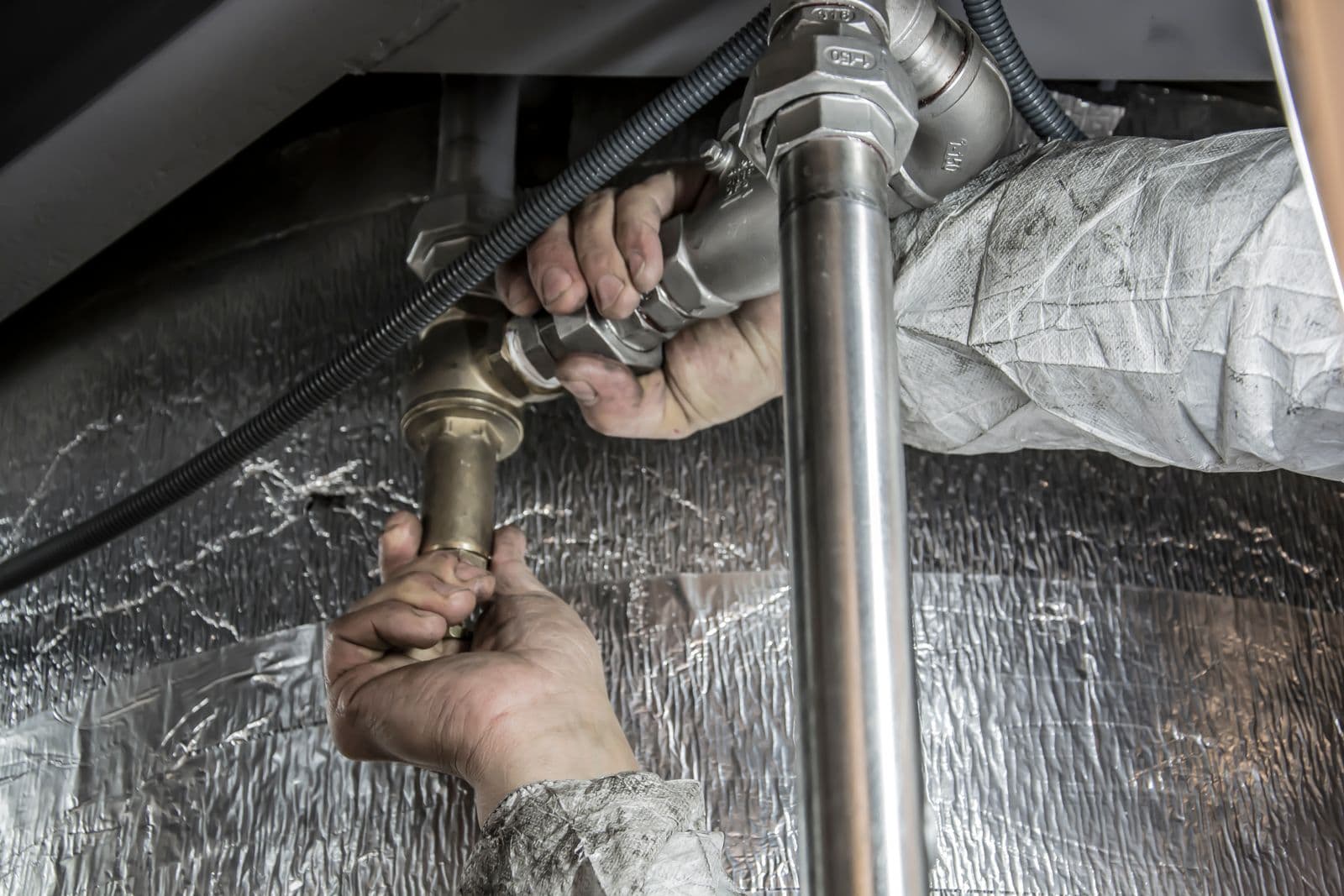
Treatment equipment is plumbing. Most of the job is the connection, the drain and the code detail behind it.


Fall River water, answered plainly
Where does Fall River's water come from?+
From North Watuppa Pond, treated at the City's plant on its west shore. Copicut Reservoir water is pumped into the North Watuppa watershed when needed. Fall River is not on MWRA water.
Is there lead in Fall River water?+
Lead comes from service lines and household plumbing, not the pond. In the third quarter of 2025, 2 of 61 homes sampled were above the 15 ppb action level, with a highest result of 46.8 ppb. The City did not violate the rule and is replacing lead service lines.
How do I know if I have a lead service line?+
The City's 2025 report points to its online service line inventory map. If your property's material isn't identified, it asks you to contact Water Administration at 508-324-2330.
Is there PFAS in Fall River water?+
PFAS6 was 5.15 ppt in the October 27, 2025 sample, below the Massachusetts limit of 20 ppt.
Why is sodium flagged?+
Sodium was 27 ppm. There's no federal limit, but MassDEP's guideline is 20 ppm, which matters for anyone told to limit sodium.
Where do these figures come from?+
The City of Fall River's Consumer Confidence Report 2025 (PWS ID 4095000), including its data table. Third-party aggregators are not used.
Related resources
Home water purification and treatment
The national service page behind this one.
Learn more →New Bedford water quality
Assawompsett and Quittacas pond water, not MWRA.
Learn more →Brockton water quality
Silver Lake water and a reservoir plant idled over PFAS6.
Learn more →Fall River battery backup
National Grid delivery under a community supply price fixed to November 2028.
Learn more →All home services
Water, battery, HVAC and solar under one licensed contractor of record.
Learn more →Get a free test at your tap
A licensed technician tests at your kitchen tap and tells you which findings apply to your house — lead, sodium or disinfection byproducts. No charge, no obligation, and coverage confirmed at your address first.
Get a free test