Goodyear, Arizona
Goodyear Water Quality
Two providers split by I-10, and a TTHM notice for City customers south of the Gila River. What the 2026 running averages say, what the City is doing about them, and what that means at your tap.
Third quarter 2026: TTHM running averages of 0.082 and 0.086 ppm at two sites, against a 0.080 ppm federal standard.
The short answer
Goodyear has two water providers: Liberty Utilities serves most of the area north of I-10, and the City serves south of the freeway from wells and Colorado River water.
City customers south of the Gila River have received a notice: TTHM running averages of 0.082 and 0.086 ppm for the third quarter of 2026, against a 0.080 ppm standard. The City says it is not an emergency, temporary treatment is expected in mid-October 2026, and a permanent fix in January 2031. If anything here justifies equipment, it is a certified drinking-water tap — not a whole-house system.
Get a free test
Tell us your Goodyear address. We confirm coverage and which water provider serves you first, then schedule a licensed technician to test at your tap — no charge, no obligation.
What filtration does — and does not
Softening, carbon and reverse osmosis solve different problems. In Goodyear the byproduct question and the hardness question are separate, and so is the equipment.
Where Goodyear water comes from
Which report applies depends on which side of I-10 — and, for the 2026 notice, which side of the Gila River — the house sits.
North of I-10: mostly Liberty Utilities
The City's Water Services FAQ says most of the area north of I-10 is served by Liberty Utilities, not by the City. For those addresses the City's notices and reports are not the ones that apply — the utility bill names the provider whose report does.
South of the freeway: City wells
For City of Goodyear water customers, wells throughout the city pump groundwater from beneath the ground. The City says hardness varies throughout its service area, so a softener setting borrowed from a neighbour across town can be wrong.
South of the freeway: Colorado River water
The City also delivers Colorado River surface water to its Water Treatment Facility. Surface water carries natural organic material, and that is where the byproduct story on this page begins.
South of the Gila River: the notice area
The 2026 TTHM notice applies only to City of Goodyear customers south of the Gila River, shown on the City's own map. It does not apply to every City customer, and it does not apply to Liberty customers.
What the City says about the TTHM notice
From the City of Goodyear Water Quality page and Water Notice FAQs, read in October 2026. System-level running averages at test sites, not a reading at your tap. A later City update supersedes them.
TTHM running average — 0.082 and 0.086 ppm
For the third quarter of 2026, the City reports running annual average TTHM levels of 0.082 ppm at one test site and 0.086 ppm at a second, against the federal standard of 0.080 ppm (80 ppb). Compliance is judged on the running average of quarterly results, not a single sample.
Not a boil-water notice
The City says the water remains safe to drink and use as normal, that no customer action is required, and that it would notify customers within 24 hours if the water were ever unsafe. The health concern it describes for TTHMs is long-term exposure over many years.
Why a second notice
Because compliance is a running annual average, improvements show up slowly. The City says steps already taken have not yet brought the average consistently below the standard, so customers in the area received a second notice.
Temporary treatment — mid-October 2026
A temporary treatment system to limit TTHM formation is expected to be operating in mid-October 2026, and stays in service until the permanent fix is finished.
Permanent fix — expected January 2031
A permanent treatment solution is being designed and built at the Surface Water Treatment Facility, with completion expected in January 2031. Until then the City is lowering chlorine residuals where appropriate, flushing and testing more.
Chlorine taste is a separate question
The City's FAQ addresses chlorine taste and odour on its own: letting water stand or chilling it reduces it. A taste complaint and a TTHM average are different findings, and they are answered by different equipment.
Why Goodyear is not Avondale with a different ZIP
Next door, Avondale is mostly City wells with a Phoenix interconnect, and its 2024 report shows TTHM well under the limit. Surprise is EPCOR's Agua Fria district, and Phoenix blends three rivers with wells. Goodyear's distinguishing facts are the provider line at I-10 and a byproduct notice limited to one part of the City's system. A filter quote built on a neighbour's report answers the wrong question.
Where these figures come from
Everything on this page traces to the City of Goodyear and EPA. Independent compilations of water quality data exist and are not used here.
- City of Goodyear — Water Quality — TTHM notice area, third-quarter 2026 running averages, temporary and permanent treatment timeline, and the link to the 2025 Water Quality Report.
- City of Goodyear — Water Services FAQs — Liberty Utilities north of I-10, wells and Colorado River water south of it, hardness varying by area, chlorine taste.
- EPA — Stage 1 and Stage 2 Disinfectants and Disinfection Byproducts Rules — the 0.080 mg/L TTHM standard and locational running annual averages.
Matching treatment to the finding
Goodyear's notice supports a certified drinking-water tap conversation — not a whole-house purchase.
TTHM: point-of-use, matched to the listing
The City itself notes that refrigerator filters and reverse osmosis drinking-water systems are usually designed to remove TTHMs. The honest version of that is: check that the specific product is certified for TTHM reduction, and put it where you drink — the kitchen tap.
Hardness: measure it at your address
The City says hardness varies throughout Goodyear and offers a Water Quality Technician to help with softener settings. A tap test gives the grains-per-gallon figure a softener actually needs.
North of I-10: start with the Liberty report
If the bill says Liberty Utilities, the TTHM notice on this page is not your system's notice. We start from your provider's own report rather than the City's.
No whole-house purchase on a notice alone
The City says no filtration is required because of the notice, and a permanent fix is under way. A whole-house system is a decision for hardness or a whole-home taste problem, not a reflex to a running-average notice.
How the free test works
A licensed technician tests at your kitchen tap, confirms which provider serves the house, and tells you which of the findings above applies to you and which does not. There is no charge and no obligation.
Seamless Home is the licensed contractor of record on the work that follows. Installation is performed by vetted installing partners engaged as our subcontractors, and the workmanship obligation stays with us. Coverage is confirmed per service area rather than promised as blanket availability.
An RO unit needs a legal drain connection — where a water softener is allowed to discharge sets out the indirect-waste rule that applies to treatment drain lines.
What a water treatment job with us covers
Installation and replacement of whole-home and point-of-use treatment, specified against what your water actually contains.
Sediment filtration
Installation of the first stage that protects everything downstream of it, sized to the service line and the household draw.
Softening
Installation of ion-exchange softening where hardness is the problem, including the drain connection the plumbing code treats as indirect waste.
Carbon filtration
Installation of carbon stages for taste, odour and disinfection by-products, specified from your utility's own water quality report.
Reverse osmosis
Point-of-use installation at the kitchen sink where the target is dissolved solids rather than whole-home flow.
Disinfection
Installation of UV or equivalent treatment where the supply is a private well or is otherwise not continuously disinfected.
System replacement
Replacing equipment that has reached the end of its service life, including the discharge and air gap details an inspector looks at.
This is installation and replacement work, specified from a published water quality report or a test of your supply — not from a sales chart. Coverage is confirmed per service area rather than promised as blanket availability.
What the work actually looks like
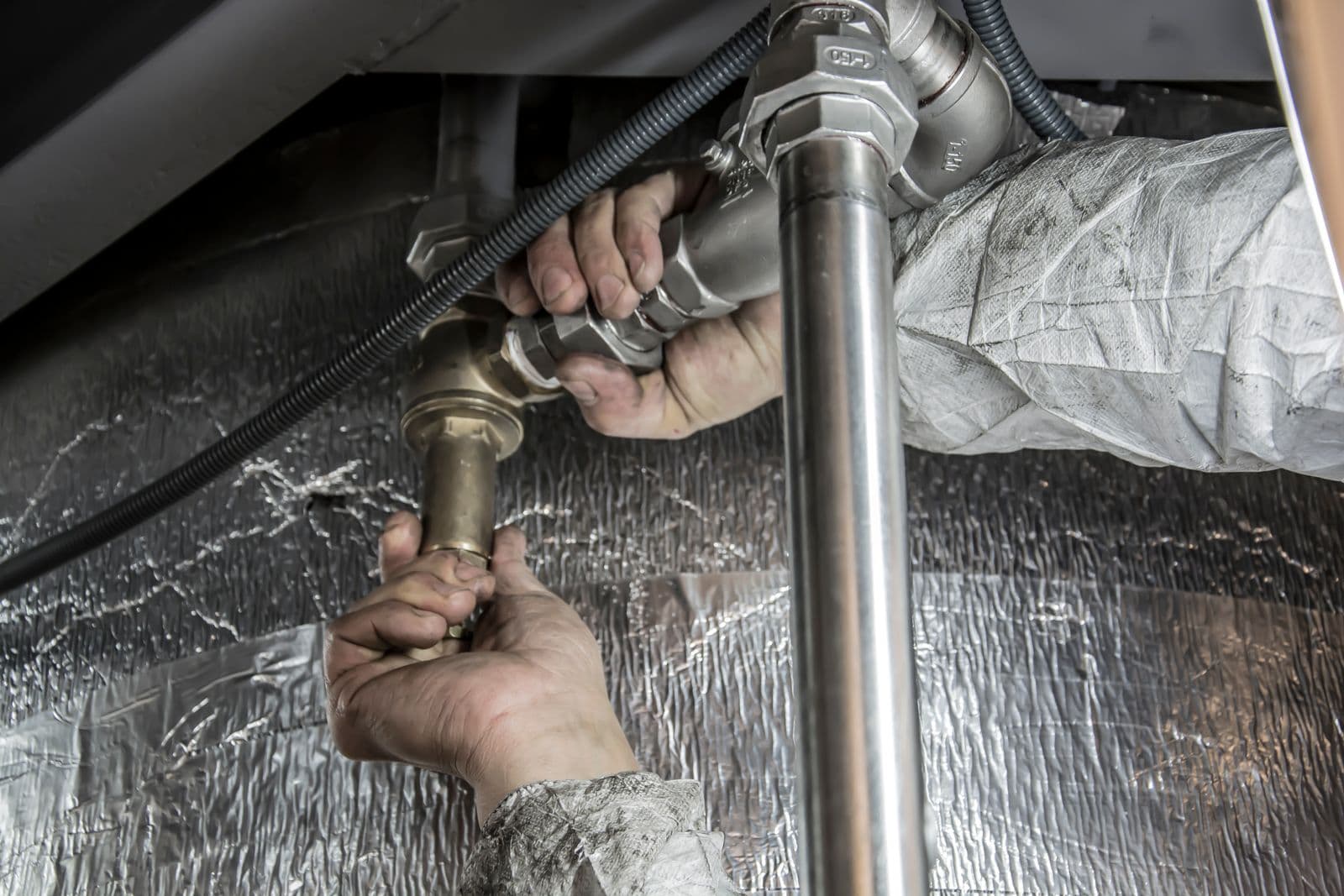
Treatment equipment is plumbing. Most of the job is the connection, the drain and the code detail behind it.


Goodyear water, answered plainly
Who provides water in Goodyear?+
It depends on where you live. The City of Goodyear's Water Services FAQ says most of the area north of I-10 is served by Liberty Utilities. South of the freeway, the City serves customers with groundwater from its wells and Colorado River water treated at its Water Treatment Facility. Your water bill names your provider.
What is the Goodyear TTHM notice?+
Testing showed total trihalomethanes (TTHMs) slightly above the federal standard at two test sites. TTHM compliance is based on a running annual average: for the third quarter of 2026 the City reports 0.082 ppm at one site and 0.086 ppm at another, against 0.080 ppm. The notice applies only to City of Goodyear water customers south of the Gila River.
Is Goodyear water safe to drink?+
The City says yes: this is not an emergency or a boil-water notice, the water can be used as normal, and no customer action is required. The health effects the City describes for TTHMs relate to drinking water above the limit over many years, not short-term use.
When will the TTHM problem be fixed?+
The City expects a temporary treatment system to be operating in mid-October 2026, and a permanent treatment solution at the Surface Water Treatment Facility to be completed in January 2031. In the meantime it is lowering chlorine residuals where appropriate, flushing and testing more.
Do I need a filter because of the notice?+
The City says you do not. It also notes that refrigerator filters and reverse osmosis systems are usually designed to remove TTHMs. If you want to lower your own exposure before the permanent fix, a kitchen-tap system certified for TTHM reduction is the proportionate step.
Where do these figures come from?+
The City of Goodyear Water Quality page and Water Notice FAQs, read in October 2026, and the City's Goodyear Weekly Report of June 26, 2026. The City's 2025 Water Quality Report is linked from the same page and carries the full regulated tables. A later update from the City supersedes the figures here.
Related resources
Home water purification and treatment
The national service page behind this one.
Learn more →Avondale water quality
City wells plus a Phoenix interconnect, next door.
Learn more →Surprise water quality
EPCOR Agua Fria district — a different West Valley provider.
Learn more →Phoenix water quality
Three rivers plus wells, and the Valley's byproduct baseline.
Learn more →Where a water softener can discharge
Indirect-waste rules for treatment drain lines.
Learn more →All home services
Water, battery, HVAC and solar under one licensed contractor of record.
Learn more →Get a free test at your tap
A licensed technician confirms your provider, tests at your kitchen tap and tells you which of the findings above applies to your house — byproducts, hardness or neither. No charge, no obligation, and coverage confirmed at your address first.
Get a free test