Glendale, Arizona
Glendale Water Quality
City water from an SRP, CAP and groundwater blend. The 2025 report documents zero lead and zero unknown service lines in the November inventory — and free chlorine disinfection, not chloramine.
Zero lead / zero unknown service lines (Nov 2025) · SRP 55% / CAP 41% / GW 4% · free chlorine.
The short answer
Glendale drinks a published blend of SRP (~55%), CAP (~41%) and groundwater (~4%), disinfected with free chlorine. The City's November 2025 service-line inventory — as stated in the 2025 CCR — documented zero lead and zero unknown service lines.
That does not make every kitchen tap identical. Home plumbing can still contribute metal, canal algae can leave a musty taste, and hardness varies enough that we test at your address rather than invent a citywide ppm figure.
Get a free test
Tell us your Glendale address. We confirm coverage first, then schedule a licensed technician to test at your tap — no charge, no obligation.
What filtration does — and does not
Softening, carbon and reverse osmosis solve different problems. A filter choice should follow a tap test — especially when hardness numbers are not printed as a single citywide figure.
Where Glendale water comes from
Three published shares — not a single reservoir story.
Salt River Project canals — 55%
Runoff from the Salt and Verde watersheds is stored in SRP lakes and delivered by canal. The City's 2025 report diagram assigns about 55% of Glendale's mix to SRP.
Central Arizona Project — 41%
Colorado River water stored in Lakes Powell, Mead and Pleasant arrives through the CAP canal. The same diagram assigns about 41% to CAP.
Groundwater — 4%
Wells and long-term storage credits make up the remaining share. Glendale says new wells over the next five years will add delivery capacity across pressure zones.
What the 2025 Glendale report actually says
Limits are fixed. Results are from the City of Glendale 2025 Water Quality Report — system-level figures, not a reading at your tap. A later report supersedes them.
Zero lead and zero unknown service lines
The City updated its service-line inventory in November 2025. The 2025 CCR states it documented zero lead service lines and zero unknown service lines for both city-owned and customer-owned portions.
Free chlorine — not chloramine
The report's disinfection-byproduct discussion describes chlorine added to kill germs. That matters for filter choice: ordinary catalytic carbon handles free chlorine more readily than monochloramine.
Tier 1 Colorado River shortage, Stage One watch
A federal Tier 1 shortage for the Colorado River System in 2025 cut Glendale's Colorado River supply by less than 1%. The City remained in Stage One Drought Watch and reports exceeding the plan's 5% use-reduction goal in 2024 and 2025.
Canal algae and musty taste
Late-summer and fall algae blooms in the canals can leave a musty odor that persists after treatment. The City uses activated carbon to absorb residual odors.
UCMR5 PFAS and lithium sampling
Between June 2024 and March 2025 Glendale collected UCMR5 data for lithium and 29 PFAS compounds. Only substances detected appear in the report's unregulated table — open the PDF for those rows.
Pyramid Peak plant upgrade (2025)
Sedimentation Basin #3 at the Pyramid Peak Water Treatment Plant received a chain-and-flight system upgrade in 2025 for debris removal and basin cleanliness.
Glendale next to Peoria, Surprise and Avondale
Peoria, Surprise and Avondale each have their own West Valley water stories. Glendale's battery page — APS RCP export context — is separate at Glendale battery backup. This page stays on the City CCR: zero LSLs, the SRP/CAP mix and free chlorine.
Where these figures come from
Everything on this page traces to the City of Glendale Water Services Department.
- City of Glendale — 2025 Water Quality Report (PDF) — source mix, lead-inventory statement, chlorine disinfection language, drought response, algae/activated-carbon note and plant upgrade.
- City of Glendale — Lead and Copper / service-line inventory — the public inventory the CCR points to.
Matching treatment to the finding
Glendale's report supports a chlorine-aware filter choice and a tap test for hardness — not a default softener sale.
Confirm your service line on the City inventory
Glendale publishes the lead service inventory at glendaleaz.gov/Lead-and-Copper. The November 2025 update is the starting point before any filter decision.
Chlorine-aware carbon, not chloramine chemistry
Because the City describes free chlorine disinfection, a properly sized catalytic carbon stage is usually the right first tool for taste and odor — different from MWRA chloramine cities.
Hardness: ask for a tap test, don't invent a number
The CCR discusses hardness as an aesthetic issue from calcium and magnesium but does not put a single ppm figure in extractable body text. We test at your tap rather than quote a third-party average.
Scale and appliances if your tap is hard
If a test shows elevated hardness, a softener sized to the house addresses scale on heaters and fixtures. Softening does not replace carbon for chlorine taste or a lead filter if home plumbing contributes metal.
How the free test works
A licensed technician tests at your kitchen tap, walks the plumbing, and tells you which of the findings above applies to your house and which does not. There is no charge and no obligation.
Seamless Home is the licensed contractor of record on the work that follows. Installation is performed by vetted installing partners engaged as our subcontractors, and the workmanship obligation stays with us. Coverage is confirmed per service area rather than promised as blanket availability.
What a water treatment job with us covers
Installation and replacement of whole-home and point-of-use treatment, specified against what your water actually contains.
Sediment filtration
Installation of the first stage that protects everything downstream of it, sized to the service line and the household draw.
Softening
Installation of ion-exchange softening where hardness is the problem, including the drain connection the plumbing code treats as indirect waste.
Carbon filtration
Installation of carbon stages for taste, odour and disinfection by-products, specified from your utility's own water quality report.
Reverse osmosis
Point-of-use installation at the kitchen sink where the target is dissolved solids rather than whole-home flow.
Disinfection
Installation of UV or equivalent treatment where the supply is a private well or is otherwise not continuously disinfected.
System replacement
Replacing equipment that has reached the end of its service life, including the discharge and air gap details an inspector looks at.
This is installation and replacement work, specified from a published water quality report or a test of your supply — not from a sales chart. Coverage is confirmed per service area rather than promised as blanket availability.
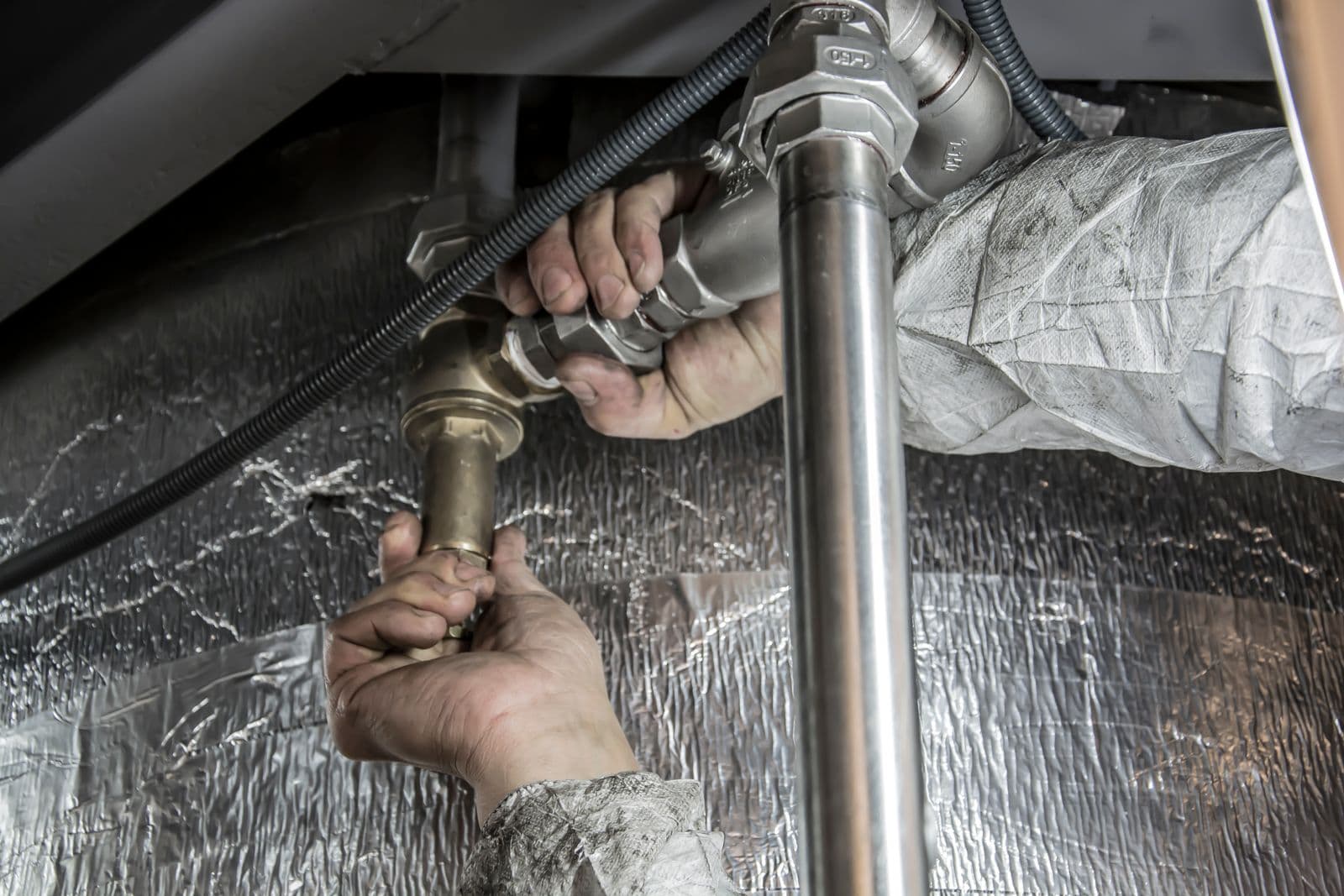
What the work actually looks like
Treatment equipment is plumbing. Most of the job is the connection, the drain and the code detail behind it.

Glendale water, answered plainly
Where does Glendale's water come from?+
From a published blend of Salt River Project canal water (about 55%), Central Arizona Project Colorado River water (about 41%), and groundwater with storage credits (about 4%), treated at City plants including Pyramid Peak.
Does Glendale still have lead service lines?+
The City's November 2025 inventory, as stated in the 2025 CCR, documented zero lead and zero unknown service lines for city-owned and customer-owned portions. Home plumbing can still contribute lead independently of the service line.
Does Glendale use chlorine or chloramine?+
The 2025 report describes chlorine added as a disinfectant. That is free chlorine chemistry, not monochloramine.
How did the Colorado River shortage affect Glendale?+
The federal Tier 1 shortage for 2025 reduced Glendale's Colorado River supply by less than 1%. The City stayed in Stage One Drought Watch and reports exceeding the Stage One 5% use-cut goal in 2024 and 2025.
Why does the water sometimes taste musty?+
Canal algae in late summer and fall can produce a musty odor. The City uses activated carbon to absorb residual odors after treatment.
Where do these figures come from?+
The City of Glendale 2025 Consumer Confidence / Water Quality Report (PDF at glendaleaz.gov). Third-party aggregators are not used. Hardness ppm values that appear only in table graphics are not transcribed here. A later report supersedes these figures.
Related resources
Home water purification and treatment
The national service page behind this one.
Learn more →Peoria water quality
Next door in the West Valley.
Learn more →Avondale water quality
West Valley neighbor with its own CCR story.
Learn more →Glendale battery backup
APS RCP export context for the same city.
Learn more →All home services
Water, battery, HVAC and solar under one licensed contractor of record.
Learn more →Get a free test at your tap
A licensed technician tests at your kitchen tap and tells you which findings apply to your house — chlorine taste, hardness, home-plumbing metals or none of them. No charge, no obligation, and coverage confirmed at your address first.
Get a free test