Gilbert, Arizona
Gilbert Water Quality
Two treatment plants, twenty wells and one rebuild. Gilbert's 2025 report found PFAS at two wellheads, took them offline, and is adding carbon at the plant that will supply most of the town.

The 2025 report lists PFOS up to 13.9 ppt at Well 7 — above the 4.0 ppt federal limit that applies from 2029 — and says the well was taken offline.
The short answer
Gilbert blends SRP canal water treated at its North plant, Colorado River water treated at Santan Vista with Chandler, and twenty wells. The 2025 report met every MCL; its violations are late paperwork, not contaminants over a limit.
The number that sets Gilbert apart is PFOS at 13.9 ppt at Well 7 — above the 4.0 ppt federal limit whose compliance date is still ahead — with the well taken offline and carbon being added at the North plant. For most households the everyday issue is hardness averaging 10.8 grains; arsenic (to 12 ppb on a single sample) and nitrate (to 8.3 ppm) are the reasons to test before buying.
Get a free test
Tell us your Gilbert address. We confirm coverage first, then schedule a licensed technician to test at your tap — no charge, no obligation.
What filtration does — and does not
Softening, carbon and reverse osmosis solve different problems. Gilbert has one of each: hardness for the softener, PFAS for certified carbon or RO, arsenic and nitrate for RO.
Where Gilbert water comes from
Two surface-water plants on two different canals, and a well field that fills the gaps. The mix is why a single citywide number is a poor guide to one tap.
North Water Treatment Plant — SRP water
Sits on the SRP Eastern Canal and treats a mix of Salt River, Verde River and SRP groundwater with coagulation, flocculation, sedimentation, filtration, ozone and chlorine. The 2025 report gives its capacity as up to 45 million gallons a day with a 16-million-gallon onsite reservoir. It is being rebuilt, and the rebuild is the PFAS story on this page.
Santan Vista — Colorado River water, shared with Chandler
Receives Central Arizona Project water from the Colorado River through 14 miles of 48-inch pipeline. The report says it was built and is operated in partnership with the City of Chandler, which uses 24 of its 48 MGD. Shared plant, separate utilities, separate reports.
Twenty wells — the supplement
Groundwater from 20 wells is used during high demand and during canal and plant maintenance. At some well sites ion exchange or adsorptive media reduce naturally occurring inorganic contaminants below EPA limits before delivery, the report says. Which water reaches a given house depends on season and location.
No known lead service lines
Gilbert's initial lead service line inventory was approved by ADEQ and found no known lead service lines; by December 2025 the Town reports it had identified every remaining unknown across more than 86,000 service connections. The 2025 90th-percentile lead result was 0.312 ppb with no sample over the 15 ppb action level.
What the 2025 report actually says
Limits are fixed. The results next to them are from the Town of Gilbert 2025 Annual Drinking Water Quality Report — system-level and wellhead figures, not a reading at your tap. A later report supersedes them.
PFAS — at two wellheads, now offline
The report's 2025 PFAS table lists wellhead results at Well 7 and Well 16. Well 7 on 8/11/25: PFOS 0.0139 ppb (13.9 ppt) and PFOA 0.00811 ppb (8.11 ppt); on 10/20/25 PFOA 0.00883 ppb (8.83 ppt). Well 16: PFOS up to 5.66 ppt and PFOA up to 3.36 ppt. The Town states both wells were taken offline as a precaution and that PFAS detection is limited to a few sites, not townwide.
Arsenic — compliant on average, not on every sample
Range not-detected to 12 ppb, average 6.3, against an MCL of 10. The report's footnote is explicit that compliance is based on a running average rather than the highest single result, and its health note says the water meets the arsenic standard but does contain low levels.
Hardness and dissolved solids
Total hardness averaged 184 mg/L — 10.79 grains per gallon — with a range of 6.61 to 17.54 grains. Total dissolved solids averaged 801 mg/L (674–984). These are aesthetic and scale measures, not health limits, and they are the reason most Gilbert households notice their water before they read about it.
Nitrate
0.30 to 8.32 ppm, average 4.59, against an MCL of 10. The report's nitrate note is about infants under six months, and it says levels can rise quickly with rainfall or agricultural activity. A household with an infant has a reason to know the number at its own tap.
Disinfection byproducts
Total trihalomethanes ranged 9–106 ppb with an average of 45 against an 80 ppb MCL that is applied as a locational running average; haloacetic acids ND–35, average 13, against 60. Neither is a violation. The 106 is a single sample, which is exactly the kind of figure a system average hides.
Violations — reporting, not exceedances
The report lists late-reporting violations: chlorine, turbidity, disinfection byproduct and coliform-rule samples submitted after deadlines in 2025, and arsenic, nitrate, TOC and alkalinity in 2024, with corrective actions on tracking and training. None is a contaminant over its limit, and the page treats them as what they are.
Why the PFAS answer here is a plant, not a pitcher
The detections in Gilbert's report are wellhead samples from two wells the Town says it took offline, and the report credits a diversified supply for letting it do that without running short. The long-term fix is granular activated carbon at the rebuilt North Water Treatment Plant, which the report says will supply 70 percent of Gilbert's water once fully operational in winter 2028.
That is a different situation from Chandler, which shares the Santan Vista plant but whose report is governed by arsenic to 9.5 ppb and TTHM samples to 77, and from Mesa, where hardness varies across three zones. Across the valley, Phoenix and Tempe publish their own reports with their own governing numbers. The East Valley shares rivers; it does not share a water report.
Where these figures come from
Everything on this page traces to primary sources. Independent compilations of water quality data exist and are not used here.
- Town of Gilbert — Water Quality Reports — 2025 Annual Drinking Water Quality Report, calendar 2025.
- EPA — PFAS National Primary Drinking Water Regulation — 4.0 ppt MCLs for PFOA and PFOS.
- EPA — proposed PFOA and PFOS compliance extension (May 2026) — 2029 compliance date, optional request to 2031.
- EPA — identifying drinking water filters certified to reduce PFAS — NSF/ANSI 53 and 58 PFAS reduction claims.
Matching treatment to the finding
Gilbert's report supports three different purchases for three different reasons. Buying the wrong one is the most common and most expensive mistake.
PFAS: certified point-of-use, if you want a margin
The wells with detections are offline and the plant answer is carbon. A household that wants its own margin should buy a point-of-use carbon or RO unit certified for PFOA and PFOS reduction under NSF/ANSI 53 or 58 — check the certification listing for the specific model, not the box.
Hardness: the most common Gilbert purchase
At an average near 11 grains and a range up to 17.5, scale on fixtures, water heaters and glass is the complaint most households have. A softener addresses hardness and nothing else on this page; it adds sodium, and its discharge has to go somewhere the plumbing code allows.
Arsenic and nitrate: RO at the drinking tap
Reverse osmosis certified for arsenic or nitrate reduction is the household tool for the two health-limit figures that sit closest to their MCLs in this report. Arsenic certification depends on the arsenic form, which is one reason a test comes before the equipment.
Test first, because the water moves
Two plants and twenty wells mean a Gilbert tap does not get one fixed water. A free test at the kitchen tap measures hardness, dissolved solids and chlorine where you live, and tells you which line of the report is worth acting on.
How the free test works
A licensed technician tests at your kitchen tap, walks the plumbing, and tells you which of the findings above applies to your house and which does not. There is no charge and no obligation.
Seamless Home is the licensed contractor of record on the work that follows. Installation is performed by vetted installing partners engaged as our subcontractors, and the workmanship obligation stays with us. Coverage is confirmed per service area rather than promised as blanket availability.
A softener or RO unit needs a legal drain connection — where a water softener is allowed to discharge sets out the indirect-waste rule that decides where it goes.
What a water treatment job with us covers
Installation and replacement of whole-home and point-of-use treatment, specified against what your water actually contains.
Sediment filtration
Installation of the first stage that protects everything downstream of it, sized to the service line and the household draw.
Softening
Installation of ion-exchange softening where hardness is the problem, including the drain connection the plumbing code treats as indirect waste.
Carbon filtration
Installation of carbon stages for taste, odour and disinfection by-products, specified from your utility's own water quality report.
Reverse osmosis
Point-of-use installation at the kitchen sink where the target is dissolved solids rather than whole-home flow.
Disinfection
Installation of UV or equivalent treatment where the supply is a private well or is otherwise not continuously disinfected.
System replacement
Replacing equipment that has reached the end of its service life, including the discharge and air gap details an inspector looks at.
This is installation and replacement work, specified from a published water quality report or a test of your supply — not from a sales chart. Coverage is confirmed per service area rather than promised as blanket availability.
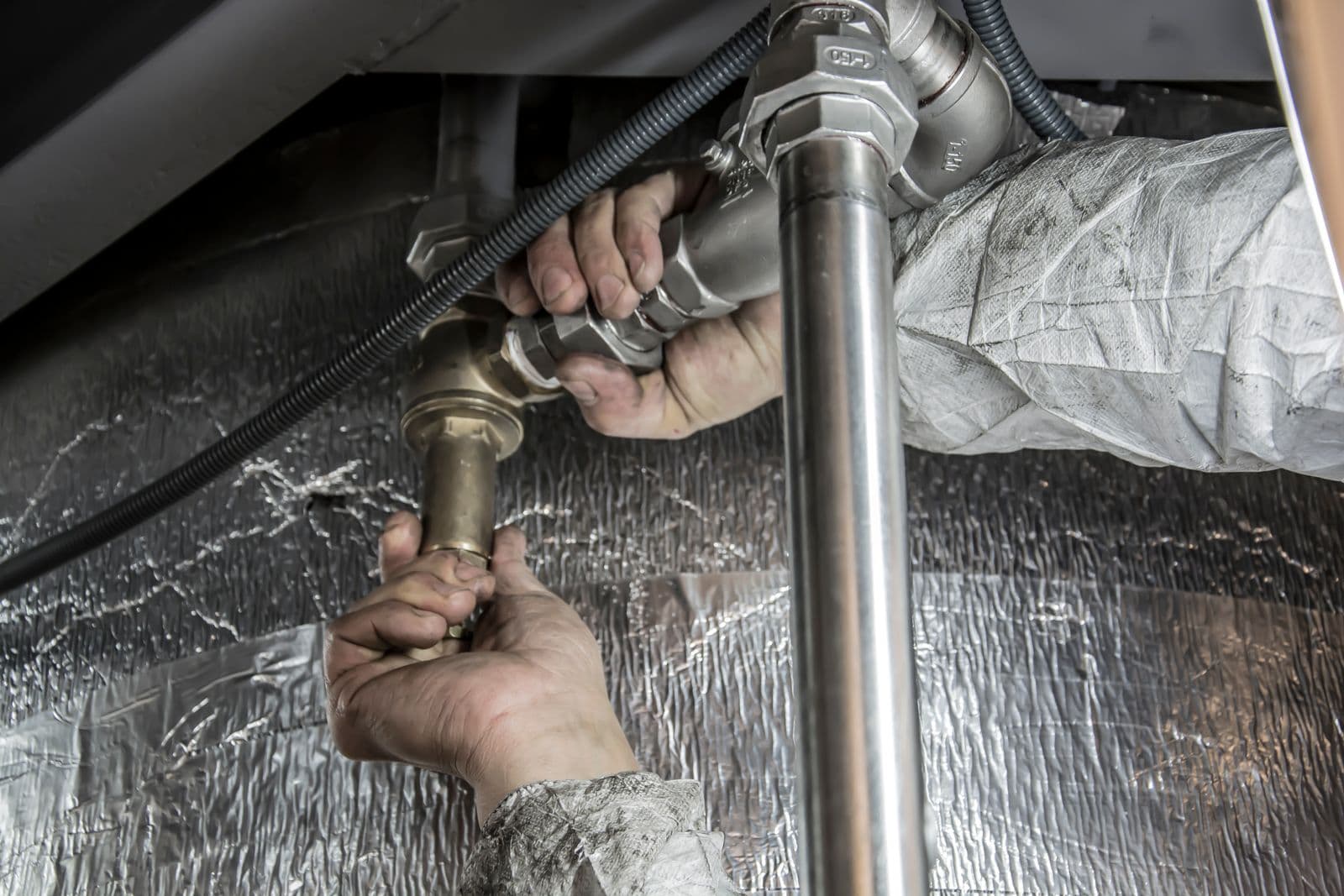
What the work actually looks like
Treatment equipment is plumbing. Most of the job is the connection, the drain and the code detail behind it.


Gilbert water, answered plainly
Is there PFAS in Gilbert water?+
The Town's 2025 report lists PFAS detections at two wellheads — Well 7 and Well 16 — with the highest results PFOS at 13.9 ppt and PFOA at 8.83 ppt, both at Well 7. It states those wells were taken offline as a precautionary measure and that detection is restricted to a few sites, not townwide. These are wellhead samples of untreated groundwater, not a reading at a household tap.
What is the federal PFAS limit?+
EPA's April 2024 rule set enforceable maximum contaminant levels of 4.0 ppt each for PFOA and PFOS, with compliance determinations beginning in April 2029. In May 2026 EPA proposed letting systems request two more years, to April 2031, while keeping the 4.0 ppt limits. The Well 7 results are above 4.0 ppt; the compliance clock has not started, and the Town took the wells offline rather than serve that water.
What is Gilbert doing about PFAS?+
Rebuilding the North Water Treatment Plant with granular activated carbon contactors, which the report describes as an effective method for removing PFAS. Phase 3 is scheduled to begin treating water in summer 2026, with the facility fully operational in winter 2028, and the report says it will supply 70 percent of Gilbert's water.
How hard is Gilbert water?+
The 2025 report gives total hardness averaging 184 mg/L, or 10.79 grains per gallon, with a range of 6.61 to 17.54 grains. Total dissolved solids averaged 801 mg/L. Neither has a federal health limit; both explain scale and spotting. Because the supply shifts between two plants and twenty wells, the figure at your tap can sit anywhere in that range.
Is Gilbert's arsenic over the limit?+
Not for compliance. The 2025 range was not-detected to 12 ppb with an average of 6.3, against an MCL of 10. The report notes that compliance is based on a running average rather than the highest individual result. A single sample above 10 is a reason to test your own tap if arsenic matters to your household.
Is Gilbert the same water as Chandler?+
Partly, and only at one plant. Santan Vista was built and is operated with the City of Chandler, which uses 24 of its 48 MGD. Gilbert's North plant, its twenty wells and its report are its own, and Chandler's report has different governing numbers. Same valley, shared plant, separate water systems.
Where do these figures come from?+
The Town of Gilbert 2025 Annual Drinking Water Quality Report, covering calendar 2025 testing, and EPA's published status of the PFOA and PFOS rule. Independent water-quality aggregators are not the source used on this page. A later report supersedes these figures.
Across the valley on the West side, Surprise reads through EPCOR's Agua Fria report — a different utility and a hardness swing, not Gilbert's wellhead PFAS story.
Related resources
Home water purification and treatment
The national service page behind this one.
Learn more →Chandler water quality
Shares Santan Vista with Gilbert — arsenic to 9.5 ppb, TTHM samples to 77.
Learn more →Mesa water quality
Three zones and hardness from 0.4 to 25 grains.
Learn more →Tempe water quality
A neighbouring East Valley report with its own numbers.
Learn more →Where a water softener can discharge
Indirect-waste rules for treatment drain lines.
Learn more →All home services
Water, battery, HVAC and solar under one licensed contractor of record.
Learn more →Get a free test at your tap
A licensed technician tests at your kitchen tap and tells you which of the findings above applies to your house — hardness, arsenic, nitrate or none of them. No charge, no obligation, and coverage confirmed at your address first.
Get a free test