Trenton, New Jersey
Trenton Water Quality
Trenton drinks Delaware River water treated by Trenton Water Works. The 2025 report shows lead at 3.5 ppb (90th percentile) and a short TTHM exceedance in late 2024.
Delaware River · lead 90th 3.5 ppb · ~9,500 lead lines replaced · TTHM LRAA 81 μg/L in Q4 2024 (MCL 80).
The short answer
Trenton's tap water comes from Trenton Water Works (PWS NJ1111001), which draws from the Delaware River. The 2025 Consumer Confidence Report covers calendar-year 2024 sampling.
Lead's 90th percentile at the tap was 3.5 ppb against a 15 ppb action level. The report also records a total trihalomethanes MCL exceedance for Q4 2024 (LRAA 81 μg/L against 80). TWW has replaced roughly 9,500 lead service lines.
Get a free test
Tell us your Trenton address. We confirm coverage first, then schedule a licensed technician to test at your tap — no charge, no obligation.
What the 2025 Trenton Water Works report shows
Figures below are system-level results from TWW's 2025 Consumer Confidence Report (calendar-year 2024 data). A later report supersedes them.
Lead 90th percentile at 3.5 ppb
In 2024 lead-and-copper sampling, the 90th percentile for lead was 3.5 ppb against a 15 ppb action level. Ten of 105 sites were above the action level. TWW states it has not exceeded a lead action level since 2018.
About 9,500 lead service lines replaced
TWW's lead program reports roughly 9,500 lead service lines replaced and a greater-than-75% reduction in lead concentration at customer taps. The utility publishes a lead service line inventory at twwleadprogram.com, with a stated goal to remove remaining lead lines by 2031.
TTHM MCL exceedance in Q4 2024
Violation 2024-4216: the locational running annual average for total trihalomethanes reached 81 μg/L against an 80 μg/L MCL for the October 1–December 31, 2024 monitoring period. TWW issued a Tier 2 public notice; the report states none of the listed violations were emergencies.
Coliform well under the threshold
Total coliform: 7 positive samples out of 1,769 in 2024 (0.40%), below the 5% monthly threshold that would trigger a treatment-technique violation.
Turbidity treatment performance
99.96% of 2024 turbidity readings at the plant were below the 0.3 NTU treatment requirement. Turbidity is a filtration-performance indicator, not a contaminant with a health-based MCL by itself.
High source-water susceptibility for DBPs
NJDEP's source water assessment rates the Delaware River intake high for pathogens, nutrients, inorganics and disinfection-byproduct precursors — the usual surface-water pattern that drives chlorination byproduct monitoring.
How the water is produced
One Delaware River intake feeds the city filtration plant.
Delaware River intake
Trenton Water Works draws surface water from the Delaware River through an intake north of the Calhoun Street Bridge, then treats it at the TWW Filtration Plant on Route 29 South.
About 217,000 customers
The 2025 report states the system serves approximately 217,000 customers in Trenton and neighboring communities, with emergency interconnections available to New Jersey American Water and Lawrence Township.
Trenton Water Works — PWS NJ1111001
The public water system ID is NJ1111001. Figures on this page come from TWW's 2025 Consumer Confidence Report covering calendar-year 2024 sampling.
Where these figures come from
Everything on this page traces to Trenton Water Works' 2025 Consumer Confidence Report (public water system NJ1111001).
- Trenton Water Works — 2025 Consumer Confidence Report (PDF)
- City of Trenton — Consumer Confidence Reports — current and prior-year reports.
- TWW lead service line inventory
Matching treatment to the finding
Lead plumbing and disinfection byproducts drive most Trenton decisions; the Delaware River source sets the byproduct conversation.
Lead reduction at the tap
Even with a 3.5 ppb system 90th percentile, older home plumbing can still contribute lead. Flushing after long stagnation and a certified lead-reduction filter are the first steps; check TWW's service-line inventory for your address.
Carbon or RO for taste and byproducts
Point-of-use carbon or reverse osmosis can reduce disinfection byproducts and improve taste when a homeowner wants to go below distribution-system averages.
Test before you buy
The report is system-wide. A kitchen-tap test tells you which of these findings actually shows up at your address.
Orthophosphate corrosion control
TWW doses orthophosphate as corrosion control. The report notes follow-up monitoring violations for orthophosphate sampling in mid-2024; those were monitoring issues, not a lead action-level exceedance.
How the free test works
A licensed technician tests at your kitchen tap, walks the plumbing, and tells you which of the findings above applies to your house and which does not. There is no charge and no obligation.
Seamless Home is the licensed contractor of record on the work that follows. Installation is performed by vetted installing partners engaged as our subcontractors, and the workmanship obligation stays with us. Coverage is confirmed per service area rather than promised as blanket availability.
What a water treatment job with us covers
Installation and replacement of whole-home and point-of-use treatment, specified against what your water actually contains.
Sediment filtration
Installation of the first stage that protects everything downstream of it, sized to the service line and the household draw.
Softening
Installation of ion-exchange softening where hardness is the problem, including the drain connection the plumbing code treats as indirect waste.
Carbon filtration
Installation of carbon stages for taste, odour and disinfection by-products, specified from your utility's own water quality report.
Reverse osmosis
Point-of-use installation at the kitchen sink where the target is dissolved solids rather than whole-home flow.
Disinfection
Installation of UV or equivalent treatment where the supply is a private well or is otherwise not continuously disinfected.
System replacement
Replacing equipment that has reached the end of its service life, including the discharge and air gap details an inspector looks at.
This is installation and replacement work, specified from a published water quality report or a test of your supply — not from a sales chart. Coverage is confirmed per service area rather than promised as blanket availability.
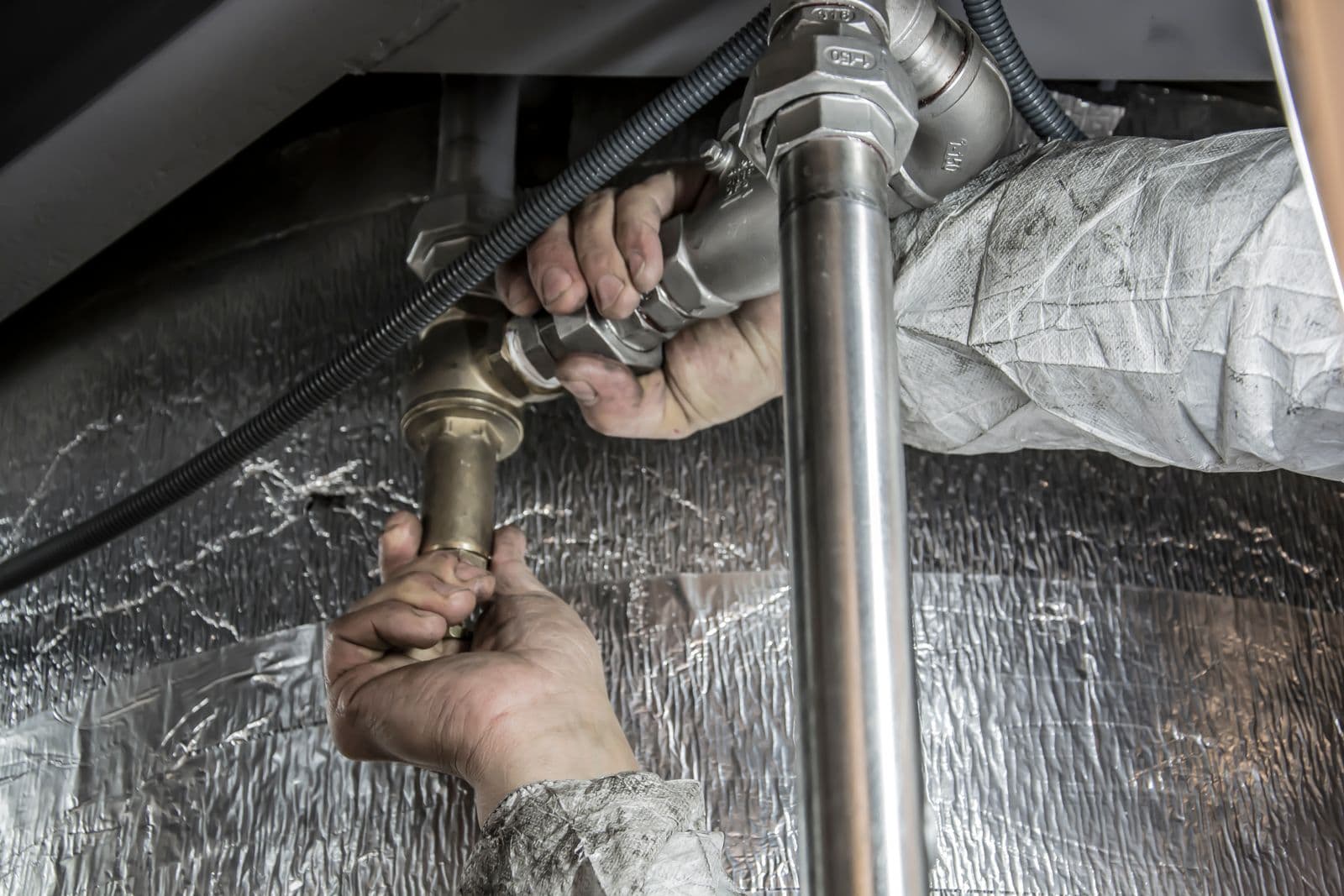
What the work actually looks like
Treatment equipment is plumbing. Most of the job is the connection, the drain and the code detail behind it.

Trenton water, answered plainly
Where does Trenton get its water?+
From the Delaware River. Trenton Water Works draws at an intake north of the Calhoun Street Bridge and treats the water at the Route 29 filtration plant.
Did Trenton's 2025 water report meet standards?+
Most regulated results were within limits, but the report records a total trihalomethanes MCL exceedance for the fourth quarter of 2024 (LRAA 81 μg/L against 80). Lead's 90th percentile stayed under the 15 ppb action level.
Is there lead in Trenton water?+
The 2024 lead 90th percentile at customer taps was 3.5 ppb against a 15 ppb action level. Ten of 105 sampled sites were above the action level. Lead can still come from plumbing inside a home; TWW publishes a lead service line inventory.
What are trihalomethanes in Trenton water?+
They are disinfection byproducts formed when chlorine reacts with organic matter in the Delaware River supply. TWW's LRAA briefly exceeded the 80 μg/L MCL in Q4 2024.
Where do these figures come from?+
From Trenton Water Works' 2025 Consumer Confidence Report (public water system NJ1111001), published on the City of Trenton website. Third-party aggregators are not used.
Related resources
Home water purification and treatment
The national service page behind this one.
Learn more →Newark water quality
Pequannock and Wanaque water across North Jersey.
Learn more →Jersey City water quality
Boonton Reservoir supply and New Jersey PFAS limits.
Learn more →Philadelphia water quality
Delaware River water on the Pennsylvania side.
Learn more →All home services
Water, battery, HVAC and solar under one licensed contractor of record.
Learn more →Get a free test at your tap
A licensed technician tests at your kitchen tap and tells you which Trenton Water Works findings apply to your house — lead from plumbing, disinfection byproducts or taste. No charge, no obligation, and coverage confirmed at your address first.
Get a free test