Newark, New Jersey
Newark Water Quality
Two reservoir systems, more than 23,000 lead service lines replaced, and PFOA just over the new federal limit in one supply. Here is what the city's 2025 report shows.
Lead 90th pct not detected · 23,000+ lead lines replaced · PFOA 4.15 ppt · chlorine up to 2.67 ppm.
The short answer
Newark's water comes from two reservoir systems: the city-owned Pequannock Watershed and the Wanaque Watershed, which the North Jersey District Water Supply Commission treats. After replacing more than 23,000 lead service lines since 2019, the city's 90th-percentile lead result in the 2025 report was not detected.
The number to watch is PFOA: its highest average in Wanaque water was 4.15 ppt, just above the 4.0 ppt federal limit that the report says becomes mandatory in 2029. Chlorine runs up to 2.67 ppm on average.
Get a free test
Tell us your Newark address. We confirm coverage first, then schedule a licensed technician to test at your tap — no charge, no obligation.
What filtration does — and does not
Newark's water is soft reservoir water, so the questions are chlorine taste, PFAS and what your own plumbing adds.
Where Newark water comes from
Sources and treatment named in the city's 2025 Water Quality Report.
Pequannock Watershed
About 35,000 acres of city-owned watershed across three counties. Water is treated at the Pequannock Water Treatment Plant by oxidation, coagulation, filtration and disinfection; the filter media has been upgraded to granular activated carbon.
Wanaque Watershed
Water from the North Jersey District Water Supply Commission (PWS ID 1613001), treated at the Wanaque Water Treatment Plant and delivered to Newark.
Corrosion control
Newark adds zinc orthophosphate at the Montclair re-chlorination station to reduce lead and copper leaching from household plumbing.
What the 2025 data actually says
Limits are fixed. Results are system figures from the city's tables, not a reading at your tap.
Lead: not detected at the 90th percentile
Newark's 90th-percentile lead result was not detected, with individual samples from not detected to 7.8 ppb and no sites over the 15 ppb action level. Copper's 90th percentile was 0.0689 ppm.
23,000+ lead lines replaced
The city reports replacing more than 23,000 lead service lines in a program that began in March 2019 and finished in under three years.
PFOA just above the new federal limit
In Wanaque water sampled at the Belleville Surge Tank, PFOA's highest average was 4.15 ppt (range not detected to 5.30) against the 4.0 ppt federal MCL. The report says compliance with that limit becomes mandatory in 2029.
PFOS
PFOS at the same location had a highest average of 2.175 ppt (range not detected to 3.40).
Disinfection byproducts
TTHM highest locational running annual average was 65.0 µg/L (samples 29.9–136; limit 80). HAA5 was 31.0 µg/L (18.0–40.3; limit 60).
Chlorine residual
Chlorine's highest annual average was 2.67 ppm, with readings from 0.36 to 3.85 ppm. Turbidity met the 0.3 NTU standard in 99.97% of readings.
Newark next to New York City and Philadelphia
Across the Hudson, New York City also draws on upstate reservoirs, but most of its water is unfiltered Catskill/Delaware supply, and buildings from before 1961 may still have lead service lines. Newark reports replacing more than 23,000 of its own since 2019.
Philadelphia treats river water rather than reservoir water, with its own report and its own numbers.
Where these figures come from
Everything on this page traces to the City of Newark Department of Water & Sewer Utilities' 2025 Water Quality / Consumer Confidence Report.
- City of Newark — 2025 Water Quality Report (PDF)
- Service line lookup: water.newarknj.gov/check-my-service-line. Lead testing: (973) 733-6303 or (973) 239-4493.
Matching treatment to the finding
Chlorine taste and PFAS are the usual reasons Newark homeowners add treatment.
Carbon for chlorine taste
With chlorine averaging up to 2.67 ppm, activated carbon at a pitcher, faucet or under-sink filter is the usual fix for taste and odor.
RO or certified filters for PFAS
Reverse osmosis and filters certified for PFOA/PFOS reduction address the PFAS the report lists, at the tap you drink from.
Lead: check the line, then the fixtures
Even with the service line replaced, older faucets and solder inside a house can add lead. A filter certified for lead at the kitchen tap covers that.
Whole-house carbon for byproducts
TTHM samples reached 136 µg/L at one point in the system. Whole-house carbon reduces disinfection byproducts at every tap, including showers.
How the free test works
A licensed technician tests at your kitchen tap, walks the plumbing, and tells you which of the findings above applies to your house and which does not. There is no charge and no obligation.
Seamless Home is the licensed contractor of record on the work that follows. Installation is performed by vetted installing partners engaged as our subcontractors, and the workmanship obligation stays with us. Coverage is confirmed per service area rather than promised as blanket availability.
What a water treatment job with us covers
Installation and replacement of whole-home and point-of-use treatment, specified against what your water actually contains.
Sediment filtration
Installation of the first stage that protects everything downstream of it, sized to the service line and the household draw.
Softening
Installation of ion-exchange softening where hardness is the problem, including the drain connection the plumbing code treats as indirect waste.
Carbon filtration
Installation of carbon stages for taste, odour and disinfection by-products, specified from your utility's own water quality report.
Reverse osmosis
Point-of-use installation at the kitchen sink where the target is dissolved solids rather than whole-home flow.
Disinfection
Installation of UV or equivalent treatment where the supply is a private well or is otherwise not continuously disinfected.
System replacement
Replacing equipment that has reached the end of its service life, including the discharge and air gap details an inspector looks at.
This is installation and replacement work, specified from a published water quality report or a test of your supply — not from a sales chart. Coverage is confirmed per service area rather than promised as blanket availability.
What the work actually looks like
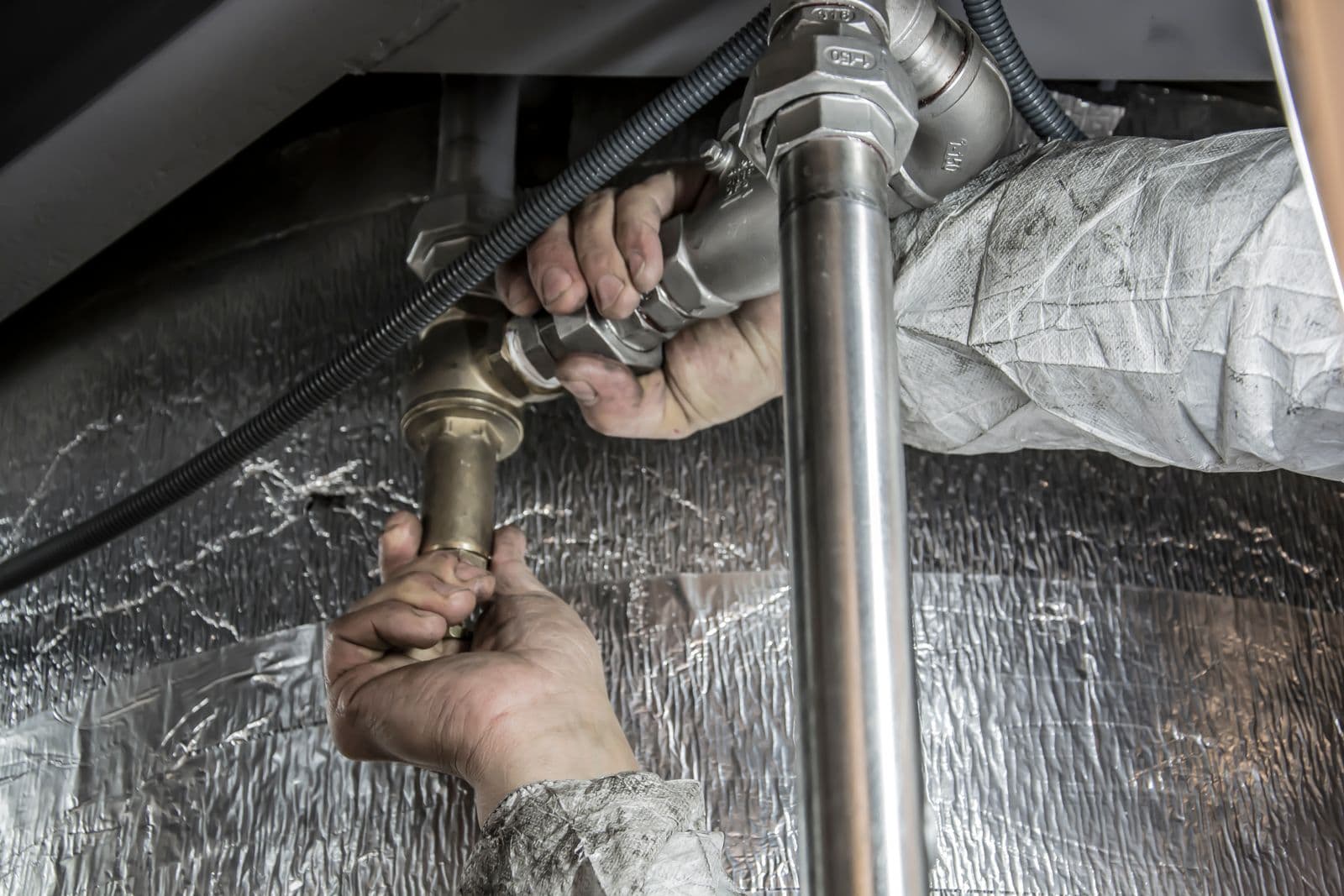
Treatment equipment is plumbing. Most of the job is the connection, the drain and the code detail behind it.


Newark water, answered plainly
Where does Newark get its water?+
From two reservoir systems: the city-owned Pequannock Watershed, treated at Newark's Pequannock plant, and the Wanaque Watershed, treated by the North Jersey District Water Supply Commission at its Wanaque plant.
Is there still lead in Newark's water?+
Newark's 2025 report shows the 90th-percentile lead result as not detected, with no samples over the 15 ppb action level. The city reports replacing more than 23,000 lead service lines since March 2019. Indoor plumbing can still contribute lead, so a tap test tells you about your own fixtures.
How do I check my service line?+
Newark has a lookup at water.newarknj.gov/check-my-service-line. For lead testing, the report lists (973) 733-6303 and (973) 239-4493.
Does Newark's water have PFAS?+
Yes, at low levels. In Wanaque water at the Belleville Surge Tank, PFOA's highest average was 4.15 ppt against a 4.0 ppt federal limit that the report says becomes mandatory in 2029; PFOS averaged up to 2.175 ppt.
Why does Newark water taste like chlorine?+
Chlorine is the disinfectant. Its highest annual average in 2025 was 2.67 ppm, within the 4 ppm limit. Activated carbon removes the taste.
Where do these figures come from?+
From the City of Newark Department of Water & Sewer Utilities' 2025 Water Quality / Consumer Confidence Report. Third-party aggregators are not used.
Related resources
Home water purification and treatment
The national service page behind this one.
Learn more →New York City water quality
Catskill/Delaware reservoirs, soft water and lead service lines.
Learn more →Philadelphia water quality
Delaware and Schuylkill river water and the city's own report.
Learn more →Woburn water quality
Another system where PFAS leads the report.
Learn more →All home services
Water, battery, HVAC and solar under one licensed contractor of record.
Learn more →Get a free test at your tap
A licensed technician tests at your kitchen tap and tells you which findings apply to your house — chlorine taste, PFAS, or lead from older fixtures. No charge, no obligation, and coverage confirmed at your address first.
Get a free test