New York City, New York
New York City Water Quality
Upstate reservoir water that met every standard in 2025 — and a lead question that depends on your building, not the reservoir. Here is what DEP's report shows.
91.3% Catskill/Delaware · 8.7% Croton · ~2 gpg soft · free chlorine 0.6 mg/L · lead 90th pct 10 µg/L.
The short answer
New York City's water comes from upstate reservoirs: 91.3% from the Catskill and Delaware systems and 8.7% from Croton in 2025. DEP reports it met all federal and state standards.
It is soft (about 2 grains per gallon) and disinfected with free chlorine. The household issue is lead: buildings from before 1961 may have lead service lines, and 16 of 326 at-tap samples were above 15 µg/L even though the city stayed under the action level.
Get a free test
Tell us your New York City address. We confirm coverage first, then schedule a licensed technician to test at your tap — no charge, no obligation.
What filtration does — and does not
In New York City the question is less about the reservoir and more about the last stretch of pipe into your building.
Where New York City water comes from
Shares of the 2025 supply, from NYC DEP's report.
Catskill and Delaware — 91.3%
Upstate reservoirs in a watershed of about 2,000 square miles, up to 125 miles north of the city. In 2025 they supplied 91.3 percent of the city's water, disinfected with chlorine and ultraviolet light.
Croton — 8.7%
The older Croton system, closer to the city, supplied 8.7 percent in 2025. Croton water is treated at the Croton Filtration Plant.
19 reservoirs, 3 controlled lakes
DEP's system is 19 reservoirs and three controlled lakes. DEP also adds phosphoric acid and sodium hydroxide for corrosion control, and fluoride.
What the 2025 DEP report actually says
Limits are fixed. Results are city-wide figures from DEP's 2025 tables, not a reading at your tap.
Soft water
Average hardness was 32 mg/L — about 2 grains per gallon — with a range of 18 to 100 mg/L. Most of the city does not need a softener.
Free chlorine
DEP disinfects with free chlorine (not chloramine). The 2025 average residual was 0.6 mg/L, ranging from not detected to 1.4 mg/L.
Disinfection byproducts
The highest locational running annual average was 52 µg/L for TTHM (limit 80) and 47 µg/L for HAA5 (limit 60). Results ranged from 4 to 81 and 7 to 64 µg/L.
Lead at the tap
In at-tap sampling the 90th percentile was 10 µg/L, below the 15 µg/L action level. Results ranged from not detected to 155 µg/L, and 16 of 326 homes were above 15 µg/L.
PFAS
PFOA was detected once, at 2.7 ng/L, in a January 2025 sample. The 2025 average was not detected.
Sodium and nitrate
Sodium averaged 16 mg/L (9 to 49). Nitrate averaged 0.14 mg/L, far below the 10 mg/L limit.
New York City next to Philadelphia and Boston
The Delaware system's reservoirs sit in the headwaters of the Delaware River, the same river Philadelphia draws from much further downstream — where PWD's story is PFAS and plant-by-plant hardness rather than lead lines.
Boston is the closer match: a large city fed by protected upland reservoirs, where the reservoir water is clean and the actions that matter are finding out what your service line is made of and filtering the tap you drink from.
Where these figures come from
Everything on this page traces to NYC DEP's 2025 Drinking Water Supply and Quality Report (calendar year 2025).
- NYC DEP — 2025 Drinking Water Supply and Quality Report (PDF)
- DEP lead service line map and replacement program: nyc.gov/dep/lead, or call 311.
Matching treatment to the finding
Soft water and free chlorine make New York simpler than most cities. The lead question is the one to settle first.
Find out your service line
DEP says homes built before 1961 may have a lead service line. Check DEP's service line map, or submit DEP's Service Line ID form, before buying any equipment.
NSF/ANSI 53 filter for lead
A filter certified for lead reduction at the kitchen tap manages exposure while you confirm the line or wait for replacement. It does not replace the pipe.
Carbon for chlorine taste
Free chlorine is easy for ordinary activated carbon to remove. A pitcher, faucet or under-sink carbon filter handles taste and odor.
Skip the softener (usually)
At about 2 grains per gallon, NYC water is soft. A softener is rarely the right first purchase here; test first if you see scale.
How the free test works
A licensed technician tests at your kitchen tap, looks at where the water enters the building, and tells you which of the findings above applies to your home and which does not. There is no charge and no obligation.
Seamless Home is the licensed contractor of record on the work that follows. Installation is performed by vetted installing partners engaged as our subcontractors, and the workmanship obligation stays with us. Coverage is confirmed per service area rather than promised as blanket availability.
What a water treatment job with us covers
Installation and replacement of whole-home and point-of-use treatment, specified against what your water actually contains.
Sediment filtration
Installation of the first stage that protects everything downstream of it, sized to the service line and the household draw.
Softening
Installation of ion-exchange softening where hardness is the problem, including the drain connection the plumbing code treats as indirect waste.
Carbon filtration
Installation of carbon stages for taste, odour and disinfection by-products, specified from your utility's own water quality report.
Reverse osmosis
Point-of-use installation at the kitchen sink where the target is dissolved solids rather than whole-home flow.
Disinfection
Installation of UV or equivalent treatment where the supply is a private well or is otherwise not continuously disinfected.
System replacement
Replacing equipment that has reached the end of its service life, including the discharge and air gap details an inspector looks at.
This is installation and replacement work, specified from a published water quality report or a test of your supply — not from a sales chart. Coverage is confirmed per service area rather than promised as blanket availability.
What the work actually looks like
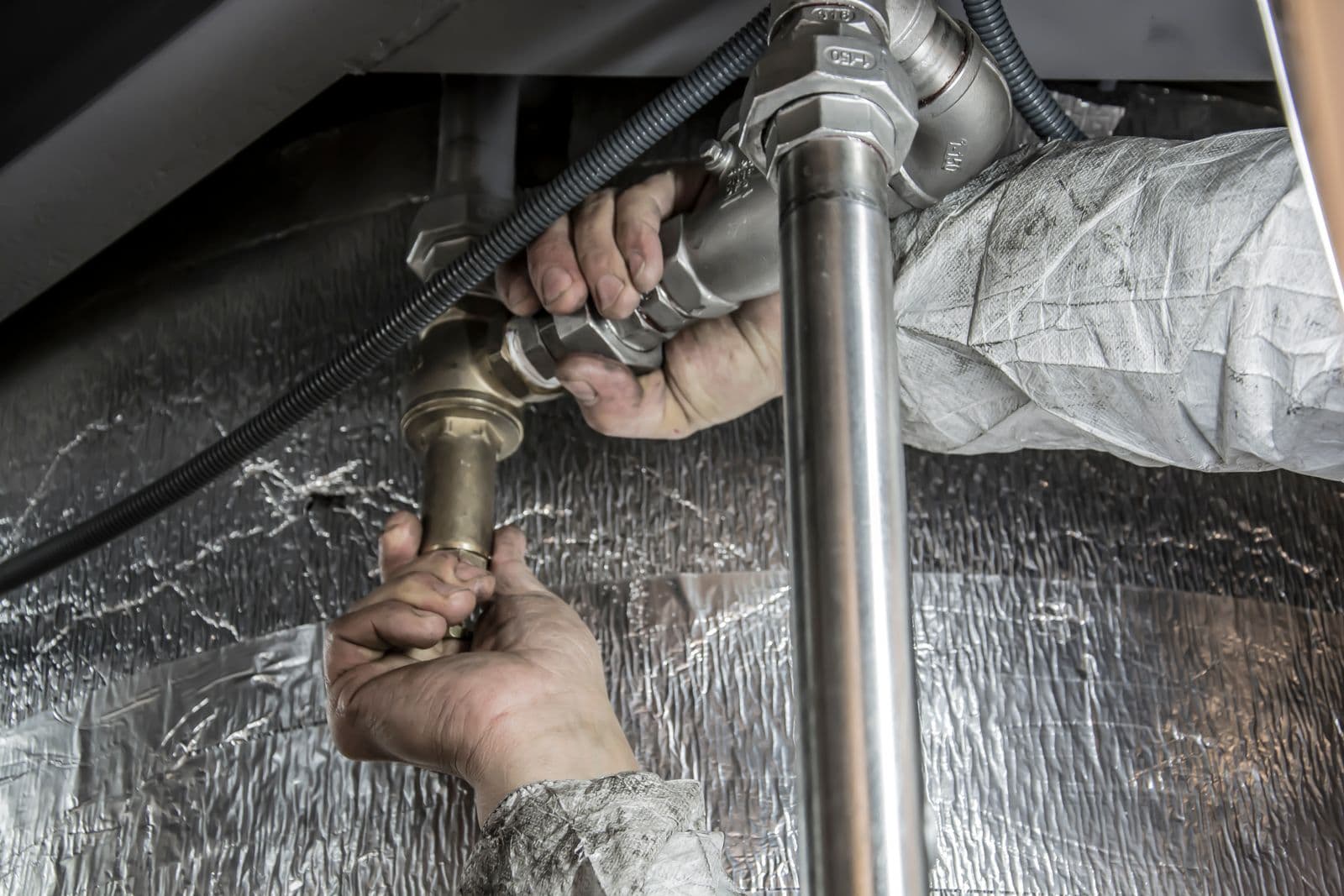
Treatment equipment is plumbing. Most of the job is the connection, the drain and the code detail behind it.
New York City water, answered plainly
Where does New York City's water come from?+
From upstate reservoirs. In 2025 the Catskill and Delaware systems supplied 91.3 percent and the Croton system 8.7 percent, according to NYC DEP's 2025 Drinking Water Supply and Quality Report. The system has 19 reservoirs and three controlled lakes in a watershed of about 2,000 square miles.
Is NYC tap water safe to drink?+
DEP reports that the city's water met all federal and state drinking water standards in 2025, based on 573,300 analyses of 36,600 samples. Lead from a home's own service line or plumbing is the exception the city-wide numbers cannot rule out.
Is NYC water hard or soft?+
Soft. Average hardness in 2025 was 32 mg/L, about 2 grains per gallon, with a range of 18 to 100 mg/L.
Does NYC have lead pipes?+
Some homes do. DEP says buildings built before 1961 may have a lead service line, the pipe between the water main and the building. DEP's map at nyc.gov/dep/lead shows known and suspected materials.
Is there a free lead service line replacement program?+
Yes, for eligible properties. DEP's Lead Service Line Replacement Program replaces lead lines at no cost, and in 2025 it expanded to eligible properties in the Bronx and Queens. Call 311 or check nyc.gov/dep/lead for eligibility.
Does NYC use chlorine or chloramine?+
Free chlorine, plus ultraviolet disinfection for Catskill/Delaware water. The 2025 average residual was 0.6 mg/L. Ordinary carbon filters remove it.
Where do these figures come from?+
From NYC DEP's 2025 Drinking Water Supply and Quality Report, covering calendar year 2025. Third-party aggregators are not used.
Related resources
Home water purification and treatment
The national service page behind this one.
Learn more →Boston water quality
Quabbin and Wachusett reservoirs and lead service lines.
Learn more →Philadelphia water quality
Delaware and Schuylkill rivers through PWD.
Learn more →Los Angeles water quality
LA Aqueduct and MWD imports, chloramine and hardness by source.
Learn more →All home services
Water, battery, HVAC and solar under one licensed contractor of record.
Learn more →Get a free test at your tap
A licensed technician tests at your kitchen tap and tells you which findings apply to your building — lead from the service line or plumbing, or chlorine taste. No charge, no obligation, and coverage confirmed at your address first.
Get a free test