Los Angeles, California
Los Angeles Water Quality
Aqueduct water and imported MWD water are not the same water. Here is what LADWP's 2025 report shows — and why your neighborhood's hardness can be twice another's.
44% LA Aqueduct · 52% MWD · chloramine 1.7 mg/L · hardness 103–236 mg/L · arsenic max 7.0 µg/L.
The short answer
In 2025 Los Angeles drew 44% of its water from the Los Angeles Aqueduct and 52% from Metropolitan Water District imports (State Water Project and Colorado River), with the rest from local groundwater and recycled water. LADWP reports no substance detected above an MCL.
The practical difference is hardness: about 103 mg/L from the Aqueduct plant versus 234–236 mg/L from MWD's Weymouth and Diemer plants. LADWP uses chloramine, arsenic peaked at 7.0 µg/L (limit 10), and its inventory found no lead service lines.
Get a free test
Tell us your Los Angeles address. We confirm coverage first, then schedule a licensed technician to test at your tap — no charge, no obligation.
What filtration does — and does not
Carbon, catalytic carbon and reverse osmosis solve different problems. Match the system to what LADWP's report actually shows.
Where Los Angeles water comes from
Shares of the 2025 supply, from LADWP's report.
Los Angeles Aqueduct — 44%
Eastern Sierra water carried by the Los Angeles Aqueduct and treated at the Los Angeles Aqueduct Filtration Plant. It supplied 44 percent of the city's water in 2025.
MWD imports — 52%
Purchased from the Metropolitan Water District: State Water Project and Colorado River Aqueduct water, treated at MWD's Weymouth, Diemer and Jensen plants.
Local groundwater 1%, recycled 3%
The rest of the 2025 supply came from local groundwater (1 percent) and recycled water (3 percent).
What the 2025 LADWP report actually says
Limits are fixed. Results are system and plant figures from LADWP's 2025 tables, not a reading at your tap.
Hardness depends on the source
Average total hardness was 103 mg/L at the LA Aqueduct Filtration Plant, but 234 mg/L at MWD Weymouth and 236 mg/L at Diemer (Jensen 140). Roughly 6 grains per gallon versus about 14.
Chloramine disinfection
LADWP disinfects with chloramines. The highest running annual average for total chlorine residual was 1.7 mg/L (range 1.4–2), under the 4 mg/L limit.
Arsenic up to 7.0 µg/L
Arsenic averaged 3.3 µg/L at the LA Aqueduct Filtration Plant, with a highest level of 7.0 µg/L — under the 10 µg/L MCL.
Dissolved solids
TDS averaged 234 mg/L from the Aqueduct plant, 297 mg/L from Jensen, and 536–545 mg/L from MWD Weymouth and Diemer.
Disinfection byproducts
City-wide TTHM highest locational running annual average 33.8 µg/L (limit 80). HAA5 highest locational average 13.4 µg/L (limit 60).
Lead: 90th percentile under 5 µg/L
In the most recent residential sampling (2023), the 90th percentile was under 5 µg/L — LADWP's narrative gives 3.9 ppb — with 3 of 105 homes over the 15 µg/L action level.
Los Angeles next to Phoenix and Salt Lake City
Colorado River water reaches Los Angeles through MWD's Colorado River Aqueduct and reaches Phoenix through the Central Arizona Project canal — the same river, different utilities and different reports. Salt Lake City is the other Western system on this site where hardness swings with the source: Wasatch mountain streams in winter, harder groundwater wells added in summer.
In Los Angeles the swing depends on which treatment plant feeds your area. LADWP reports hardness separately for each source, so a test at your tap is the quickest way to know whether you are closer to 103 or 236 mg/L.
Where these figures come from
Everything on this page traces to LADWP's Drinking Water Quality Report 2025 (January 1 – December 31, 2025).
- LADWP — Drinking Water Quality Report 2025 (PDF)
- LADWP Water Quality Hotline: (213) 367-3182, for questions or to ask about the 2026 residential lead and copper sampling round.
Matching treatment to the finding
Chloramine, hardness that depends on your plant, and arsenic are the usual reasons Los Angeles homeowners add treatment.
Softening, if you're on MWD water
Areas served from Weymouth or Diemer can see roughly twice the hardness of Aqueduct-served areas. Test before sizing a softener; the right answer depends on which plant serves you.
Catalytic carbon for chloramine
Chloramine is harder for standard carbon to remove than chlorine. Catalytic carbon handles taste and odor; aquarium and dialysis users need dedicated treatment.
RO for drinking water
Reverse osmosis reduces arsenic, dissolved solids and hardness at one tap. It is the common choice where the arsenic advisory or a high-TDS supply is the concern.
Your own plumbing for lead
LADWP found no lead service lines in its system. Lead risk is in household plumbing — for example lead solder in older copper. A certified NSF/ANSI 53 filter addresses it at the tap.
How the free test works
A licensed technician tests at your kitchen tap, walks the plumbing, and tells you which of the findings above applies to your house and which does not. There is no charge and no obligation.
Seamless Home is the licensed contractor of record on the work that follows. Installation is performed by vetted installing partners engaged as our subcontractors, and the workmanship obligation stays with us. Coverage is confirmed per service area rather than promised as blanket availability.
What a water treatment job with us covers
Installation and replacement of whole-home and point-of-use treatment, specified against what your water actually contains.
Sediment filtration
Installation of the first stage that protects everything downstream of it, sized to the service line and the household draw.
Softening
Installation of ion-exchange softening where hardness is the problem, including the drain connection the plumbing code treats as indirect waste.
Carbon filtration
Installation of carbon stages for taste, odour and disinfection by-products, specified from your utility's own water quality report.
Reverse osmosis
Point-of-use installation at the kitchen sink where the target is dissolved solids rather than whole-home flow.
Disinfection
Installation of UV or equivalent treatment where the supply is a private well or is otherwise not continuously disinfected.
System replacement
Replacing equipment that has reached the end of its service life, including the discharge and air gap details an inspector looks at.
This is installation and replacement work, specified from a published water quality report or a test of your supply — not from a sales chart. Coverage is confirmed per service area rather than promised as blanket availability.
What the work actually looks like
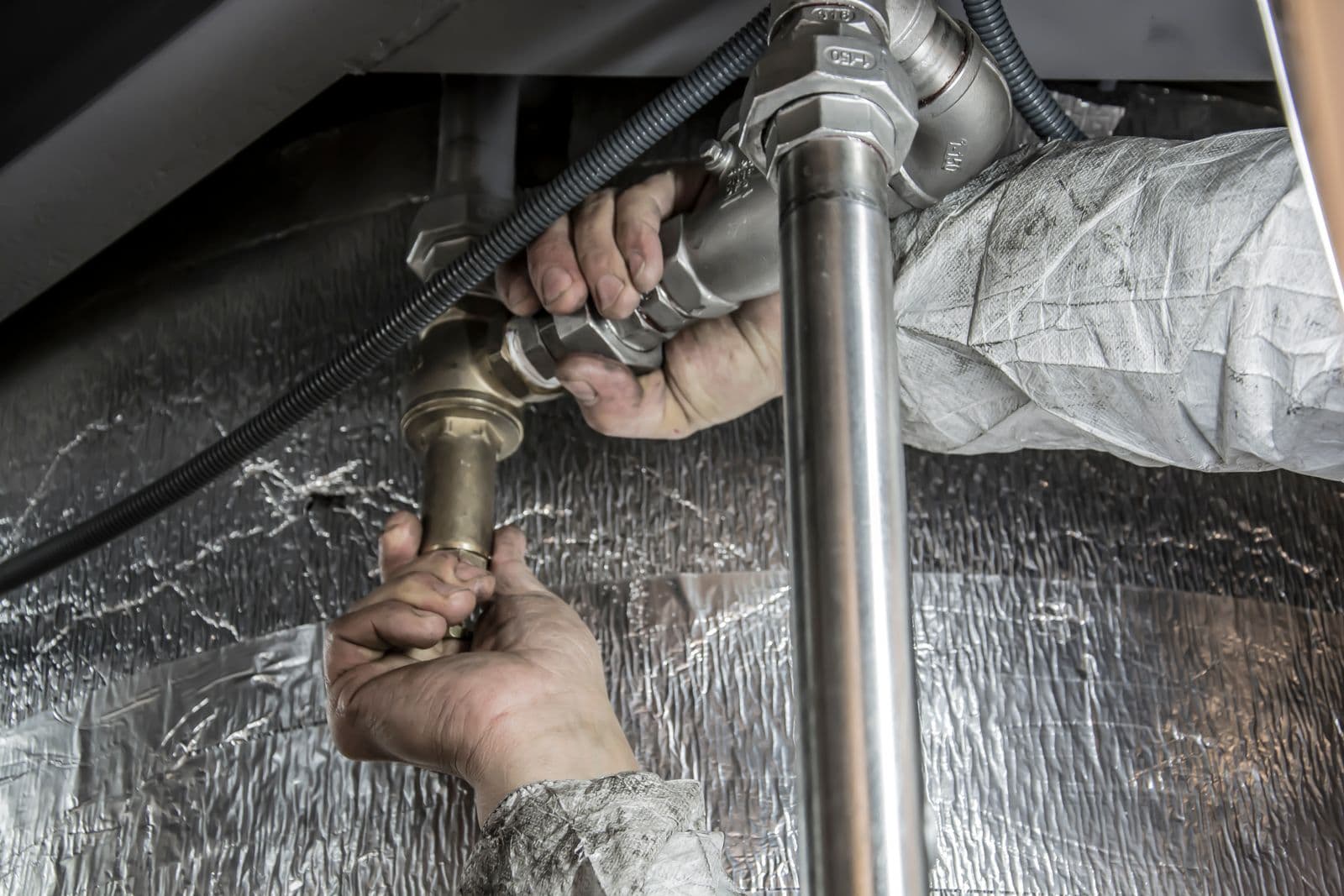
Treatment equipment is plumbing. Most of the job is the connection, the drain and the code detail behind it.


Los Angeles water, answered plainly
Where does Los Angeles get its water?+
In 2025, 44 percent came from the Los Angeles Aqueduct, 52 percent was purchased from the Metropolitan Water District (State Water Project and Colorado River Aqueduct), 1 percent was local groundwater and 3 percent recycled water, according to LADWP's 2025 Drinking Water Quality Report.
Is Los Angeles tap water hard?+
It depends on the source serving your area. LADWP's 2025 tables show average hardness of 103 mg/L at the Los Angeles Aqueduct Filtration Plant (moderately hard) and 234–236 mg/L at MWD's Weymouth and Diemer plants (very hard). Jensen averaged 140 mg/L.
Does LADWP use chlorine or chloramine?+
Chloramine. The highest running annual average for total chlorine residual in 2025 was 1.7 mg/L, under the 4 mg/L maximum residual disinfectant level. Remove chloramine before filling a fish tank or pond.
Is there arsenic in LA water?+
Low levels. The highest arsenic result in 2025 was 7.0 µg/L against a 10 µg/L MCL, and the average at the Los Angeles Aqueduct Filtration Plant was 3.3 µg/L. Reverse osmosis at the kitchen tap reduces it if you want it lower.
Does Los Angeles have lead service lines?+
LADWP's inventory concluded there are no lead service lines in its distribution system, and it received a non-lead designation from the State Water Board. Lead can still come from household plumbing, which is why LADWP runs residential tap sampling — the next round is in 2026.
Did LADWP detect PFAS?+
LADWP reports PFAS detections in a few samples from individual wells at the Pollock Well Field, but no PFAS compounds subject to state or federal regulation were found in the blended water served to customers.
Where do these figures come from?+
From LADWP's Drinking Water Quality Report 2025, covering January 1 through December 31, 2025. Third-party aggregators are not used.
Related resources
Home water purification and treatment
The national service page behind this one.
Learn more →Phoenix water quality
Colorado River via CAP, Salt and Verde, and groundwater.
Learn more →Salt Lake City water quality
Wasatch streams, summer wells and no added fluoride.
Learn more →Where a water softener can discharge
What to check before installing a softener.
Learn more →All home services
Water, battery, HVAC and solar under one licensed contractor of record.
Learn more →Get a free test at your tap
A licensed technician tests at your kitchen tap and tells you which findings apply to your house — chloramine, hardness from your plant, or your own plumbing. No charge, no obligation, and coverage confirmed at your address first.
Get a free test