Paterson, New Jersey
Paterson Water Quality
Paterson drinks Passaic River water treated at Little Falls and blended with Wanaque Reservoir water. PVWC's 2025 data show hard water, sodium above New Jersey's guideline, and PFAS under state limits.
Passaic River + Wanaque blend · hardness 106–242 mg/L · sodium to 138.8 mg/L · PFOA 8.62 ppt (NJ limit 14) · lead 90th 3.73 ppb.
The short answer
Paterson's water comes from the Passaic Valley Water Commission: Passaic River water treated at the Little Falls plant, blended for most customers with water from the Wanaque Reservoir. PVWC reports it met all NJDEP and EPA standards in 2025.
The issues are mostly aesthetic: hardness up to 242 mg/L and sodium up to 138.8 mg/L, above New Jersey's recommended limit. PFOA averaged as high as 8.62 ppt, under the state's 14 ppt limit.
Get a free test
Tell us your Paterson address. We confirm coverage first, then schedule a licensed technician to test at your tap — no charge, no obligation.
What PVWC's 2025 data show
Figures below are system-level results from PVWC's 2026 Drinking Water Quality Report, which covers calendar year 2025. A later report supersedes them.
Hard water: 106 to 242 mg/L
Hardness in Little Falls plant water ranged from 106 to 242 mg/L as CaCO₃, roughly 6 to 14 grains per gallon. Wanaque water measured 42 mg/L, so what reaches your tap depends on the blend.
Sodium above New Jersey's guideline
Sodium in Little Falls water ranged from 49.29 to 138.8 mg/L, above New Jersey's recommended upper limit of 50. PVWC attributes it to road salt, soil runoff, upstream wastewater plants and treatment chemicals. It matters mainly for people on sodium-restricted diets.
Dissolved solids up to 533 mg/L
Total dissolved solids ranged from 353 to 533 mg/L against a 500 mg/L recommended limit. The report notes high TDS can cause scale on fixtures and appliances, staining and a salty taste.
PFOA and PFOS under New Jersey limits
PFOA's highest running annual average was 8.62 ppt (individual results 5.7–11.0) against New Jersey's 14 ppt limit; PFOS was 5.25 ppt (3.1–5.9) against 13 ppt. The report notes EPA's own PFAS thresholds take effect for reporting on April 26, 2027.
Lead 90th percentile under 4 ppb
Of 206 homes tested in 2025, four were above the 15 ppb action level. The 90th percentile was 3.73 ppb for January–June (2 of 102 over) and 2.4 ppb for July–December (2 of 104 over). PVWC says 212 customer-owned lead service locations have not responded to replacement outreach.
Disinfection byproducts mid-range
Total trihalomethanes peaked at a locational annual average of 48.25 ppb (individual results 15.4–77.6) against 80. Haloacetic acids peaked at 29.08 ppb against 60. No E. coli was found in 2,630 samples.
How the water is produced
A river supply, an advanced treatment plant and a reservoir purchase.
Passaic River at Totowa
PVWC withdraws water from the Passaic River in Totowa and treats it at the Alan C. Levine Little Falls Water Treatment Plant. If river quality is a problem it can draw from the Pompton River or the Point View Reservoir instead.
Blended with Wanaque Reservoir water
For most customers in the main service area, Little Falls water is blended with water bought from the North Jersey District Water Supply Commission's Wanaque plant. Emergency connections to Newark's Pequannock plant and Jersey City are used at times.
Owned by three cities
PVWC is a public supplier owned by Paterson, Clifton and Passaic. Its main service area covers those three cities plus Prospect Park and Woodland Park.
Treatment at Little Falls, and the open reservoirs
The Little Falls plant uses sand-ballasted settling, filtration through granular activated carbon and sand, ozone for primary disinfection and chlorine to keep the water disinfected in the pipes. Fluoride is not added.
After treatment, some water is stored in three uncovered reservoirs in Woodland Park and Paterson. The report says open storage exposes treated water to wildlife and other contamination and that chlorine is not very effective against Giardia and Cryptosporidium. PVWC is under an NJDEP consent order to cover or replace them.
Nearby, Newark treats its own Pequannock supply, and Jersey City draws from the Boonton Reservoir. Both publish their own reports.
Where these figures come from
Everything on this page traces to the Passaic Valley Water Commission's 2026 Drinking Water Quality Report for the main service area (PWSID NJ1605002), based on 2025 data and dated April 7, 2026.
- PVWC — Water Quality Reports — the main-system report for Paterson, Clifton and Passaic.
- PVWC — lead service line inventory
Matching treatment to the finding
Hardness, sodium and dissolved solids drive most Paterson decisions.
Softening for scale
At up to 14 grains per gallon, Little Falls water is hard enough that many households soften to protect water heaters and fixtures. A softener adds sodium, so a separate drinking tap is worth considering if anyone limits salt.
Reverse osmosis for sodium and TDS
Sodium and dissolved solids above New Jersey's guidelines are what reverse osmosis at the kitchen sink reduces. It also reduces PFAS, which some households want even though PVWC's results are under the state limits.
Lead filter or service-line check
Look up your service line at pvwcleadserviceline.com. If it is lead or unknown, a certified lead-reduction filter is the interim step the report itself points to.
Test before you buy
Because the Little Falls and Wanaque waters differ so much in hardness and sodium, a test at your own tap tells you which numbers apply to your house.
How the free test works
A licensed technician tests at your kitchen tap, walks the plumbing, and tells you which of the findings above applies to your house and which does not. There is no charge and no obligation.
Seamless Home is the licensed contractor of record on the work that follows. Installation is performed by vetted installing partners engaged as our subcontractors, and the workmanship obligation stays with us. Coverage is confirmed per service area rather than promised as blanket availability.
What a water treatment job with us covers
Installation and replacement of whole-home and point-of-use treatment, specified against what your water actually contains.
Sediment filtration
Installation of the first stage that protects everything downstream of it, sized to the service line and the household draw.
Softening
Installation of ion-exchange softening where hardness is the problem, including the drain connection the plumbing code treats as indirect waste.
Carbon filtration
Installation of carbon stages for taste, odour and disinfection by-products, specified from your utility's own water quality report.
Reverse osmosis
Point-of-use installation at the kitchen sink where the target is dissolved solids rather than whole-home flow.
Disinfection
Installation of UV or equivalent treatment where the supply is a private well or is otherwise not continuously disinfected.
System replacement
Replacing equipment that has reached the end of its service life, including the discharge and air gap details an inspector looks at.
This is installation and replacement work, specified from a published water quality report or a test of your supply — not from a sales chart. Coverage is confirmed per service area rather than promised as blanket availability.
What the work actually looks like
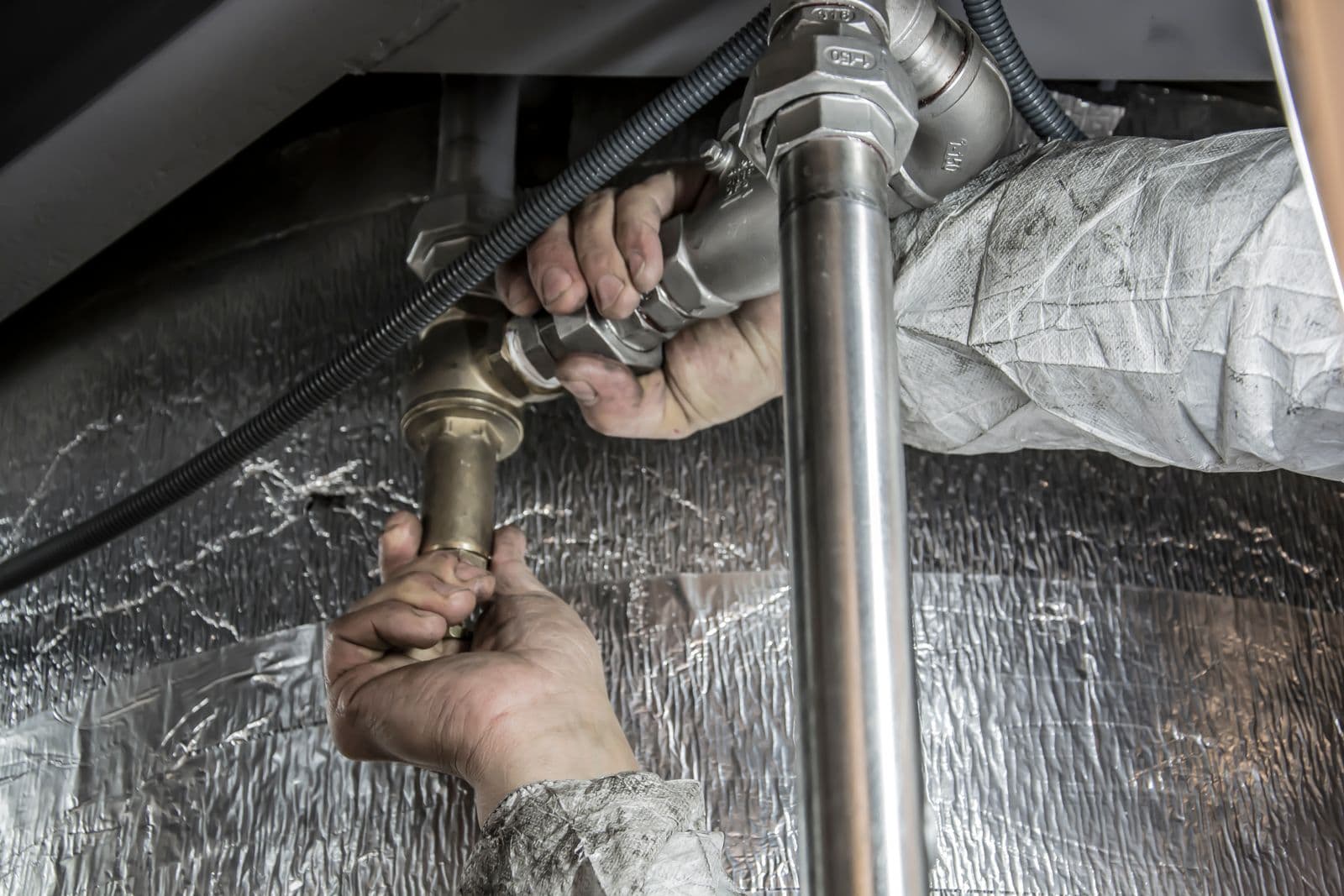
Treatment equipment is plumbing. Most of the job is the connection, the drain and the code detail behind it.
Paterson water, answered plainly
Where does Paterson get its water?+
From the Passaic Valley Water Commission. PVWC draws Passaic River water in Totowa, treats it at the Little Falls plant with ozone and granular activated carbon, and for most customers blends it with water bought from the Wanaque Reservoir plant.
Is Paterson tap water hard?+
Often, yes. The 2025 data show hardness from 106 to 242 mg/L in Little Falls water, about 6 to 14 grains per gallon. Wanaque water is much softer at 42 mg/L, and most homes get a blend.
Why is there so much sodium in PVWC water?+
PVWC lists road salt runoff, soil, upstream wastewater treatment plants and treatment chemicals as sources. Sodium in Little Falls water ranged from 49.29 to 138.8 mg/L in 2025, above New Jersey's recommended upper limit of 50 mg/L, which is a guideline rather than a health-based limit.
Does Paterson water have PFAS?+
Low levels. PFOA's highest running annual average was 8.62 ppt against New Jersey's 14 ppt limit, and PFOS was 5.25 ppt against 13 ppt. Neither exceeded the state limit.
What are the uncovered reservoirs in the report?+
PVWC stores treated water in three open reservoirs in Woodland Park and Paterson: Great Notch, New Street and Stanley Levine. Federal rules require them to be covered or given added treatment, and PVWC is working under an NJDEP consent order; the first phase, new tanks at the Levine Reservoir, is estimated at about $44.2 million.
Where do these figures come from?+
From the Passaic Valley Water Commission's 2026 Drinking Water Quality Report covering 2025, published on pvwc.com. Third-party aggregators are not used.
Related resources
Home water purification and treatment
The national service page behind this one.
Learn more →Newark water quality
Its own Pequannock supply, just to the south.
Learn more →Jersey City water quality
Boonton Reservoir supply in Hudson County.
Learn more →Trenton water quality
Delaware River supply in central New Jersey.
Learn more →All home services
Water, battery, HVAC and solar under one licensed contractor of record.
Learn more →Get a free test at your tap
A licensed technician tests at your kitchen tap and tells you which PVWC findings apply to your house — hardness and sodium from your Passaic and Wanaque blend, lead from plumbing, or PFAS. No charge, no obligation, and coverage confirmed at your address first.
Get a free test