Lansing, Michigan
Lansing Water Quality
All groundwater from deep wells, softened before it reaches you, with no PFAS detected. Here is what the Board of Water & Light's 2025 report shows.
112 deep wells · softened to ~98 ppm (5.7 gpg) · no PFAS detected · lead 90th pct 0 ppb · last lead line removed 2016.
The short answer
Lansing's water is all groundwater: the Board of Water & Light pumps it from 112 wells about 400 feet deep in the Saginaw Aquifer, then softens it at the plant, removing about 80% of the hardness. BWL reports meeting or exceeding every EPA and EGLE standard in 2025.
Typical conditioned water is about 98 ppm hardness (roughly 5.7 grains per gallon), with no PFAS detected and a 0 ppb 90th-percentile lead result. The trade-off of plant softening is sodium, which reached 110 ppm.
Get a free test
Tell us your Lansing address. We confirm coverage first, then schedule a licensed technician to test at your tap — no charge, no obligation.
What filtration does — and does not
Lansing’s water is already softened, so the questions are sodium, chloramine taste and what your own plumbing adds.
Where Lansing water comes from
Supply and treatment described in BWL's 2025 Annual Water Quality Report.
112 deep wells
Wells about 400 feet deep draw from the Saginaw Aquifer. BWL describes Lansing as one of the largest communities in the country that relies only on groundwater.
Two conditioning plants
The Dye and Wise plants soften the water, removing about 80% of the hardness, then disinfect with chloramine, add fluoride and corrosion control, filter and store it.
Scale of the system
About 166,000 people served directly plus 40,450 through wholesale customers, over 820.5 miles of water mains, at an average of 18.4 million gallons a day.
What the 2025 data actually says
Limits are fixed. Results are system figures from the utility's tables, not a reading at your tap.
Hardness after softening
Typical conditioned water was 98 ppm (range 89–120), roughly 5.7 grains per gallon. Dissolved solids were typically 332 ppm and pH about 9.4.
Sodium up to 110 ppm
Sodium ranged from 84 to 110 ppm, a side effect of softening. There is no federal limit, but people on low-sodium diets may want to know.
No PFAS detected
BWL reports no PFAS detections at a reporting level of 2 parts per trillion.
Lead: 0 ppb at the 90th percentile
In 2023 tap sampling, the 90th percentile was 0 ppb, the range 0–3 ppb, and no sites exceeded the action level. The next round runs June 1 to September 30, 2026.
Chloramine and byproducts
Chloramine averaged 2.0 ppm (0.50–2.8; limit 4). TTHM's highest running average was 3.9 ppb and HAA5's 3.0 ppb, far under the 80 and 60 ppb limits.
Fluoride
Natural fluoride in the raw water is about 0.35 ppm; BWL adjusts it to about 0.7. The 2025 result was 0.72 ppm.
Lansing next to Ann Arbor and Detroit
Ann Arbor also softens its water at the plant, but starts from the Huron River plus wells. Lansing starts from deep wells only.
Detroit treats Great Lakes surface water, with its own report and its own numbers. For power in Lansing, see home battery backup in Lansing.
Where these figures come from
Everything on this page traces to the Lansing Board of Water & Light's 2025 Annual Water Quality Report, issued April 1, 2026.
- Lansing BWL — 2025 Annual Water Quality Report (PDF)
- Questions: water@lbwl.com or 517-702-7059. BWL reports removing the last known active lead service line in 2016.
Matching treatment to the finding
Plant softening does most of the work, so Lansing homeowners usually add treatment for taste or sodium.
A second softener is usually unnecessary
BWL already removes about 80% of the hardness. Test before adding a softener; a typical 98 ppm is already in the moderately hard range.
RO for sodium and dissolved solids
Reverse osmosis at the kitchen tap reduces sodium (up to 110 ppm) and dissolved solids for drinking and cooking.
Catalytic carbon for chloramine
Chloramine averaged 2.0 ppm. Catalytic carbon is the media designed to reduce chloramine taste and odor.
Check your own plumbing
The public lead lines are gone, but older faucets and solder inside a house can still matter. A tap test answers it.
How the free test works
A licensed technician tests at your kitchen tap, walks the plumbing, and tells you which of the findings above applies to your house and which does not. There is no charge and no obligation.
Seamless Home is the licensed contractor of record on the work that follows. Installation is performed by vetted installing partners engaged as our subcontractors, and the workmanship obligation stays with us. Coverage is confirmed per service area rather than promised as blanket availability.
What a water treatment job with us covers
Installation and replacement of whole-home and point-of-use treatment, specified against what your water actually contains.
Sediment filtration
Installation of the first stage that protects everything downstream of it, sized to the service line and the household draw.
Softening
Installation of ion-exchange softening where hardness is the problem, including the drain connection the plumbing code treats as indirect waste.
Carbon filtration
Installation of carbon stages for taste, odour and disinfection by-products, specified from your utility's own water quality report.
Reverse osmosis
Point-of-use installation at the kitchen sink where the target is dissolved solids rather than whole-home flow.
Disinfection
Installation of UV or equivalent treatment where the supply is a private well or is otherwise not continuously disinfected.
System replacement
Replacing equipment that has reached the end of its service life, including the discharge and air gap details an inspector looks at.
This is installation and replacement work, specified from a published water quality report or a test of your supply — not from a sales chart. Coverage is confirmed per service area rather than promised as blanket availability.
What the work actually looks like
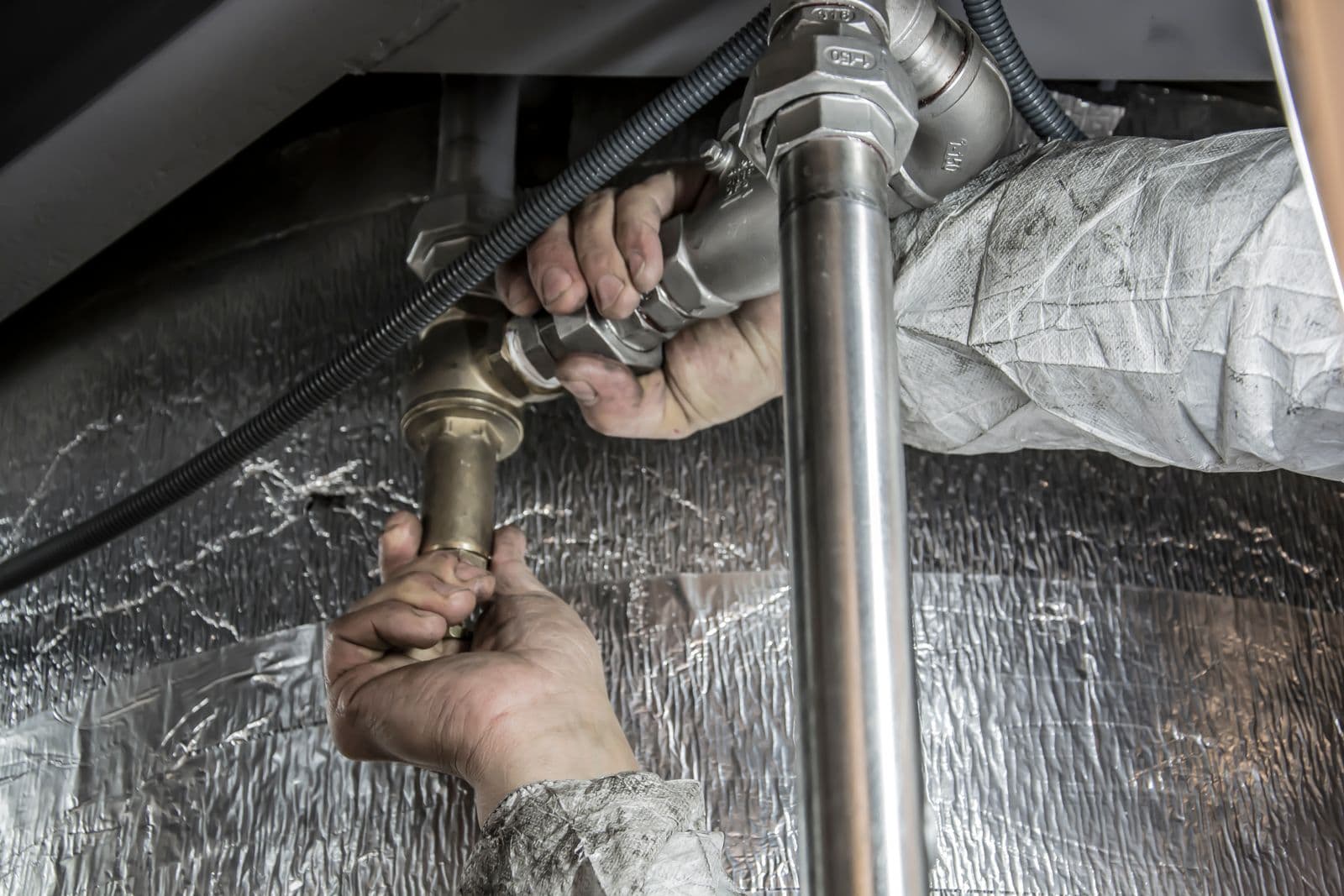
Treatment equipment is plumbing. Most of the job is the connection, the drain and the code detail behind it.

Lansing water, answered plainly
Where does Lansing get its water?+
From 112 wells about 400 feet deep in the Saginaw Aquifer. The Board of Water & Light treats it at the Dye and Wise water conditioning plants.
Is Lansing water hard?+
Less than you might expect for well water. BWL softens it at the plant, removing about 80% of the hardness; typical conditioned water was 98 ppm, about 5.7 grains per gallon.
Does Lansing water have PFAS?+
BWL reports no PFAS detected at a reporting level of 2 parts per trillion.
Does Lansing have lead service lines?+
BWL reports removing the last known active lead service line in 2016. In 2023 sampling, the 90th-percentile lead result was 0 ppb.
Why is there sodium in Lansing water?+
Softening adds it. Sodium ranged from 84 to 110 ppm in 2025. Reverse osmosis at the kitchen tap reduces it if you are watching sodium.
Where do these figures come from?+
From the Lansing Board of Water & Light's 2025 Annual Water Quality Report, issued April 1, 2026. Third-party aggregators are not used.
Related resources
Home water purification and treatment
The national service page behind this one.
Learn more →Ann Arbor water quality
Huron River water softened at the plant.
Learn more →Detroit water quality
Great Lakes surface water and its own water quality report.
Learn more →Home battery backup in Lansing, MI
BWL time-of-use rates and the May 2025 storm.
Learn more →Where a water softener can discharge
What to check before installing a softener.
Learn more →All home services
Water, battery, HVAC and solar under one licensed contractor of record.
Learn more →Get a free test at your tap
A licensed technician tests at your kitchen tap and tells you which findings apply to your house — sodium, chloramine taste, or older plumbing. No charge, no obligation, and coverage confirmed at your address first.
Get a free test