Kansas City, Kansas
Kansas City, KS Water Quality
Kansas City, Kansas drinks Missouri River water drawn through deep collector wells and treated at BPU's Nearman plant. It meets every health standard in the 2026 report — and it is very hard, with dissolved solids just over the taste-and-appearance guideline.
Missouri River collector wells · hardness 280 ppm (16.4 gpg) · TDS 510 ppm (guideline 500) · TTHM RAA 30 ppb (limit 80) · lead 90th 7.5 ppb · no PFAS detected.
The short answer
Kansas City, Kansas gets its water from the Missouri River, drawn through collector wells deep below the riverbed and treated at BPU's Nearman Water Treatment Plant. BPU's 2026 report, covering 2025, says the water meets or exceeds all federal and state standards.
What homeowners notice is mineral content: total hardness of 280 ppm (16.4 grains per gallon) and total dissolved solids of 510 ppm, just over the 500 ppm secondary guideline. EPA screening found none of 29 PFAS compounds.
Get a free test
Tell us your Kansas City, Kansas address. We confirm coverage first, then schedule a licensed technician to test at your tap — no charge, no obligation.
What the 2026 BPU report shows
System-level results from the Kansas City Board of Public Utilities' 2026 Water Quality Report, covering 2025 unless noted. A later report supersedes them.
Very hard: 280 ppm, 16.4 gpg
BPU reports total hardness of 280 ppm as calcium carbonate, or 16.4 grains per gallon, with calcium at 73 ppm and magnesium at 26. Hardness is not a health concern, but it drives scale on fixtures, water heaters and appliances.
Dissolved solids above the guideline
Total dissolved solids measured 510 ppm against a 500 ppm secondary standard, sulfate 170 ppm against 250, and sodium 51 to 61 ppm. Secondary standards cover taste and appearance, not safety.
Lead 90th percentile: 7.5 ppb
BPU's most recent lead sampling (June to September 2023) found a 90th percentile of 0.0075 ppm — 7.5 ppb — with no sites over the 15 ppb action level. Because results have been low, the state allows testing once every three years. BPU publishes a service line inventory you can search.
Byproducts under their limits
Total trihalomethanes had a highest running annual average of 30 ppb (16 to 36) against 80, and haloacetic acids 15 ppb (8 to 18) against 60.
Chloramine disinfection
Chloramines had a highest running annual average of 2.72 ppm, with readings from 1.10 to 3.80, against a 4.0 ppm limit.
No PFAS detected
Under EPA's UCMR 5 program, BPU sampled quarterly through 2024 for 29 PFAS compounds and lithium. None of the PFAS were detected; lithium ranged from 50.7 to 55.3 µg/L.
Where the water comes from
One river, one plant, with neighbors on standby.
Missouri River collector wells
BPU draws water from deep below the Missouri River through two of the nation's largest horizontal collector wells, rather than from the river surface.
Nearman Water Treatment Plant
Opened in 2000, it can pump up to 72 million gallons a day into more than 1,000 miles of pipe serving more than 51,000 customers.
Emergency interconnections
BPU keeps connections with Kansas City, Missouri and Johnson County WaterOne. The 2026 report says the WaterOne connection supplied the Argentine system for emergencies several times in 2025.
Water and power in Kansas City, Kansas
BPU is also the electric utility here, not Evergy. Our Kansas City, KS battery backup page covers BPU's rates and the August 2026 storms. Down the turnpike, Wichita is Evergy territory.
Upriver, Omaha also drinks Missouri and Platte River water and also runs hard. South in Oklahoma, Tulsa draws from lakes instead.
Where these figures come from
Everything on this page traces to the Kansas City Board of Public Utilities 2026 Water Quality Report, which covers testing from January 1 to December 31, 2025 unless a row notes otherwise.
- BPU — 2026 Water Quality Report (PDF)
- BPU Reports — water quality reports and monthly mineral data.
- BPU — Service Line Inventory — look up the recorded material of your service line.
Matching treatment to the finding
Hardness and dissolved minerals drive most Kansas City, Kansas decisions.
Softener for 16.4 grains
At 280 ppm, a whole-house softener is the standard answer to scale on fixtures, water heaters and dishwashers. Sizing starts from hardness measured at your own tap.
Reverse osmosis for TDS and taste
Dissolved solids of 510 ppm and sulfate of 170 ppm affect taste. Reverse osmosis at the kitchen sink reduces both, plus the sodium a softener adds.
Catalytic carbon for chloramine
Chloramine taste and odor are reduced by catalytic carbon, at the tap or for the whole house.
Check your service line
Search BPU's service line inventory for your address. If the house predates 1986, testing at the tap shows what the plumbing adds.
How the free test works
A licensed technician tests at your kitchen tap, walks the plumbing, and tells you which of the findings above applies to your house and which does not. There is no charge and no obligation.
Seamless Home is the licensed contractor of record on the work that follows. Installation is performed by vetted installing partners engaged as our subcontractors, and the workmanship obligation stays with us. Coverage is confirmed per service area rather than promised as blanket availability.
What a water treatment job with us covers
Installation and replacement of whole-home and point-of-use treatment, specified against what your water actually contains.
Sediment filtration
Installation of the first stage that protects everything downstream of it, sized to the service line and the household draw.
Softening
Installation of ion-exchange softening where hardness is the problem, including the drain connection the plumbing code treats as indirect waste.
Carbon filtration
Installation of carbon stages for taste, odour and disinfection by-products, specified from your utility's own water quality report.
Reverse osmosis
Point-of-use installation at the kitchen sink where the target is dissolved solids rather than whole-home flow.
Disinfection
Installation of UV or equivalent treatment where the supply is a private well or is otherwise not continuously disinfected.
System replacement
Replacing equipment that has reached the end of its service life, including the discharge and air gap details an inspector looks at.
This is installation and replacement work, specified from a published water quality report or a test of your supply — not from a sales chart. Coverage is confirmed per service area rather than promised as blanket availability.
What the work actually looks like
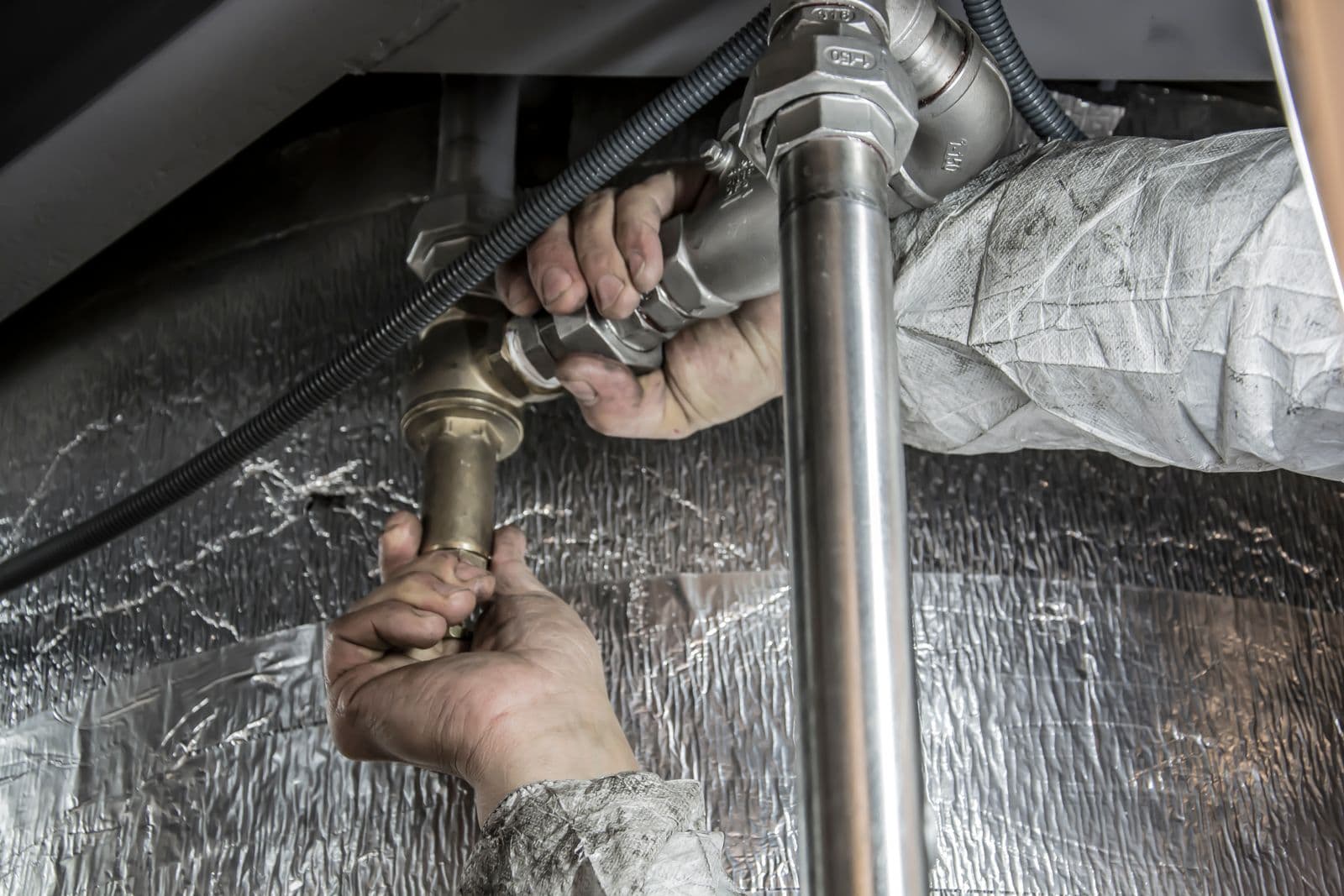
Treatment equipment is plumbing. Most of the job is the connection, the drain and the code detail behind it.


Kansas City, KS water, answered plainly
Where does Kansas City, Kansas get its water?+
From the Missouri River watershed. BPU draws water from deep below the river through collector wells and treats it at the Nearman Water Treatment Plant before it reaches more than 51,000 customers.
Is Kansas City, Kansas tap water safe to drink?+
BPU's 2026 report says its water meets or exceeds all federal and state health standards. Trihalomethanes had a highest running annual average of 30 ppb against an 80 ppb limit.
How hard is Kansas City, Kansas water?+
Very hard. The 2026 report lists total hardness of 280 ppm, or 16.4 grains per gallon.
Why does the water taste mineral-heavy?+
Total dissolved solids measured 510 ppm, just over the 500 ppm secondary guideline, with sulfate at 170 ppm and sodium up to 61 ppm. Secondary standards cover taste, not safety.
Is there PFAS in Kansas City, Kansas water?+
BPU sampled for 29 PFAS compounds under EPA's UCMR 5 program in 2024 and detected none.
Where do these figures come from?+
From the Kansas City Board of Public Utilities 2026 Water Quality Report, covering 2025. Third-party aggregators are not used.
Related resources
Home water purification and treatment
The national service page behind this one.
Learn more →Kansas City, KS battery backup
BPU electric rates and storm outages.
Learn more →Omaha water quality
Missouri and Platte River supply, also hard.
Learn more →Des Moines battery backup
MidAmerican's inflow-outflow billing and the 2020 derecho.
Learn more →All home services
Water, battery, HVAC and solar under one licensed contractor of record.
Learn more →Get a free test at your tap
A licensed technician tests hardness and dissolved solids at your kitchen tap and tells you which BPU findings apply to your house. No charge, no obligation, and coverage confirmed at your address first.
Get a free test