Grand Rapids, Michigan
Grand Rapids Water Quality
Grand Rapids drinks Lake Michigan water. The 2025 report shows a lead 90th percentile of 7 ppb under Michigan's 12 ppb action level — and 17,165 service lines that are lead or presumed lead.
Lake Michigan · lead 90th 7 ppb (AL 12), 1 of 50 over · 17,165 lead or presumed-lead lines · TTHM 59 ppb.
The short answer
Grand Rapids' tap water comes from Lake Michigan, the sole source for the City of Grand Rapids Water System. The 2025 report says the water meets Safe Drinking Water Act requirements.
The lead 90th percentile was 7 ppb against Michigan's 12 ppb action level, with one of 50 high-risk homes over. The city counts 17,165 known or presumed lead service lines, so the result at your tap depends on your line. Trihalomethanes were 59 ppb against an 80 ppb limit.
Get a free test
Tell us your Grand Rapids address. We confirm coverage first, then schedule a licensed technician to test at your tap — no charge, no obligation.
What the 2025 Grand Rapids report shows
Figures below are results from the City of Grand Rapids' 2025 Water Quality Report. A later report supersedes them.
Lead 90th percentile at 7 ppb
2025 sampling at 50 homes selected as high risk found a lead 90th percentile of 7 ppb, with results from not detected to 13 ppb and 1 home over the action level. Michigan lowered its lead action level from 15 to 12 ppb on January 1, 2025.
17,165 known or presumed lead lines
About one in five of the city's 80,196 service lines is known or presumed lead. That is the main reason a home test matters more here than the citywide average.
Trihalomethanes at 59 ppb
Total trihalomethanes were reported at 59 ppb (range 17.0–70.7) against an 80 ppb MCL, and haloacetic acids at 31 ppb (range 12.3–46.7) against 60. Both form when chlorine meets natural organic matter in lake water.
PFOS 1.7 ppt; PFOA not detected
PFOS was reported at 1.7 ppt (range ND–2.4) against Michigan's 16 ppt limit. PFOA, PFNA, PFHxS, PFBS, PFHxA and GenX were not detected in 2025.
Low sodium, fluoride at 0.65 ppm
Sodium was 14 ppm and nitrate 0.7 ppm. Fluoride was 0.65 ppm.
Turbidity met the standard every time
100% of turbidity samples were below the 0.3 NTU treatment-technique value; the highest single reading was 0.120 NTU.
How the water is produced
One Great Lake, one treatment plant, and a service line inventory that decides most lead questions.
Lake Michigan — the sole source
The 2025 report states that Lake Michigan, a surface water source, is the sole source of water treated for the Grand Rapids Water System.
Source water assessment: moderately high
Michigan EGLE's 2003 Source Water Assessment found the supply has a moderately high susceptibility to contaminants. The plant monitors the water routinely and continuously.
80,196 service lines
The city lists 80,196 service lines in the system. Of those, 17,165 are known or presumed lead, and the city publishes a service line map at grandrapidsmi.gov/LSLmap.
Grand Rapids next to other Michigan cities
Kalamazoo and Lansing pump groundwater, so their reports are about wells, iron and softening rather than a Great Lake. Detroit is the other Michigan system on this site where lead service lines drive the story.
If you are also weighing outage protection, our Grand Rapids battery backup page covers Consumers Energy's summer peak and outage credits.
Where these figures come from
Everything on this page traces to the City of Grand Rapids' 2025 Water Quality Report (Consumer Confidence Report) and the city's Lead and Copper Rule page.
Matching treatment to the finding
Lead service lines drive most Grand Rapids decisions; byproducts and chlorine taste come next.
Lead first, if your line is lead
Check the city's service line map. If your line is known or presumed lead, flush for at least 5 minutes after stagnation, as the report advises, and use a filter certified to reduce lead until the line is replaced.
Disinfection byproducts
Carbon filtration certified for trihalomethane reduction at the kitchen tap addresses the 59 ppb TTHM reading.
Chlorine taste
Chlorine residual averaged 1.04 ppm. A whole-house carbon filter removes the taste and smell at every tap.
Test before you buy
With one in five service lines lead or presumed lead, a kitchen-tap test tells you whether your house looks like the 7 ppb average or the 13 ppb high.
How the free test works
A licensed technician tests at your kitchen tap, walks the plumbing, and tells you which of the findings above applies to your house and which does not. There is no charge and no obligation.
Seamless Home is the licensed contractor of record on the work that follows. Installation is performed by vetted installing partners engaged as our subcontractors, and the workmanship obligation stays with us. Coverage is confirmed per service area rather than promised as blanket availability.
What a water treatment job with us covers
Installation and replacement of whole-home and point-of-use treatment, specified against what your water actually contains.
Sediment filtration
Installation of the first stage that protects everything downstream of it, sized to the service line and the household draw.
Softening
Installation of ion-exchange softening where hardness is the problem, including the drain connection the plumbing code treats as indirect waste.
Carbon filtration
Installation of carbon stages for taste, odour and disinfection by-products, specified from your utility's own water quality report.
Reverse osmosis
Point-of-use installation at the kitchen sink where the target is dissolved solids rather than whole-home flow.
Disinfection
Installation of UV or equivalent treatment where the supply is a private well or is otherwise not continuously disinfected.
System replacement
Replacing equipment that has reached the end of its service life, including the discharge and air gap details an inspector looks at.
This is installation and replacement work, specified from a published water quality report or a test of your supply — not from a sales chart. Coverage is confirmed per service area rather than promised as blanket availability.
What the work actually looks like
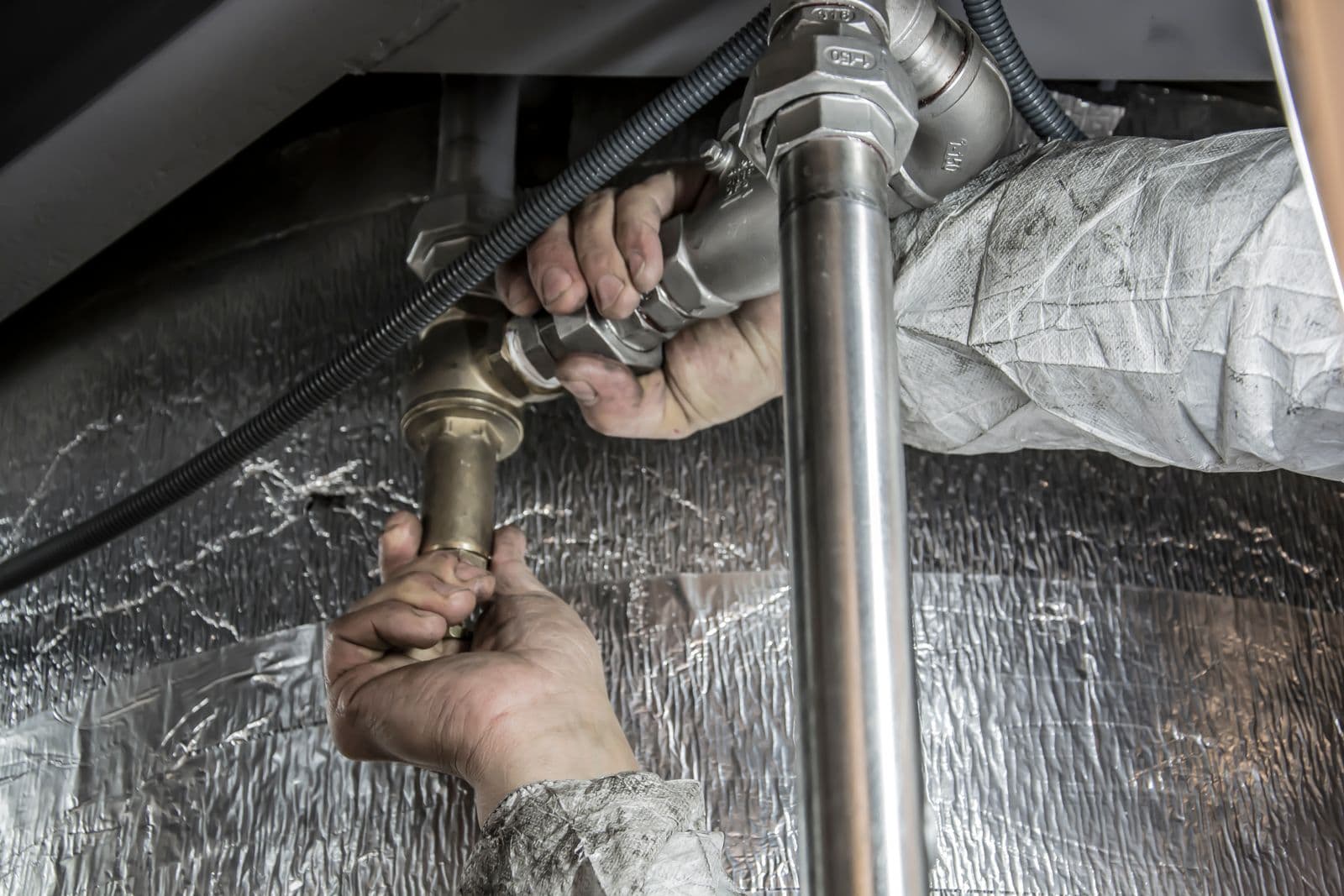
Treatment equipment is plumbing. Most of the job is the connection, the drain and the code detail behind it.


Grand Rapids water, answered plainly
Where does Grand Rapids get its water?+
From Lake Michigan, which the city's 2025 report names as the sole source of water treated for the Grand Rapids Water System.
Is there lead in Grand Rapids water?+
The 2025 lead 90th percentile was 7 ppb, under Michigan's 12 ppb action level, but results ran up to 13 ppb and 1 of 50 homes was over. The city lists 17,165 known or presumed lead service lines out of 80,196.
How do I know if my house has a lead service line?+
The city publishes a service line map at grandrapidsmi.gov/LSLmap. You can also look where the line enters the house near the meter; a licensed plumber can confirm the material.
Does Grand Rapids water have PFAS?+
PFOS was reported at 1.7 ppt (up to 2.4) against Michigan's 16 ppt limit. Other regulated PFAS, including PFOA, were not detected in 2025.
What is Michigan's lead action level?+
Michigan lowered its lead action level from 15 ppb to 12 ppb on January 1, 2025. The city notes EPA set a 10 ppb level in October 2024, which Michigan is expected to review.
Where do these figures come from?+
From the City of Grand Rapids' 2025 Water Quality Report (Consumer Confidence Report) and its Lead and Copper Rule page. Third-party aggregators are not used.
Related resources
Home water purification and treatment
The national service page behind this one.
Learn more →Home battery backup in Grand Rapids
Consumers Energy rates and outage credits.
Learn more →Kalamazoo water quality
Groundwater-fed system to the south.
Learn more →Detroit water quality
Another Michigan system with many lead lines.
Learn more →All home services
Water, battery, HVAC and solar under one licensed contractor of record.
Learn more →Get a free test at your tap
A licensed technician tests at your kitchen tap and tells you which Grand Rapids findings apply to your house — lead from a service line, disinfection byproducts or chlorine taste. No charge, no obligation, and coverage confirmed at your address first.
Get a free test