Fresno, California
Fresno Water Quality
Fresno blends Central Valley groundwater with surface water treatment plants. The 2025 report shows moderate hardness, lead not detected at the 90th percentile, and arsenic and nitrate averages under federal limits.
Hardness ~7.5 gpg · arsenic avg 3.15 ppb · nitrate avg 4.80 ppm · lead 90th pct ND · TDS ~187 ppm.
The short answer
Fresno's tap water comes from City wells and surface water treatment plants run by the Department of Public Utilities (PWS CA1010007). The 2025 report says the City met all state and federal water quality standards.
Hardness averaged about 7.5 grains per gallon. Arsenic averaged 3.15 ppb and nitrate 4.80 ppm, both under federal limits. Lead was not detected at the 90th percentile in the August 2025 tap sampling of 53 homes.
Get a free test
Tell us your Fresno address. We confirm coverage first, then schedule a licensed technician to test at your tap — no charge, no obligation.
What the 2025 Fresno report shows
Figures below are system-level results from the City of Fresno's 2025 Annual Water Quality Report. A later report supersedes them.
Moderately hard: about 7.5 grains per gallon
Average total hardness was 129 mg/L as CaCO₃ (range 87–150), roughly 7.5 grains per gallon. That is enough for scale on fixtures and water heaters, though milder than coastal Southern California imports.
Arsenic averaged 3.15 ppb
Arsenic averaged 3.15 µg/L city-wide in 2025 (range ND–5.1) against a 10 µg/L MCL. The report includes the standard arsenic health-effects language for results below the MCL but above the public-health goal.
Nitrate averaged 4.80 ppm
Nitrate (as N) averaged 4.80 mg/L (range ND–12) against a 10 mg/L MCL. A footnote notes Well 85 at Herndon and Maple had a sample that required averaging with a follow-up for compliance.
Hexavalent chromium averaged 2.50 ppb
Hexavalent chromium averaged 2.50 µg/L (range 0.1–9.6) against a 10 µg/L MCL. No violation.
Lead not detected at the 90th percentile
In August 2025 lead-and-copper sampling of 53 homes, lead's 90th percentile was not detected and no home exceeded the 15 ppb action level. Copper's 90th percentile was 0.18 ppm.
Dissolved solids around 187 ppm
Total dissolved solids averaged 186.8 mg/L (range 87–260), under California's 1,000 mg/L secondary MCL. Sodium averaged 27 mg/L.
How the water is produced
Groundwater wells and surface water plants share the load across the city.
Groundwater wells across the city
Fresno's long-standing supply is local groundwater. The 2025 report says the utility runs more than 460 groundwater quality tests daily and removes a well from service if it violates standards.
Surface water treatment plants
Surface water plants supplement the wells. The report notes more than 128 physical, chemical and microbiological tests performed daily at those facilities, and turbidity tables for Northeast, Southeast T-3 and Southeast plants.
City of Fresno Department of Public Utilities
The City of Fresno DPU Water Utility (PWS CA1010007) serves more than 550,000 residents in the city and county. Director Paul Amico's letter in the 2025 report states the City met all state and federal water quality standards for the reporting period.
Where these figures come from
Everything on this page traces to the City of Fresno Department of Public Utilities' 2025 Annual Water Quality Report (public water system CA1010007).
- City of Fresno — 2025 Annual Water Quality Report (PDF)
- City of Fresno — Water Quality and Testing — current and past Consumer Confidence Reports.
Matching treatment to the finding
Hardness, nitrate, arsenic and chromium drive most Fresno treatment decisions.
Softening or conditioning for scale
At roughly 7.5 grains per gallon, hardness is a common reason Fresno homeowners look at whole-house treatment. A softener or conditioner is sized to measured hardness and household use.
Reverse osmosis at the kitchen tap
Under-sink RO lowers dissolved solids, arsenic, nitrate and chromium in the water you drink and cook with. It is a point-of-use choice, not a whole-house one.
Well-specific results matter
Fresno's blend changes with which wells and plants are online. A tap test tells you whether your house sits near the city-wide averages or above them.
Test before you buy
The City removes wells that violate standards from service. Confirming what is at your tap avoids buying treatment for a problem you do not have.
How the free test works
A licensed technician tests at your kitchen tap, walks the plumbing, and tells you which of the findings above applies to your house and which does not. There is no charge and no obligation.
Seamless Home is the licensed contractor of record on the work that follows. Installation is performed by vetted installing partners engaged as our subcontractors, and the workmanship obligation stays with us. Coverage is confirmed per service area rather than promised as blanket availability.
What a water treatment job with us covers
Installation and replacement of whole-home and point-of-use treatment, specified against what your water actually contains.
Sediment filtration
Installation of the first stage that protects everything downstream of it, sized to the service line and the household draw.
Softening
Installation of ion-exchange softening where hardness is the problem, including the drain connection the plumbing code treats as indirect waste.
Carbon filtration
Installation of carbon stages for taste, odour and disinfection by-products, specified from your utility's own water quality report.
Reverse osmosis
Point-of-use installation at the kitchen sink where the target is dissolved solids rather than whole-home flow.
Disinfection
Installation of UV or equivalent treatment where the supply is a private well or is otherwise not continuously disinfected.
System replacement
Replacing equipment that has reached the end of its service life, including the discharge and air gap details an inspector looks at.
This is installation and replacement work, specified from a published water quality report or a test of your supply — not from a sales chart. Coverage is confirmed per service area rather than promised as blanket availability.
What the work actually looks like
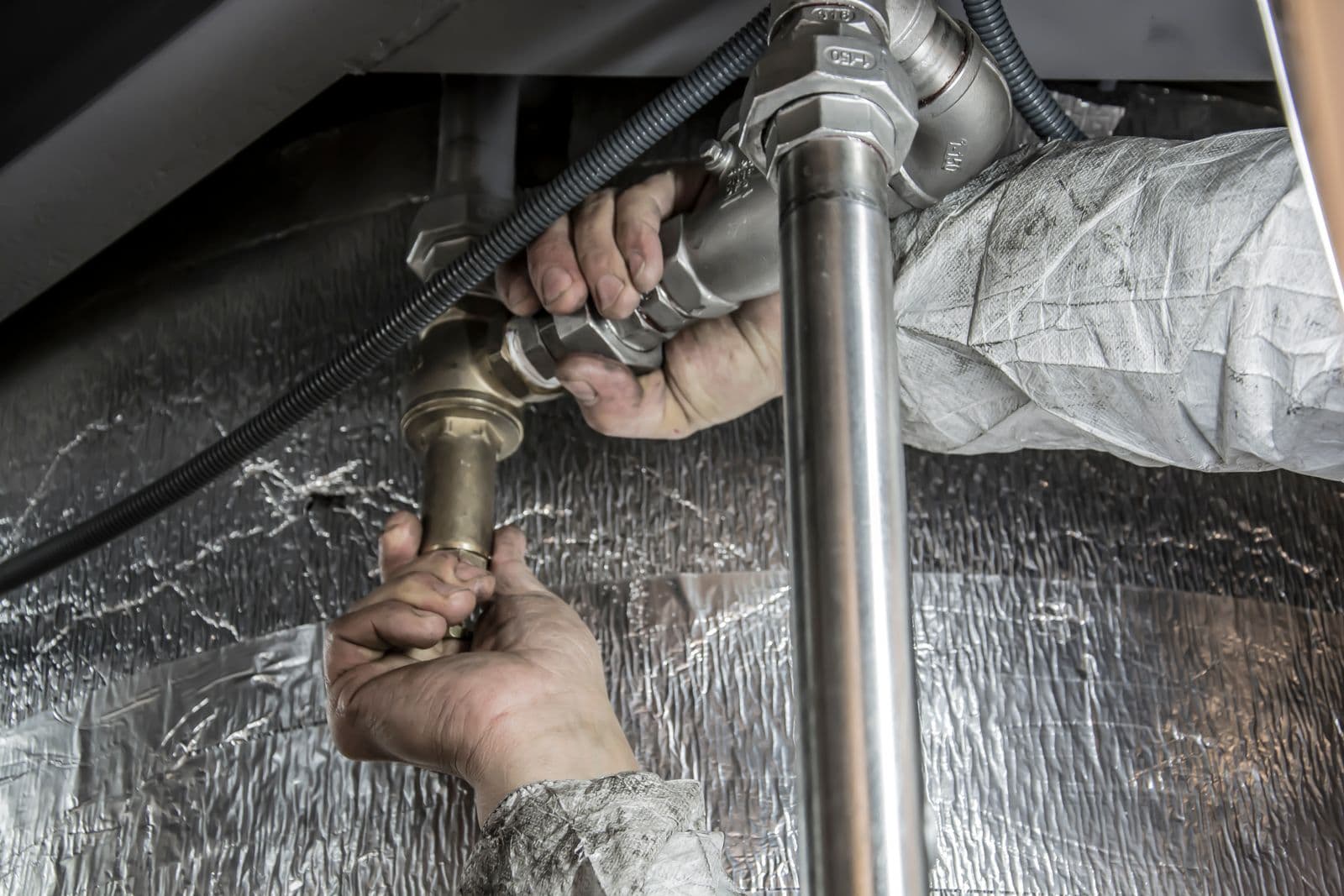
Treatment equipment is plumbing. Most of the job is the connection, the drain and the code detail behind it.


Fresno water, answered plainly
Where does Fresno get its water?+
From City of Fresno Department of Public Utilities wells and surface water treatment plants. The 2025 report emphasizes both groundwater and surface-water facilities serving more than 550,000 residents.
Is Fresno tap water hard?+
Moderately. Average total hardness in 2025 was 129 mg/L as CaCO₃ (about 7.5 grains per gallon), with a range of 87–150 mg/L.
Did Fresno's 2025 water meet standards?+
Yes. Director Paul Amico's letter in the City's 2025 Annual Water Quality Report states the City met all state and federal water quality standards for the reporting period.
Is there lead in Fresno water?+
Lead was not detected at the 90th percentile in the August 2025 sampling of 53 homes, and no home exceeded the action level. Lead can still come from plumbing inside a home.
What about nitrate and arsenic?+
Nitrate averaged 4.80 mg/L against a 10 mg/L MCL (range ND–12). Arsenic averaged 3.15 µg/L against a 10 µg/L MCL (range ND–5.1). Both met the federal limits city-wide.
Where do these figures come from?+
From the City of Fresno Department of Public Utilities' 2025 Annual Water Quality Report (PWS CA1010007). Third-party aggregators are not used.
Related resources
Home water purification and treatment
The national service page behind this one.
Learn more →San Diego water quality
Mostly imported Colorado River and State Water Project water, about 14 grains hard.
Learn more →Los Angeles water quality
LA Aqueduct and Metropolitan imports, and how hardness shifts with the mix.
Learn more →Home battery backup in Sacramento
SMUD's 5–8 p.m. peak — another Central Valley utility page.
Learn more →All home services
Water, battery, HVAC and solar under one licensed contractor of record.
Learn more →Get a free test at your tap
A licensed technician tests at your kitchen tap and tells you which Fresno findings apply to your house — hardness and scale, nitrate, arsenic or chromium. No charge, no obligation, and coverage confirmed at your address first.
Get a free test