San Diego, California
San Diego Water Quality
San Diego imports most of its water from the Colorado River and the State Water Project. The 2025 report shows hard water, dissolved solids above 500 ppm and lead not detected.
Colorado River + State Water Project · hardness ~14 gr/gal · TDS 532–585 ppm · lead 90th pct not detected · TTHM LRAA 55 ppb.
The short answer
San Diego's tap water is mostly imported Colorado River and State Water Project water, treated at the City's Alvarado, Miramar and Otay plants. The 2025 report says it met all state and federal health standards.
It is hard — about 14 grains per gallon — with dissolved solids of 532 to 585 ppm. Lead was not detected at the 90th percentile in the latest tap sampling, and the City's service-line inventory found no lead in the system.
Get a free test
Tell us your San Diego address. We confirm coverage first, then schedule a licensed technician to test at your tap — no charge, no obligation.
What filtration does — and does not
Hardness and dissolved solids are the usual reasons San Diego homeowners add treatment, not a health violation.
Where San Diego water comes from
Supply and treatment as described in the City of San Diego 2025 Annual Drinking Water Quality Report.
Mostly imported water
The City imports most of its supply, the bulk of it raw water bought from the San Diego County Water Authority. Most of that is a blend of Colorado River and State Water Project water.
Three City treatment plants
Raw water is treated at the Alvarado, Miramar or Otay plant. Service areas overlap, so the report's map tells you which columns in the tables apply to your address.
Under 10% bought already treated
Less than 10% of the City's water arrives pre-treated, a blend from Metropolitan's Skinner plant, the Water Authority's Twin Oaks Valley plant and the Carlsbad Desalination Plant.
What the 2025 data actually says
Limits are fixed. Results are plant and system figures from the report tables, not a reading at your tap.
Hard water: about 14 grains per gallon
Average total hardness was 237 ppm (13.8 gr/gal) at Alvarado, 242 ppm (14.1) at Miramar and 243 ppm (14.2) at Otay. That is the scale on fixtures and water heaters most San Diego homes notice first.
Dissolved solids above 500 ppm
Total dissolved solids averaged 532 ppm at Alvarado, 533 at Miramar and 585 at Otay, under California's 1,000 ppm secondary limit. Sodium averaged 86 to 111 ppm across the three plants.
Lead not detected at the 90th percentile
In the 2023 round (sampling runs every three years), 56 homes tested their taps. The lead 90th percentile was not detected, results ranged up to 1.4 ppb, and no home was above the 15 ppb action level.
No lead found in the service-line inventory
The City completed its initial service-line inventory, which did not identify any lead in the system, and has finished the additional verifications the Lead and Copper Rule Revisions require.
Disinfection byproducts
The highest locational running annual average for total trihalomethanes was 55 ppb against the 80 ppb MCL, with single results from 8.6 to 87.0 ppb. HAA5 peaked at an LRAA of 15 ppb. No violations.
Chloramine in the pipes
Chloramines keep the water disinfected in distribution. The City ran 7,691 chloramine samples in 2025; the average residual was 1.75 ppm against a 4.0 ppm maximum.
San Diego next to Los Angeles and Yuma
Los Angeles leans on its own aqueduct as well as Metropolitan imports, so its hardness swings with the source mix in a way San Diego's mostly imported supply does not.
Upstream on the Colorado River, Yuma draws the same river water directly — the mineral profile San Diego homeowners see in their scale starts there.
Where these figures come from
Everything on this page traces to the City of San Diego's 2025 Annual Drinking Water Quality Report (public water system 3710020).
- City of San Diego — 2025 Annual Drinking Water Quality Report (PDF)
- City of San Diego — Water Quality Reports — current and past reports, plus the non-detected parameters list.
Matching treatment to the finding
Hardness, dissolved solids and chloramine taste drive most San Diego treatment decisions.
Softening or conditioning for scale
At roughly 14 grains per gallon, hardness is the usual reason San Diego homeowners look at whole-house treatment. A softener or conditioner is sized to measured hardness and household use.
Reverse osmosis at the kitchen tap
Under-sink RO lowers dissolved solids and sodium in the water you drink and cook with. It is a point-of-use choice, not a whole-house one.
Carbon rated for chloramine
If you notice a disinfectant taste, look for carbon media rated for chloramine. Standard chlorine filters are not always effective against it.
Test before you buy
The plant serving your address matters, and so does your home's plumbing. A tap test tells you which of these findings actually applies to your house.
How the free test works
A licensed technician tests at your kitchen tap, walks the plumbing, and tells you which of the findings above applies to your house and which does not. There is no charge and no obligation.
Seamless Home is the licensed contractor of record on the work that follows. Installation is performed by vetted installing partners engaged as our subcontractors, and the workmanship obligation stays with us. Coverage is confirmed per service area rather than promised as blanket availability.
What a water treatment job with us covers
Installation and replacement of whole-home and point-of-use treatment, specified against what your water actually contains.
Sediment filtration
Installation of the first stage that protects everything downstream of it, sized to the service line and the household draw.
Softening
Installation of ion-exchange softening where hardness is the problem, including the drain connection the plumbing code treats as indirect waste.
Carbon filtration
Installation of carbon stages for taste, odour and disinfection by-products, specified from your utility's own water quality report.
Reverse osmosis
Point-of-use installation at the kitchen sink where the target is dissolved solids rather than whole-home flow.
Disinfection
Installation of UV or equivalent treatment where the supply is a private well or is otherwise not continuously disinfected.
System replacement
Replacing equipment that has reached the end of its service life, including the discharge and air gap details an inspector looks at.
This is installation and replacement work, specified from a published water quality report or a test of your supply — not from a sales chart. Coverage is confirmed per service area rather than promised as blanket availability.
What the work actually looks like
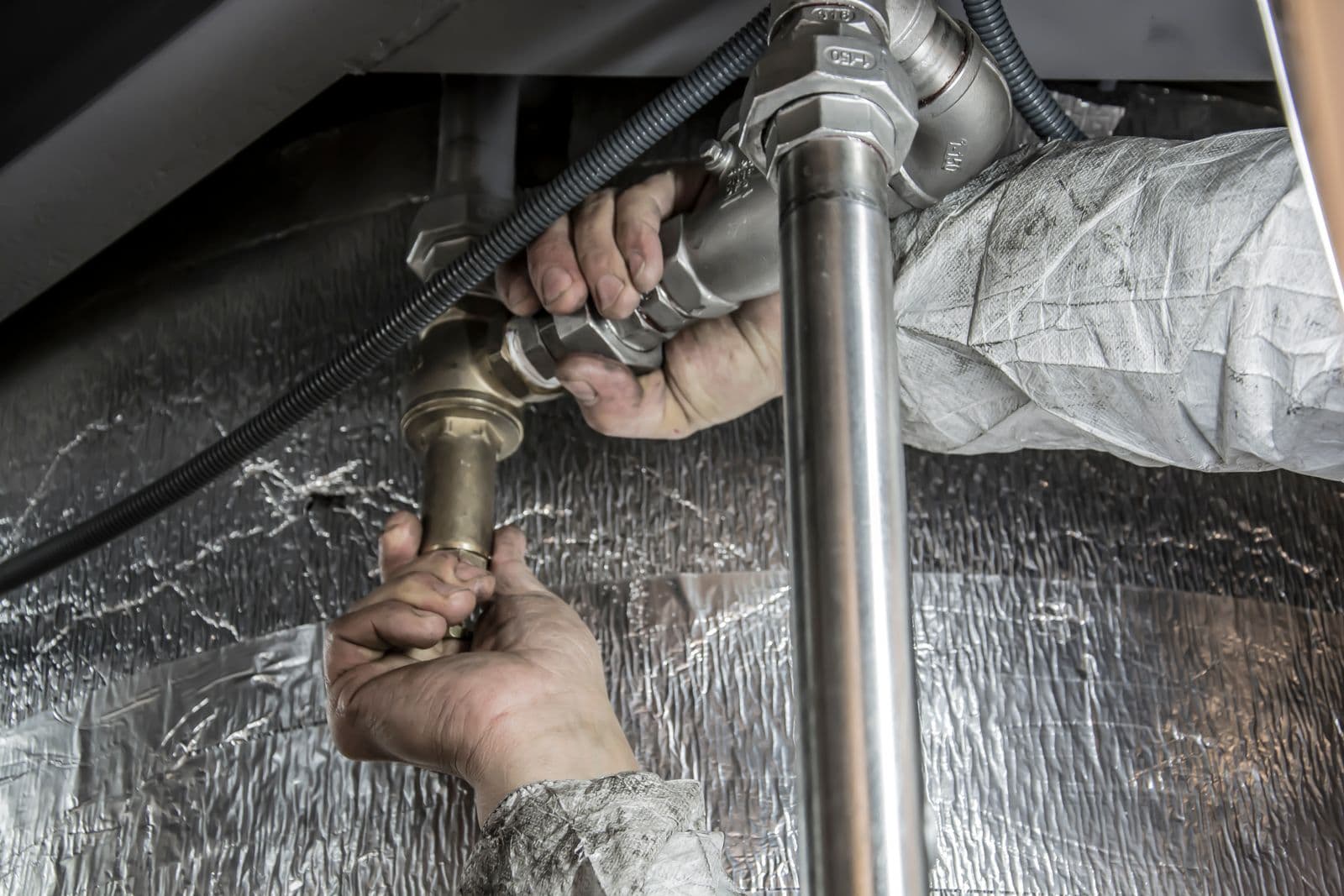
Treatment equipment is plumbing. Most of the job is the connection, the drain and the code detail behind it.


San Diego water, answered plainly
Where does San Diego get its water?+
Mostly from imported water bought from the San Diego County Water Authority, largely a blend of Colorado River and State Water Project water, treated at the City's Alvarado, Miramar or Otay plants. Less than 10% arrives already treated from Metropolitan's Skinner plant, the Twin Oaks Valley plant and the Carlsbad Desalination Plant.
Is San Diego tap water hard?+
Yes. In 2025, average total hardness was 237 to 243 ppm at the three City plants, about 13.8 to 14.2 grains per gallon. Purchased treated water averaged 145 ppm.
Did San Diego's 2025 water meet standards?+
The City's 2025 report states that its tap water met all state and federal drinking water health standards, based on monitoring through 2025.
Is there lead in San Diego water?+
Lead was not detected at the 90th percentile in the 2023 tap sampling of 56 homes, and none exceeded the action level. The City's initial service-line inventory did not identify any lead in the system. Lead can still come from plumbing inside a home.
What is Pure Water San Diego?+
The City's advanced water purification program. The 2025 report says Phase 1 construction is about 90% complete and the project is expected to start delivering purified drinking water in early 2027.
Where do these figures come from?+
From the City of San Diego Public Utilities Department's 2025 Annual Drinking Water Quality Report (public water system 3710020). Third-party aggregators are not used.
Related resources
Home water purification and treatment
The national service page behind this one.
Learn more →Los Angeles water quality
LA Aqueduct and Metropolitan imports, and how hardness shifts with the mix.
Learn more →Yuma water quality
Colorado River water drawn directly, upstream of San Diego's imports.
Learn more →Home battery backup in San Diego
SDG&E's 4–9 p.m. peak and wildfire-season shutoffs.
Learn more →All home services
Water, battery, HVAC and solar under one licensed contractor of record.
Learn more →Get a free test at your tap
A licensed technician tests at your kitchen tap and tells you which findings apply to your house — hardness and scale, dissolved solids or chloramine taste. No charge, no obligation, and coverage confirmed at your address first.
Get a free test