Yuma, Arizona
Yuma Water Quality
Colorado River water from the Yuma Main Canal, treated at two plants. The 2025 report's everyday facts: trihalomethanes one part per billion under the limit, a chlorine dioxide notice at Agua Viva, and sodium of 110 ppm.
TTHM 79 ppb in 2025 — against an 80 ppb limit, with single samples up to 96.
The short answer
Yuma drinks Colorado River water taken from the Yuma Main Canal and treated at the Main Street and Agua Viva plants, under some of the most senior water rights in Arizona.
The 2025 report lists trihalomethanes at 79 ppb against a limit of 80, a June 2025 chlorine dioxide notice at Agua Viva, and sodium of 110 ppm. It prints no hardness figure. If anything here justifies equipment, it is byproducts and taste (carbon) and sodium (reverse osmosis) at the kitchen tap — confirmed by a test, not assumed.
Get a free test
Tell us your Yuma address. We confirm coverage first, then schedule a licensed technician to test at your tap — no charge, no obligation.
What filtration does — and does not
Softening, carbon and reverse osmosis solve different problems. Yuma's report is a byproducts and sodium story, not a hardness purchase order.
Where Yuma water comes from
River water straight from the canal, at the far end of the Colorado — a different starting point from the Phoenix, Tucson and Flagstaff systems.
The Colorado River, under senior rights
The City's report says Yuma's drinking water is supplied by the Colorado River and that the community holds some of the most senior water rights in Arizona, which it credits for reliability during the ongoing drought in the river basin.
Main Street plant: conventional treatment
Raw water is pumped from the Yuma Main Canal, dosed with chlorine dioxide for algae control, coagulated with alum and polymer, settled, and run through dual-media sand and anthracite filters before fluoride and chlorine are added.
Agua Viva plant: membranes or wells
Agua Viva can treat river water, groundwater or a blend. River water goes through ultrafiltration membranes; well water is disinfected and treated for naturally occurring iron and manganese before it reaches storage.
500+ miles of pipe
From the plants, water moves through more than 500 miles of City pipeline. Which plant's water reaches a given house, and how long it has been in the pipe, shapes the disinfection byproduct numbers below.
What the 2025 Yuma report actually says
Limits are fixed. The results next to them are from the City of Yuma's 2025 Water Quality Report — system-level figures, not a reading at your tap. A later report supersedes them.
Trihalomethanes — 79 ppb (limit 80)
The highest locational running annual average for TTHMs was 79 ppb against an MCL of 80, with individual samples from 37 to 96 ppb. The report notes some individual results were above 80 ppb; compliance is judged on the running average, which stayed below the limit.
Chlorine dioxide — June 2025 notice
On June 7, 2025, a sample at the Agua Viva plant showed 1.2 ppm chlorine dioxide against a maximum of 0.8. The City stopped using it; the next day's sample was non-detect. Follow-up distribution samples were taken for chlorite instead of chlorine dioxide, which triggered a Tier 1 notice for failure to monitor.
Sodium — 110 ppm
Sodium was listed at 110 ppm at both the Main Street and Agua Viva plants, from erosion of natural deposits. There is no federal limit for sodium, but it is a number worth knowing for anyone watching sodium intake.
Haloacetic acids and chlorine
HAA5 ran 17 ppb (range 8.7–24.0) against a limit of 60. The chlorine residual averaged 0.57 ppm, with a range of 0.02 to 1.36, against a maximum of 4.
Lead — 1.1 ppb at the 90th percentile
In the 2024 round, lead was 1.1 ppb at the 90th percentile with 0 of 100 homes above the 15 ppb action level (range ND–12); copper was 0.073 ppm. The report says no lead service lines have been identified in the City to date, with inspections continuing.
Arsenic, fluoride, PFAS, lithium
Arsenic 1.1 ppb (Main Street) and 1.7 ppb (Agua Viva) against a limit of 10; fluoride 0.41 and 0.38 ppm, added because Yuma voters mandated it. Federal UCMR5 monitoring found no PFAS; lithium averaged 70.6 ppb at Main Street and 110 ppb at Agua Viva.
Why Yuma is not Phoenix on the river
Phoenix blends Colorado River water from the CAP canal with Salt and Verde water from SRP reservoirs; Tucson recharges its Colorado River water into the aquifer first; and Flagstaff has no river water at all. Yuma treats the river directly, and a long trip through warm pipe gives chlorine more time to react with the river's organic matter. That is why trihalomethanes sit right at the limit here, and why a quote built on another city's report is a quote for the wrong house.
Where these figures come from
Everything on this page traces to the City of Yuma's own annual report. Independent compilations of water quality data exist and are not the source used here.
- City of Yuma — Water Quality Report (2025 report, CY 2025 data) — sources and treatment, regulated substances, disinfection byproducts, lead and copper, UCMR5 and the chlorine dioxide Tier 1 notice.
- City of Yuma — Laboratory — public water system 14024 and how to reach the lab with a water quality question.
Matching treatment to the finding
Yuma's report supports a byproducts-and-taste or sodium conversation at the kitchen tap — not a softener default.
Byproducts and taste: carbon
Trihalomethanes and the chlorine taste that comes with a disinfected river supply are what activated carbon is for, at the kitchen tap or as a whole-house stage. Match the product's certification to TTHM reduction if that is the goal.
Sodium: reverse osmosis at the tap
Carbon does not remove sodium. A kitchen-tap reverse osmosis system does, and the City's own report names home RO as a way to remove chlorine dioxide as well.
Hardness: test, do not assume
The 2025 report does not print a hardness figure, and river water and well water will not share one. A tap test answers it for your house before anyone sizes a softener — and a softener adds sodium, which matters at 110 ppm.
Older homes: the plumbing, not the main
System lead results are low and no lead service lines have been found. The report is clear that household plumbing and fixtures are the remaining source, which a tap test checks directly.
How the free test works
A licensed technician tests at your kitchen tap, walks the plumbing, and tells you which of the findings above applies to your house and which does not. There is no charge and no obligation.
Seamless Home is the licensed contractor of record on the work that follows. Installation is performed by vetted installing partners engaged as our subcontractors, and the workmanship obligation stays with us. Coverage is confirmed per service area rather than promised as blanket availability.
An RO unit needs a legal drain connection — where a water softener is allowed to discharge sets out the indirect-waste rule that applies to treatment drain lines.
What a water treatment job with us covers
Installation and replacement of whole-home and point-of-use treatment, specified against what your water actually contains.
Sediment filtration
Installation of the first stage that protects everything downstream of it, sized to the service line and the household draw.
Softening
Installation of ion-exchange softening where hardness is the problem, including the drain connection the plumbing code treats as indirect waste.
Carbon filtration
Installation of carbon stages for taste, odour and disinfection by-products, specified from your utility's own water quality report.
Reverse osmosis
Point-of-use installation at the kitchen sink where the target is dissolved solids rather than whole-home flow.
Disinfection
Installation of UV or equivalent treatment where the supply is a private well or is otherwise not continuously disinfected.
System replacement
Replacing equipment that has reached the end of its service life, including the discharge and air gap details an inspector looks at.
This is installation and replacement work, specified from a published water quality report or a test of your supply — not from a sales chart. Coverage is confirmed per service area rather than promised as blanket availability.
What the work actually looks like
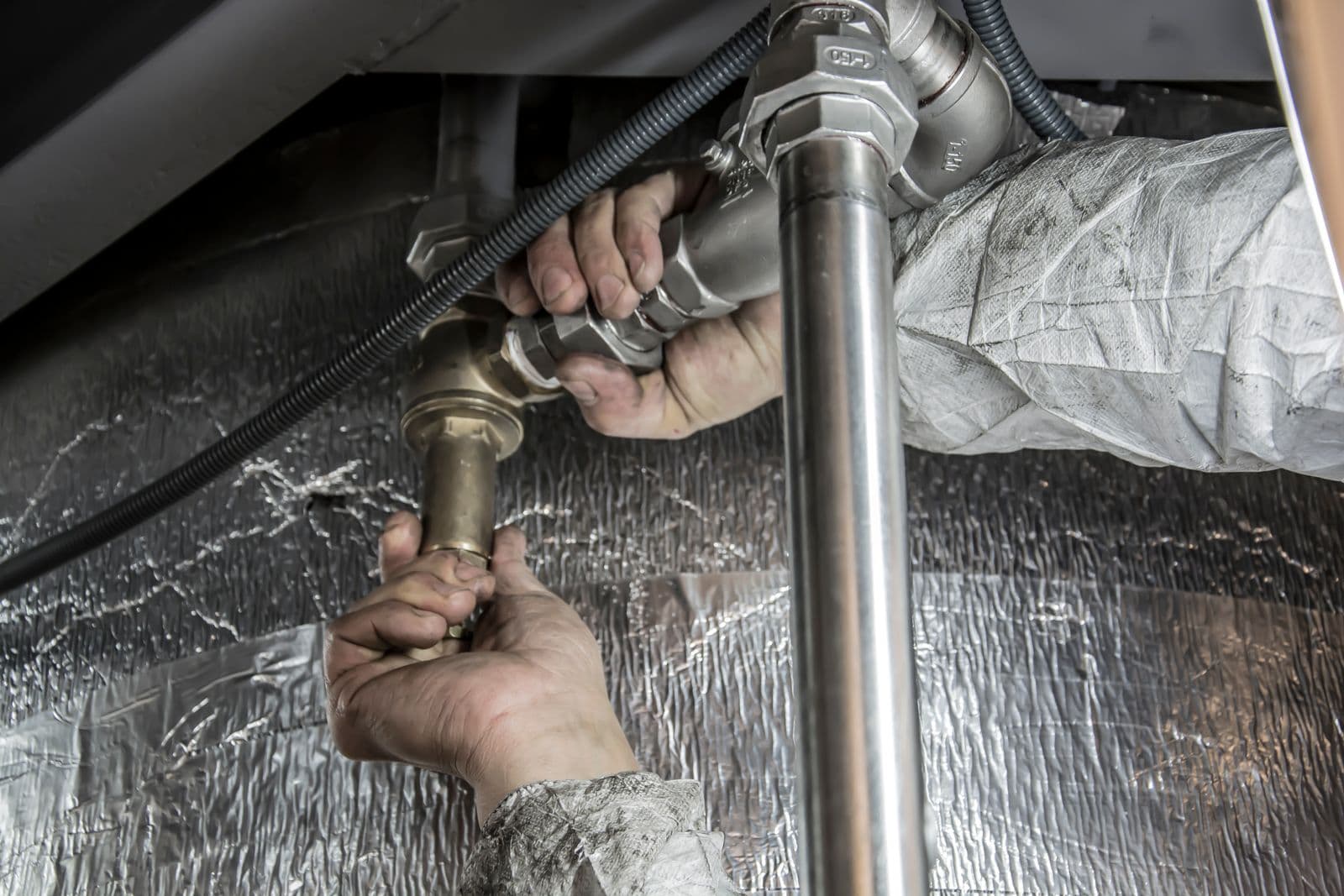
Treatment equipment is plumbing. Most of the job is the connection, the drain and the code detail behind it.

Yuma water, answered plainly
Where does Yuma's water come from?+
The Colorado River. The City of Yuma treats it at the Main Street Water Treatment Facility (conventional filtration, from the Yuma Main Canal) and the Agua Viva Water Treatment Facility, which can treat river water with ultrafiltration membranes, groundwater from wells, or a blend.
Are trihalomethanes a problem in Yuma water?+
Yuma met the standard, but with little room. The City's 2025 report lists a highest locational running annual average of 79 ppb against the 80 ppb limit, and some individual samples reached as high as 96 ppb. Compliance is measured on the running average, so it is not a violation. Activated carbon certified for TTHM reduction is the usual household option.
What was the 2025 chlorine dioxide notice?+
On June 7, 2025, a sample at the Agua Viva plant showed 1.2 ppm chlorine dioxide, above the 0.8 ppm maximum. The City stopped using chlorine dioxide, and a sample the next day was non-detect. Because follow-up samples in the distribution system were taken for chlorite rather than chlorine dioxide, the City had to issue a Tier 1 notice for failure to monitor. It says later monitoring found no chlorine dioxide in the distribution system and that it has changed its procedures.
Why is there so much sodium in Yuma water?+
The 2025 report lists sodium at 110 ppm at both treatment plants, from erosion of natural deposits. There is no federal limit. A kitchen-tap reverse osmosis system reduces sodium; a water softener adds to it.
Is Yuma water hard?+
The 2025 report does not print a hardness figure, so we do not quote one. A tap test at your house is the reliable answer before anyone recommends a softener.
Where do these figures come from?+
The City of Yuma's 2025 Water Quality Report (public water system AZ0414024), which covers January through December 2025. Third-party water-quality aggregators are not the source of the figures on this page. A later report supersedes them.
Related resources
Home water purification and treatment
The national service page behind this one.
Learn more →Home battery backup in Yuma, AZ
APS's record summer peak and the grid batteries already in Yuma.
Learn more →Phoenix water quality
CAP canal and SRP reservoir water in the valley.
Learn more →Tucson water quality
Recharged Colorado River water in southern Arizona.
Learn more →Flagstaff water quality
A mountain system with no river water at all.
Learn more →Where a water softener can discharge
Indirect-waste rules for treatment drain lines.
Learn more →All home services
Water, battery, HVAC and solar under one licensed contractor of record.
Learn more →Get a free test at your tap
A licensed technician tests at your kitchen tap and tells you which of the findings above applies to your house — byproducts, sodium, hardness or none of them. No charge, no obligation, and coverage confirmed at your address first.
Get a free test