Danville, Virginia
Danville Water Quality
Dan River water, treated by the City. The 2025 report prints its EPA PFAS monitoring results, with PFOA at a high of 9.1 ppt, alongside trihalomethanes that range from 39 to 61 ppb depending on where you live.
Dan River · PFOA high 9.1 ppt · TTHM 39–61 ppb by site · hardness 36 mg/L.
The short answer
Danville draws from the Dan River and treats it at the City's own plant. The 2025 report says every regulated substance detected was below its limit. The water is soft, about 36 mg/L hardness, with low sodium.
Two things stand out. The report's EPA UCMR 5 table lists PFOA at a highest result of 9.1 ppt, above the 4.0 ppt limit in EPA's 2024 PFAS rule. That is monitoring data, not a violation. And trihalomethanes ranged from 39 to 61 ppb across four sites. Reverse osmosis at the kitchen tap covers PFAS; carbon covers byproducts. Test first.
Get a free test
Tell us your Danville address. We confirm coverage first, then schedule a licensed technician to test at your tap — no charge, no obligation.
What filtration does — and does not
Softening, carbon and reverse osmosis solve different problems. Danville's report points at RO and carbon, not a softener.
Where Danville water comes from
One river, one City plant.
The Dan River
Danville's only source is the Dan River, a surface water. The Virginia Department of Health's 2002 source water assessment rated it highly susceptible to contamination.
Danville's own treatment plant
The City plant averaged 6.33 million gallons a day in 2025, and its state-certified lab runs more than 4,000 tests a month during treatment.
City mains, and some neighbors
Danville Utilities distributes the water in the city and also supplies small parts of Pittsylvania and Caswell counties.
What the 2025 Danville report actually says
Limits are fixed. Results are from the City of Danville 2025 Water Quality Report. They are system-level figures, not a reading at your tap.
PFOA — highest result 9.1 ppt
In EPA's UCMR 5 monitoring (December 2024 to September 2025), PFOA ranged from 1.3 to 9.1 ng/L (ppt). EPA's 2024 PFAS rule set a 4.0 ppt limit for PFOA. These are monitoring results, not a violation.
Trihalomethanes vary by site
Locational running annual averages were 39 ppb at Piney Forest Tank, 45 at Stokesland Tank, 54 at Lombardy Court and 61 at Holland Road, against an 80 ppb MCL. Levels run higher far out in the system and in summer.
Lead — one of 30 over the action level
2024 tap samples ranged from under 3 ppb to 18 ppb, and one of 30 homes exceeded the 15 ppb action level. Copper: none of 32 over.
Soft water — 36 mg/L hardness
Treated water hardness ranged 20–48 mg/L, averaging 36. Sodium was 8.7 mg/L. A softener isn't what this report calls for.
Cryptosporidium in raw water
Testing from 2016 to 2018 found Cryptosporidium in 2 of 24 raw, untreated river samples. The report says the plant is designed and operated to inactivate 99.9999% of remaining microorganisms.
No regulated violations
The report says all regulated substances detected were below allowed levels. Turbidity peaked at 0.578 NTU, with 99.98% of monthly samples under 0.3 NTU.
Danville next to Lynchburg, Roanoke and Charlottesville
Up US-29, Lynchburg gets gravity-fed water from a mountain reservoir. Roanoke draws on three sources depending on the address, and Charlottesville gets soft RWSA water. Danville's report is the one in this group that prints a PFOA result above EPA's new limit. For the electric side of the same city, see Danville battery backup.
Where these figures come from
Everything on this page traces to the City of Danville and Danville Utilities.
- City of Danville — 2025 Water Quality Report (PDF) — source, treated-water characteristics, regulated results by site, lead and copper, UCMR 5 PFAS and the service-line inventory.
- Danville Utilities — Water Quality Reports archive — where each year's report is posted.
Matching treatment to the finding
Danville's report supports reverse osmosis or certified carbon for PFAS and carbon for byproducts. It does not support a default equipment sale.
Reverse osmosis for PFAS
Under-sink reverse osmosis is the tool that reduces PFOA and other PFAS at the drinking tap. Certified carbon blocks can also reduce PFOA and PFOS.
Carbon for byproducts and taste
Activated carbon reduces trihalomethanes and chlorine taste. It matters most on the Holland Road end of the range.
Check your service line
Danville's inventory uses records and predictive modeling; homes built after 1988 are ruled out. Older homes can look up their line through Danville Utilities.
Test before buying anything
The report's figures are system-level. A tap test tells you whether your plumbing adds lead and what PFAS treatment is worth it.
How the free test works
A licensed technician tests at your kitchen tap, walks the plumbing, and tells you which of the findings above applies to your house and which does not. There is no charge and no obligation.
Seamless Home is the licensed contractor of record on the work that follows. Installation is performed by vetted installing partners engaged as our subcontractors, and the workmanship obligation stays with us. Coverage is confirmed per service area rather than promised as blanket availability.
What a water treatment job with us covers
Installation and replacement of whole-home and point-of-use treatment, specified against what your water actually contains.
Sediment filtration
Installation of the first stage that protects everything downstream of it, sized to the service line and the household draw.
Softening
Installation of ion-exchange softening where hardness is the problem, including the drain connection the plumbing code treats as indirect waste.
Carbon filtration
Installation of carbon stages for taste, odour and disinfection by-products, specified from your utility's own water quality report.
Reverse osmosis
Point-of-use installation at the kitchen sink where the target is dissolved solids rather than whole-home flow.
Disinfection
Installation of UV or equivalent treatment where the supply is a private well or is otherwise not continuously disinfected.
System replacement
Replacing equipment that has reached the end of its service life, including the discharge and air gap details an inspector looks at.
This is installation and replacement work, specified from a published water quality report or a test of your supply — not from a sales chart. Coverage is confirmed per service area rather than promised as blanket availability.
What the work actually looks like
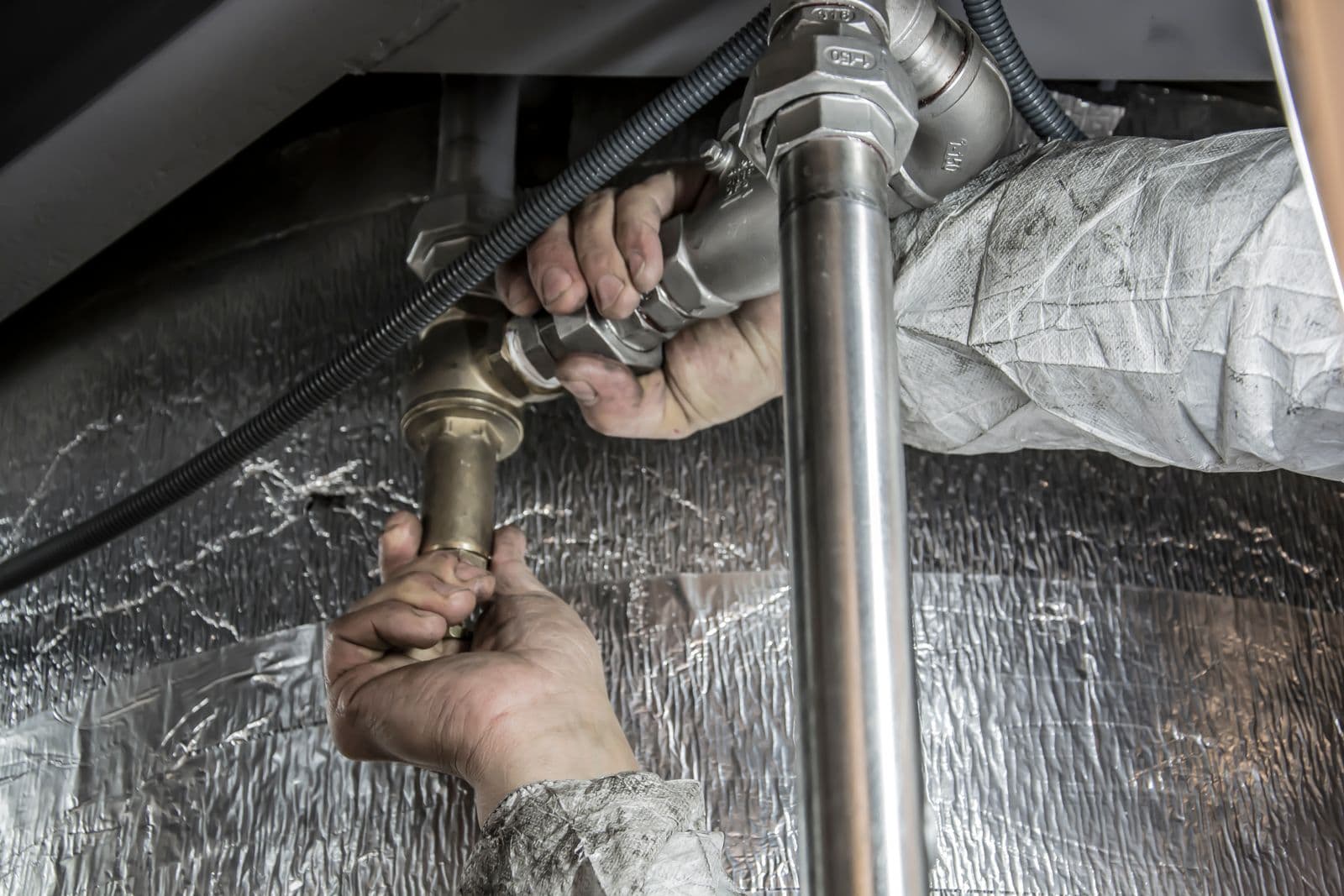
Treatment equipment is plumbing. Most of the job is the connection, the drain and the code detail behind it.


Danville water, answered plainly
Where does Danville's water come from?+
From the Dan River, treated at the City of Danville's water treatment plant. Danville Utilities also supplies small parts of Pittsylvania and Caswell counties.
Is there PFAS in Danville's water?+
The 2025 report's UCMR 5 table lists PFOA with a highest result of 9.1 ng/L (range 1.3 to 9.1) and PFOS at 2.1 ng/L. EPA's 2024 PFAS rule set 4.0 ppt for PFOA. UCMR 5 is monitoring data, not a compliance finding.
Is Danville water hard?+
No. Treated water hardness averaged 36 mg/L (20 to 48), with sodium at 8.7 mg/L.
Did Danville have lead problems?+
The system met the lead rule. In the 2024 sampling, results ranged from under 3 ppb to 18 ppb and one of 30 homes was over the 15 ppb action level. Lead comes mostly from service lines and home plumbing.
Why are trihalomethanes higher in some areas?+
Trihalomethanes form when chlorine reacts with natural organic matter, and they build up the longer water sits in pipes. Danville's four sites ranged from 39 to 61 ppb, all under the 80 ppb limit.
Where do these figures come from?+
The City of Danville 2025 Water Quality Report, published by Danville Utilities. Third-party aggregators are not used.
Related resources
Home water purification and treatment
The national service page behind this one.
Learn more →Lynchburg water quality
Gravity-fed mountain reservoir water with free chlorine.
Learn more →Roanoke water quality
Three sources, depending on your address.
Learn more →Charlottesville water quality
Soft RWSA water with free chlorine.
Learn more →Danville battery backup
Danville Utilities' own grid batteries, and what they can't do for one house.
Learn more →All home services
Water, battery, HVAC and solar under one licensed contractor of record.
Learn more →Get a free test at your tap
A licensed technician tests at your kitchen tap and tells you which findings apply to your house — PFAS, disinfection byproducts or plumbing lead. No charge, no obligation, and coverage confirmed at your address first.
Get a free test