Raleigh, North Carolina
Raleigh Water Quality
Raleigh drinks treated lake water from Falls Lake and Lake Benson. The 2025 report shows soft water, lead not detected at the 90th percentile and disinfection byproducts well under their limits — the disinfectant itself is what most people taste.
Falls Lake + Lake Benson · hardness 25.2 ppm (soft) · lead 90th ND, 0 of 85 over AL · TTHM 34.2 ppb (limit 80) · chloramines avg 2.80 ppm.
The short answer
Raleigh's tap water is treated surface water from Falls Lake in northern Wake County and Lake Benson in Garner. Raleigh Water's 2025 report lists no violations in its tables, a lead 90th percentile of not detected, and total hardness of just 25.2 ppm — soft water.
The disinfection byproducts that drive most filter decisions sit well under their limits: trihalomethanes at 34.2 ppb against 80 and haloacetic acids at 22.0 ppb against 60. Chloramine averaged 2.80 ppm.
Get a free test
Tell us your Raleigh address. We confirm coverage first, then schedule a licensed technician to test at your tap — no charge, no obligation.
What the 2025 Raleigh report shows
System-level results from Raleigh Water's Consumer Confidence Report for reporting year 2025. A later report supersedes them.
Lead: not detected at the 90th percentile
Raleigh Water's 2025 tap sampling put the lead 90th percentile at not detected, with results from non-detect to 4 ppb and none of 85 sites above the 15 ppb action level. Copper's 90th percentile was 0.04 ppm against 1.3. The report says Raleigh Water has never found a lead pipe; lead at a tap typically comes from solder or fixtures.
Soft water: 25.2 ppm hardness
Total hardness averaged 25.2 ppm (21.9 to 35.3) and alkalinity 29.8 ppm. That is soft water, so a whole-house softener is rarely the first thing a Raleigh test points to.
Chloramine and chlorine
The report lists chloramines at an average of 2.80 ppm (0.02 to 4.00) and chlorine at 2.26 ppm (0.09 to 3.95), both against a 4 ppm limit. Disinfectant taste and odor is the most common reason Raleigh households filter.
Byproducts well under limits
Total trihalomethanes measured 34.2 ppb (range 7.60 to 42.8) against an 80 ppb limit, and haloacetic acids 22.0 ppb (4.28 to 33.6) against 60. No violations are listed for either.
Sodium, pH and sulfate
Sodium measured 24.3 ppm in January 2025 sampling. pH averaged 8.40 and sulfate 46.3 ppm, against a 250 ppm secondary standard.
Both lakes rated high susceptibility
North Carolina DEQ's source water assessment (September 9, 2020) rated both Falls Lake and Lake Benson as higher susceptibility to potential contaminant sources. Raleigh's watershed program has permanently protected more than 11,000 acres and 120 miles of streams.
Where the water comes from
Two reservoirs, both surface water.
Falls Lake
The main reservoir, in northern Wake County. DEQ's 2020 source water assessment rated it higher susceptibility to potential contaminant sources.
Lake Benson
The second source, in Garner. It carries the same higher susceptibility rating, which is why upstream watershed protection is part of Raleigh Water's program.
Water and power in Raleigh
If you are also weighing backup power, our Raleigh battery backup page covers Duke Energy Progress's time-of-use rates and Critical Peak Days. Next door, Durham is on the same utility.
Soft water shapes the treatment conversation. Like Columbia, SC, which draws on the Broad River and Lake Murray, Raleigh's question is mostly taste, disinfectant and what the home's own plumbing adds — not scale.
Where these figures come from
Everything on this page traces to the City of Raleigh Annual Water Quality Report for reporting year 2025 (PWS ID NC0392010), published by Raleigh Water.
- Raleigh Water — Annual Water Quality Report, Reporting Year 2025 (PDF)
- Raleigh Water Reports — current and previous Consumer Confidence Reports.
- Raleigh Water — PFAS data and information — the utility's voluntary PFAS testing results.
Matching treatment to the finding
Taste and disinfectant drive most Raleigh decisions, not hardness.
Catalytic carbon for chloramine
Chloramine is harder for ordinary carbon to remove than free chlorine. A catalytic carbon filter, at the kitchen tap or for the whole house, is the usual choice when disinfectant taste or odor is the complaint.
Reverse osmosis for drinking water
Point-of-use reverse osmosis reduces dissolved solids, byproducts and most other substances in the report for drinking and cooking water.
Softening is usually unnecessary
At 25.2 ppm hardness, Raleigh water is soft. Test first; a softener is rarely the right first purchase here.
PFAS: read the utility's data
Raleigh Water publishes voluntary PFAS results on a dedicated page. If PFAS is your concern, reverse osmosis is the treatment most often certified to reduce it.
How the free test works
A licensed technician tests at your kitchen tap, walks the plumbing, and tells you which of the findings above applies to your house and which does not. There is no charge and no obligation.
Seamless Home is the licensed contractor of record on the work that follows. Installation is performed by vetted installing partners engaged as our subcontractors, and the workmanship obligation stays with us. Coverage is confirmed per service area rather than promised as blanket availability.
What a water treatment job with us covers
Installation and replacement of whole-home and point-of-use treatment, specified against what your water actually contains.
Sediment filtration
Installation of the first stage that protects everything downstream of it, sized to the service line and the household draw.
Softening
Installation of ion-exchange softening where hardness is the problem, including the drain connection the plumbing code treats as indirect waste.
Carbon filtration
Installation of carbon stages for taste, odour and disinfection by-products, specified from your utility's own water quality report.
Reverse osmosis
Point-of-use installation at the kitchen sink where the target is dissolved solids rather than whole-home flow.
Disinfection
Installation of UV or equivalent treatment where the supply is a private well or is otherwise not continuously disinfected.
System replacement
Replacing equipment that has reached the end of its service life, including the discharge and air gap details an inspector looks at.
This is installation and replacement work, specified from a published water quality report or a test of your supply — not from a sales chart. Coverage is confirmed per service area rather than promised as blanket availability.
What the work actually looks like
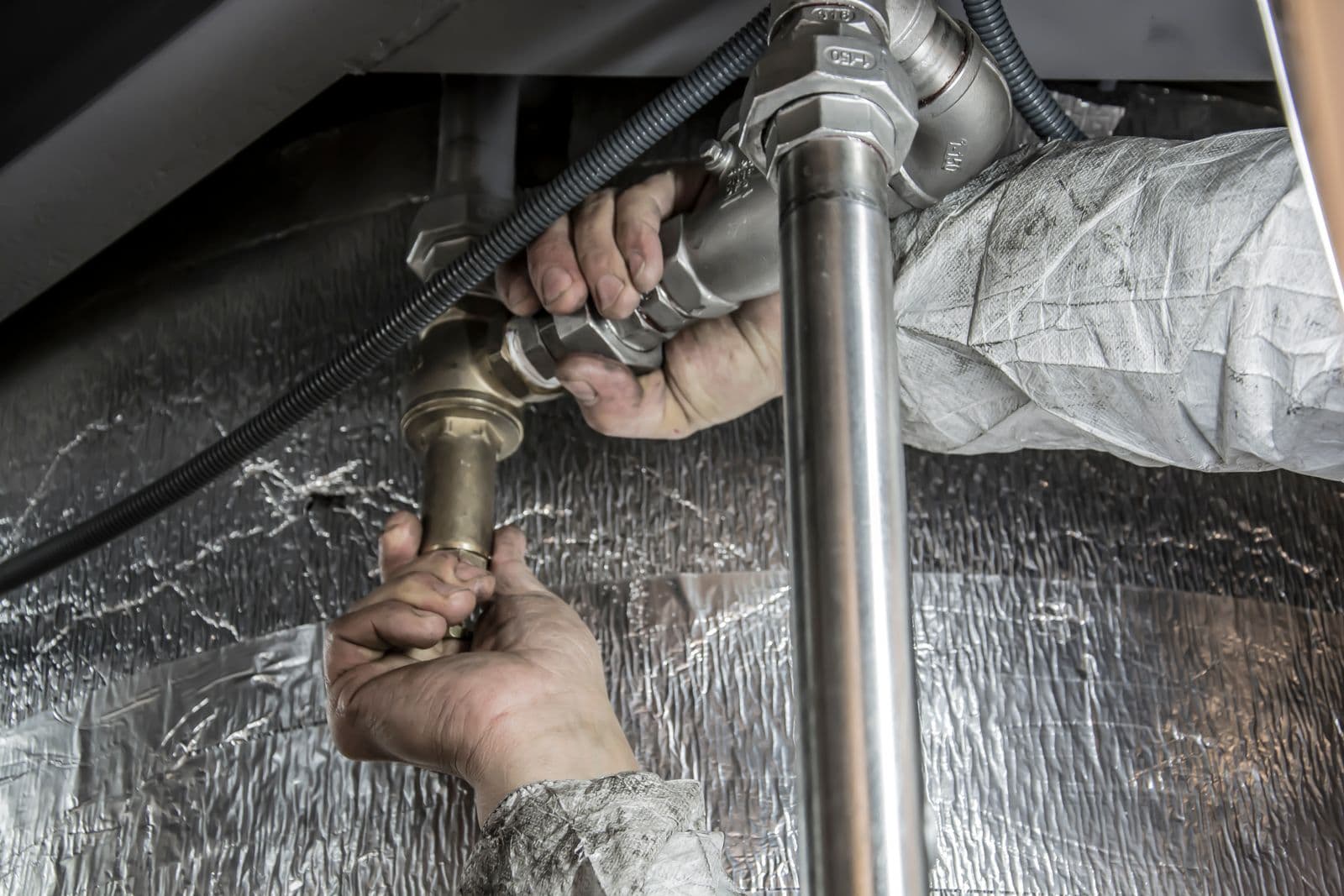
Treatment equipment is plumbing. Most of the job is the connection, the drain and the code detail behind it.
Raleigh water, answered plainly
Where does Raleigh get its water?+
From Falls Lake, in northern Wake County, and Lake Benson, in Garner. Raleigh Water treats it at two water treatment plants and serves about 650,000 residents, including Garner, Wake Forest, Rolesville, Knightdale, Wendell and Zebulon.
Is Raleigh tap water safe to drink?+
Raleigh Water's 2025 report lists no violations for the substances it detected. Trihalomethanes measured 34.2 ppb against an 80 ppb limit and haloacetic acids 22.0 ppb against 60.
Is Raleigh water hard or soft?+
Soft. The 2025 report lists total hardness averaging 25.2 ppm, with a range of 21.9 to 35.3 ppm.
Is there lead in Raleigh water?+
The 2025 lead 90th percentile was not detected, with results up to 4 ppb and none of 85 sites above the action level. Raleigh Water says it has never found a lead pipe, though lead solder and fixtures inside a home can still add lead.
Why does Raleigh water taste like chlorine?+
Raleigh disinfects with chlorine and chloramine; the 2025 report lists chloramines averaging 2.80 ppm. A catalytic carbon filter is the usual fix for the taste.
Where do these figures come from?+
From the City of Raleigh Annual Water Quality Report for reporting year 2025 (PWS ID NC0392010). Third-party aggregators are not used.
Related resources
Home water purification and treatment
The national service page behind this one.
Learn more →Raleigh battery backup
Duke Energy Progress TOU rates and Critical Peak Days.
Learn more →Durham battery backup
Duke Energy Progress next door.
Learn more →Columbia, SC water quality
Another soft-water lake and river supply.
Learn more →All home services
Water, battery, HVAC and solar under one licensed contractor of record.
Learn more →Get a free test at your tap
A licensed technician tests at your kitchen tap and tells you which Raleigh findings apply to your house — chloramine, disinfection byproducts or lead from fixtures. No charge, no obligation, and coverage confirmed at your address first.
Get a free test