Prescott, Arizona
Prescott, AZ Water Quality
All groundwater from seven deep wells. Prescott met every standard in 2025, and its highest arsenic reading was 10 ppb, exactly the federal limit.

Arsenic 2.6–10 ppb (limit 10) · TTHM max 6.3 ppb · PFOA 10 ppt and PFOS 9 ppt in 2023 UCMR 5 sampling.
The short answer
Prescott's water is 100% groundwater from seven deep wells in the Little Chino Sub-Basin. The City reports that it met every federal and state health standard in 2025.
The number to know is arsenic: readings from 2.6 to 10 ppb, against a 10 ppb limit. Arsenic comes naturally from the volcanic and granitic rock the groundwater moves through. The City manages it by blending wells and with adsorptive media on one well. Reverse osmosis at the kitchen tap is the standard way to take it lower at home.
Get a free test
Tell us your Prescott address. We confirm coverage first, then schedule a licensed technician to test at your tap — no charge, no obligation.
What filtration does — and does not
Carbon, catalytic carbon and reverse osmosis solve different problems. Prescott's report points at arsenic, which carbon alone does not remove.
Where Prescott water comes from
One aquifer, seven wells, City pipes.
Seven deep production wells
The City pumps from seven wells drilled into the confined Lower Volcanic Unit of the aquifer under the Little Chino Sub-Basin, inside the Prescott Active Management Area.
Blending and adsorptive media
An ADEQ-approved blending plan mixes wells with different arsenic levels. One well that can't be blended has an adsorptive-media treatment system. All water is chlorinated.
A large, hilly system
About 27,231 connections, 572 miles of pipeline, 35 booster pump stations and 26 storage tanks. Prescott pumped 7,292 acre-feet in 2025, an average of 6.51 million gallons a day.
What the 2025 Prescott report actually says
Limits are fixed. Results are from the City of Prescott Water Quality Report for Reporting Year 2025. They are system-level figures, not a reading at your tap.
Arsenic 2.6–10 ppb (limit 10)
The highest 2025 result equalled the 10 ppb limit. The City samples arsenic 10 times a month and reports no violation. A reading at the limit meets the standard.
Byproducts near zero
Total trihalomethanes ranged from 3.6 to 6.3 ppb (limit 80) and haloacetic acids were not detected. Groundwater carries little of the organic matter that forms them.
Chlorine up to 1.7 ppm
The disinfectant residual ranged from 0.23 to 1.7 ppm against a 4 ppm limit.
PFAS found in 2023 sampling
EPA's UCMR 5 sampling in November 2023 found PFOA at 0.01 µg/L (10 ppt) and PFOS at 0.009 µg/L (9 ppt), plus lithium at 16.1 µg/L. These were unregulated monitoring results.
Nitrate 1.07–1.98 ppm
Well under the 10 ppm limit. Fluoride was up to 0.29 ppm and sodium 14 ppm.
Lead: 0 of 30 homes over
June 2025 tap samples put lead under 5.0 ppb at the 90th percentile, with no home over the 15 ppb action level. Copper was 0.046 ppm.
Prescott next to Flagstaff and Lake Havasu City
Flagstaff mixes surface water and wells, and Lake Havasu City draws Colorado River water through wells. Prescott is groundwater only, which keeps its byproducts low and puts arsenic at the center of the report.
The report also lists two paperwork notices for 2025: second-quarter arsenic results reached ADEQ late, and so did the certification for lead service line notices. The City says both were filed and did not affect water quality.
Where these figures come from
Everything on this page traces to the City of Prescott.
- City of Prescott — Water Quality Report, Reporting Year 2025 (PDF) — source wells, treatment, arsenic, byproducts, PFAS sampling, lead and copper, and the 2025 reporting notices.
- City of Prescott — Water Quality Report page — release of the 2025 report and how to request a copy.
Matching treatment to the finding
Prescott's report supports arsenic reduction at the tap. It does not support a carbon-only system.
Reverse osmosis for arsenic
An under-sink RO system certified for arsenic reduction is the direct answer to a report that peaks at the limit. It also reduces PFAS and nitrate.
Choose certified equipment
Look for a system certified to NSF/ANSI 58 for arsenic reduction, and keep up with membrane and pre-filter changes so it keeps performing.
Carbon is for taste here
Byproducts are low, so a whole-house carbon stage in Prescott mostly addresses chlorine taste and smell.
Test at the tap first
The City blends different wells to meet demand, so a test at your kitchen tap shows what your house actually gets.
How the free test works
A licensed technician tests at your kitchen tap, walks the plumbing, and tells you which of the findings above applies to your house and which does not. There is no charge and no obligation.
Seamless Home is the licensed contractor of record on the work that follows. Installation is performed by vetted installing partners engaged as our subcontractors, and the workmanship obligation stays with us. Coverage is confirmed per service area rather than promised as blanket availability.
What a water treatment job with us covers
Installation and replacement of whole-home and point-of-use treatment, specified against what your water actually contains.
Sediment filtration
Installation of the first stage that protects everything downstream of it, sized to the service line and the household draw.
Softening
Installation of ion-exchange softening where hardness is the problem, including the drain connection the plumbing code treats as indirect waste.
Carbon filtration
Installation of carbon stages for taste, odour and disinfection by-products, specified from your utility's own water quality report.
Reverse osmosis
Point-of-use installation at the kitchen sink where the target is dissolved solids rather than whole-home flow.
Disinfection
Installation of UV or equivalent treatment where the supply is a private well or is otherwise not continuously disinfected.
System replacement
Replacing equipment that has reached the end of its service life, including the discharge and air gap details an inspector looks at.
This is installation and replacement work, specified from a published water quality report or a test of your supply — not from a sales chart. Coverage is confirmed per service area rather than promised as blanket availability.
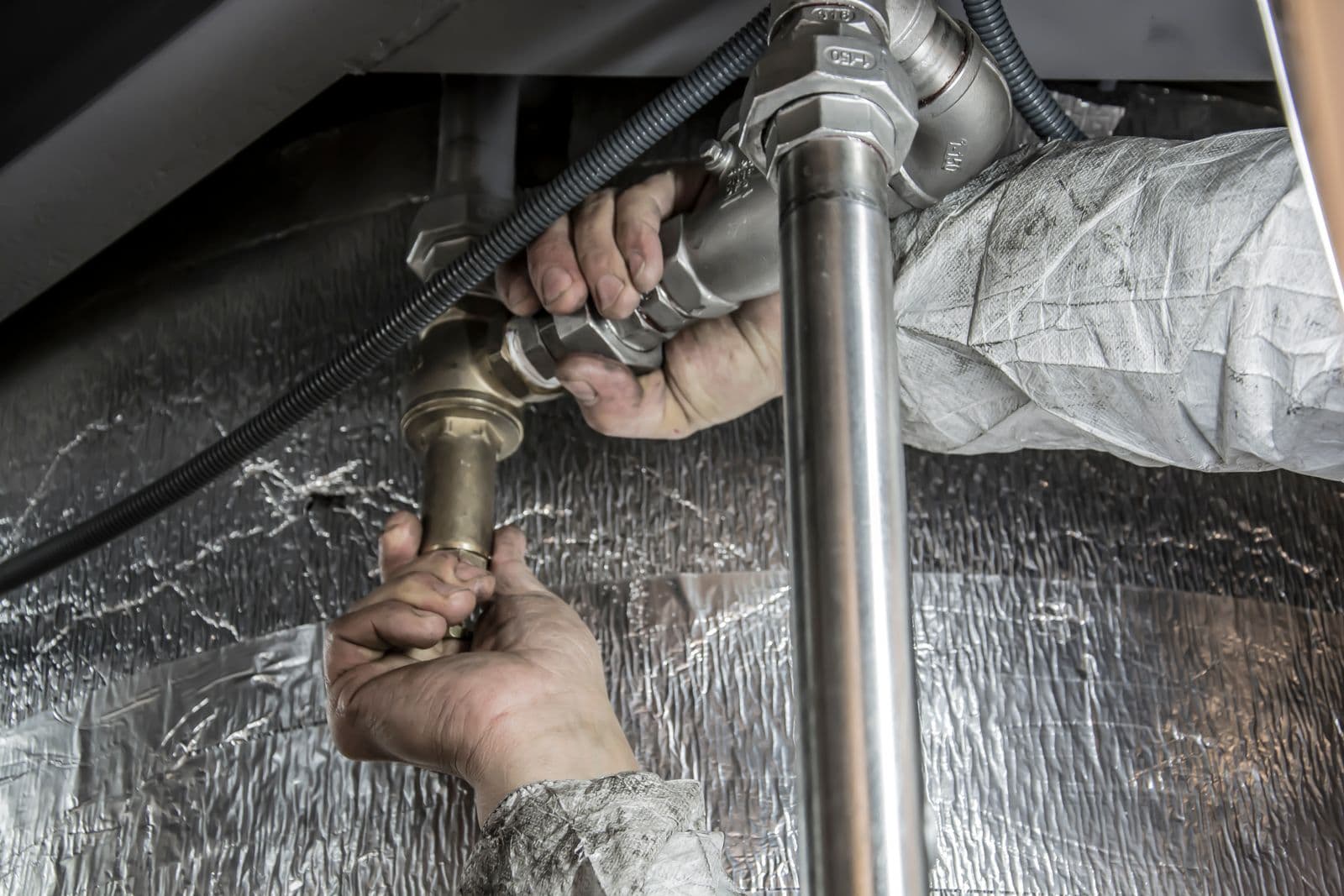
What the work actually looks like
Treatment equipment is plumbing. Most of the job is the connection, the drain and the code detail behind it.


Prescott water, answered plainly
Where does Prescott's water come from?+
Groundwater only. The City pumps from seven deep wells in the Little Chino Sub-Basin, treats it and delivers it through 572 miles of pipeline, 35 booster stations and 26 storage tanks.
Is there arsenic in Prescott's water?+
Yes, naturally. The 2025 report shows arsenic from 2.6 to 10 ppb against a 10 ppb limit, with no violation. The City manages it with an ADEQ-approved blending plan and adsorptive media on one well.
Is Prescott's water safe to drink?+
The City reports that it met all applicable federal and state health standards in 2025. Some homeowners add reverse osmosis because the highest arsenic reading equalled the limit.
Is there PFAS in Prescott's water?+
EPA's UCMR 5 sampling in November 2023 found PFOA at 10 ppt and PFOS at 9 ppt. The report lists these as unregulated monitoring results.
Is Prescott's water hard?+
The 2025 report does not publish a hardness figure, so we don't quote one. A tap test measures it before anyone recommends a softener.
Where do these figures come from?+
From the City of Prescott Water Quality Report for Reporting Year 2025, issued by Water Operations. Third-party aggregators are not used.
Related resources
Home water purification and treatment
The national service page behind this one.
Learn more →Flagstaff water quality
Another northern Arizona system.
Learn more →Lake Havasu City water quality
Colorado River water drawn through wells.
Learn more →Bullhead City water quality
Another Arizona groundwater system.
Learn more →All home services
Water, battery, HVAC and solar under one licensed contractor of record.
Learn more →Get a free test at your tap
A licensed technician tests at your kitchen tap and tells you which findings apply to your house — arsenic, chlorine taste or your own plumbing. No charge, no obligation, and coverage confirmed at your address first.
Get a free test