Lake Havasu City, Arizona
Lake Havasu City Water Quality
Colorado River Aquifer groundwater from City wells, treated to strip manganese and arsenic. What reaches the tap is still 19 grains per gallon hard, with 753 ppm dissolved solids and 150 ppm sodium.
Hardness 19 gpg · TDS 753 ppm · sodium 150 ppm · arsenic 4.1 ppb · TTHM 59.44 ppb.
The short answer
Lake Havasu City pumps groundwater from the Colorado River Aquifer and runs it through a plant designed to remove manganese and reduce arsenic, which averaged 4.1 ppb against a 10 ppb limit. The 2025 report lists no violations.
What treatment doesn't change is the mineral load. Hardness averaged 19 grains per gallon, total dissolved solids 753 ppm (EPA's secondary guideline is 500) and sodium 150 ppm. In this city that points to a softener for scale and reverse osmosis at the kitchen tap, after a test.
Get a free test
Tell us your Lake Havasu City address. We confirm coverage first, then schedule a licensed technician to test at your tap — no charge, no obligation.
What filtration does — and does not
Softening, carbon and reverse osmosis solve different problems. Lake Havasu City's report points at a softener and RO.
Where Lake Havasu City water comes from
River-connected groundwater, treated by the City.
Colorado River Aquifer wells
The City draws groundwater from the Colorado River Aquifer under an allocation of 28,581 acre-feet a year. Its 11 wells, led by a horizontal collector well, can produce 45 million gallons a day.
A plant built for manganese and arsenic
The treatment plant, designed for 26 million gallons a day, averaged 12.4 in 2025. It removed about 31,580 pounds of manganese sludge last year and lowers arsenic below the federal limit, then disinfects with UV and chlorine.
538 miles of main, 14 pressure zones
Water reaches just over 33,000 services through 538 miles of pipe and 27 storage tanks holding 22.4 million gallons.
What the 2025 Lake Havasu City report actually says
Limits are fixed. Results are from the Lake Havasu City 2025 Annual Drinking Water Quality Report, published June 2026. They are system-level figures, not a reading at your tap.
Hardness — 19 grains per gallon
Total hardness averaged 19 grains per gallon (18–20). That is calcium and magnesium from the source. It is not a health standard, but it is what shows up as scale on fixtures and water heaters.
Total dissolved solids — 753 ppm
TDS averaged 753 ppm (702–787), above EPA's non-enforceable secondary guideline of 500 ppm. High TDS shows up as taste and spotting.
Sodium — 150 ppm
Sodium was 150 ppm in the most recent sampling (January 2023). There is no MCL for sodium, but it matters for anyone on a low-sodium diet.
Arsenic — 4.1 ppb after treatment
The running annual average was 4.1 ppb (3.4–4.9) against the 10 ppb MCL. Arsenic occurs naturally here; the plant is what keeps it under the limit.
Trihalomethanes — 59.44 ppb
The TTHM running annual average was 59.44 ppb (52–67) against an 80 ppb MCL. Haloacetic acids were 8.01 ppb. No violation.
Two PFAS at low levels
2025 sampling for 29 PFAS detected two: PFBS averaging 2.5 ppt and PFOS averaging 2.4 ppt (2.2–2.6). The other 27 were not detected.
Lake Havasu City next to Yuma, Flagstaff and Phoenix
Downriver, Yuma takes Colorado River water from the Yuma Main Canal, and its main issue is trihalomethanes near the limit. Flagstaff switches between a lake, mountain springs and wells by season, and Phoenix blends canal and reservoir water. Lake Havasu City's report stands out for minerals: hardness, dissolved solids and sodium. For the electric side of the same city, see Lake Havasu City battery backup.
Where these figures come from
Everything on this page traces to Lake Havasu City.
- Lake Havasu City — 2025 Annual Drinking Water Quality Report (published June 2026, PDF) — source, treatment plant, regulated results, PFAS sampling, hardness and TDS.
- Lake Havasu City — Water Division — the collector well and UV and chlorine disinfection.
Matching treatment to the finding
Lake Havasu City's report supports a softener for scale and RO for drinking water. It does not support a default equipment sale.
A softener for 19 grains
At 19 grains per gallon, a whole-house softener is the tool that stops scale. Softening adds sodium, so it pairs with a drinking-water stage.
Reverse osmosis at the kitchen tap
Under-sink reverse osmosis reduces TDS, sodium, residual arsenic and PFAS, the four drinking-water findings in this report.
Carbon for byproducts and taste
Activated carbon reduces trihalomethanes and chlorine taste. A whole-house unit covers showers as well.
Test before buying anything
The City's figures are system-level. A tap test confirms hardness and TDS in your house and checks your plumbing for lead and copper.
How the free test works
A licensed technician tests at your kitchen tap, walks the plumbing, and tells you which of the findings above applies to your house and which does not. There is no charge and no obligation.
Seamless Home is the licensed contractor of record on the work that follows. Installation is performed by vetted installing partners engaged as our subcontractors, and the workmanship obligation stays with us. Coverage is confirmed per service area rather than promised as blanket availability.
What a water treatment job with us covers
Installation and replacement of whole-home and point-of-use treatment, specified against what your water actually contains.
Sediment filtration
Installation of the first stage that protects everything downstream of it, sized to the service line and the household draw.
Softening
Installation of ion-exchange softening where hardness is the problem, including the drain connection the plumbing code treats as indirect waste.
Carbon filtration
Installation of carbon stages for taste, odour and disinfection by-products, specified from your utility's own water quality report.
Reverse osmosis
Point-of-use installation at the kitchen sink where the target is dissolved solids rather than whole-home flow.
Disinfection
Installation of UV or equivalent treatment where the supply is a private well or is otherwise not continuously disinfected.
System replacement
Replacing equipment that has reached the end of its service life, including the discharge and air gap details an inspector looks at.
This is installation and replacement work, specified from a published water quality report or a test of your supply — not from a sales chart. Coverage is confirmed per service area rather than promised as blanket availability.
What the work actually looks like
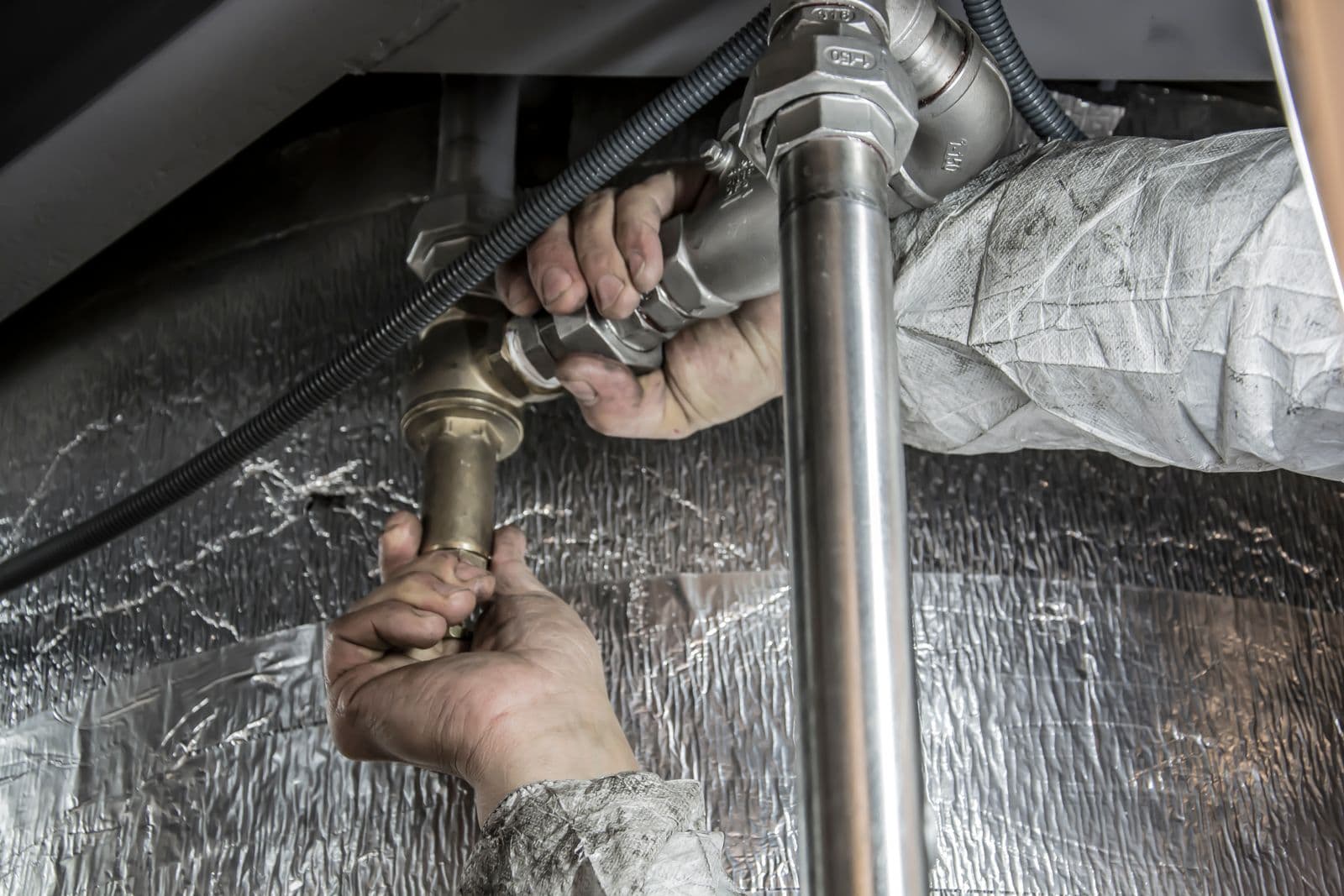
Treatment equipment is plumbing. Most of the job is the connection, the drain and the code detail behind it.

Lake Havasu City water, answered plainly
Where does Lake Havasu City's water come from?+
From the Colorado River Aquifer, through 11 City wells and mainly a horizontal collector well. It is treated at the City's plant to remove manganese and reduce arsenic, then disinfected with UV and chlorine.
How hard is Lake Havasu City water?+
The 2025 report lists total hardness at an average of 19 grains per gallon, ranging from 18 to 20. Total dissolved solids averaged 753 ppm against EPA's 500 ppm secondary guideline.
Is there arsenic in Lake Havasu City water?+
Yes, at low levels. The running annual average was 4.1 ppb (3.4 to 4.9) against the 10 ppb federal limit, after treatment designed to reduce it.
Is there PFAS in Lake Havasu City water?+
Sampling from March to December 2025 for 29 PFAS detected PFBS (average 2.5 ppt) and PFOS (average 2.4 ppt). The other 27 compounds were not detected.
Does this report cover my address?+
It covers the Lake Havasu City system (AZ 04-08-022). If your water bill comes from EPCOR instead of the City, a different report applies.
Where do these figures come from?+
The Lake Havasu City 2025 Annual Drinking Water Quality Report, published June 2026. Third-party aggregators are not used.
Related resources
Home water purification and treatment
The national service page behind this one.
Learn more →Yuma water quality
Colorado River canal water with trihalomethanes near the limit.
Learn more →Flagstaff water quality
Lake, springs and wells that change by season.
Learn more →Phoenix water quality
Canal and reservoir surface water.
Learn more →Lake Havasu City battery backup
UNS Electric's R-Tech pilot and on-peak demand billing.
Learn more →All home services
Water, battery, HVAC and solar under one licensed contractor of record.
Learn more →Get a free test at your tap
A licensed technician tests at your kitchen tap and tells you which findings apply to your house — hardness, dissolved solids, sodium or arsenic. No charge, no obligation, and coverage confirmed at your address first.
Get a free test