Flint, Michigan
Flint Water Quality
Lake Huron water via GLWA. The 2025 report keeps lead under Michigan's action level while 628 lead service lines remain on the inventory.
GLWA Lake Huron · lead 90th pct 3 and 6 ppb · 628 lead lines left · PFAS ND at the plant · TTHM 30.5 ppb.
The short answer
Flint's drinking water comes from Lake Huron via the Great Lakes Water Authority. The 2025 report shows lead at 3 ppb then 6 ppb at the 90th percentile in the two monitoring periods, under Michigan's 12 ppb action level.
The March 31, 2026 inventory still listed 628 lead service lines and 205 of unknown composition. PFAS samples at the GLWA Lake Huron plant were not detectable.
Get a free test
Tell us your Flint address. We confirm coverage first, then schedule a licensed technician to test at your tap — no charge, no obligation.
What filtration does — and does not
Remaining lead service lines are still the main reason Flint homeowners keep a certified filter at the tap.
Where Flint water comes from
Source and inventory named in the City of Flint's 2025 Water Quality Report.
Lake Huron via GLWA
Flint's primary source is the lower Lake Huron watershed, treated at the Great Lakes Water Authority Lake Huron Water Treatment Plant.
Genesee County as a secondary plant
The report also lists the Genesee County Drain Commission Lake Huron plant as a secondary source with its own monitoring tables.
Service lines still being finished
As of March 31, 2026 the Complete Distribution System Inventory counted 33,341 lines replaced or confirmed copper, 628 lead service lines and 205 of unknown composition.
What the 2025 data actually says
Limits are fixed. Results are system figures from the City's tables, not a reading at your tap.
Lead: 3 ppb, then 6 ppb
In January–June 2025 the 90th percentile was 3 ppb (0 sites over Michigan's 12 ppb action level). In July–December 2025 it was 6 ppb, with 2 sites over the action level.
Copper stayed low
Copper's 90th percentile was 0.1 ppm in both 2025 periods against a 1.3 ppm action level, with no sites above it.
628 lead service lines left
After the inventory cutoff of March 31, 2026, Flint reported 628 lead service lines and 205 unknown lines still on the books.
TTHMs 30.5 ppb, HAA5 17.9 ppb
In the City of Flint distribution system, total trihalomethanes had a running annual average of 30.475 ppb (12.6–57.3) and haloacetic acids 17.875 ppb (9–32). No violation.
PFAS not detected at GLWA
The report says 2025 PFAS samples from the GLWA Lake Huron plant showed not detectable (ND).
Fluoride and nitrate at the plant
At GLWA Lake Huron, fluoride was 0.58 ppm and nitrate 0.33 ppm on the February 11, 2025 sample date shown in the report.
Flint next to Detroit, Lansing and Kalamazoo
Where these figures come from
Lead, copper, byproducts and inventory figures trace to the City of Flint's 2025 annual report; the six-month lead series is also published by the State of Michigan.
Matching treatment to the finding
Remaining lead service lines are the usual reason Flint homeowners keep treatment at the tap.
State-provided filters during construction
Officials recommend residents use state-provided filters where service-line construction is underway. Keep using a certified lead filter if your line is lead or unknown.
Point-of-use RO for extra assurance
Under-sink reverse osmosis adds a barrier at the drinking tap beyond the city's corrosion control and filter program.
Flush before you drink if you have lead plumbing
The report repeats the usual lead advice: use cold water, flush before drinking or cooking, and never boil water to remove lead.
Know your service line status
With 628 lead lines and 205 unknowns still listed, confirm your address before you decide what treatment you need.
How the free test works
A licensed technician tests at your kitchen tap, walks the plumbing, and tells you which of the findings above applies to your house and which does not. There is no charge and no obligation.
Seamless Home is the licensed contractor of record on the work that follows. Installation is performed by vetted installing partners engaged as our subcontractors, and the workmanship obligation stays with us. Coverage is confirmed per service area rather than promised as blanket availability.
What a water treatment job with us covers
Installation and replacement of whole-home and point-of-use treatment, specified against what your water actually contains.
Sediment filtration
Installation of the first stage that protects everything downstream of it, sized to the service line and the household draw.
Softening
Installation of ion-exchange softening where hardness is the problem, including the drain connection the plumbing code treats as indirect waste.
Carbon filtration
Installation of carbon stages for taste, odour and disinfection by-products, specified from your utility's own water quality report.
Reverse osmosis
Point-of-use installation at the kitchen sink where the target is dissolved solids rather than whole-home flow.
Disinfection
Installation of UV or equivalent treatment where the supply is a private well or is otherwise not continuously disinfected.
System replacement
Replacing equipment that has reached the end of its service life, including the discharge and air gap details an inspector looks at.
This is installation and replacement work, specified from a published water quality report or a test of your supply — not from a sales chart. Coverage is confirmed per service area rather than promised as blanket availability.
What the work actually looks like
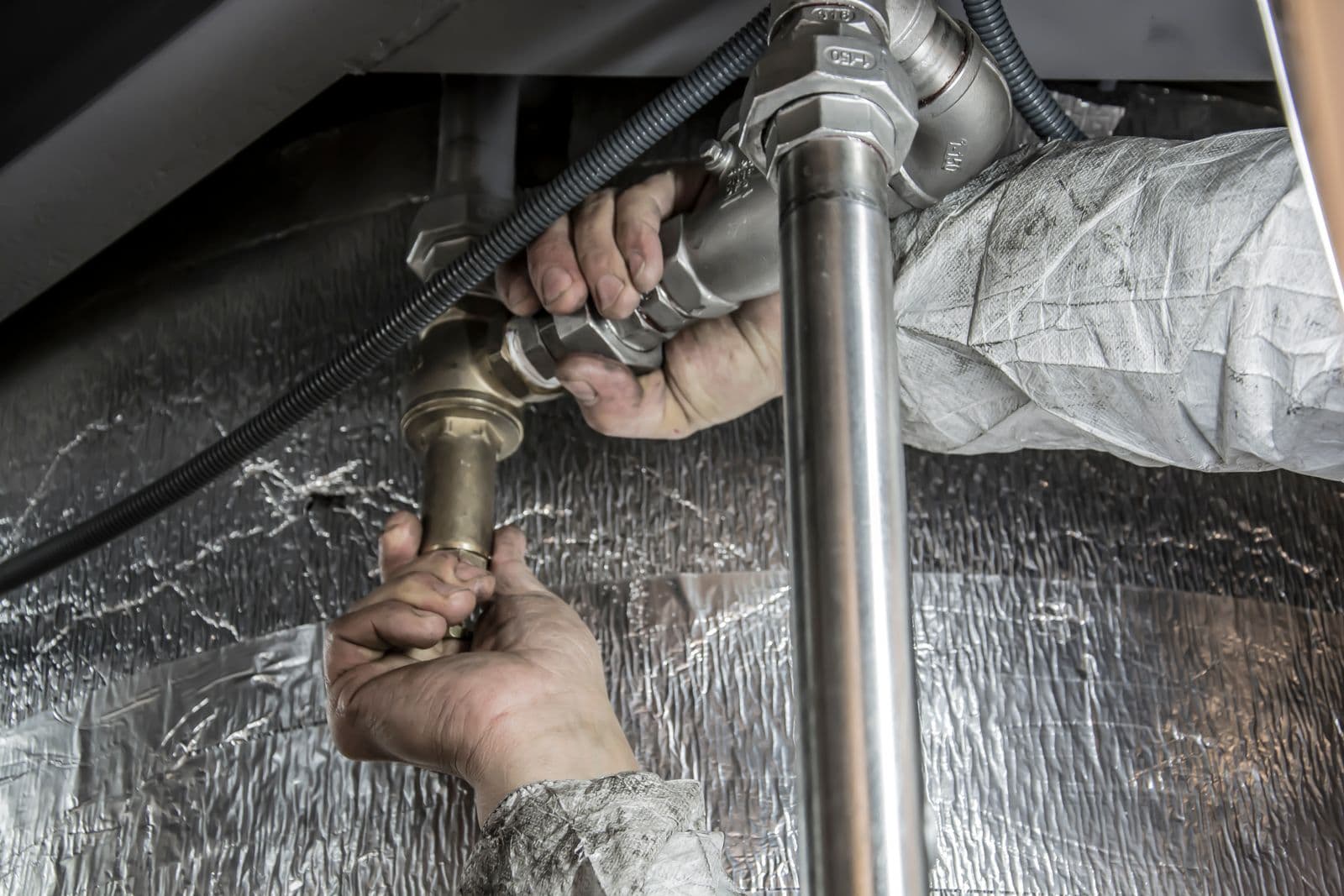
Treatment equipment is plumbing. Most of the job is the connection, the drain and the code detail behind it.


Flint water, answered plainly
Where does Flint get its water now?+
Primarily from Lake Huron, treated by the Great Lakes Water Authority Lake Huron Water Treatment Plant. Genesee County's Lake Huron plant is listed as a secondary source.
What were Flint's 2025 lead results?+
The 90th percentile was 3 ppb for January–June 2025 and 6 ppb for July–December 2025, both under Michigan's 12 ppb action level.
How many lead service lines are left?+
As of March 31, 2026 the inventory listed 628 lead service lines and 205 of unknown composition, with 33,341 replaced or confirmed copper.
Does Flint water have PFAS?+
The 2025 report says PFAS samples from the GLWA Lake Huron plant were not detectable (ND).
Where do these figures come from?+
From the City of Flint's Annual Water Quality Report 2025 and Michigan's published six-month lead monitoring results. Third-party aggregators are not used.
Related resources
Home water purification and treatment
The national service page behind this one.
Learn more →Detroit water quality
Great Lakes surface water and a large remaining lead-line inventory.
Learn more →Lansing water quality
Saginaw Aquifer wells, softened at the plant, no PFAS detected.
Learn more →Kalamazoo water quality
All groundwater, arsenic 7.8 ppb under the 10 ppb limit.
Learn more →All home services
Water, battery, HVAC and solar under one licensed contractor of record.
Learn more →Get a free test at your tap
A licensed technician tests at your kitchen tap and tells you which findings apply to your house — especially lead from the service line. No charge, no obligation, and coverage confirmed at your address first.
Get a free test