San Antonio, Texas
San Antonio, TX Water Quality
Aquifer water, free chlorine and no 2025 violations. Here is what the San Antonio Water System report shows.
Five aquifers · free chlorine avg 1.46 ppm · lead 90th pct 1.6 ppb · no violations in 2025.
The short answer
San Antonio runs mainly on groundwater from five aquifers, led by the Edwards, with Canyon Lake water in some areas. SAWS reports no violations in 2025 and disinfects with free chlorine.
Lead was 1.6 ppb at the 90th percentile. Two numbers are worth a look: trihalomethanes peaked at 86.2 ppb at one location (the report shows no violation), and unregulated lithium averaged 15.6 ppb. The report doesn't give a hardness figure, so test that at your tap.
Get a free test
Tell us your San Antonio address. We confirm coverage first, then schedule a licensed technician to test at your tap — no charge, no obligation.
What filtration does — and does not
Carbon, softening and reverse osmosis solve different problems. A tap test tells you which one San Antonio water calls for.
Where San Antonio water comes from
Five aquifers, one lake in some areas, and six wholesale suppliers.
Five aquifers
SAWS water starts as groundwater from the Edwards, Carrizo, Simsboro, Trinity and Wilcox aquifers, according to its 2026 report on 2025 data.
Canyon Lake in some areas
Some parts of the system also get surface water from Canyon Lake.
Six wholesale suppliers
SAWS buys water from Canyon Regional Water Authority, GBRA Western Canyon, Oliver Ranch, SSLGC, Texas Water Supply Co. and Vista Ridge.
What the SAWS report actually says
Limits are fixed. Results are system figures from the SAWS 2026 Water Quality Report (2025 data), not a reading at your tap.
No violations in 2025
The report states that the SAWS system received no violations in 2025. SAWS samples 390 sites a month for bacteria and found no E. coli.
Free chlorine 1.46 ppm
SAWS reports free chlorine, averaging 1.46 ppm with a range of 0.16 to 3.7 ppm, under the 4 ppm maximum residual level.
Lead 1.6 ppb at the 90th percentile
In 2024 tap sampling, no site exceeded the 15 ppb action level. Copper was 0.187 ppm at the 90th percentile.
Disinfection byproducts
Haloacetic acids peaked at 30.6 ppb (limit 60). The highest one-location yearly average for trihalomethanes was 86.2 ppb against 80; the report lists it as no violation.
Lithium above its reference level
Lithium isn't regulated. Federal UCMR 5 testing found an average of 15.6 ppb (13.1–17.2), above the 10 ppb health-based reference the report lists.
Nitrate and fluoride
Nitrate reached 2.45 ppm (limit 10) and fluoride 0.69 ppm (limit 4) at the water plants.
San Antonio next to Austin, Dallas and Houston
Austin, Dallas and Houston rely mostly or entirely on rivers and lakes and disinfect with chloramine. San Antonio is the groundwater city of the four, and SAWS reports free chlorine.
That changes the filter choice. Ordinary carbon handles free chlorine well, so the catalytic carbon often suggested for chloramine cities is usually not needed here.
Where these figures come from
Everything on this page traces to the San Antonio Water System.
- SAWS — 2026 Water Quality Report, 2025 data (PDF) — sources, violations, the 2025 tables, UCMR 5 lithium and Project Lead.
- TCEQ — Texas Drinking Water Watch — where SAWS says secondary constituents are published.
Matching treatment to the finding
San Antonio's report doesn't point at one problem. Start with a tap test for hardness, then choose carbon or RO for what you want reduced.
Test hardness at your tap
SAWS doesn't print hardness in its report; secondary results sit on Texas Drinking Water Watch. A tap test tells you whether a softener is worth it.
Carbon for chlorine taste
Free chlorine is the easiest disinfectant for carbon to remove. A whole-house carbon filter covers taste and smell at every tap.
Reverse osmosis at the sink
If lithium or byproducts concern you, a certified under-sink RO system is the usual drinking-water stage. Check certifications for what you want reduced.
Check pre-1989 service lines
Lead service line materials were banned in 1989. Older homes with unknown line status qualify for a free SAWS inspection.
How the free test works
A licensed technician tests at your kitchen tap, walks the plumbing, and tells you which of the findings above applies to your house and which does not. There is no charge and no obligation.
Seamless Home is the licensed contractor of record on the work that follows. Installation is performed by vetted installing partners engaged as our subcontractors, and the workmanship obligation stays with us. Coverage is confirmed per service area rather than promised as blanket availability.
What a water treatment job with us covers
Installation and replacement of whole-home and point-of-use treatment, specified against what your water actually contains.
Sediment filtration
Installation of the first stage that protects everything downstream of it, sized to the service line and the household draw.
Softening
Installation of ion-exchange softening where hardness is the problem, including the drain connection the plumbing code treats as indirect waste.
Carbon filtration
Installation of carbon stages for taste, odour and disinfection by-products, specified from your utility's own water quality report.
Reverse osmosis
Point-of-use installation at the kitchen sink where the target is dissolved solids rather than whole-home flow.
Disinfection
Installation of UV or equivalent treatment where the supply is a private well or is otherwise not continuously disinfected.
System replacement
Replacing equipment that has reached the end of its service life, including the discharge and air gap details an inspector looks at.
This is installation and replacement work, specified from a published water quality report or a test of your supply — not from a sales chart. Coverage is confirmed per service area rather than promised as blanket availability.
What the work actually looks like
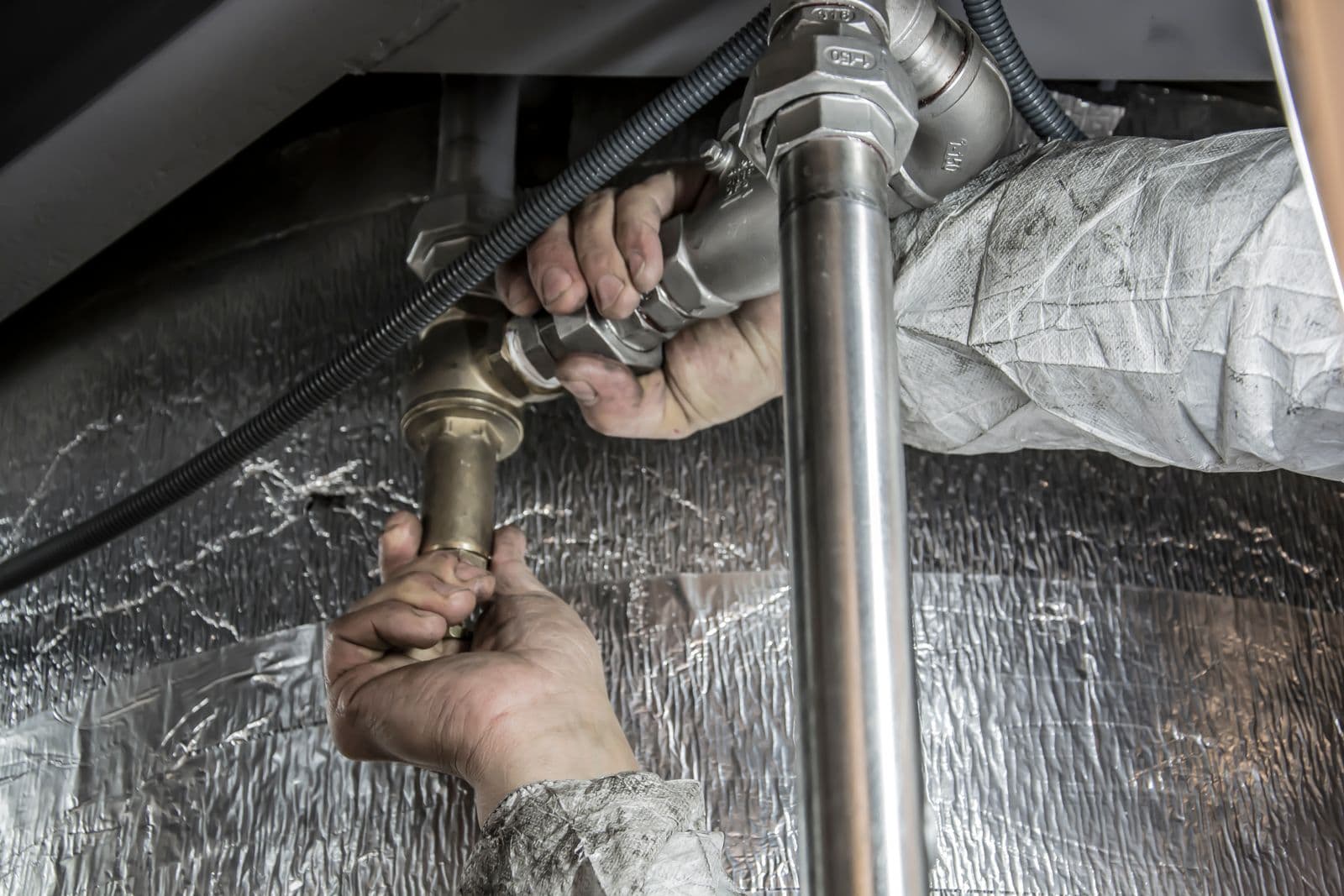
Treatment equipment is plumbing. Most of the job is the connection, the drain and the code detail behind it.

San Antonio water, answered plainly
Where does San Antonio get its water?+
Mostly from groundwater. SAWS lists the Edwards, Carrizo, Simsboro, Trinity and Wilcox aquifers, plus surface water from Canyon Lake in some areas, and it buys water from six wholesale suppliers.
Does San Antonio use chlorine or chloramine?+
The SAWS report lists free chlorine residual, averaging 1.46 ppm in 2025. That's different from Dallas, Houston and Austin, which all report chloramine.
Did SAWS have any violations in 2025?+
No. The report states that the SAWS system received no violations in 2025, and no E. coli positives were found in the 390 sites sampled each month.
What is the lithium result about?+
Lithium is one of the unregulated substances EPA had utilities test for under UCMR 5. SAWS found an average of 15.6 ppb, above the 10 ppb health-based reference concentration listed in the report. There's no legal limit for lithium.
Does my home have a lead service line?+
Lead materials for water service lines were banned in 1989. SAWS offers a free inspection through Project Lead for homes built before 1989 whose line status is unknown, and you can self-report your line material at saws.org/lead.
Is San Antonio water hard?+
The report doesn't give a hardness figure. SAWS points to Texas Drinking Water Watch for secondary constituents, and a test at your tap measures it directly.
Where do these figures come from?+
From the SAWS 2026 Water Quality Report, which covers 2025 data. Third-party aggregators are not used.
Related resources
Home water purification and treatment
The national service page behind this one.
Learn more →Austin water quality
Lake Travis and Lake Austin water, with chloramine.
Learn more →Dallas water quality
Seven lake and river sources and no known lead service lines.
Learn more →Houston water quality
Two rivers plus deep wells, and two 2025 violations.
Learn more →All home services
Water, battery, HVAC and solar under one licensed contractor of record.
Learn more →Get a free test at your tap
A licensed technician tests at your kitchen tap and tells you which findings apply to your house — hardness, chlorine or your own plumbing. No charge, no obligation, and coverage confirmed at your address first.
Get a free test